
Table of Contents
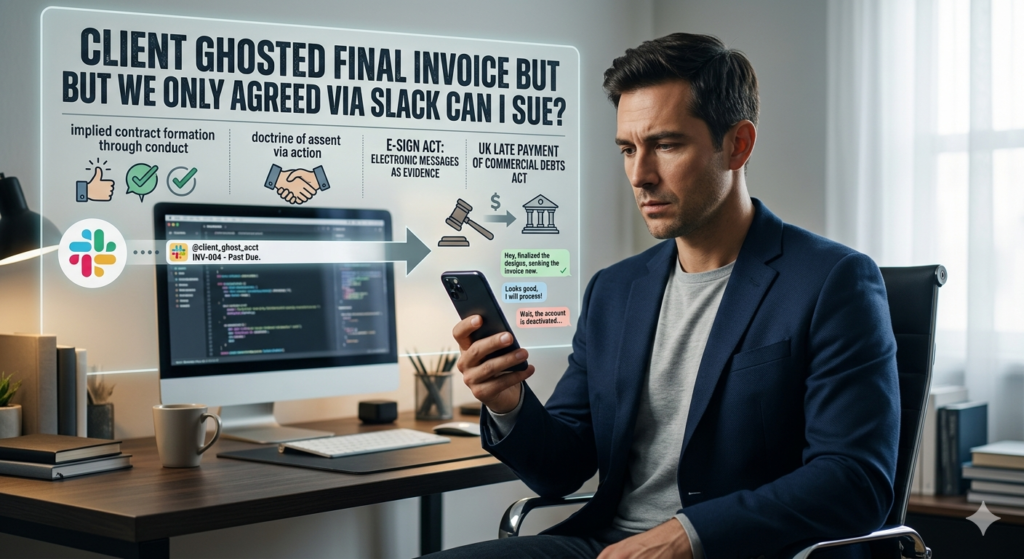
The Digital Trap: What to Do When a Client Ghosted a Final Invoice
It is an incredibly common scenario in the modern decentralized economy: a client ghosted a final invoice that you spent weeks working on, simply because your contract terms were negotiated informally. You connected with a corporate client, joined their internal Slack workspace, discussed deliverables, agreed on a budget within a public or private channel, and got straight to work. There is no formal 20-page Master Services Agreement (MSA), no physical signature, and no formal PDF document processed through DocuSign.
Months pass. You hit every milestone, deploy the code, launch the marketing campaign, or hand over the final creative assets. The client happily accepts the work, praises your performance in a direct message, and then completely vanishes. Your emails bounce, your Slack access is suddenly revoked, and your compensation sits unpaid.
When you consult peers online because a client ghosted a final invoice, the immediate reaction is often discouraging: “You didn’t get a signed contract? You are out of luck. You cannot sue without a written agreement.”
As a legal professional, I am here to tell you that this common assumption is completely incorrect under both United States and United Kingdom commercial laws. A formal paper document is merely one way to prove a contract exists; it is not the contract itself. In the eyes of the court, a contract is a mutual exchange of promises backed by value. If your client layout, project milestones, and pricing parameters were explicitly detailed across your Slack conversations, you do not merely have a casual chat logging system—you have a legally binding implied-in-fact contract.
The Core Legal Doctrine : Assent via Action Explained
To understand how a court views your digital message logs, we must dissect the Doctrine of Assent via Action and the framework of an Implied-in-Fact Contract.
In traditional contract disputes, courts look for an express contract where the terms are stated explicitly in spoken or written words. However, both US Common Law and UK Contract Law place equal weight on an implied-in-fact contract. This form of agreement is structured not through a formal signing ceremony, but through the actual conduct, behavior, and electronic interactions of the commercial parties involved.
Under long-standing common law principles, establishing a valid contract requires four essential elements:
- An Unambiguous Offer: One party proposes clear terms, scopes, and specific payment values.
- Clear Acceptance: The receiving party agrees to those exact terms without modifying them.
- Mutual Intent to Be Bound: Both sides behave in a manner showing they expect the deal to be legally operational, rather than a social favor.
- Consideration: A bargained-exchange of value (e.g., your specialized professional hours in exchange for their corporate funds).
The Doctrine of Assent via Action stipulates that acceptance and mutual intent do not require a physical signature or a formal “I accept these terms” statement. Instead, when a client writes “Looks good, please begin developing the homepage backend” on Slack, and you subsequently write “Starting now” and begin deploying code to their GitHub repository, assent has occurred through direct, tangible action. By knowingly accepting your professional services while explicitly acknowledging the pricing structure in the chat history, the client loses their legal right to claim that no binding relationship existed.
United States Statutory Framework & Case Precedents
If your delinquent client is an individual or an entity operating within the United States, your electronic communications are heavily protected by both federal and state-level statutory provisions.
Federal Legislation : The E-SIGN Act
At the national level, the Electronic Signatures in Global and National Commerce Act (E-SIGN Act), 15 U.S.C. Ch. 96, dictates a clean, modern commercial baseline: a contract, signature, or disclosure cannot be denied legal validity, enforceability, or status as evidence solely because it was generated or preserved in an electronic format.
State Legislation: The Uniform Electronic Transactions Act (UETA)
Complementing the federal E-SIGN framework, 49 US states have adopted the Uniform Electronic Transactions Act (UETA). Under UETA provisions (such as California Civil Code § 1633.1 through 1633.17), if a law requires an agreement to be in writing, an electronic record fully satisfies that law.
Furthermore, a signature can be any electronic sound, symbol, or process attached to or logically associated with a record and executed with the intent to sign. When a corporate officer types their own name at the end of a Slack message or responds with a definitive thumbs-up emoji to an itemized breakdown of milestones, modern judicial reviews interpret that process as an authentic digital signature.
Restatement (Second) of Contracts § 19
The baseline governing doctrine is explicitly stated in Section 19 of the Restatement (Second) of Contracts, which clarifies the parameters of manifestation of assent:
“(1) The manifestation of assent may be made wholly or partly by written or spoken words or by other acts or by failure to act.
(2) The conduct of a party is not effective as a manifestation of his assent unless he intends to engage in the conduct and knows or has reason to know that the other party may infer from his conduct that he assents.”
When a company inputs you into their core operational channels, reviews your weekly work submissions, and integrates your assets into their revenue-generating business infrastructure, their outward conduct communicates absolute manifestation of assent.
Essential US Case Precedents
- Lucy v. Zehmer, 196 Va. 493 (1954) : The bedrock American case establishing the Objective Theory of Contracts. The court held that if a person’s outward words and deliberate actions manifest an intention to agree, their hidden or inner intentions are completely irrelevant. Even if a client claims internally that their Slack interactions were casual or non-binding, the objective interpretation of their messages controls the case.
- Meyer v. Uber Technologies, Inc., 868 F.3d 66 (2d Cir. 2017) : This case focused on digital transaction interfaces. The Second Circuit Court of Appeals confirmed that a physical signature is completely obsolete for contract formation in a modern digital environment, provided the interface gives a reasonable user clear notice that their actions will create a binding legal obligation.
- CX Digital Service, Inc. v. Smoking Everywhere, Inc., No. 09-62020-CIV (S.D. Fla. 2011) : A critical modern precedent regarding instant messaging platforms. Here, an account manager and a corporate executive modified a commercial contract via an instant messaging conversation. The court firmly held that the informal instant messages constituted an enforceable, binding written amendment. The phrase “make it happen” typed inside a chat interface was ruled as valid contractual assent.
United Kingdom Statutory Framework & Case Precedents
If your non-paying client is a registered UK company or resident, English Contract Law applies an equally pragmatic approach to electronic platforms. The English court system values commercial business reality over rigid, antiquated administrative paperwork.
Statutory Foundations : Electronic Communications Act 2000
Under the Electronic Communications Act 2000 (ECA 2000) and the updated Electronic Identification and Trust Services for Electronic Transactions Regulations 2016, electronic signatures and records are fully admissible in any UK legal proceeding.
The UK Law Commission explicitly declared in its landmark 2019 report on electronic execution that digital check-boxes, typed names at the base of emails, and conversations across instant messaging applications satisfy standard statutory requirements for a contract written “under hand.”
Essential UK Case Precedents
- RTS Flexible Systems Ltd v Molkerei Alois Müller GmbH & Co KG [2010] UKSC 14 : The UK Supreme Court dealt directly with a situation where a massive project proceeded without an executed, signed contract. Lord Clarke ruled that courts must objectively evaluate the entire course of conduct:”The court must ask whether all the facts, objectively evaluated, show that the parties have come to an agreement on all the essentials… If their conduct shows that they have done so, the court will find that a contract exists.”
- Golden Ocean Group Ltd v Salgaocar Mining Industries PVT Ltd [2012] EWCA Civ 265 : The Court of Appeal evaluated whether a commercial guarantee could be legally stitched together through a sequence of highly informal emails. The court affirmed that an electronic sequence of informal messages comfortably satisfies the UK Statute of Frauds requirements, as long as the core deal parameters (price, scope, timelines) are explicitly discernible within the text trail.
- Marks and Spencer plc v BNP Paribas Securities Services [2015] UKSC 72 : The Supreme Court clarified the strict limits on implied terms, emphasizing that while courts will not rewrite an unwise deal, they will enforce an implied contract where it is absolutely necessary to give “business efficacy” to the transaction. If you delivered work and the client used it, implying a contract to pay for that work is legally necessary to prevent an absurd commercial reality.
Evidentiary Audit: How to Turn Your Slack Workspace Into Court Evidence
While an implied-in-fact contract carries the exact same weight as a signed paper contract, it does introduce one practical challenge: the burden of proof is entirely on your shoulders. If you intend to file a small claims lawsuit or issue an escalating statutory demand letter, you must treat your Slack history as a pristine legal archive.
If you suspect a client is preparing to ghost you, perform this exact Evidentiary Audit Checklist immediately before they have the opportunity to deactivate your account permissions:
Evidentiary Audit Matrix
├── Download Master Slack Workspace Logs (.JSON format via Admin tools)
├── High-Resolution Full-Screen Captures with System Timestamps
├── Link Invoiced line-items to explicit text approval timestamps
└── Extract external file delivery confirmations (GitHub / Figma / Dropbox)
Step 1: Secure Full-Screen Captures with Time Metadata
Do not capture cropped or isolated screenshots of individual text bubbles. A court requires complete context to verify that the conversation was uninterrupted.
- Use your operating system settings to ensure your desktop’s official clock, date, and timezone are clearly visible in the corner of your screen captures.
- Capture the entire Slack application interface, including the top channel bar, the workspace name, and the direct list of channel members.
Step 2: Extract the RAW JSON Log Data
If you have access to the enterprise or workspace billing dashboard, navigate to your settings and initiate an data export. If you are an external guest or single-channel member, utilize third-party browser developer tools or verified Slack integration plugins to export your individual direct message history into a un-editable, raw data string (.CSV or .JSON). This data contains immutable Unix timestamps that prove the authenticity of the conversation.
Step 3: Map Your Structural Chronology
Construct a highly organized, chronological index table that directly connects your invoiced milestones to explicit Slack confirmations. Your document layout must clearly demonstrate:
- The Date of Proposal: The timestamped message where you stated: “I can complete this API integration for $2,000, payable within 14 days of deployment.”
- The Manifestation of Assent: The message where the client responded: “Approved, let’s proceed with that configuration.”
- The Delivery Confirmation: The message where you sent the final file links, coupled with the client’s explicit text stating: “Got it, this looks fantastic and works flawlessly.”
Interactive Statutory Recovery Calculator
Interactive Statutory Recovery Calculator
Calculate your accurate outstanding debt, statutory interest, and late compliance penalties instantly.
Live Statutory Claim Summary
Example Profile: If a UK-based corporate client stalls a £5,000 invoice for 90 days past due, your statutory claim automatically scales by £163.35 in mandatory interest plus a £70 administrative collection penalty, bringing your true recovery demand to £5,233.35.
Step-by-Step Escalation Protocol
If you are standing with a clean portfolio of evidence but are still being met with complete silence, do not jump straight into an expensive, protracted courtroom lawsuit. Follow this structured, calculated escalation protocol designed to maximize psychological pressure and force accounts payable departments to act.
Phase 1: The Formal Account Freeze Warning
Send a clean, professional, non-emotional message across all active digital channels (Slack, email, and LinkedIn). Your statement must carry zero personal anger. Use this operational framework:
“Per our timestamped Slack agreement dated [Insert Date], the final deliverables for [Project Name] were formally accepted and integrated into your live infrastructure on [Insert Date]. Our final invoice remains delinquent. If funds are not cleared within 48 business hours, we will formally initiate our internal data compliance protocol. This includes filing statutory non-payment notices with your local regulatory departments and initiating immediate copyright reclamation procedures for the un-transferred software assets/creative designs currently running on your live production systems.”
Phase 2: The Formal Pre-Litigation Statutory Demand Letter
If the 48-hour window expires without contact, you must elevate your posture. You will draft and transmit a formal Letter Before Action (LBA) if the debtor is in the UK, or a formal Statutory Demand for Payment if they reside in the US.
This document must be sent via physical Certified Mail with Return Receipt Requested, ensuring that their corporate registered office must physically sign for the envelope.
Your demand letter must be cleanly formatted and contain:
- An explicit reference to your Implied-in-Fact Contract established via digital correspondence.
- A full, itemized breakdown of the original debt amount, supplemented by your calculated statutory interest penalties and collection levies.
- An exact, unalterable deadline (14 business days from the date of receipt) for the funds to be securely wired into your bank account.
- A clear closing notice detailing that if payment is not completed, the file will be passed directly to your legal chambers for the filing of a formal small claims lawsuit, where you will seek full recovery of court costs and statutory double-damages where available.
Pre-Litigation Statutory Demand Letter Generator
Pre-Litigation Statutory Demand Letter Generator
Input your transaction coordinates to instantly build a formal, jurisdictionally compliant Demand Notice / Letter Before Action (LBA).
1. Case Parameters
2. Financial Details
Alex Morgan
74 Applegate Lane, London, EC1A 4HD
DATE: May 17, 2026
TO:
The Managing Director / Accounts Payable Desk
Acme Solutions Ltd
102 Business District, Manchester, M1 1AG
FORMAL NOTICE SENT VIA RECORDED DELIVERY
RE: LETTER BEFORE ACTION (LBA) – NOTICE OF DELINQUENT COMMERCIAL DEBT
OUTSTANDING PRINCIPAL UNDER INVOICE REFERENCE: INV-2026-894
Dear Sir / Madam,
This formal statement functions as a Letter Before Action issued in strict accordance with the UK Civil Procedure Rules and Pre-Action Protocols regarding the recovery of commercial summary debts.
1. THE ENFORCEABLE IMPLIED CONTRACT:
Please be advised that on or about your representative interactions inside our shared Slack Workspace Channels, an enforceable contract under law was formed. Your organization requested specialized freelance services, explicitly approved the delivery roadmap parameters, and subsequently accepted the completed assets. Under prevailing commercial doctrines, your clear manifestation of assent and utilization of our deliverables created a binding implied-in-fact commercial contract.
2. ITEMIZED RECOVERY SUMMARY BALANCES:
Our records show that your corporate accounting infrastructure remains completely delinquent on payment responsibilities. Consequently, statutory penalties are hereby activated:
• Baseline Invoiced Principal Due: £5000.00
• Accrued Commercial Statutory Interest: £144.86
• Mandatory Fixed Statutory Compensation Levy: £70.00
———————————————————————-
TOTAL DEMAND CLAIM OUTSTANDING BALANCE: £5214.86
3. STATUTORY SETTLEMENT DEADLINE:
You are hereby given formal warning notice that full, un-cleared liquidation of this structural debt balance must be completed within 14 business days of this notification delivery.
4. INTIMATION OF LEGAL CIVIL CLAIMS:
Should your company choose to maintain its silence or skip settlement clearance by the designated time, your file will be escalated directly to our legal chambers for filing a formal court claim. We will aggressively pursue full asset recovery. Please take direct note that all subsequent administrative legal fees, tracking costs, and trial expenditures will be appended to your corporate liability metrics under modern statutory cost shifting frameworks.
Govern yourselves accordingly.
Sincerely,
___________________________________
Alex Morgan
Independent Contractor / Lead Professional
8. Frequently Asked Questions (FAQ)
Can I sue a client if they are located in a different US state than me ?
Yes. You do not need to fly out to their home jurisdiction to seek initial legal recourse. Under the expanding scope of state-level freelance protection laws—such as the New York Freelance Isn’t Free Act (FIFA), the Illinois Freelance Worker Protection Act, and the Los Angeles Freelance Worker Protections Ordinance—freelancers can file administrative complaints online through the debtor’s local Department of Labor. If your invoice is over $800 and past 30 days delinquent, these specific statutes mandate that the court award you double damages (200% of the invoice value) plus full coverage of your attorney fees.
What happens if the client deleted the Slack channel or revoked my login access ?
Revoking your user access does not delete the evidentiary history from existence. Under the civil legal discovery rules of both the US and UK, intentional deletion of data when a legal dispute is reasonably anticipated is classified as Spoliation of Evidence. Courts penalize this behavior heavily, often granting the court a “rebuttable presumption” that the deleted messages contained definitive proof of the client’s non-performance. As long as you have saved your local email notification strings, system logs, or preliminary screenshots, you have a solid foundation to file your claim.
Is a single thumbs-up emoji (👍) response on Slack considered a valid signature?
Yes, modern courts routinely rule that emojis can signal valid contractual agreement. For instance, in the major Canadian commercial precedent South West Terminal Ltd. v. Achter Land & Cattle Ltd. (2023 SKKB 116)—which has been heavily cited across US and UK legal commentaries—a judge ruled that a standard thumbs-up emoji sent via a messaging platform comfortably satisfied the statutory requirements for a signed agreement. The court stated that judges cannot ignore the modern reality of how everyday business communication occurs.
How much does it cost to file a small claims case for an unpaid invoice?
Filing a case in Small Claims Court (US) or utilizing the Money Claim Online portal (UK) is remarkably inexpensive and designed to be handled without hiring an expensive trial lawyer. Filing fees generally scale based on the size of your debt claim, ranging between $30 to $100 in the United States, and starting at £35 in the United Kingdom. These baseline filing costs are legally added straight to your judgment demand, meaning that when you win the case, the delinquent client is legally forced to reimburse you for those exact processing expenses.
Author Professional Biography
Advocate Sagar Haribhau Shirsat is an experienced, licensed legal professional specializing in digital infrastructure law, corporate contract enforcement, and transnational commercial dispute resolution. Holding active Bar Council enrollment number MAH/8118/2020, Advocate Shirsat counsels independent contractors, digital agencies, and remote software engineers across global tech ecosystems, helping them protect their intellectual assets and enforce their statutory financial recovery rights against delinquent corporate entities.
- Professional Chambers Gateway: Freelance Recovery Contact Portal
- Official Professional Network: Connect on LinkedIn