Table of Contents
The Subcontractor’s Worst Nightmare
In the corporate world, outsourcing has become the baseline operating model. Enterprise organizations and fortune-500 companies routinely hire mid-tier agencies to handle complex engineering, software builds, or marketing campaigns. These agencies, short on niche internal talent, turn around and hire specialized independent subcontractors to execute the physical labor.
For a while, the workflow moves smoothly. You, acting as the specialized subcontractor, write the application code, build the data framework, or design the media assets. You deliver the finished product to the agency, and the agency seamlessly passes your intellectual property directly into the production servers of the enterprise end-client.
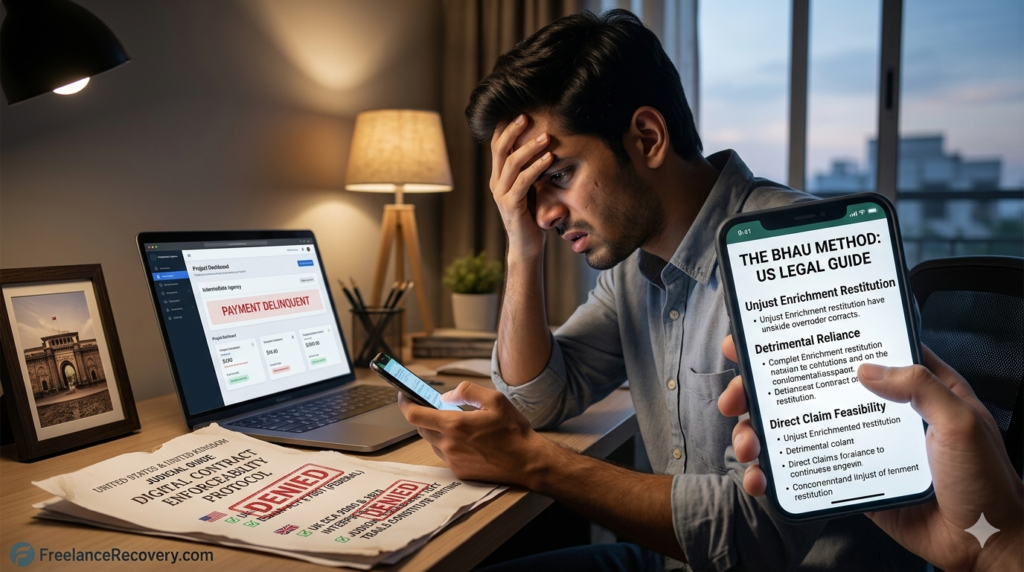
Then, the transaction pipeline snaps. The agency goes quiet, files for corporate bankruptcy, or simply ghosts your accounts receivable handlers. Your formal invoices remain completely unfulfilled, yet when you look online, you see that the enterprise end-client is actively using your software, utilizing your code, and generating corporate profits from your hard labor.
Your contract is technically with the middle-tier agency, not the corporate giant using your work. When the agency defaults, the urgent financial question surfaces: Can an unpaid subcontractor sue the end-client directly?
The short answer within United States jurisprudence is that while standard contract rules generally prevent direct action due to a lack of contractual relationship, equity law provides an exceptional escape hatch. Under the equitable doctrine of Unjust Enrichment, an unpaid subcontractor can bypass the bankrupt or uncooperative middle agency and sue the end-client directly to seek financial restitution.
you might be interested in this – Is a WhatsApp Conversation a Legally Binding Contract ? The Ultimate US & UK Judicial Guide
The Core Legal Doctrine: Restitution and Unjust Enrichment
To understand how a subcontractor can legally leapfrog the middle agency, we must step outside the rigid boundaries of standard contract law and enter the domain of equity and quasi-contracts .
Normally, if you want to sue an enterprise entity for an outstanding invoice, you must prove privity of contract—meaning both your name and the end-client’s corporate stamp are present on the exact same signed document. Because a subcontractor only possesses a signed contract with the middle agency, traditional contract paths are structurally blocked.
However, United States common law recognizes that a rigid adherence to contract rules can sometimes cause severe injustice. If an end-client receives a highly valuable commercial asset, integrates it into their business operations, and pays absolutely no one for it, they have received a massive corporate windfall at your direct expense.
To correct this imbalance, courts look to the Restatement (Third) of Restitution and Unjust Enrichment § 1. This foundational section states a simple, fundamental legal maxim:
“A person who is unjustly enriched at the expense of another is subject to a liability in restitution.”
When a court applies this principle to an independent subcontractor dispute, it ignores the lack of a signed signature agreement between you and the corporate giant. Instead, the court constructs a quasi-contract (an implied-in-law contract). The law forces the end-client to pay you the reasonable market value of your labor—a remedy known inside legal chambers as quantum meruit—because allowing them to keep your specialized work for free would be a form of commercial theft.
The Three-Pronged Legal Test for Direct Claims
A subcontractor cannot sue an end-client directly simply because they are unhappy about a missed invoice. To survive an aggressive corporate motion to dismiss in a US civil court, your advocate must systematically prove three specific legal criteria.
1. A Benefit Was Conferred
You must conclusively demonstrate that your specialized services or products actively reached the end-client and provided them with a measurable commercial advantage. This cannot be abstract. You must show that software code was integrated into their live app, architectural frameworks were deployed on their servers, or marketing assets were run in their public campaigns.
2. Appreciation and Knowledge of the Benefit
You must prove that the end-client was fully aware they were receiving your work and understood its underlying commercial value. If the enterprise entity actively reviewed your deliverables, sat on project calibration calls where you explained your logic, or directly requested edits from you over communication tools, they cannot claim to be an innocent, unaware bystander.
3. Inequity of Retention Without Compensation
This is the heart of the claim. You must prove that under the circumstances, it is fundamentally unfair, unconscionable, and inequitable for the enterprise brand to retain and use your custom work without paying for the value generated.
Want to get confirmed ? use this little tool for free to confirm –
Pre-Action Suitability Assessment
Evaluate your subcontractor dispute against the Three-Pronged Legal Test to verify if you have grounds to bypass the agency and sue the end-client directly.
Evaluating Case Merits…
The Critical Roadblock : The “Double Payment” Defense
Before launching a direct legal attack against an enterprise client, you must evaluate the single most powerful defense weapon in their legal arsenal: The Double Payment Defense.
The core philosophy of an unjust enrichment claim is that the end-client received something for nothing. However, if the end-client turns around and proves that they already paid the middle-tier agency the full project budget for your specific milestone, the court will rule that the end-client was not unjustly enriched.
In that scenario, the end-client did not get your assets for free; they paid their chosen provider, and it was the middle agency that fraudulently withheld the funds from you. In such cases, your direct claim is blocked, and your only remaining option is to pursue the defaulting agency.
Therefore, the golden window of opportunity for an unpaid subcontractor occurs when the end-client has withheld final payments from the middle agency. If the enterprise entity has not yet paid the agency for your milestone, those funds are legally considered “unallocated.” You can step in, execute a direct equitable action, freeze those funds, and claim them as restitution before they vanish into the agency’s mounting debts.
this might be helpful to you – Client Ghosted Final Invoice But We Only Agreed Via Slack. Can I Sue ?
Interactive Tool : Unjust Enrichment Recovery Assessment Matrix
If you are currently evaluating whether to bypass a defaulting agency and file a claim against an enterprise brand, use our specialized operational evaluator. This tool calculates your structural recovery score based on US equitable restitution standards and identifies potential vulnerabilities in your claim.
Unjust Enrichment Direct Claims Evaluator
Analyze your subcontractor dispute against established US restitution benchmarks to determine if you can legally bypass the middle agency and sue the end-client directly.
Real Court Precedents : Subcontractors vs. End-Clients
To properly understand how these complex claims play out inside a real courtroom, we can review landmark precedents across various US state courts. These show exactly how judges analyze disputes when an unpaid subcontractor bypasses an agency to sue an end-client directly.
Case 1 : Kossian v. American National Insurance Co. (California Court of Appeal)
In this highly influential case, a contractor performed extensive debris removal and property stabilization work under a contract with a building owner. The building owner subsequently defaulted on their financial obligations and went bankrupt. However, the owner possessed an insurance policy covering property damage. The insurance company received the full value of the stabilized building and collected the policy premiums, but refused to pay the contractor, pointing to the lack of a signed contract . read full case here .
The California Court of Appeal ruled decisively in favor of the contractor. The court held that even though there was absolutely no contractual relationship or direct communication between the contractor and the insurance company, the doctrine of unjust enrichment applied. The judge stated that it was fundamentally inequitable for the insurance entity to receive the specific benefit of the contractor’s labor without paying for the value they absorbed.
Case 2: L.E. Cooke Co. v. Washington City Housing Authority
In this construction sector scenario, a specialized subcontractor supplied utility systems to a local municipal housing authority under an agreement with a prime contractor who subsequently defaulted. The Housing Authority attempted to block the subcontractor’s lawsuit by raising a standard contract defense: they had no direct signature agreement with the subcontractor. read full case here .
The court rejected the housing authority’s defense because the evidence revealed that the housing agency was actively holding back a substantial chunk of final project funds from the defaulting prime contractor. The court ruled that because those funds had not left the housing authority’s pockets, the agency was in possession of a windfall. The subcontractor was granted a direct judgment for restitution under the rules of quantum meruit.
Step-by-Step Strategic Blueprint for Subcontractors
If you find yourself holding an unfulfilled subcontractor invoice after a middle agency defaults, you must act quickly. To build an ironclad case for direct recovery, execute this tactical blueprint before the client clears their accounts payable pipeline:
You can check with this tool for free :
Subcontractor Direct Escalation Protocol
Click on any step in the tactical pipeline below to reveal the active operational directives and legal requirements needed to bypass a defaulting intermediary.
1. Audit the Internal Payment Pipeline Immediately
Do not wait for the agency to ghost you for a second month. Send an urgent, professional text or email asking for verification of their billing status with the end-client. Your main goal is to find out if the end-client has already released the project budget for your milestones.
2. Issue a Formal "Notice of Outstanding Subcontractor Claim"
If you discover the end-client is holding back payments due to the agency's performance failures, immediately send a formal written notice directly to the end-client's legal team and project managers. State clearly that you are the specialized subcontractor who built the assets, that you have not been paid, and that you are asserting an equitable claim over those unallocated funds.
3. Implement an Orderly Stop-Work Protocol
If the end-client refuses to communicate or explicitly states they plan to pay the defaulting agency anyway, protect your interests. Halt all ongoing development, freeze updates to live repositories, and remove API authorization access tokens if your contract terms permit. This forces the enterprise legal desk to come to the negotiating table.
Frequently Asked Questions
What is the difference between a mechanic's lien and an unjust enrichment claim ?
A Mechanic's Lien is a statutory right tied specifically to physical real estate and construction projects (e.g., building a corporate office or installing structural wiring). If you are an unpaid construction subcontractor, you file a lien directly against the property title. An Unjust Enrichment claim is an equitable common-law remedy used for digital, creative, intellectual, or professional services (such as custom software development or marketing campaigns) where a property lien cannot be applied.
Can an end-client sue me for cutting off software access if the agency defaults ?
No, provided your actions are legally defensible. If the enterprise client has not paid for the assets, they do not own the intellectual property rights to them. Because no contract exists between you and the end-client, they cannot sue you for breach of contract. Their only recourse is to pursue the defaulting middle agency that failed to manage the project pipeline properly.
How can subcontractors protect themselves from this scenario beforehand ?
The ultimate shield is to include a Direct Payment Escalation Clause in your initial agreement with the middle agency. This clause states that if the agency misses an invoice milestone by more than 14 days, you retain the automatic legal right to inform the end-client directly and request that all subsequent project funds be paid straight to your accounts receivable desk.
Author Profile
Adv. Sagar Haribhau Shirsat is an active legal professional specializing in commercial transaction architectures, equity restitution frameworks, and digital contract enforcement systems. He designs defensive risk strategies that help independent subcontractors and specialized agencies protect their cash flow and enforce their billing rights against defaulting intermediaries.
- Connect via his Official Professional LinkedIn Profile.
Disclaimer : This guide is intended for educational purposes and risk management analysis. It does not replace formal legal counsel. For specific cross-jurisdictional contract disputes, always consult a certified attorney or local legal advocate.