Table of Contents
The Shift in Modern Contract Formation
For decades, the traditional corporate landscape operated under a singular, rigid assumption: a contract required structured legal language, clean margins, and a physical “wet ink” signature executed on a heavy sheet of paper.
Today, that operational boundary has collapsed. Instant messaging platforms, specifically WhatsApp, have transitioned from informal social channels into major hubs for commercial negotiations. Freelancers, independent corporate entities, software development agencies, and multinational corporations routinely settle pricing milestones, clear delivery timelines, and issue formal project modifications directly inside chat screens.
But when a payment dispute flares up or an agency stops performing, a critical legal vulnerability surfaces: Is a WhatsApp conversation actually a legally binding contract ?
The objective answer from both United States and United Kingdom jurisdictions is a definitive yes. If the core common-law components of a contract are present, a brief instant message can bind your operational assets just as securely as a signature witnessed by a public notary.
Got another problem ? – Client Ghosted Final Invoice But We Only Agreed Via Slack. Can I Sue ?
The Core Legal Framework : How a Digital Message Becomes Textual Writing
To understand how a fleeting instant message achieves the status of an enforceable contract, we must examine the specific statutory infrastructure that governs modern electronic transactions. Both US and UK legislative frameworks explicitly declare that digital text satisfies the historical legal definitions of a “written instrument.”
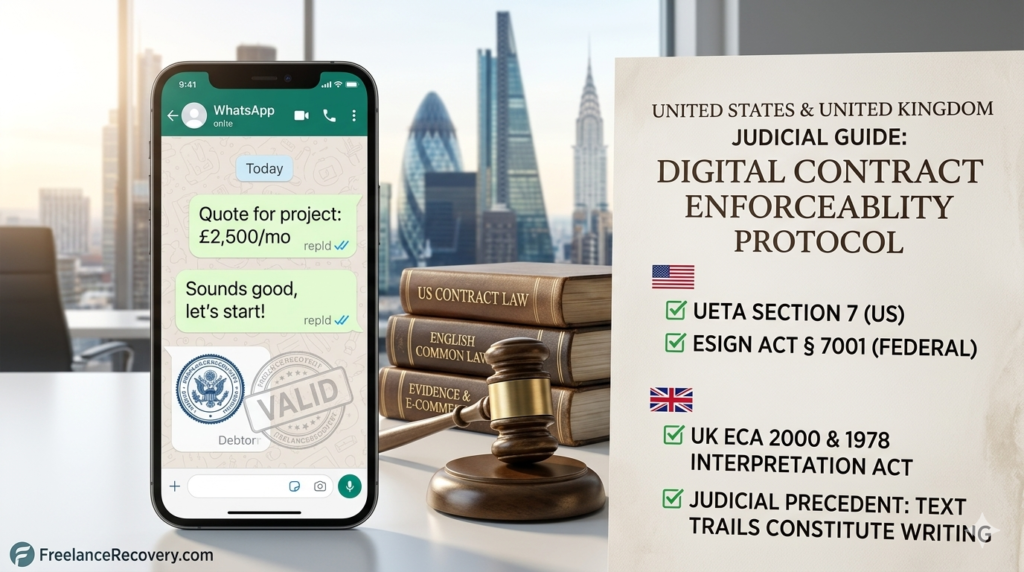
The US Framework : ESIGN Act & UETA
In the United States, electronic agreements are uniformly validated by two primary statutory frameworks:
- The Electronic Signatures in Global and National Commerce Act (ESIGN Act), 15 U.S.C. § 7001: A federal statute decreeing that a contract or signature cannot be denied legal effect, validity, or enforceability solely because it is electronic in nature.
- The Uniform Electronic Transactions Act (UETA): Adopted by 49 US states, UETA bridges the gap for local contract disputes. Specifically, Section 7 of the UETA explicitly dictates:
- A record or signature may not be denied legal effect solely because it is in electronic form.
- A contract may not be denied legal effect solely because an electronic record was used in its formation.
- If a law requires a record to be in writing, an electronic record satisfies the law.
Under these acts, every time an individual types an itemized quote into a WhatsApp chat and the recipient responds with an affirmative statement, the digital logs satisfy the Statute of Frauds—the legal rule requiring certain agreements to be permanently recorded in writing.
The UK Framework : Electronic Communications Act & Interpretation Act
Across the Atlantic, the English legal system applies an identical level of digital recognition under a combination of statutory mandates and common-law evolutions:
- The Electronic Communications Act 2000 (ECA 2000) : Section 7 of this Act explicitly confirms that an electronic signature incorporated into an electronic communication is fully admissible in any legal proceeding regarding its validity.
- The Interpretation Act 1978, Schedule 1 : Under English law, the term “writing” is broadly defined to include “typing, printing, lithography, photography, and other modes of representing or reproducing words in a visible form.” Because a WhatsApp message permanently stores typed characters on a device screen and a remote server, the Technology and Construction Court (TCC) and Commercial Courts in London treat it as a robust, visible, and written record of communication.
The 4 Essential Pillars of a Binding WhatsApp Contract
The mere act of texting does not automatically create an enforceable obligation. The communication channel itself is neutral. To transform a casual chat log into an ironclad contract that an advocate can confidently present inside a courtroom, the text exchange must clearly display the four core pillars of traditional contract formation:
| Legal Pillar | Technical Definition | How it Looks Inside a WhatsApp Chat |
| 1. Offer | A clear, unambiguous expression of willingness to contract on specific terms. | “I can build the landing page for your brand for $4,500, delivered by June 15.” |
| 2. Acceptance | A final, unqualified assent to all structural components of the offer. | “Sounds great, go ahead with that price and timeline!” or a clear confirmation emoji. |
| 3. Consideration | An exchange of value or mutual promises between the parties. | The freelancer promises specialized labor; the corporate client promises monetary funds. |
| 4. Intention to Bind | An objective showing that both sides intend to create legal consequences. | Starting project work, sharing system passwords, or making a partial down payment. |
In commercial transactions, the law operates under a rebuttable presumption that business entities intend to create legally binding arrangements. If you are discussing commercial assets, project fees, or professional design timelines over WhatsApp, a judge will assume you meant business unless you explicitly state otherwise.
Real Court Precedents : Casual “Yes” and Emojis as Enforceable Law
To understand how high-stakes this reality is for businesses and freelancers, look at how courts handle these disputes when negotiations break down.
The Landmark UK Precedent : Jaevee Homes Ltd v Fincham [2025] EWHC 942 (TCC)
In the definitive case of Jaevee Homes Limited v Mr Steve Fincham (trading as Fincham Demolition), a property developer engaged a demolition contractor for a commercial project. Initial price estimates were sent via standard email, but the critical operational negotiations quickly shifted entirely to a WhatsApp chat thread.
During the text conversation, key payment structures and project launch dates were ironed out. The contractor ended the specific text thread by asking if the job was officially theirs so they could begin allocating physical crews and resources. The property developer replied with a single, clear word: “Yes.”
A few days later, the developer emailed a formal, multi-page subcontract containing entirely different, restrictive payment terms. The contractor ignored the unsigned document and performed the work based on the WhatsApp agreements, later suing for unpaid fees.
The UK High Court ruled in favor of the contractor. The judge confirmed that the contract had already crystallized on May 17 via the WhatsApp exchange. The single word “Yes” contained a clear offer and acceptance. Crucially, the court ruled that because the developer did not write “Subject to Contract” anywhere in the text thread, the casual chat created a binding legal obligation that a subsequent formal contract could not unilaterally erase.
The Western Case for Emojis : Achter Land & Cattle Ltd v South West Terminal Ltd
While not a domestic US case, this landmark North American appellate ruling is frequently cited by US contract attorneys to establish how modern electronic intent is interpreted under the Uniform Commercial Code (UCC).
A grain buyer texted a formal purchase contract to a farming entity, writing: “Please confirm flax contract.” The farmer responded to the text message with a simple 👍 (thumbs-up) emoji. When the product was never delivered, the buyer sued for breach of contract.
The farmer argued in court that the thumbs-up emoji merely meant he received the text message, not that he agreed to the binding terms. The court rejected this defense, ruling that in modern business interactions, a thumbs-up emoji acts as an official electronic signature. It signals definitive approval and forms an enforceable contract.
Interactive Tool : Digital Contract Enforceability Matrix
If you are currently facing a contractual dispute involving a WhatsApp thread, a Slack log, or an email chain, use our interactive framework below. This dynamic calculator scans your structural transaction elements and instantly determines the estimated courtroom enforceability score of your digital agreement.
Digital Contract Enforceability Risk Matrix
Evaluate your instant messaging history against global common-law validation metrics to assess the legal validity of your agreement.
1. Essential Contract Ingredients
2. Supporting Conduct & Performance
Estimated Courtroom Validity
Your text thread contains all vital statutory elements. A court is highly likely to treat this WhatsApp history as a legally binding, written commercial obligation.
Strategic Shielding : How Freelancers and Agencies Can Protect Themselves
Whether your goal is to enforce a text agreement to recover a delinquent invoice, or to protect your business from an accidental multi-thousand-dollar commercial commitment via a brief text message, you must follow strict internal communication protocols.
1. Deploy the “Subject to Contract” Disclaimer
If you are merely brainstorming project ideas, exploring price combinations, or discussing draft strategies with a prospect, you must explicitly neutralize your legal intent. Append this line to your discussions:
“This discussion is exploratory and is explicitly subject to contract. No legally binding obligations are formed until a formal contract document is mutually executed by both operations.”
2. Establish Official Corporate Channels
Clearly state inside your initial onboarding emails that your staff and account handlers do not possess the apparent authority to modify financial delivery criteria or accept price adjustments via instant messaging networks.
3. Archive and Backup Thread Histories
If a client signs off on a design change inside WhatsApp, do not rely on the app’s live memory. Use the Export Chat function to preserve a clean, time-stamped text file including media coordinates. Under the federal rules of evidence, these unedited system exports act as a valid, untampered historical log.
Defensive Protocol & Contract Disclaimer Generator
Strategic Shielding: Defensive Protocol & Contract Disclaimer Generator
Instantly construct legally engineered disclaimers, email clauses, and formal protocol frameworks to immunize your instant messaging workflows from accidental liabilities.
1. Operational Parameters
2. Functional Restrictions
💬 Copy/Paste WhatsApp & Slack Chat Starter Disclaimer
Drop this exact string into your text conversations before discussing rates, estimates, or modifications:
✉️ Onboarding Email Protection Clause
Append this block inside your initial introduction/intake onboarding emails:
Frequently Asked Questions
Can a contract be formed without a formal wet-ink signature?
Yes. Under both the US ESIGN Act and the UK Electronic Communications Act, a contract does not require physical paper or wet-ink signatures. Mutual assent can be completely expressed through digital records, typed names, clear text responses, or tracking actions.
Does a thumbs-up emoji create a binding contract?
Yes, it can. Recent global commercial litigation shows that if a clear offer is texted to you and you reply with a confirmation emoji like 👍 or 🤝, courts evaluate the historical context of your interactions. If you routinely use casual symbols to close deals, a judge will treat that emoji as a valid electronic signature that seals the agreement.
What should I do if a client accepts my quote on WhatsApp but refuses to pay?
First, immediately export your entire text history log to prevent intentional un-sending or message deletion. Next, itemize the digital contract components (the offer text, their response, and your performance steps) and issue a formal Pre-Litigation Statutory Demand Notice referencing local electronic commerce frameworks.
Author Profile
Adv. Sagar Haribhau Shirsat is a practicing legal professional specializing in commercial transaction laws, corporate compliance matrices, and digital contract enforcement systems. He assists independent operators, design agencies, and corporate brands in building defensive billing systems and optimizing cross-border debt recovery workflows.
- Connect via his Official Professional LinkedIn Profile.
This guide explains standard commercial principles of contract law; to address highly specific cross-jurisdictional text disputes, we strongly encourage reviewing this video on how casual messaging creates legally binding contracts to understand how global judges analyze conversational consensus.