Table of Contents
Chasing a non-paying client is an operational failure that begins long before an invoice goes past due. When an independent creative, developer, or agency owner faces a ghosted slack channel or a skipped milestone payment, the instinct is to look for a cure. But real collections leverage is engineered during onboarding. If your contract infrastructure is flawed, recovering your funds becomes an uphill battle.
To protect your cash flow, you must understand how to recover unpaid invoice without lawyer interventions by building an uncompromised defensive perimeter. This guide dismantles the systemic vulnerabilities that freelancers face, replacing them with institutional frameworks that force clients to pay on time, every time.
The Client Risk Vetting Protocol
In corporate law, we observe a consistent trend: clients who fight minor late-fee clauses during onboarding are almost always the exact accounts that default on final deliverables. Client acquisition is not just a sales goal; it is a credit underwriting process. You are extending an interest-free loan of your labor and intellectual capital to an external entity. Before granting that credit, you must audit their operational credibility and corporate footprint.
Step 1 : Corporate Registration and Jurisdiction Verification
Never sign an agreement with a brand name or a vague trading moniker. You must verify the legal entity behind the corporate mask.
- Ask for the official registered entity name (e.g., LLC, Inc., Ltd.).
- Verify their standing via state or national business registries, such as the U.S. Securities and Exchange Commission (SEC) or local Secretary of State portals.
- If a client is operating out of a residential address or a virtual mailbox while promising a $50,000 budget, their risk profile increases exponentially.
Step 2 : Digital Footprint and Communication Vector Audits
Where does your client communicate? If your relationship is confined entirely to a casual platform, you are exposed. In fact, many creators wonder: is a whatsapp conversation a legally binding contract? While text strings can establish intent, proving identity and authorized corporate capacity in a court of law using messy chat logs is an operational nightmare. If a prospect refuses to use official corporate email addresses, flag them immediately.
Step 3 : Interactive Risk Assessment
Before writing a proposal, run every new prospect through the automated matrix below to quantify their structural default risk.
The Ironclad Contract Architecture
When a client refuses to pay, your invoice is not your primary weapon—your contract framework is. If your agreement does not outline the operational mechanics of default, you have no leverage. A safe service agreement must contain three core protections to make learning how to recover unpaid invoice without lawyer fees straightforward.
┌────────────────────────────────────────────────────────┐
│               IRONCLAD CONTRACT LAYERS                 │
├────────────────────────────────────────────────────────┤
│ Layer 1: Upfront Payment Milestone (Capital Security)   │
├────────────────────────────────────────────────────────┤
│ Layer 2: Automatic Work Suspension (Scope Containment) │
├────────────────────────────────────────────────────────┤
│ Layer 3: IP Interlocking Gating (Asset Protection)     │
└────────────────────────────────────────────────────────┘
The Upfront Payment Milestone
Never start working for free. An upfront payment milestone changes the psychology of the professional engagement. It filters out non-viable buyers and covers your baseline operational costs. For new clients, a minimum 50% upfront deposit is mandatory. For larger enterprise deals, you can structure this into rolling 25% tranches, but work never begins until the first payment clears.
The Clear Scope Definition Matrix
Scope creep is the single most common justification clients use to withhold payment. They claim you did not deliver what was promised, inventing arbitrary requirements to stall your invoice. Your contract must explicitly detail what is included and what is excluded.
Operational Warning : Avoid vague descriptions like "Provider will design the company website." Instead, use precise limits: "Provider will deliver exactly five (5) unique HTML5 page templates layout, limited to the site map in Exhibit A. Any additional pages will be billed via a separate Change Order at $150/hour."
The Automatic Work Suspension Clause
You must have the contractual right to stop working if a payment is missed. Without this clause, pausing your work can be construed as a material breach of contract on your part, giving the client a legal excuse to sue or withhold further funds.
- Sample Text : "If the Client fails to pay any invoice within five (5) business days of its due date, the Provider reserves the absolute right to immediately suspend all services and withhold all deliverables without liability. Work will resume only after all outstanding balances, including accrued late fees, are paid in full."
The Milestone Operational Blueprint
To completely eliminate payment friction, you must separate your project delivery into clear phases. Each phase acts as a mini-contract with an independent gate. If a client defaults on Phase 2, they can never access Phase 3, and they never receive your final files.
The Intellectual Property Transfer Interlock
The absolute highest leverage point you have is the legal ownership of your work product. Under standard copyright regimes, such as the U.S. Copyright Office framework, intellectual property belongs to the creator until it is explicitly assigned in writing.
Never grant intellectual property transfer upon creation. Your contract must clearly state that all rights, titles, and interests in the work product transfer to the client only after full, final payment is received and cleared by your bank. If a client uses your unapproved designs, code, or strategies without paying the final invoice, they are committing federal copyright infringement—which carries statutory damages far exceeding the cost of your invoice.
To optimize your cash velocity and see exactly how to structure your next engagement, use the financial planning calculator below.
The Automation of Boundary Enforcement
If you are writing highly emotional, manual emails begging a client to pay your past-due invoice, you have already lost the upper hand. Debt collection is an objective operational exercise. It requires zero emotion, complete detachment, and immediate execution.
                  THE OBJECTIVE ESCALATION TIMELINE

  Day 1             Day 5             Day 15            Day 30
    ├─────────────────┼─────────────────┼─────────────────┤
Invoice           Automated         Formal Notice     Final Statutory
 Due              Suspension          of Dispute        Demand Notice
                  of Services       (IP Warning)       (Small Claims)
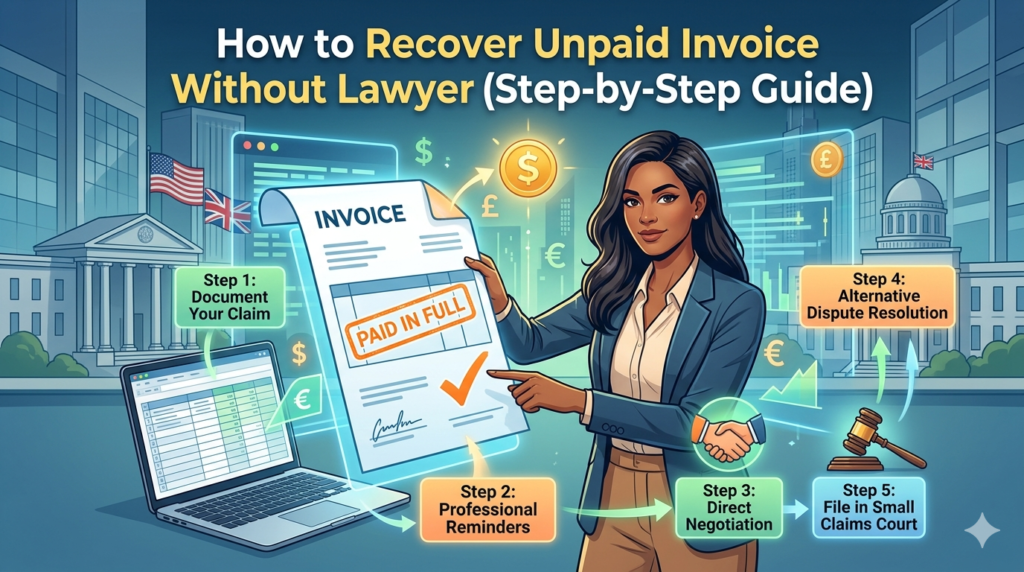
Phase 1 : The Automated System-Generated Reminder
Configure your billing system (such as QuickBooks, FreshBooks, or Stripe) to send clear notifications before the invoice is late, and continue on a strict timeline if it goes past due. Your personal voice should not be involved here; the platform should send these updates automatically. For a deep dive into building the perfect multi-tiered payment recovery timeline, read the best follow-up timeline for unpaid freelance invoices.
Phase 2 : The Formal Notice of Dispute
If a client ignores your automated billing emails and goes completely silent on communication apps, you must immediately escalate. A common pitfall occurs when a client ghosted final invoice slack channels entirely, leaving the contractor unsure of how to proceed.
When this happens, stop trying to reach them on instant messaging. Instead, issue a formal, cold, system-enforced Notice of Dispute directly to their registered corporate business address via certified mail or verified legal email.
Phase 3 : The Out-of-Court Escalation Framework
If you need to recover an unpaid invoice without paying a lawyer thousands of dollars in billable hours, you have two powerful options:
- The Small Claims Court Track : Every jurisdiction features a simplified small claims court infrastructure designed specifically for individuals and small businesses to settle monetary disputes up to a specific limit (often $5,000 to $10,000 depending on the state). You do not need a lawyer; you simply present your signed contract, proof of work delivered, and clear evidence of non-payment.
- Third-Party Collections Placement : If the client is completely unresponsive, you can hand the debt over to a commercial collections agency. These agencies work on a contingency basis—meaning they take a percentage of the recovered funds and only get paid if they successfully collect your money. Having a collection agency report an unpaid invoice directly to business credit bureaus will severely damage the client's corporate credit rating, which often forces bad-faith actors to pay instantly.
For a comprehensive blueprint on navigating these collection strategies without paying high retainer fees, refer to the freelancers legal guide to recovering unpaid invoices without expensive lawsuits.
The Pre-Sign Boundary Scripts ( Handling Client Pushback )
When a client tries to push back on your contract infrastructure during onboarding, use these firm, professional scripts to hold the line.
Scenario A : Client objects to the 50% Upfront Payment Milestone
Client: "We usually pay on Net-30 terms after completion. We can’t do a 50% deposit for external vendors."
Your Operational Response:
"I completely understand that corporate policies vary. However, our agency’s operational framework requires a cleared 50% upfront commitment milestone to secure production bandwidth and launch the kickoff phase. This aligns our cash velocity with the project's resource allocation. We can look into breaking the remaining 50% into smaller milestone tranches if that helps your accounting team, but work cannot begin until the initialization deposit clears."
Scenario B : Client objects to the Intellectual Property Lock
Client: "Our legal team requires that we own all work product and IP from the moment you create it."
Your Operational Response :
"We gladly transfer full, exclusive intellectual property rights for all custom assets. However, our contract framework structures this transfer to execute automatically upon receipt of final, cleared payment. This ensures a clean, risk-mitigated exchange for both corporate entities. We cannot assign legal ownership of uncompleted or unpaid assets prior to closing the final invoice."
Or you can use this FREE generator :
Onboarding Objection Handler Onboarding Objection HandlerSelect the specific pushback your client is giving you to get an immediate, legally defensive operational script.Your Defensive ScriptI completely understand that corporate policies vary. However, our agency’s operational framework requires a cleared 50% upfront commitment milestone to secure production bandwidth and launch the kickoff phase. This aligns our cash velocity with the project's resource allocation. We can look into breaking the remaining 50% into smaller milestone tranches if that helps your accounting team, but work cannot begin until the initialization deposit clears.
The Multi-Tier Recovery Timeline & Email Templates
If an invoice passes its due date, immediately remove emotion from the equation. Execute this precise, automated escalation timeline.
Day 1 Past Due : The System-Generated Courtesy Reminder
- Action: Send automatically through your invoicing software. Keep it completely transactional.
Plaintext
Subject: Reminder: Invoice [Invoice_Number] for [Project_Name] is Overdue

Dear [Client_First_Name],

This is a automated notification that invoice [Invoice_Number], issued on [Issue_Date] for the amount of [Amount], is now past due.

Please review the attached invoice and confirm the payment processing date. If payment has already been initiated, please reply with the bank transaction receipt so we can update your account status.

Thank you,
[Your_Name/Agency_Name]
Day 5 Past Due : The Hard Stop / Service Suspension Notice
- Action: Send via email. Concurrently pause all live staging links, stop code commits, or halt creative asset production.
Plaintext
Subject: NOTICE: Service Suspension for [Project_Name] / Overdue Invoice [Invoice_Number]

Dear [Client_First_Name],

Our records show that invoice [Invoice_Number] ([Amount]) remains unpaid despite our previous notification.

Per Section [X] of our signed Service Agreement, all active production, support, and asset deployment for [Project_Name] have been suspended effective immediately. Our engineering and creative teams have been reassigned to other projects.

To restore production scheduling and avoid late interest accruals, please ensure the outstanding balance is cleared immediately via the payment link below:

[Insert_Payment_Link]

Work will resume within 2 business days once the funds have completely cleared in our account.

Regards,
[Your_Name]
Day 15 Past Due : The Formal Notice of Dispute & IP Warning
- Action: Send via email and certified mail with return receipt requested to their physical corporate headquarters.
Plaintext
Subject: FORMAL NOTICE OF DISPUTE: Unpaid Balance and IP Intellectual Property Reservation

To the Management of [Client_Company_Name],

This letter serves as a formal Notice of Dispute under the terms of our agreement dated [Contract_Date]. Your account is currently 15 days in default regarding Invoice [Invoice_Number] for the amount of [Amount].

Please be advised that per our contract framework, no intellectual property, usage rights, or titles have transferred to your company. All work product, draft files, code repositories, and designs delivered during this project remain the exclusive property of [Your_Name/Agency_Name].

Any public deployment, commercial utilization, or internal modification of these assets while this invoice remains unpaid constitutes an unauthorized use of copyright material.

To resolve this dispute amicably out of court, please arrange for full payment of [Amount] plus accrued late fees of [Late_Fee_Amount] to be settled within five (5) business days.

Sincerely,
[Your_Name]
Day 30 Past Due : The Final Pre-Action Statutory Demand
- Action: Final warning before taking out-of-court legal action. (For UK users, this aligns with a Statutory Demand; for US users, it functions as a Letter Before Action for Small Claims).
Plaintext
Subject: FINAL DEMAND BEFORE LEGAL ACTION: Overdue Balance [Invoice_Number]

To the Management of [Client_Company_Name],

Despite multiple formal notices, your outstanding balance of [Amount] for services rendered remains unpaid.

This is our final attempt to resolve this debt non-judicially. If full payment is not received or a verified bank transfer receipt is not provided within seven (7) business days, we will immediately escalate this matter without further notice through the following channels:

1. Filing a formal claim in Small Claims Court to secure an enforceable civil judgment (including claims for maximum statutory interest, court costs, and administrative fees).
2. Assigning the debt to a commercial third-party collection agency, which will result in direct default reporting to major corporate credit bureaus.

Please find our corporate bank details attached to this email to settle the balance immediately.

Final Demand Enforcement Lead,
[Your_Name/Agency_Name]
or here is the E-mail response generator tool to use for FREE :
Step-by-Step Small Claims Action Checklist
If the timeline runs out and the client completely ghosts you, execute these exact steps to recover your funds independently.
Small Claims Filing Workflow
Execute your independent legal recovery track sequentially. Click sections to open action guidelines.
- Signed Master Service Agreement & Scope Addendums
- Itemized Invoices with system timestamps
- Unanswered email reminder sequences & Notice of Dispute
- Search state Secretary of State or UK Companies House
- Extract the official Registered Office Address
- Confirm corporate identity standing status
- Fill statutory statements outlining the unpaid contract debt
- Attach compiled PDF proof portfolio exhibits
- Remit standard court filing fee allocation
- Engage a professional Process Server or Court Bailiff
- Deliver directly to Registered Agent or Officer
- File the signed Proof of Service back with the court
- Consolidate Your Evidence Folder : Export your signed PDF contract, your itemized scope of work matrix, your automated system logs proving delivery, and your unreplied email reminders into a single, chronological PDF document.
- Locate the Correct Legal Defendant : Do not sue the individual manager. Go to your state's Secretary of State database (US) or Companies House (UK) and pull their exact registered corporate entity details. Use their registered office address for all court filings.
- File the Claim : Go to your local county municipal court clerk's office (US) or log into the UK Government’s Money Claim Online (MCOL) portal. Fill out the small claims complaint form, state the facts briefly ("Defendant hired plaintiff for services, plaintiff delivered under contract, defendant accepted work but defaulted on invoice"), and pay the nominal filing fee.
- Serve and Collect : Ensure the court papers are officially served to the business's Registered Agent. Once the court rules in your favor or the client settles out of fear of a public judgment on their credit record, your cash velocity is fully recovered.
Real life Citations :
To turn your risk-prevention plan into actionable reality, you can use these real-world legal references for the United States and the United Kingdom. These simple citations give you direct legal support when enforcing your contract framework or issuing an automatic work suspension without hiring an expensive lawyer.
United States Citations
When dealing with non-paying clients based in the US, your primary out-of-court leverage comes from state statutory protections, Uniform Commercial Code (UCC) rules regarding intellectual property, and regional small claims caps.
1. Intellectual Property & Copyright Interlocking
- The Rule: You own your creative work product until the client completely fulfills their payment terms.
- The Citation: 17 U.S.C. § 204(a) (The U.S. Copyright Act)
- Simple Language: Under federal law, the transfer of copyright ownership is not valid unless it is done in writing. By explicitly stating in your contract framework that the transfer of title is contingent upon a cleared final invoice, any unauthorized commercial use of your files before payment constitutes federal copyright infringement.
2. Freelancer Protection Statutes (State & Local)
- The Rule: Specific regions have strict laws that penalize companies for failing to pay independent contractors on time.
- The Citations:
- New York State: Freelance Isn't Free Act (N.Y. Lab. Law § 191-d)
- Los Angeles: Freelance Worker Protections Ordinance (LAMC Chapter XVIII, Article 10)
- Simple Language: If your client is located in these jurisdictions, they are legally required to pay you on or before the date specified in the contract. If they fail to do so, these statutes allow you to sue for double damages, statutory late fees, and attorney fees in small claims court without requiring complex commercial litigation.
3. Small Claims Court Jurisdiction
- The Rule: You can file a claim yourself to recover a defaulted debt without formal legal representation.
- The Citation: State Small Claims Jurisdictional Limits (e.g., California CCP § 116.220 for claims up to $10,000; New York City Civil Court Act § 1801 for claims up to $10,000).
- Simple Language: Small claims court is specifically optimized for independent business operators. If your progressive milestone calculations show an unpaid balance below your state's cap, you can file a quick statement of claim using your signed contract and system reminders as your primary evidence.
United Kingdom Citations
If you or your client are operating within England, Wales, Scotland, or Northern Ireland, the legal system provides a highly structured framework for claiming automatic late fees, statutory interest, and out-of-court debt collection.
1. Automatic Late Fees and Statutory Interest
- The Rule: You have an automatic legal right to charge interest and collection costs on late commercial invoices, even if it wasn't written into your contract.
- The Citation: Late Payment of Commercial Debts (Interest) Act 1998 (as amended by the 2002 and 2013 Regulations) (Smith, 2022).
- Simple Language: This act gives you massive leverage. If a business client pays you late, you are legally entitled to charge an automatic statutory interest rate of 8% plus the Bank of England base rate on the unpaid amount. Additionally, you can demand a fixed compensation fee ranging from £40 to £100 per overdue invoice to cover your administrative debt collection costs (Smith, 2022).
2. Enforcing Work Suspension
- The Rule: You have the clear statutory right to pause work if a business client defaults on an intermediate payment milestone.
- The Citation: Section 4A, Late Payment of Commercial Debts (Interest) Act 1998
- Simple Language: If a client misses a payment deadline on an agreed milestone phase, this specific provision allows you to legally suspend your services. The client cannot claim you are in breach of contract for pausing construction or development, and they are responsible for any costs you incur due to the delay.
3. The Statutory Demand (Pre-Court Escalation)
- The Rule: A formal document that gives a non-paying company 21 days to clear a debt over £750 before you can file to wind up their business.
- The Citation: Section 123(1)(a) of the Insolvency Act 1986
- Simple Language: If your system reminders and Notice of Dispute are ignored, you can issue a formal Statutory Demand for Payment of an Undisputed Debt. This is an incredibly powerful out-of-court weapon. It states that if they do not settle the invoice or file a valid dispute within 21 days, you have the legal right to petition the court to shut down their company due to insolvency. It almost always forces bad-faith clients to clear their balance immediately.
References
Smith, A. M. (2022). An empirical study of the effects of regulatory systems on the collection of late payment of commercial debts owed to micro and small businesses in the UK (Doctoral dissertation, University of Plymouth). https://pearl.plymouth.ac.uk/context/pbs-theses/article/1199/viewcontent/2022Smith10473535PhD.pdf Cited by: 1
Strategic FAQ
How do I handle a client who demands to see final deliverables before paying the final invoice ?
You must point directly to your contract's milestone gating architecture. Remind them politely but firmly that your production system is hard-coded to release final intellectual property ownership and raw assets only after the final invoice is cleared by your bank. If they want to verify your work, offer to host a live, shared-screen walkthrough or send watermarked, low-resolution preview files. Never hand over the actual, un-watermarked source code or master assets before payment is confirmed.
What should I do if a client says they can't pay because their own client hasn't paid them yet ?
A client's cash flow problems are not your operational concern. Your contract is an independent agreement with their firm, not a contingent partnership based on their downstream revenues. This excuse is a clear sign of poor business management. Politely let them know that your payment terms are absolute and independent of external projects, and immediately pause all active services until your account balance is brought current.
Is an email agreement or Slack sign-off legally binding if we never signed a formal PDF ?
Yes, written communication can form a legally binding contract if it contains a clear offer, acceptance, and consideration. However, proving the specific terms and conditions of an unstructured conversation in court is incredibly difficult. It opens the door for a bad client to claim they misunderstood the scope or never agreed to your late-fee rules. Always transition your informal email or messaging terms into a structured, formal agreement before you begin any production work.
How do I enforce late fees if a client ignores them and only pays the original invoice amount ?
If a client sends a payment for just the base invoice amount while ignoring your contract's accrued late fees, do not mark that milestone as fully resolved. Apply their payment to the outstanding late fees first, leaving a remaining balance on the principal invoice. Notify them right away that a partial payment was received, and that your services will remain paused until the remaining balance is paid in full.
What if the client claims my work didn't meet their expectations and refuses to pay ?
This is why having an explicit, objective scope matrix and a formal revision approval process in your contract is so critical. If your work matches the technical specifications and guidelines laid out in your agreement, the client is legally required to pay. Objective completion—not subjective satisfaction—is the legal standard for commercial contracts. Let them know that you have fully met all contractual milestones, and that any changes outside the agreed scope must be handled through a new, paid Change Order.
About the Author
Advocate Sagar Haribhau Shirsat is a legal engineering architect and veteran commercial counsel specializing in structuring bulletproof risk-prevention infrastructures for independent contractors, digital agencies, and enterprise technical providers. His work focuses on eliminating operational payment friction through automated contract engineering, asset-locking delivery systems, and proactive debt-mitigation frameworks. Connect with his professional network on LinkedIn for ongoing insights into corporate asset protection.