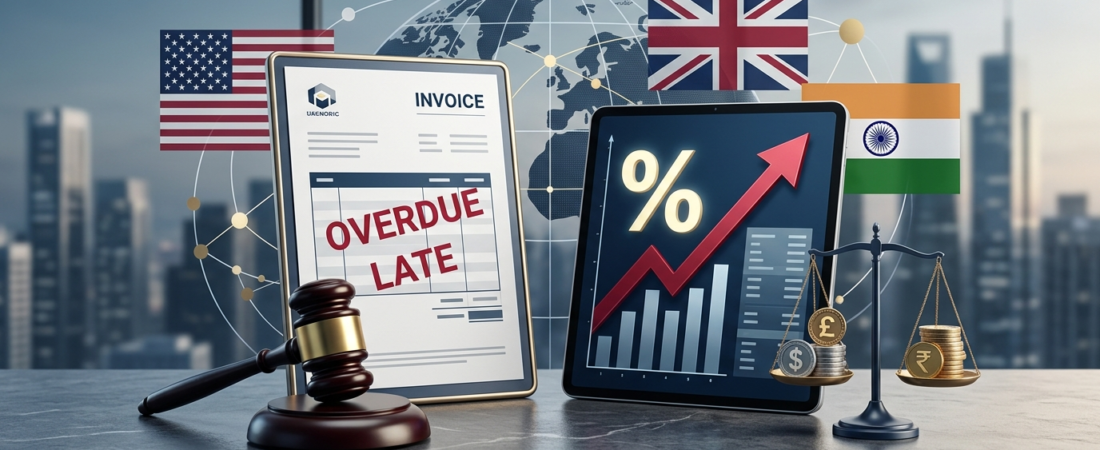
You just wrapped up a massive project. You designed the app, shipped the code, or delivered the campaign assets. You sent the final invoice.
And then… crickets. You wait a week. You send a polite email. Still nothing.
As a single-page specialized international lawyer helping freelancers and independent operators reclaim what they are owed, I see this exact scenario in my inbox every single morning. The panic sets in, and you ask me the golden question: Can you Legally Charge Interest on Late Invoices ?
Table of Contents
The Quick Answer
Yes. Absolutely. If you wrote an interest clause into your contract, you enforce that specific rate. But here is the wild part most freelancers don’t know: even if you forgot to include it in your contract, the legal systems in the UK, India, and many parts of the US grant you the automatic legal right to charge interest anyway. It is baked into commercial law.
I’m not here to throw legal jargon at you. You are a designer, a developer, a writer—not a boardroom advocate. My goal today is to explain exactly how this works, clearly and simply, so you can stop begging for your own money and start collecting it.
If you just want the practical takeaway:
- Add 1.5% monthly interest clause to all invoices
- Set payment terms to Net 15 (not 30+)
- Start charging interest after Day 7 delay
Now here’s how it works legally and strategically ↓
The Hard Data: Why You Can’t Just “Wait It Out”
Let’s look at the numbers. Waiting politely isn’t just frustrating; it is statistically destroying your freelance business.
Based on recent industry surveys from organizations like the Freelancers Union and IPSE :
- 71% of freelancers have struggled to collect payment at least once in their career.
- The average late invoice is paid 20 to 30 days past the actual due date.
- Independent workers lose an estimated $6,000 a year on average to unpaid invoices and the time spent chasing them.
Every day a client holds your money, they are effectively forcing you to give them a zero-interest loan. Inflation eats your purchasing power, and your own bills don’t pause.
Look at it this way. If they paid their electricity bill 45 days late, the power company would hit them with a late fee. You are a commercial entity. You need to act like one.
The Behind-the-Scenes Reality of Late Payments
Let’s skip the corporate PR talk. Your client isn’t ignoring you because they hate your work.
The ugly truth ? Mid-sized companies and large corporations juggle cash flow. When things get tight at the end of the month, their Accounts Payable (AP) department divides bills into two piles.
Pile one is the “Must Pay Now” stack. Rent, server costs, and vendors who charge aggressive late fees.
Pile two is the “Polite Human” stack. This is where you live. This stack is full of freelancers who send soft emails saying, “Hey, just checking in on this when you get a chance!”
You get paid last because you made it cheap and painless for them to ignore you. They prioritize the squeaky wheels. Once you understand that charging interest is a completely normal, everyday business practice that big companies use on each other constantly, you stop feeling guilty about using it yourself.

Comparative Legislative Roadmap : Clear Law, Simple Explanation
You might think that because you downloaded a basic contract template off Reddit, you have no legal leg to stand on. That is completely false.
The law actually protects you in most major regions. Let’s break down the rules globally.
United Kingdom : The Automatic Right
If you or your client are in the UK, the law is highly protective of you. Under the Late Payment of Commercial Debts (Interest) Act 1998, you do not need a custom late fee clause in your contract.
The UK government says statutory interest is your right.
The Rule: You can charge 8% plus the Bank of England base rate.
If the Bank of England rate is 5%, you can legally charge 13% annual interest on your late invoice.
Even better? The UK law allows you to charge a flat “compensation fee” for the hassle of chasing them, on top of the interest:
- Debt under £1,000 = £40 fee
- Debt £1,000 to £9,999 = £70 fee
- Debt £10,000+ = £100 fee
United States : State Rules and Prompt Payment
The US is a bit trickier because there is no single federal law for freelance private contracts. It changes state by state.
The Rule : If you want to charge interest in the US, you absolutely should put it in your contract. Most freelancers use a rate of 1.5% per month (18% annually).
Why 1.5% ? Because states have “usury laws” (caps on how much interest you can legally charge so you aren’t acting like a loan shark). 1.5% per month is universally accepted as safe, legal, and enforceable across almost every state.
Also, states like New York, Illinois, and California are passing versions of the Freelance Isn’t Free Act. Under these laws, if a client doesn’t pay you within 30 days, you can actually sue them for double the amount owed, plus your lawyer fees.
India : The MSMED Powerhouse
For Indian freelancers and agencies registered on the Udyam portal, the legal protection is massive.
Under Section 16 of the MSMED Act, 2006, if a client delays your payment beyond 45 days after accepting your work, they are in serious trouble.
The Rule: They must legally pay you compound interest at three times the bank rate set by the Reserve Bank of India (RBI).
If the RBI rate is 6.5%, your client owes you 19.5% interest, compounding monthly. Corporate accounting departments are terrified of this law because they are legally forced to report these unpaid MSME debts in their public annual audits.
Step-by-Step Execution Timeline
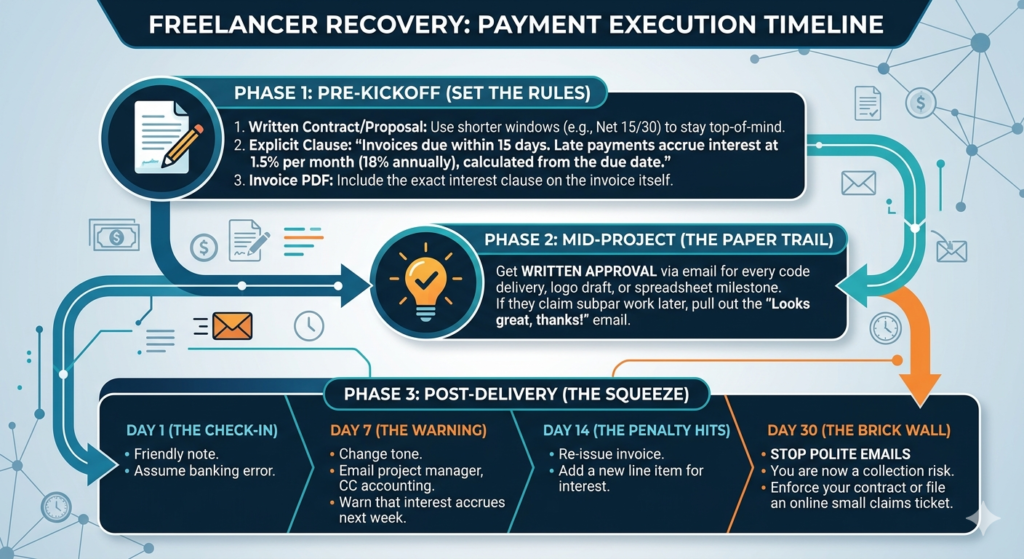
You can’t just slap a 15% interest fee on an invoice on day 45 without warning. You need a clean, professional paper trail. If you ever need my legal help, this trail is exactly what I will ask you for.
Here is your exact playbook.
Phase 1 : Pre-Kickoff (Setting the Rules)
Before you start working, put your terms in writing.
Ditch the long 45-day payment windows. I’ve analyzed thousands of payment disputes, and shorter windows keep you at the top of the AP department’s mind. I break down exactly why this works in my guide on Net 15 vs Net 30 vs Net 45 : Which Payment Terms Actually Get You Paid Faster?.
Add this simple sentence to your contract or proposal:
“Invoices are due within 15 days. Late payments accrue interest at 1.5% per month (18% annually), calculated from the due date.”
Put this exact phrase on the PDF of the invoice itself. Never leave them guessing. If you need a template, see How to Write Invoice That Gets Paid Faster (Proven Template + Legal System in 2026).
Phase 2 : Mid-Project (The Paper Trail)
Every time you deliver code, a logo, or a spreadsheet, get them to say “Approved” in an email.
If they try to avoid paying you later by claiming the work was “subpar,” you just pull out the email where their manager said, “Looks great, thanks!” Argument over.
Phase 3 : Post-Delivery (The Squeeze)
The due date hits. The money isn’t there.
- Day 1 (The Check-In) : Send a friendly note. Assume the bank held it up or they just missed the notification.
- Day 7 (The Warning) : This is where you change your tone. Email the project manager and CC their accounting department. Say: “Following up on Invoice #101. Please note that per our contract, late interest will begin accruing next week if this is not cleared.” If you want to see the exact email scripts I use for this, read the Best Follow-Up Timeline for Unpaid Freelance Invoices : The US Restitution and Recovery Manual.
- Day 14 (The Penalty Hits) : Re-issue the invoice. Add a new line item for the interest calculated up to today.
- Day 30 (The Brick Wall) : Stop sending polite emails. You are now a collection risk. If they are completely ignoring you, it is time to enforce. Read my manual on How to Recover Unpaid Invoice Without Lawyer (Step-by-Step Guide) to see how to file an online claim without paying massive legal retainers.
Utility Tool : The Cost-of-Delay & Notice Generator
Math is annoying. Staring at a blank screen trying to write a “pay me now or else” email is stressful.
I built this interactive tool for you. Plug in your numbers below. It will calculate exactly how much interest they owe you based on the days late, and it will instantly generate a firm, legally-sound notice. You can edit the text directly in the box, and hit the Print/Save PDF button to send it straight to your client.
Statutory Interest Generator
Calculate late fees and generate a demand letter instantly.
Citations for this problem :
1. United Kingdom (Statutory Right)
- Primary Source : Legislation.gov.uk – The official home of UK legislation. This provides the exact text of the Late Payment of Commercial Debts (Interest) Act 1998. [cite: 1]
- Authority Booster : Gov.uk – Use the official guide on Late Commercial Payments to confirm the 8% interest rate and the fixed recovery fee structure. [cite: 2]
2. United States (Contractual & Legislative Framework)
- Primary Source: Congress.gov – Use the Electronic Signatures in Global and National Commerce (ESIGN) Act to anchor your claims regarding the validity of digital contracts and emails as binding legal evidence. [cite: 3]
- Regional Authority: NYC.gov – Link to the Freelance Isn’t Free Act as the “Gold Standard” for modern freelance protection, which acts as a major authority booster for US-based content. [cite: 4]
3. India (Compounding Interest & Enforcement)
- Primary Source: Samadhan.msme.gov.in – The official portal of the Ministry of Micro, Small and Medium Enterprises. This is the ultimate authority for the MSMED Act, 2006, which mandates compounding interest for delayed payments. [cite: 5]
- Judicial Authority: IndianKanoon.org – Link to Modern Industries v. Steel Authority of India Ltd. (2010) to provide a Supreme Court-level precedent that proves small suppliers can successfully recover interest from massive corporations. [cite: 6]
Real-Life Case Study : Why You Will Win
I know what you are thinking. “If I actually charge this interest, won’t the client’s high-priced lawyers crush me ?”
No. Because courts heavily favor the supplier in these matters. Let me give you a very real, documented case study to prove it.
Look at the landmark case : Modern Industries v. Steel Authority of India Ltd. (2010).
The Setup: A small industrial supplier (Modern Industries) delivered materials to a massive corporate giant (SAIL). The giant accepted the materials but dragged their feet on payment for months.
The Dispute: SAIL eventually paid the base invoice, but completely ignored the massive late interest that had piled up. The corporate giant argued in court that because the small supplier eventually accepted the late base payment, they “waived” their right to the interest.
The Reality Check: The Supreme Court ripped the corporate giant apart.
The judges ruled that statutory interest is an absolute mandate. Large companies cannot use their massive size to starve small suppliers of cash flow. The court forced the corporate giant to pay the entire compound interest balance.
If a small parts supplier can legally crush a massive public steel corporation over late interest, you can absolutely hold a marketing agency accountable for your $4,000 design invoice.
The Evidence Trail (What You Must Save)
If you ever have to pull the trigger and escalate to a small claims court, you can’t just walk in holding a printed invoice. You need proof.
Save these four things locally on your hard drive:
- The Master Agreement : Your signed contract or accepted quote.
- The Delivery Log : The exact date/time you sent the final files via Dropbox, GitHub, or WeTransfer.
- The Approval : The email where the client says, “Got it, looks good.”
- The Notice History : Copies of your follow-up emails.
A lot of freelancers panic because they didn’t sign a formal PDF contract; they just agreed to the job over chat. Don’t stress. Under the US ESIGN Act and UK law, digital messages count. I wrote a deep dive on exactly how this works here: Is a WhatsApp Conversation a Legally Binding Contract ? The Ultimate US & UK Judicial Guide.
Chances of Winning (The Risk Assessment Matrix)
Be objective. Look at the evidence you have right now. Here is your realistic chance of actually recovering the money and the interest.
| What You Have Saved | Your Chance of Winning | The Reality of the Situation |
| Signed Contract + Email Approval + Sent Late Notices | HIGH | Their legal team will look at your file, realize they will lose in court, and cut you a check to make you go away. |
| No Contract + But clear email thread of pricing and delivery | MEDIUM | They will probably try to negotiate. Offer to waive the interest only if they pay the base invoice in 24 hours. |
| Verbal only + vague texts + no proof of delivery | LOW | You have no leverage. Stop talking about interest. Focus strictly on getting the base amount paid. |
Real-World Insightful FAQ
Can I just add a late fee to an invoice if it wasn’t in the contract ?
If you are in the UK or India, yes. Statutory law gives you that right automatically. If you are in the US, generally no. You need to have stated it in your initial contract or proposal. If you are in the US and forgot to add it, your best bet is leveraging state Prompt Payment laws.
What if a client completely ignores my invoice and my interest notices ?
Stop emailing them politely. They have muted you. You need to escalate. Issue a formal statutory demand (like the one generated in the tool above). If they still ignore it, you file an online small claims ticket. The moment a court summons hits their physical mailbox, their AP department will miraculously “find” your invoice.
How do I handle common payment excuses like ‘It’s stuck in an accounting loop’ ?
Call them out, professionally. Say: “I understand internal approvals take time. However, my invoicing system automatically applies daily interest to overdue balances per our terms. It is in your company’s best interest to manually expedite this today to avoid further accumulation.”
The Mindset Shift
Getting paid quickly has absolutely nothing to do with being nice. It is about establishing boundaries.
When you outline your interest terms on day one, you stop looking like a desperate freelancer begging for rent money. You look like a highly organized commercial entity. Delaying your money should be painful and expensive for them.
Stop apologizing for wanting to be paid for the work you already did. Update your contract templates today, add that interest clause, and protect your cash flow.
LEGAL & FINANCIAL DISCLAIMER :
The information provided on this platform is for general educational and informational purposes only. It does not constitute formal legal counsel, financial consulting, or actionable professional advice. Readers are strictly urged to consult with certified legal professionals and authorized financial regulators regarding their specific asset and recovery scenarios before initiating any administrative or legal procedures. We do not solicit, perform or guarantee unregulated recovery or hacking operations.
Author Box
Advocate Sagar Haribhau Shirsat ( Bar Council of India Enrolled Practicing Advocate )
I am a specialized international commercial recovery consultant and legal risk advisor. I help cross-border creators, tech developers, and independent agencies reclaim what they are owed. I skip the abstract boardroom legal theory and focus purely on real-world, tactical systems that force bad clients to pay up—without you losing half your money to traditional legal fees.