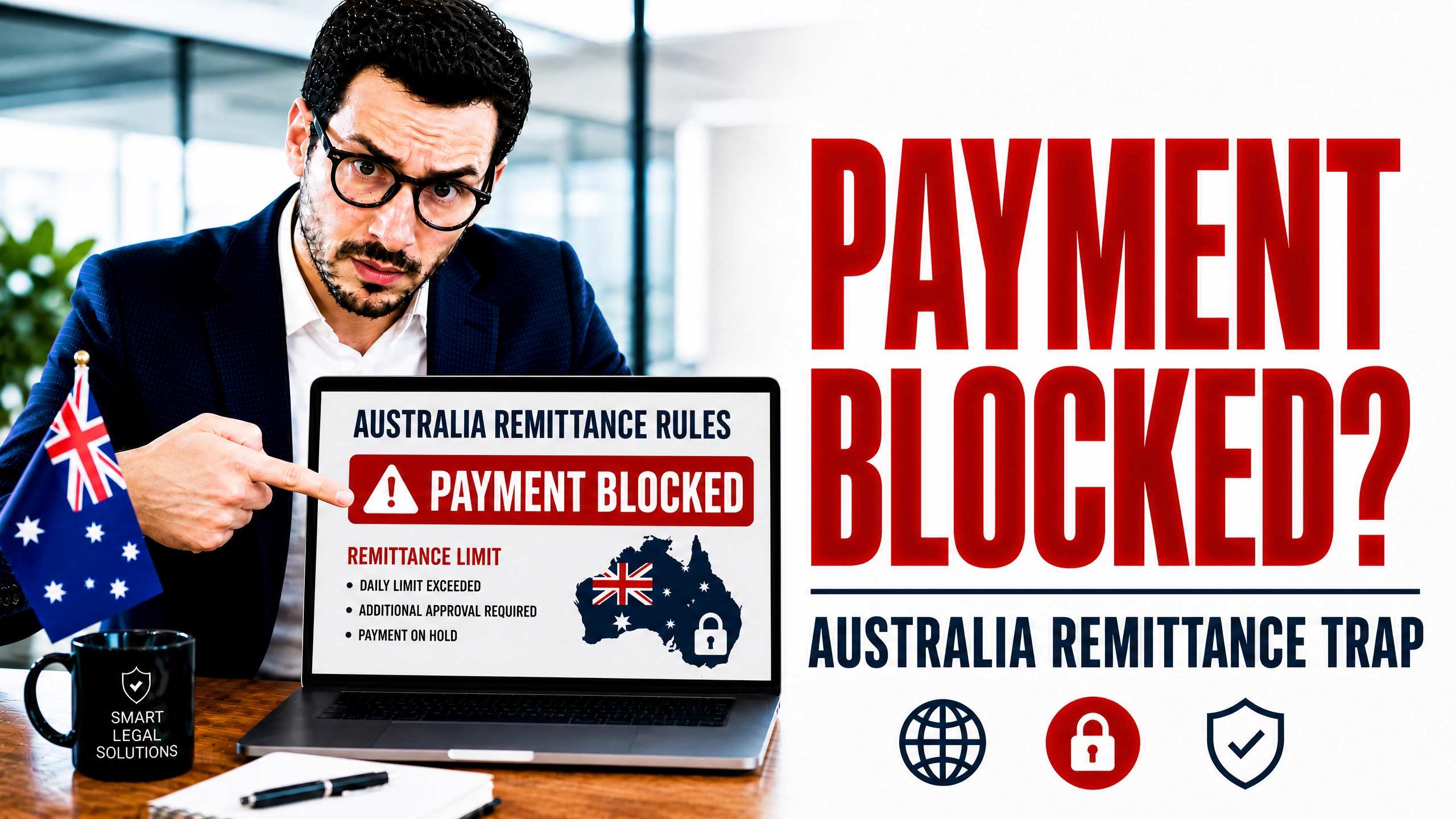
An email lands in your inbox. It’s from your Australian client.
You delivered the final milestone two weeks ago. The project is live. They are actively making money off your work. But instead of a payment notification, you get an apology.
“Hey, we tried to wire the funds, but our bank flagged it. There are strict outbound remittance rules right now. We are working with compliance to clear the hold. Sorry for the delay!”
Your heart sinks. Your rent is due. You don’t know Australian banking laws.
Are they telling the truth ? Is the Australian government actually holding your $4,500 invoice hostage?
Look, let me be brutally honest with you.
I’ve been consulting freelancers on international payment disputes for years. I have seen this exact email hundreds of times.
In 95% of cases, it is a complete fabrication.
It is a stalling tactic used by agencies and operators who are waiting on their own clients to pay them. They are using you as a free line of credit.
But you can’t just accuse them of lying. That burns the bridge.
Instead, I am going to show you exactly how to call their bluff safely. We are going to deconstruct this excuse, flip the script, and force the payment through.
Grab a coffee. Let’s get your money.
Table of Contents
The ‘Regulatory Hold’ Excuse Exposed

Here is the thing: international banking has friction. But it does not have arbitrary black holes.
Australian businesses send millions of dollars offshore every single day to remote contractors. The banking infrastructure is built for this.
When a client claims a “regulatory hold,” they are hoping you are intimidated by financial jargon.
They know you aren’t an expert on international financial law. They expect you to say, “Oh, okay, keep me posted!”
Don’t fall for it.
If you just sit back and wait, your invoice gets pushed to the bottom of the pile. You enter what I call the accounting graveyard.
If you want to know how this psychological trap works, read about how to handle clients stuck in an accounting loop.
The reality is that a legitimate bank hold generates automated documentation.
If their bank actually blocked the transfer, the client would receive a formal notice. They would have a reference number.
If they can’t provide a specific error code or a screenshot of the banking portal’s notice, the “hold” does not exist.
Verifying Real Outbound Transaction Regulations
Let’s look at the actual laws. Australia is strictly regulated, but not in the way your client claims.
The primary regulatory body is AUSTRAC (Australian Transaction Reports and Analysis Centre).
AUSTRAC oversees the Anti-Money Laundering and Counter-Terrorism Financing Act 2006 (AML/CTF Act).
Under this law, Australian banks must report any International Funds Transfer Instruction (IFTI) to AUSTRAC.
But here is the critical distinction.
Reporting a transaction is not the same as blocking a transaction.
Banks automate these reports. The data is sent to the government in the background. It does not stop your payment from clearing.
There are only two real reasons an Australian bank will genuinely block an outbound transfer to a freelancer.
First, if you are located in a comprehensively sanctioned country. If you are reading this, you probably aren’t.
Second, if the client’s account triggered an internal fraud alert because they don’t have the funds, or their account is under investigation.
In that case, the problem is their financial health, not international remittance rules.
If you are dealing with a company in financial free-fall, you need to know what happens if your corporate client goes bankrupt.
The “outbound remittance rules” excuse is just a polite way of saying, “We don’t have the cash flow this week.”
USA vs Global (AU) Comparison : The Compliance Reality

To understand why this excuse is so common, let’s compare US and Australian systems.
United States (FinCEN / OFAC)
US banks are notoriously trigger-happy. If you wire money from a US Chase account to a new overseas vendor, Chase might temporarily freeze it.
They want to verify you aren’t violating OFAC sanctions. But even then, the US client can clear it with a 10-minute phone call.
Australia (AUSTRAC / ATO)
Australia’s banking network is heavily integrated with Southeast Asia and global trade.
Transfers via the major “Big Four” banks (Commonwealth, Westpac, ANZ, NAB) to non-sanctioned countries are routine.
Unless the transfer exceeds $10,000 AUD in physical cash (which doesn’t apply to digital wires), the friction is incredibly low.
The Australian Tax Office (ATO) also requires businesses to keep records of international contractors, but they do not hold up real-time digital payments.
The takeaway ? The US might pause a wire for 24 hours. Australia rarely pauses standard commercial B2B wires at all unless the sender’s account is compromised.
Implementing Alternative Multi-Currency Local Accounts
Now that we know the law, how do we get your money?
We remove the “international” part of the equation entirely.
If they claim international remittance is the problem, you provide a domestic Australian solution.
You need to use a service like Wise (formerly TransferWise), Payoneer, or Airwallex.
These platforms provide you with a virtual local Australian bank account.
I use this strategy constantly. It works like magic.
You generate an account with an Australian BSB (Bank State Branch) code and a standard Account Number.
When you give these details to your client, they aren’t sending an international wire anymore.
They are doing a standard domestic bank transfer. It routes locally within Australia.
It completely bypasses SWIFT codes, international compliance departments, and their fabricated “remittance holds.”
If you haven’t set up your global banking infrastructure yet, check out my guide on how to protect yourself when working with international clients.
Here is how you execute the pivot smoothly.
The Payment Pivot Email Generator
I built a simple HTML tool you can use right now. Save this code as an .html file, open it in your browser, and generate your custom response.
Payment Pivot Email Generator
Generate a polite, firm email that bypasses international wire delay excuses.
This email is polite. It doesn’t accuse them of lying.
But it completely destroys their excuse. If they still refuse to pay after you provide a local BSB, you know for a fact they are having cash-flow problems.
Risk Matrix : Analyzing Their Response
Once you send the pivot email, their reaction will tell you exactly how much danger your invoice is in.
| Client Response | Risk Level | The Reality | Your Next Step |
| “Great, thanks! Paid.” | Low | They had the money but were too lazy to deal with their bank’s international portal. | Confirm receipt. Continue working. |
| “Our system only allows international wires for foreign vendors.” | Medium | This is an accounting policy, not a law. They are being difficult to protect cash flow. | Remind them you operate globally. Give a firm 48-hour deadline. |
| Silence / Ghosting | High | They are broke. The “remittance hold” was a lie to buy time. | Suspend all services and IP licenses immediately. |
If you hit the High-Risk category and they stop replying, do not panic.
You need to shift from customer service mode into asset protection mode.
Start by reading the exact follow-up timeline for late freelance invoices.
Closing the Escape Loop
You solved the immediate problem. Now we need to make sure it never happens again.
Freelancers get abused because their contracts are weak.
You likely sent a standard proposal that said “Payment due in 14 days.” That is not enough.
You need to close the escape loop. You have to put the legal burden of banking friction solely on the client.
The Escape Loop Closure Flow
Here is a simple flow of how your billing cycle should look to prevent excuses:
Payment Escape Loop Closure
Automated contract enforcement and payment tracking lifecycle.
When you update your contracts, you need a specific clause regarding international banking.
Add this to your Master Services Agreement:
“Client is responsible for ensuring all cross-border or domestic payment gateways are cleared prior to the invoice due date. Delays caused by internal banking compliance, intermediary banks, or currency routing do not exempt the Client from late fees.”
If you want to know how to enforce those penalties properly, read my guide on how to charge late fees legally.
By having this in writing, you strip away their ability to play the victim when their bank supposedly flags a transfer.
They agreed to figure it out beforehand.
If they push back on this clause during negotiations, it is a massive red flag. Good clients don’t argue about paying on time.
Evidence Checklist
Before you confront a client who is dragging out the “banking delay” excuse, make sure you have your documentation locked down.
If this escalates to a formal dispute, you need a paper trail.
- [ ] The Signed Agreement : Confirming the original payment terms.
- [ ] Proof of Delivery : Links, timestamps, and emails showing the work was accepted.
- [ ] Usage Proof : Screenshots of the client using your work publicly.
- [ ] The Excuse Email : Save a PDF copy of them claiming a regulatory hold.
- [ ] Local Account Issuance : Proof that you provided them with a domestic BSB/Account option.
If they are actively using your work while claiming they can’t pay you, you have immense leverage.
For digital creators, read what to do when a client uses your work but refuses to pay.
Quick Decision Section
Are you still unsure how to move forward today ? Use this quick decision tree.
If the invoice is 1-7 days late:
Send the Payment Pivot Email from the generator above. Stay friendly. Assume positive intent, but provide the local banking details.
If the invoice is 8-14 days late:
They are ignoring the local bank option. Stop working.
Learn how to use the notice of suspension of services without ruining the relationship entirely.
If the invoice is 15+ days late and they are ghosting:
The banking excuse was a lie. You are now in a breach of contract scenario.
It is time to look at unpaid invoice follow-up email templates that carry legal weight.
FAQs
Can the Australian government actually block my payment ?
No, not for standard freelance services. Unless you are on a global sanctions list, AUSTRAC only requires banks to report the data, not halt the funds. The delay is entirely on the client’s end.
My client says their bank takes 10 days to clear international payees. Is this true ?
Sometimes, legacy banks have internal security protocols for first-time international payees. However, providing them with a local BSB via Wise completely bypasses this 10-day wait.
Should I offer a discount if they pay via credit card instead ?
Never discount your work because their internal systems are broken. You can offer a credit card gateway (like Stripe), but they should absorb the processing fee, not you.
What if they refuse to use the local Wise account I provided ?
If they refuse a frictionless domestic payment method, they are acting in bad faith. It usually indicates they do not have the funds available to pay you at all.
When should I threaten legal action over a delayed wire ?
Never “threaten.” You simply enforce boundaries. Send a formal final notice before evaluating if it’s officially time for a freelancer to take legal action.
Stop Accepting Excuses
Look, building a global freelance business is hard enough without playing banker for your clients.
When a client in Australia, or anywhere else, blames “outbound remittance rules,” they are testing your boundaries.
They are checking to see if you are a professional who demands respect, or an amateur who will quietly wait another three weeks.
Provide the local banking details. Call the bluff. Protect your cash flow.
You did the work. You deserve the money. Now go get it.
About the Author
Adv. Sagar Haribhau Shirsat is an active legal professional specializing in commercial transaction architectures, cross-border corporate compliance, and digital debt recovery systems. He designs strategic asset-protection and recovery frameworks that help freelancers, independent contractors, and global agencies defend their cash flow and enforce their billing rights.
Connect via his Official Professional LinkedIn Profile.
Disclaimer : This guide is intended for educational purposes and risk management analysis. It does not replace formal legal counsel. For specific cross-jurisdictional contract disputes, always consult a certified attorney or local legal advocate.