Table of Contents

Immediate Relief for the 2 AM Panic
If you are a freelancer sitting awake at 2:00 AM staring at an unread email thread, watching your payment terms expire while a client profits from your hard work, read this clearly: You have not been defeated, and you are not powerless. The panic you are feeling right now is completely valid, but emotion will not clear your bank ledger. What you need is an objective, systematic process. This operational manual establishes the best follow-up timeline for unpaid freelance invoices, turning casual, easily ignored checkout check-ins into high-leverage legal demands.
As a practicing legal advocate, I see this issue daily. This guide will show you exactly what is happening behind the scenes, why your client has gone silent, what specific steps you must take, and exactly how to execute them right now. You do not need a law degree to protect your business; you just need to follow a disciplined framework that shifts the financial risk back onto the defaulting party.
What is Happening & Why : The Structural Mechanics of Corporate Client Ghosting
When an invoice slides past its due date, your business relationship shifts from a creative collaboration into a formal transactional dispute. To fix this, you must understand the underlying causes of the breakdown.
What is Happening ?
Your administrative contact has stopped replying, your Slack access may have been quietly restricted, and your payment tokens remain unexecuted. To a 19-year-old freelancer, this feels like an intentional personal attack. In reality, it is simply a cold operational maneuver.
Why is it Happening ?
We have consistently observed that agencies delay payments significantly more than direct enterprise clients. Agencies usually run a back-to-back liquidity model: they wait to collect funds from their end-client before routing capital down to subcontractors. If their end-client delays a milestone sign-off, the agency handles their cash crunch by cutting off communication with you, using your silent invoices as an interest-free line of credit.
With direct corporate clients, the root cause is usually internal friction. A bureaucratic breakdown occurs when your primary point of contact fails to route your invoice through automated accounts payable tracking platforms (like Tipalti, Bill.com, or SAP Ariba), leaving your payment trapped in an unapproved processing queue.
By continuing to send casual, friendly text messages, you inadvertently tell their accounting team that there are no consequences for keeping you waiting. To break this loop, you must transition your communication from informal check-ins to an organized contractual escalations.
you may be interested in – Is a WhatsApp Conversation a Legally Binding Contract ? The Ultimate US & UK Judicial Guide
The Core Framework : The Best Follow-Up Timeline for Unpaid Freelance Invoices
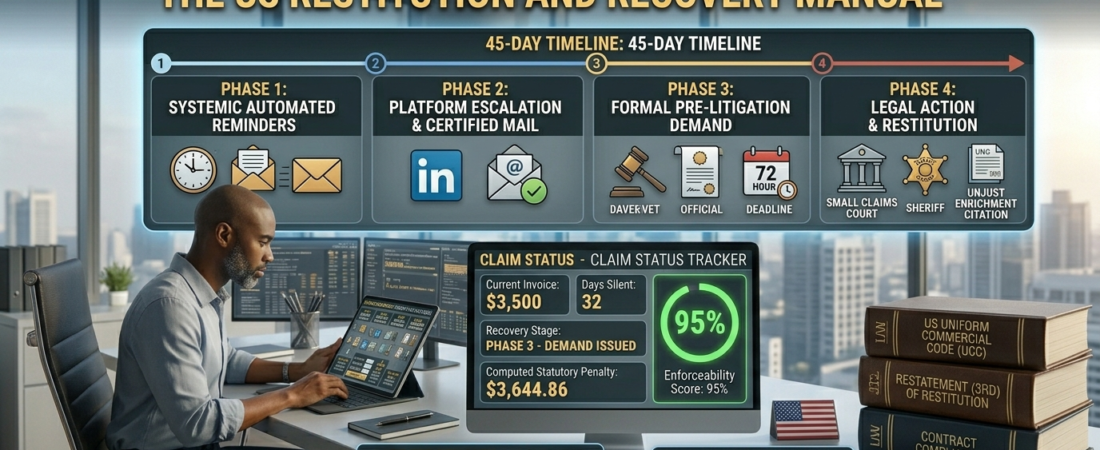
The most effective strategy to recover outstanding balances is a strict 45-Day Escalation Framework built around the best follow-up timeline for unpaid freelance invoices.
The 45-Day Billing Escalation Timeline
Systemic Reminders
Assume administrative oversight. Send non-emotional, polite alerts directly accompanied by click-to-pay links.
Platform Escalation
Bypass unresponsive channels. Connect directly with CFOs/MDs via LinkedIn and deliver physical certified letters.
Legal Restitution
Apply statutory interest fees. Issue a formal pre-litigation PDF notice with a strict 72-hour settlement deadline.
The 3-Stage Recovery System and Escalation Ladder
Do not send erratic, uncoordinated messages. Deploy this disciplined 3-Stage Escalation Ladder to step up communication velocity based on objective milestone intervals.
Stage 1 : Systemic Automation (Days 1 to 14 Post-Due Date)
During this opening phase, protect your relationship capital by assuming the delay stems from an everyday administrative oversight. Your goal is simply to establish a clear, documented record of your collection efforts.
- The Execution Timing : Send an initial automated ping exactly 24 hours after the payment deadline passes. Follow up with formal reminders on Day 7 and Day 14.
- The Exact Message Script (Day 7 Automated Follow-Up) :Subject: Outstanding Balance Reconciliation: Invoice [Invoice_Number]Dear [Client_First_Name],This is a standard administrative notification to confirm that Invoice [Invoice_Number] ($[Amount]), originally submitted on [Submission_Date] for completed project milestones, has run past its formal net terms timeline.Please find a copy of the itemized invoice along with our direct electronic payment options attached below. Kindly reply to confirm your scheduled transaction execution date.
Automated Script Customizer
Input your milestone data to instantly personalize your Day 7 follow-up message.
Stage 2 : Platform Escalation (Days 15 to 29 Post-Due Date)
If your Stage 1 communications are ignored for two weeks, diplomacy must shift. Your primary point of contact is either avoiding the issue or filtering your messages. In most cases, clients respond within 48 hours after a Stage 2 escalation.
- The Execution Timing : Initiate on Day 15. Break out of the standard email loop entirely.
- The LinkedIn Executive Target Framework : Mid-level project managers rarely control corporate purse strings. Search for the company’s organizational profile on LinkedIn and identify their Chief Financial Officer (CFO), Controller, or Managing Director. Send a precise, objective, non-emotional direct message:“Alternative communication line: Our team has transmitted an outstanding commercial account summary regarding completed deliverables to your accounts payable department. Because primary project lines have become unresponsive, we are seeking direct operational verification of receipt from leadership to prevent formal contractual escalation.”
- The Certified Mail Protocol : Print your contract, completed invoice, and email logs. Send this physical bundle to their registered office address via USPS Certified Mail with Return Receipt Requested. This creates an undeniable legal record, stripping the corporate entity of their ability to claim they never received your payment notices.
Stage 3 : Legal Enforcement Apex (Day 30+ Post-Due Date)
When an invoice hits Day 30 without a payment solution, it transitions into a mature default asset. You must now deploy a formal, high-firmness Pre-Litigation Demand Notice.
This document must not be sent as plaintext in an email. It should be formatted as a structured, formal PDF attachment containing explicit statutory legal citations, an updated ledger reflecting late-fee penalties, and a hard 72-hour or 7-day settlement deadline.
The Evidence Stack and Legal Threshold Analysis
Before you issue a formal legal demand, you must assemble an Evidence Stack. Should your claim ultimately land before an arbitrator or a small claims magistrate, your success will depend entirely on clear, objective documentation rather than emotional arguments.
The Hierarchical Evidence Hierarchy
Organize your documentation according to this structural legal framework before initiating any legal action:
| Evidence Tier | Item Categorization | Legal Valuation Weight |
|---|---|---|
| Level 1 | Signed Master Service Agreement (MSA), Statement of Work (SOW), explicit email cost confirmations. | Primary (Conclusive Proof) |
| Level 2 | GitHub commit histories, platform transfer logs, staging link deployment dates, shared file drive history logs. | Secondary (Delivery Verification) |
| Level 3 | Slack, Teams, or WhatsApp messages where the client states “Looks perfect,” or confirms receipt and deployment. | Corroborative (Establishes Acceptance) |
US-Specific Deep Dive : Unjust Enrichment and Restitution Under the Law
Many freelancers panic if they realize their underlying contract was weak, un-signed, or built on vague verbal confirmations. This is where US common law provides a powerful safety net : the doctrine of Unjust Enrichment and the right to Quantum Meruit (“what one has earned”).
Under established American civil principles, if you deliver a valuable asset (like an engineered software stack, corporate branding, or content asset framework) to an organization, and that organization absorbs, displays, and uses your work to generate commercial profits without paying you, they are committing an actionable injustice.
You have the legal right to seek immediate financial restitution from the specific party who possesses and uses your asset. The court measures your compensation based on the fair market value of the work received, preventing the client from exploiting your labor under the guise of an unsigned document.
many times it happens like this – Can an Unpaid Subcontractor Sue the End-Client Directly ? The US Legal Guide
Tactical Scenarios : The Busy Client (X), The Cash Flow Crunch (Y), and The Intentional Scammer (Z)
A common mistake in debt recovery is treating every late payment exactly the same way. If you push too hard against a trusted client facing a temporary roadblock, you can destroy a valuable relationship; if you treat a bad-faith scammer with soft reminders, you give them time to vanish.
Scenario A : The Client is Busy & Disorganized
- Observed Pattern : The client is apologetic over messages, frequently responds with “sent to accounting,” but continuously misses administrative payment processing deadlines.
- Tactical Action (Do X) : Lower the friction required to process your transaction. Bypass the creative director entirely. Send an un-emotional email containing a direct-to-accounting click-to-pay token link along with a clean statement of account directly to their finance department.
Scenario B : The Client has a Real Cash Flow Crunch
- Observed Pattern : The client is transparent about their lack of liquid funds, responds to your messages honestly, and asks for an extended extension or installment options.
- Tactical Action (Do Y) : Secure your position by locking in the debt profile through a structured repayment plan backed by a protective Acceleration Clause.
- Sample Clause :“In the event that the Debtor fails to clear any individual scheduled installment payment within forty-eight (48) hours of its stated deadline, the entire remaining aggregate balance of $[Total_Amount] shall immediately become fully mature, due, and payable without further notice or demands.”
Scenario C : The Intentional Corporate Scammer
- Observed Pattern : The client has deployed your assets live to their website, cut off your platform access, blocked your emails, and gone completely silent across all channels.
- Tactical Action (Do Z) : Cease informal communications instantly. Skip standard pings and execute Stage 3 enforcement immediately by deploying a formal Pre-Litigation Statutory Demand Notice with a strict 72-hour deadline.
The Core Assets : Late Payment Penalty Calculator & Formal Notice Generator
Here are your live operational tools to help you take action right now.
Asset 1 : Late Payment Commercial Penalty Calculator
Use this application to calculate late payment interest penalties.
⚠️ Jurisdiction Dependent & Use Responsibly Note: Calculations generated here are based on standard statutory interest frameworks (e.g., US uniform commercial defaults or typical state interest rules). Review your original contract clauses or local civil code to ensure alignment before finalizing your updated claim balance.
Commercial Debt Statutory Penalty Calculator
Asset 2 : Pre-Litigation Formal Notice Generator
Input your specific case parameters below to instantly generate a customized, boardroom-ready Pre-Litigation Demand Document.
⚠️ Jurisdiction Dependent Disclaimer: This system outputs a formal pre-litigation notice based on standard commercial collection practices. It functions as an administrative step and does not substitute for customized counsel from a certified local attorney.
Interactive Pre-Litigation Notice Builder
Input your parameters to generate an objective, high-firmness collection notice template.
Live Document Output Sandbox
The Reality Check : Operational Metrics and When This Strategy Fails
A reliable recovery manual must address the hard truth that a structured communication strategy will not work 100% of the time. If a client is determined to hide from their obligations, completely insolvent, or operating a shell company design, your demand letters may be completely ignored.
Expected Recovery Performance Indicators
Before determining your next steps, evaluate your situation against these standard collection metrics:
- Time Required to Resolution : 14 to 45 Business Days.
- Out-of-Pocket Execution Costs : $0 (if handled via open platform pings and electronic PDF delivery); $8–$15 if deploying physical USPS Certified Mail bundles.
- Historical Success Probability : * Scenario A (Busy): 92%
- Scenario B (Cash Flow Crunch) : 78% (via payment restructuring)
- Scenario C (Intentional Scam) : 40% (via out-of-court demands alone)
When This Strategy Fails
If your formal 72-hour Stage 3 Pre-Litigation Demand Notice passes without any response, your communication strategy has reached its limit. Do not waste further time sending additional emails or trying to call their team.
At this point, you must execute one of two practical recovery measures based on the value of your invoice:
- For Invoices Under $3,000 : File a claim directly in your local Small Claims Court. Small claims processes are designed to be fast, cost-effective, and do not require you to retain an attorney. You simply present your Evidence Stack directly to a magistrate judge. Once a default judgment is entered in your favor, you can pass it to a local sheriff or a third-party collection agency to place a lien against the client's corporate checking accounts or garnish assets.
- For Invoices Over $3,000 : Hand your entire documentation package over to a certified commercial Debt Collection Agency. Most professional agencies operate on a contingency baseline, meaning they only charge a fee (typically 20% to 33% of the recovered capital) if they successfully collect the money. Collecting 70% of an outstanding milestone value through an agency is far better for your cash flow than retaining 100% of an unpaid invoice that you cannot collect on your own.
Author Biography
Adv. Sagar Haribhau Shirsat is an active legal professional specializing in transactional contract architectures, cross-border corporate compliance operations, and B2B asset protection frameworks. He designs practical, high-leverage collection strategies that help independent contractors and creative agencies protect their cash flow and enforce their billing rights globally.
- Connect via his Official Professional LinkedIn Profile.
Disclaimer: This manual is intended strictly for educational purposes and strategic risk analysis. It does not constitute formal legal representation. For specific state-level jurisdictional issues or complex civil disputes, always consult with a certified local attorney or legal advocate.