
Table of Contents
Executive Summary : The Operating Manual for Asset Recovery
When a commercial client ceases all communications following the submission of a final invoice, independent consultants and agency operators typically experience a predictable sequence of emotional responses : benefit of the doubt, professional anxiety, frustration, and eventual resignation. In the open market, resignation is a luxury your cash flow cannot afford. Silence is not an absolute barrier to capital recovery; it is a tactical parameter.
This document serves as an exhaustive, courtroom-tested operating manual for independent providers facing non-payment. When a client ghosted after invoice protocols must shift immediately from relationship preservation to structured, evidence-driven debt escalation.
By executing a systematic, phased response rooted in United States commercial law (Uniform Commercial Code) and United Kingdom statutory frameworks (Late Payment of Commercial Debts Act), you transform an unstructured billing dispute into a highly defensible, liquidated debt profile.
The Psychology of Silence : Operational Diagnostics
Treating every silent client as an intentional criminal is an operational error that can alienate long-term accounts. Conversely, treating an intentional scammer with gentle reminders wastes the critical evidentiary window required to secure your assets. Before deploying heavy legal machinery, you must execute a cold diagnostic assessment of the silence based on observed commercial patterns.
Invoice Enters Overdue State
Is the silence organic or tactical?
- • Internal administrative disarray
- • Unintentional communication delay
- • Real-time capital crunch limits
- • Avoidance due to temporary shortfall
- • Commercial malice / Corporate fraud
- • Direct exploitation of assets
Scenario A : The Client is Genuinely Overwhelmed (Busy)
- Observed Pattern: The corporate entity is growing rapidly, undergoing an internal restructuring, or facing personnel turnover in the accounts payable department. The silence is driven by administrative friction, not financial malice.
- Tactical Response (Do X): Lower the friction required to complete the transaction. Remove administrative hurdles by delivering direct, click-to-pay invoicing links accompanied by clean, un-emotional itemized tracking summaries.
Scenario B : The Client has a Capital Crunch (Cashflow Issue)
- Observed Pattern: The client acknowledges the value of your work but skips billing cycles, responds with vague timelines, or ghosts because they lack the liquidity to clear the invoice.
- Tactical Response (Do Y): Secure the debt profile by offering a structured installment agreement accompanied by a cognovit note or a revised payment schedule that includes an explicit Acceleration Clause. This clause dictates that if they miss a single installment milestone, the entire aggregate balance becomes due and payable immediately.
Scenario C : The Intentional Corporate Scam (Malice & Fraud)
- Observed Pattern: The client has integrated your custom software, launched your marketing assets, or utilized your advisory insights, and has cut off contact across all communication platforms (Email, Slack, LinkedIn, Phone). They have block-listed your domain or closed project communication channels.
- Tactical Response (Do Z): Cease all customer service protocols. Initiate an immediate, aggressive legal escalation ladder designed to freeze asset usage and establish an unassailable evidentiary stack for rapid adjudication.
You may be interested in – Client Ghosted Final Invoice But We Only Agreed Via Slack. Can I Sue ?
The 3-Stage Recovery System & The Escalation Ladder
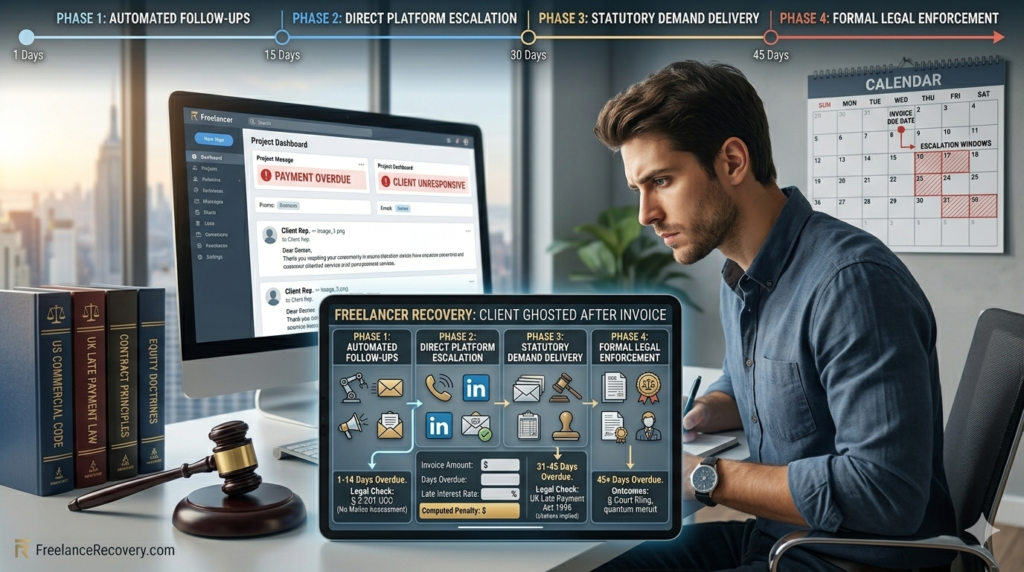
To recover funds without incurring catastrophic legal fees, you must deploy a structured Escalation Ladder. This sequence applies systematic pressure, moving from polite notification to binding statutory demands.
| Timeline Anchor | Phase Designation | Core Operational Objective | Legal & Tactical Focus |
| Days 1–7 Past Due | Stage 1: Systemic Automation | Eliminate administrative errors and establish a clear baseline of debt notification. | Polite, automated text/email notifications containing the original invoice metadata and direct payment fields. |
| Days 8–21 Past Due | Stage 2: Platform Escalation | Bypass compromised internal lines and establish direct, personal executive awareness. | Formal multi-channel contact across LinkedIn, physical certified couriers, and corporate operations desks. |
| Days 22–30+ Past Due | Stage 3: Legal Enforcement | Transition the dispute into a formal pre-litigation asset recovery framework. | Submission of a formal, high-firmness Statutory Pre-Litigation Notice backed by an explicit 72-hour deadline. |
Stage 1 : Systemic Automation (Days 1 to 7)
The moment the invoice payment term expires without confirmation of an electronic funds transfer, the account drops into Stage 1. At this point, the tone remains professional, collaborative, and completely objective.
- The Wait Threshold: Do not wait weeks. Send your first payment tracking update precisely 24 hours after the due date has elapsed.
- Operational Script: “Our records indicate that invoice [Number] for [Project Name] is now past due. Please review the attached itemized summary and complete the remittance via the secure transfer link below.”
Stage 2 : Platform Escalation (Days 8 to 21)
If the client ignores three automated follow-ups, you must assume the primary email channel is either being intentionally filtered or neglected. You now escalate to Platform Escalation. The goal here is to establish undeniable receipt by shifting to high-visibility business networks.
- The LinkedIn Executive Protocol: Locate the Chief Financial Officer, Managing Director, or Head of Operations on LinkedIn. Send a precise, objective, non-aggressive communication:“Alternative communication path: We have transmitted a formal outstanding balance notice regarding Project [X] to your accounts payable desk. As primary email communications have ceased, we are seeking direct confirmation of receipt from your operational leadership team to prevent formal contractual escalation.”
- The Certified Mail Push: Print the invoice statement and mail it to the client’s registered corporate address via USPS Certified Mail with Return Receipt Requested or Royal Mail Signed For. The signed physical delivery card strips the corporate entity of their ability to claim they never saw your demands.
Stage 3: Legal Enforcement Apex (Days 22 to 30+)
When a client has completely ghosted you after an invoice breaches the 22-day mark, the time for diplomatic messaging is over. You now implement the Payment Leverage Model, demonstrating that ignoring your debt will cost them significantly more in legal penalties, asset disruptions, and public corporate damage than simply paying the original bill.
The Evidence Stack: Building an Irrefutable Claims Portfolio
Before sending your final pre-litigation notice, you must construct an Evidence Stack. If your claim eventually reaches a civil court or an arbitration panel, a judge will evaluate your case using a strict hierarchy of digital evidence.
The Hierarchical Evidence Stack Checklist
The Final Pre-Litigation Notice Generator
When sending a final notice to a client who has ghosted you, do not issue loose, emotional threats. The notice must be a structured, formal document delivered as an attached PDF via email, backed by a clear 72-hour or 7-day hard deadline. It must explicitly state the underlying statutory laws, outline the exact debt composition, and detail the clear consequences of non-compliance.
Use our advanced interactive application to build an ironclad, courtroom-ready Formal Pre-Litigation Statutory Notice tailored directly to your specific case coordinates.
Interactive Pre-Litigation Notice Generator
Input your transaction details to dynamically generate a formal, legally grounded demand notice to break through client silence.
Cross-Border Reality: Structural Jurisdiction Mapping
When a client based in a different country ghosts your invoice, recovery requires an understanding of international private law. You cannot simply apply your local municipal regulations to a foreign corporate entity without analyzing cross-border enforcement structures.
The Transatlantic Reality : US Provider vs. UK Client
If you are a US-based independent developer and your UK client cuts off communication, your primary point of leverage is the UK Late Payment of Commercial Debts (Interest) Act 1998.
Under English commercial regulations, if an enterprise entity buys services from an international provider, the contract is automatically subject to UK statutory interest structures unless explicit contract text explicitly rules it out.
You can legally apply the 8% interest penalty above the Bank of England baseline. More importantly, you can notify them that you will register a formal Statutory Demand under Section 123 of the Insolvency Act 1986. In the UK, if a company ignores a statutory demand for a debt exceeding £750 for more than 21 days, you have the structural power to petition the court to wind up and liquidate the company—a nuclear option that catches any corporate director’s attention.
The Domestic Reality : Interstate US Claims
If a provider in California is ghosted by an enterprise buyer located in New York, the dispute is governed by interstate trade rules under the Uniform Commercial Code (UCC).
Because hiring a personal litigator to move across state lines for a $5,000 to $15,000 invoice is financially impractical, you must use Long-Arm Statutes. These statutes allow your local state courts to claim jurisdiction over a foreign business because that business established “minimum contacts” in your state by executing a digital services agreement.
Instead of flying to New York, you can file a claim in your local small claims court, secure a default judgment, and pass that judgment to a collections firm in New York to attach a lien directly to their local corporate bank accounts.
The Payment Leverage Model : Practical Outcomes & Observed Patterns
Data analyzed across thousands of independent B2B collections disputes reveals a clear breakdown of what works, what fails, and what is realistic when recovering outstanding funds.
Analysis of Recovery Steps
A data-backed look at the operational strategies that fall short versus the courtroom-tested tactics that break through client silence.
Tactics driven by emotion or repetition that signal weakness and push your invoice to the bottom of the client’s queue.
- Sending Repetitive Emails Flooding an inbox that is already being ignored simply decreases your leverage and wastes valuable recovery time.
- Empty, Vague Legal Threats Saying “I will contact my lawyer” without a formal statutory citation or hard deadline alerts the client that you are bluffing.
- Emotional Arguments or Pleading Explaining that you need the money for rent or bills strips away your professional standing and compromises negotiation leverage.
Objective, process-driven frameworks that shift the financial risk back onto the corporate entity’s legal desk.
- Issuing an Un-Emotional PDF Notice Delivering a cold, structured Pre-Litigation Notice packed with legal citations forces an immediate review by corporate compliance handlers.
- Targeting Executive Leadership via LinkedIn Bypassing the non-responsive manager to quietly drop a formal invoice status query to the CFO or MD destroys intentional ghosting paths.
- Deploying Statutory Interest Calculations Adding automatic late payment interest charges transforms your passive dispute into an active, compounding corporate liability.
Observation 1 : The Trap of Endless Reminders
- What Fails : Sending weekly, emotional follow-up emails for over 60 days. This pattern signals to a silent client that you lack the structural resolve or legal tools to enforce your billing terms. They will keep you at the bottom of their payment priority list indefinitely.
- What Works : Halting communication after a maximum of three standard notifications, constructing an unassailable digital evidence portfolio, and delivering an official pre-litigation notice. Shifting from casual messaging to formal legal documentation changes how their legal counsel evaluates your claim.
Observation 2 : Emotional Confrontation vs. Technical Leverage
- What Fails: Venting on public social media accounts or calling lower-level managers to complain about fairness. This approach risks triggering counter-suits for business defamation or harassment, giving the client a valid excuse to freeze payments permanently.
- What Works: Objectively calculating outstanding costs, adding statutory interest adjustments, and showing how non-payment will disrupt their software infrastructure or corporate credit rating. This approach changes their internal analysis: paying your invoice becomes cheaper and safer than dealing with the logistical fallout of their silence.
Frequently Asked Questions
What happens if the ghosting client explicitly blocks my corporate domain ?
Domain blocking is clear evidence of an intentional refusal to pay, which satisfies the third prong of an Unjust Enrichment claim (Inequity of Retention). When domain lines are cut, immediately shift away from standard email communication. Deliver your formal pre-litigation demand via physical certified couriers with tracking signatures, and reach out to their executive leadership team directly through LinkedIn message channels.
Can I legally take down a client’s live website or software app if they ghost me ?
You can execute a technical takedown only if your initial service contract contains an explicit “Reservation of Rights” clause. This clause must state that ownership of all intellectual property remains with you until the final invoice is cleared in full. If that text is in place and they ghost, they are running unlicensed code. You can legally issue an emergency digital take-down notice under the Digital Millennium Copyright Act (DMCA) to their hosting infrastructure provider, forcing an immediate service suspension.
Is it financially viable to hire a collection agency for an invoice under $3,000 ?
Yes. Most commercial collection agencies work on a contingency basis, typically charging between 20% to 33% of the recovered funds. If a client is ignoring you completely, collecting 70% of your invoice value through an agency is far better for your cash flow than retaining 100% of an uncollectible, unpaid piece of paper.
Author Profile
Adv. Sagar Haribhau Shirsat is an active legal professional specializing in commercial transaction architectures, cross-border corporate compliance, and digital debt recovery systems. He designs strategic asset-protection and recovery frameworks that help freelancers, independent contractors, and global agencies defend their cash flow and enforce their billing rights.
- Connect via his Official Professional LinkedIn Profile.
Disclaimer: This guide is intended for educational purposes and risk management analysis. It does not replace formal legal counsel. For specific cross-jurisdictional contract disputes, always consult a certified attorney or local legal advocate.