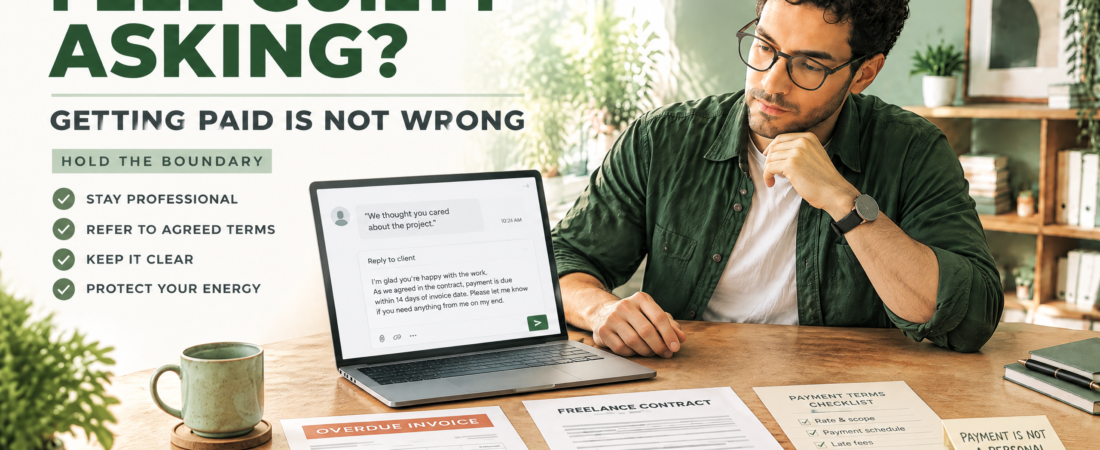
There is an uncomfortable truth many freelancers learn only after losing money: empathy and payment discipline are not the same thing.
You can understand why a client is struggling financially without agreeing to finance their business.
A client might tell you their funding was delayed, a major customer has not paid them, a co-founder left, or a personal emergency has disrupted their plans. Those circumstances may be completely genuine.
But a genuine problem on the client’s side does not automatically change the payment terms you agreed to.
That is the boundary this guide is about.
I have seen freelancers hesitate to pursue money they had already earned because they were afraid of appearing difficult, greedy, or disloyal. The result is often the same: the freelancer carries the financial risk while the client keeps receiving the benefit of the work.
The goal is not to become cold.
The goal is to separate human sympathy from business decisions.
If a client says, “I thought you believed in what we were building,” the right response is not to argue about their character. Bring the conversation back to the agreement, the invoice, the work delivered, and the next payment date.
That is the Emotional Detachment Playbook.
Table of Contents
Case Study: The “We Are Family” Trap
Hypothetical example: Sarah is a freelance brand designer who completes a project for a startup founder named Steve.
Throughout the project, Steve is enthusiastic. He tells Sarah that she is “part of the family” and that her work is crucial to the company’s future.
Sarah completes the agreed deliverables and sends a final invoice for $4,500.
Instead of disputing the work or the invoice, Steve sends her a message:
“Our seed funding got delayed. I’m taking a personal loan to keep the company alive. Can you give me a few months? I thought you believed in what we were building here.”
There are two separate issues here.
Steve may genuinely be experiencing a cash-flow problem.
At the same time, Sarah still needs to decide what she is willing to do with an overdue business receivable.
Those facts can coexist.
Sarah does not need to prove that Steve is manipulating her. She only needs to establish what was agreed, whether the invoice is due, whether there is a legitimate dispute, and what she will do if payment is not made.
If you need to turn communications into an organized record, start with [how to turn an email trail into a legally defensible invoice statement].
The important distinction is this:
Empathy can affect your tone. It does not automatically rewrite your contract.
1. Recognize the Difference Between Empathy and Financial Pressure

A client saying:
“We’re having a difficult month.”
is not automatically manipulation.
A client saying:
“If you cared about us, you would stop asking for your money.”
is different.
The second statement attempts to move the discussion away from the actual commercial question.
You do not need to diagnose the client’s psychology. You simply need to redirect the conversation.
Try this mental rule:
Their circumstances explain the delay. They do not necessarily excuse the delay.
A freelancer who accepts every emotional explanation as a reason to keep working without payment is effectively extending credit without deciding to do so.
That is especially dangerous when the client is already using your work.
If a client has [ghosted your final invoice after agreeing through Slack], the communication channel itself does not automatically determine whether you have an enforceable claim. What matters is what the communications establish, the surrounding facts, and the law governing the agreement.
Similarly, if the client offers only a token payment, do not automatically assume that accepting it helps or hurts your legal position. The consequences can vary by jurisdiction and by the wording of the agreement. Before accepting a partial payment as a settlement, understand [the partial payment trap and the legal issues that can arise].
Common guilt-based statements
You may hear:
- “We’re a small business. You have to understand.”
- “I’m paying this out of my own pocket.”
- “Our investor hasn’t released the money yet.”
- “I thought you believed in the company.”
- “If you force this now, you’ll put us out of business.”
- “We’re all struggling together.”
- “Can’t you just wait until our customer pays?”
The correct response is not necessarily confrontation.
It is clarity.
2. Separate Your Fee From the Client’s Internal Cash-Flow Problem
Your client may have a genuine cash-flow crisis.
That does not automatically make you responsible for financing it.
You are a service provider, not necessarily an investor, lender, or shareholder.
Before agreeing to new terms, ask four questions:
- Was the work completed according to the agreement?
- Is the invoice actually due?
- Has the client identified a genuine dispute about the amount or quality of the work?
- If there is no substantive dispute, am I voluntarily agreeing to extend credit?
That last question matters.
If you choose to give a client another 30 days because you value the relationship, that is a business decision.
It is very different from allowing the client to create an indefinite delay through emotional pressure.
If you work on retainer, build systems that make payment boundaries less personal. For example, [the retainer exhaustion warning system] can help you notify clients before a balance reaches zero.
If the client is already overdue, review whether your agreement permits suspension of services. [The notice of suspension of services guide] explains why suspension should be based on your contractual rights rather than an emotional reaction.
And if the client keeps requesting additional work while an existing invoice remains unpaid, review [how to prevent scope creep from eating your profits].
The objective is simple:
Do not allow sympathy to silently turn into unlimited unpaid credit.
3. Stop Treating a Payment Request Like an Apology
One of the easiest mistakes freelancers make is beginning every collection message with:
“I’m really sorry to bother you…”
You are not necessarily bothering the client.
If an invoice is due, you are discussing a business obligation.
That does not mean you should be rude.
It means your communication should contain facts rather than emotional pleading.
Instead of:
“I’m sorry to keep following up. I know things are difficult. Whenever you get a chance, could you possibly…”
Use:
“Invoice #104 for $4,500 was due on September 1 and remains outstanding. Please confirm the payment date.”
That is not aggressive.
It is precise.
If you need a structured sequence, use [unpaid invoice follow-up email templates from Day 1 through Day 30].
And if the client disappears completely, [the recovery timeline for a client who ghosted after receiving an invoice] gives you a more disciplined escalation framework.
4. Build an Evidence File Before You Escalate
Before sending a strong payment demand, collect the documents that establish what happened.
Your evidence checklist
1. The agreement
Keep the signed contract, proposal, statement of work, purchase order, or relevant communications.
If you never signed a formal contract, do not automatically assume that means you have no claim. The circumstances and applicable law matter. See [whether you can sue a client without a contract in 2026].
2. The scope
Preserve the agreed deliverables, milestones, deadlines, revisions, and pricing.
If the client changed the project after work began, document those changes. [The guide to charging for scope creep without losing the client] explains why scope changes should be recorded rather than handled informally.
3. Proof of delivery
Keep:
- delivery emails;
- file-transfer records;
- timestamps;
- client approvals;
- project-management records;
- repository activity;
- messages acknowledging receipt.
4. The invoice
Keep the original invoice and any revised invoices.
If a corporate client claims that accounting “lost” it, do not simply resend it indefinitely. Document the pattern and review [what to do when a corporate client claims your invoice was lost for the third time].
You can also use [the guide to getting paid by corporate accounts payable] when the problem appears to be an AP-process issue rather than a genuine dispute.
5. The client’s payment-related communications
Save messages in which the client acknowledges the invoice, promises payment, requests additional time, or disputes the amount.
Do not edit screenshots.
Preserve the original messages and their surrounding context.
5. The Contract Controls More Than the Client’s Emotional Story
Suppose the client says:
“I thought we were partners.”
Your answer does not need to be:
“We’re not partners.”
Your answer can simply return to the agreement.
For example:
“I value the relationship and understand that the business is experiencing cash-flow pressure. The outstanding invoice remains payable under our agreed terms. Please confirm whether payment will be made by [date].”
That response acknowledges the human issue without converting it into a concession.
The same principle applies when a client suddenly asks for a new condition before paying.
For example, if a client retrospectively demands an NDA that was never part of the original agreement, review [how to handle an uncontracted NDA demand before an invoice is cleared].
Likewise, if the client suddenly claims the invoice was lost inside accounting, distinguish a genuine administrative problem from an indefinite delay.
6. The Sterile Response: A Better Way to Answer a Guilt Trip
When a guilt-trip message arrives, do not write a five-paragraph emotional defense.
Use what I call The Sterile Response.
It is:
- polite;
- factual;
- short;
- specific;
- non-accusatory;
- tied to the agreement.
You do not need to prove that the client is a bad person.
You only need to communicate what is due and what happens next.
Example: Client Says Funding Is Delayed
Hi [Client Name],
I understand that the business is currently dealing with a funding delay.
Invoice #[000] for [amount] remains outstanding and was due on [date].
I am unable to extend the agreed payment terms indefinitely, so please confirm whether the invoice will be paid by [date].
If you need to propose revised payment terms, please send the proposed dates and amounts in writing so I can review them.
Best,
[Your Name]
Notice what this does not say.
It does not accuse the client of fraud.
It does not call them manipulative.
It does not threaten court immediately.
It does not apologize for invoicing.
It puts the commercial issue back on the table.
7. Use the Right Response for the Situation
If the client has a genuine temporary cash-flow problem
You can decide to offer a written payment plan.
If you do, put the new dates and amounts in writing.
Do not rely on:
“I’ll pay you soon.”
A useful payment plan identifies:
- total balance;
- installment amounts;
- dates;
- payment method;
- what happens if an installment is missed.
If the client disputes the invoice
Do not respond with:
“You’re just trying to avoid paying.”
Ask for the specific dispute.
For example:
“Please identify the invoice items or deliverables you dispute, together with the basis for the dispute, so I can review them.”
That creates a record.
If the client simply refuses to pay
Move from persuasion to escalation.
Review [how to recover an unpaid invoice yourself without immediately hiring a lawyer].
If the client has already used the work
Document the use before taking any further action. Depending on the type of work and governing law, separate contractual and intellectual-property issues may arise.
For example, freelancers dealing with unauthorized use can review [what to do when a client uses your work but refuses to pay].
For design work, see [the legal guide for a client who used your design without paying].
For written content, see [what to do when a client publishes your article without paying].
For video work, see [how to respond when a client uses your video without paying].
8. HTML Tool: The Emotionless Response Generator
Use the following general-purpose tool to create a concise response.
Sterile Response Generator
Generate an emotionless, legally firm response to client guilt trips in seconds.
This tool is a communication aid, not legal advice. The appropriate response can depend on your contract, the nature of the dispute, and the law governing the relationship.
9. Do Not Confuse a Payment Dispute With a Copyright Dispute
This is one area where freelancers need particular caution.
It is tempting to think:
“They haven’t paid me, so the copyright is automatically still mine.”
That is not a universal rule.
Copyright ownership can depend on the contract, an assignment, a work-made-for-hire arrangement, applicable law, and the type of work involved.
For example, the U.S. Copyright Office explains that copyright initially vests in the author subject to exceptions such as works made for hire, while copyright ownership can also be transferred by agreement. A transfer of copyright ownership under U.S. law generally has specific writing requirements.
The practical lesson is simple:
Do not assume non-payment automatically gives you a right to revoke every use of delivered work. Read the agreement first.
If your contract expressly makes an assignment, license, or other rights transfer conditional on payment, that provision may be important. If the contract says something different, the analysis changes.
For additional examples involving digital work, see:
- [client used your website code without paying];
- [client put your code on AWS and still hasn’t paid];
- [how to handle unauthorized use of your video script];
- [how to revoke Figma access after non-payment];
- [what to do when a client asks for PSD or AI files before payment].
10. Do Not Shut Down Servers, Delete Files, or Revoke Access Just Because You Are Angry
This deserves its own warning.
Non-payment does not automatically give a freelancer permission to:
- delete a client’s data;
- shut down production servers;
- destroy files;
- remove a live website;
- revoke access to critical business systems;
- interfere with a client’s accounts.
Your contractual rights and the applicable law matter.
If your agreement gives you a suspension right, follow the agreed process.
Before taking technical action, review [whether you can shut down a client’s server for non-payment] and, where relevant, [how to legally pause access to an unpaid Shopify project].
The safer principle is:
Use contractual remedies deliberately. Do not turn an unpaid invoice into a separate technical or business-interference dispute.
11. A Practical Escalation Timeline
The following is a general example, not a universal legal timetable. Your actual timing should reflect the contract, payment terms, governing law, and any applicable notice requirements.
Day 1 overdue
Send a concise payment reminder.
If the problem is administrative, ask the client to confirm the expected payment date.
Day 7
Send a firmer written follow-up.
If applicable, review whether contractual or statutory interest can be claimed. For example, UK business-to-business transactions can be subject to statutory interest and recovery costs under the Late Payment legislation, subject to the applicable conditions.
See [how to charge late fees legally in the US, UK, and India].
Day 14
If the client responds with a guilt trip, use the Sterile Response.
Do not debate whether the client is a good or bad person.
Return to:
invoice + due date + amount + proposed payment date.
Day 21
If there is still no payment or meaningful resolution, consider a formal demand.
You can use [the final notice before legal action copy-and-paste framework] as a starting point, but adapt it to the governing law and facts.
Day 30 and beyond
Consider the appropriate escalation route:
- contractual suspension;
- negotiated payment plan;
- formal demand;
- mediation;
- collection services;
- court or tribunal proceedings;
- other remedies available under the governing law.
If you are unsure when escalation becomes proportionate, read [when it is officially time for a freelancer to take legal action].
And if you are considering outsourcing recovery, compare the costs and risks in [whether you should hire a debt collection agency].
12. What If the Client Says, “I’ll Pay You When My Client Pays Me”?
Do not immediately agree.
First, check the contract.
A contract may contain a payment condition, pay-when-paid clause, pay-if-paid provision, milestone condition, acceptance requirement, or other mechanism affecting when payment becomes due.
The legal effect of these clauses varies by jurisdiction and wording.
Therefore, the safe response is:
“Please point me to the contractual provision you are relying on and confirm the payment date you propose.”
If the contract does not contain such a provision, the client’s own receivables may not automatically determine when your invoice is due.
Do not guess.
Read the agreement.
13. U.S. vs. UK: Why Jurisdiction Matters
The emotional problem may look identical in every country:
“We’re struggling. Please wait.”
The legal consequences are not identical.
United States
There is no single nationwide freelancer-payment rule that applies identically to every independent contractor relationship.
Some states and cities have enacted specific protections.
For example, New York City’s Freelance Isn’t Free Act provides covered freelance workers with rights concerning written contracts and timely payment. The city’s official materials state that where the contract specifies a payment date, payment is due on that date; where no payment date is specified, payment is generally due within 30 days after completion of the work under the contract.
That does not mean every U.S. freelancer everywhere automatically has a 30-day statutory payment rule.
Your location, the client’s location, the applicable statute, the contract, and the type of relationship can all matter.
United Kingdom
For qualifying business-to-business transactions, GOV.UK explains that statutory interest and debt-recovery costs may be available when another business pays late.
If a payment date was not agreed, the government’s guidance generally treats the payment as late 30 days after the customer receives the invoice or the goods/services are supplied, whichever is later.
The Late Payment legislation can also provide statutory interest and fixed recovery costs, subject to its scope and conditions.
Cross-border work
International disputes create additional questions:
- Which law governs the contract?
- Where can proceedings be brought?
- Is there an arbitration clause?
- How will a judgment be enforced?
- Is the client a company or individual?
- Are there mandatory local payment rules?
- Are there currency or tax complications?
That is why freelancers working internationally should review [how to protect yourself when working with international clients].
Never assume that a payment rule from one country automatically applies to another.
14. Quick Decision Section: What Should You Do Right Now?
If you are reading this immediately after receiving a guilt-trip message, do this:
1. Do not answer while emotionally activated
You do not need to respond in five minutes.
Read the message.
Save it.
Then step away long enough to write a factual response.
2. Check the contract
Find:
- payment date;
- late-payment provisions;
- dispute procedure;
- suspension rights;
- termination provisions;
- intellectual-property provisions;
- governing-law clause.
3. Confirm whether there is actually a dispute
Ask:
“Is the client disputing the invoice, or are they asking for additional time to pay?”
Those are different problems.
4. State the facts
For example:
“Invoice #104 for $4,500 was due September 1 and remains outstanding.”
5. Ask for a specific payment date
Do not accept:
“Soon.”
Ask for:
“Please confirm the date on which payment will be made.”
6. Document any new arrangement
If you agree to installments, put the dates and amounts in writing.
7. Escalate proportionately
If the client refuses to pay, move to the next contractual or legal step rather than repeating the same emotional conversation.
15. Five Mistakes to Avoid When a Client Guilt-Trips You
Mistake 1: Giving an indefinite extension
“Take your time” can become three months.
If you voluntarily extend payment, establish a date.
Mistake 2: Discounting because you feel guilty
A discount may be appropriate as a negotiated settlement in some situations.
But do not automatically cut your invoice simply because the client made you uncomfortable.
If you do negotiate, document exactly what the reduced payment settles.
Mistake 3: Continuing to work during an unresolved non-payment
If your contract permits suspension, consider whether continuing work increases your exposure.
See [how to use a suspension notice without unnecessarily destroying the client relationship].
Mistake 4: Threatening legal action you are not prepared to take
Do not write:
“Pay today or I will sue you tomorrow.”
unless you genuinely understand the next step.
A measured demand is usually more credible.
Mistake 5: Taking technical revenge
Do not delete files, destroy data, or shut down systems simply because the invoice is unpaid.
Protect your legal position.
Do not create a second dispute.
16. Frequently Asked Questions
1. Is it rude to demand payment if the client is genuinely going through a personal tragedy?
No. You can be compassionate without agreeing to indefinite payment delays.
You might write:
“I’m sorry to hear about the situation. I still need to keep the outstanding invoice on its agreed payment schedule. If you need revised terms, please send me a proposed payment plan.”
Your tone can be humane while your business boundary remains clear.
2. What if the client threatens to damage my reputation because I won’t give them more time?
Document the communication.
Do not respond with threats of your own.
Keep the discussion focused on the invoice and the contract. If the threats become legally significant, obtain advice in the relevant jurisdiction rather than attempting to label the conduct yourself.
3. Can I automatically take back my work because the client has not paid?
Not necessarily.
Do not assume that non-payment automatically cancels a client’s existing rights or gives you an unrestricted right to remove delivered work.
Review the contract’s intellectual-property and licensing provisions first.
For U.S. copyright questions, the Copyright Office explains that ownership and transfers depend on the applicable copyright rules and agreements. The same principle applies to cross-border work: the governing law matters.
4. Should I offer a 50% discount just to make the problem disappear?
Not automatically.
A discount can be a legitimate settlement strategy when you consciously choose to trade some of the receivable for speed, certainty, or closure.
But do not discount merely because the client made you feel guilty.
If you settle for less, document whether the payment is intended to resolve the entire disputed balance.
5. They said they will pay me “when their client pays them.” Is that automatically legal?
No simple worldwide answer exists.
Check the contract for payment conditions and any pay-when-paid or pay-if-paid language. The effect and enforceability of those provisions vary by jurisdiction.
If the clause is unclear or the amount is substantial, obtain advice under the law governing the contract.
The Bottom Line
A client’s financial difficulty may be real.
Their personal emergency may be real.
Their business may genuinely be struggling.
You can acknowledge all of that without making yourself responsible for financing the problem.
The healthiest boundary is:
“I understand your situation. I still need to manage my business according to our agreement.”
That sentence is the heart of the entire strategy.
You do not need to call the client manipulative.
You do not need to become aggressive.
You do not need to threaten court in the first email.
You need to separate:
their story
from
your invoice.
Then work through the evidence, the contract, the payment terms, and the available remedies in a disciplined sequence.
If the client eventually pays, the relationship may survive.
If they do not, your documentation will be much stronger because you kept the communication factual from the beginning.
And if you need the broader recovery framework, start with [the Freelancer’s Legal Guide to Recovering Unpaid Invoices].
Author
Adv. Sagar Haribhau Shirsat is an Indian advocate writing about freelance contracts, unpaid invoices, payment disputes, and practical recovery strategy for freelancers, independent contractors, and small businesses.
Professional profile: Official LinkedIn profile.
Disclaimer: This article is for general educational and informational purposes. It is not a substitute for legal advice about a particular dispute. Contract rights, payment laws, intellectual-property rights, limitation periods, collection procedures, and available remedies vary by jurisdiction and by the facts of the relationship. Cross-border disputes can involve additional jurisdiction, governing-law, enforcement, tax, and regulatory issues. Before taking legal action or exercising contractual or intellectual-property remedies, review the governing agreement and obtain advice from a qualified lawyer in the relevant jurisdiction where appropriate.
Last updated: September 13, 2026