Table of Contents
The 2 AM Reality Check : Your Work is Stolen Property (For Now)
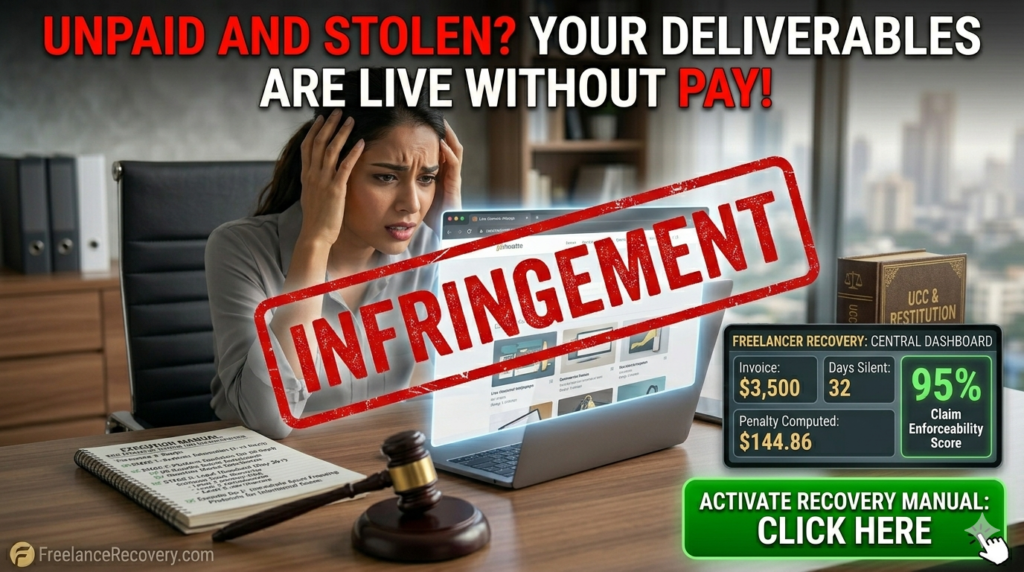
Take a deep breath. Drop your shoulders away from your ears. If you are sitting up at 2 AM looking at a live website, a published ad campaign, or a social media page featuring your graphic designs, written copy, or code—while your final invoice sits ignored in an inbox—you are probably furious, panicked, and feeling completely powerless.
Let’s clear up a massive lie right now: They do not own your work yet. Many young designers, developers, and writers think that once a client has the source files, the game is over and you are at their mercy. Legally, that is completely wrong. Think of your work like a house. Just because you handed them the keys to look inside doesn’t mean they own the deed.
Unless you signed a contract that explicitly states otherwise, the legal transfer of your intellectual property (IP) is strictly dependent on you getting paid. Until that transaction hits your bank account, they do not hold a license to use your work. They aren’t just a “late client”; they are actively engaging in copyright infringement.
This guide is an engineering manual to solve exactly this problem: client used my work without paying: what to do (step-by-step). We will skip the dry legal jargon and provide you with a step-by-step roadmap that you can begin executing tonight.
The Blueprint : What is Happening, Why, and the Power Shift
To beat them at this game, you have to look behind their corporate curtain. Let’s look at the situation through the four core pillars of recovery:
What is Happening ?
The client has taken your digital files, built them into their commercial infrastructure, and is actively using them to make money or generate business leads. At the exact same time, they have stopped answering your emails, are avoiding your payment messages, or have quietly removed you from their Slack workspace.
Why is it Happening ?
In my legal practice, I see this all the time. It rarely happens because they forgot. It happens because of basic human psychology and broken business cash flows:
- The Emergency Has Passed: Before you delivered the work, they had a major problem. They needed that asset. Now that they have it, the emergency is solved. The pressure to pay drops to zero because they already have what they want.
- The Agency Float: We have observed that agencies delay payments far more than direct clients. They often use your unpaid work to satisfy their own client, collect that client’s money, and then use your funds to pay down their older company debts. They are essentially using your invoice as an interest-free loan.
What Should You Do ?
You must shift the dynamic immediately. Right now, they have all the benefits (your work) and none of the risks (retaining their cash). You need to flip that equation so that continuing to use your unpaid work becomes a massive, public risk to their business.
Stop asking for the money. Start threatening the license to use the asset. If they don’t pay, they lose the right to use the work. If they keep using it, it becomes a federal legal issue. This realization is where you regain control.
The Evidence Stack : Locking Down Proof Before They Hide It
If you send an angry message right now without preparation, a sketchy client will simply block you, download your work, move it to a different hidden link, and pretend they never used it. Before you say another word to them, you must build your Evidence Stack.
This is your unshakeable paper trail. Think of it like a ladder of evidence. If you eventually have to go to court, this documentation is exactly what a judge will look at.
Tier 1 : Digital Proof of Infringement (The “Caught in the Act” Layer)
Do not just take a basic screenshot using your phone. You need high-fidelity, timestamped, full-screen captures.
- Capture the work actively running on their live web domain or social channels.
- Include the full browser URL bar and your operating system’s system clock in the screenshot.
- Use a public archiving tool like the Wayback Machine on Archive.org to create a permanent, public record of their web pages before they have a chance to take them down.
Tier 2 : The Metadata and Creation Trail
Locate your original creative design files on your hard drive (e.g., .PSD, .FIG, .RAW, or local Git log history). These files contain hidden creation metadata that proves you built this work days or weeks before it appeared on their live systems.
Tier 3 : Written Acknowledgments of the Debt
Compile every piece of communication where they confirmed they received the work and approved it. Look for phrases like “Looks great!”, “Received, thank you!”, or “We are launching this tomorrow.” > 💡 Note: Even casual app chat screenshots matter here. If you didn’t have a formal contract, check our breakdown on is a WhatsApp conversation a legally binding contract to see how those text logs protect your case.
The 3-Stage Payment Leverage Model : The Escalation Ladder
Do not jump straight to screaming about lawyers, and do not send weak emails begging for payment. You need to use a structured 3-Stage Payment Leverage Model. This is an intentional escalation sequence that gives them a chance to pay up before things get serious.
| Escalation Phase | Exact Timeline | Strategic Action | Expected Result |
|---|---|---|---|
| Stage 1: Friendly Audit | Days 1–5 after theft discovery | Polite administrative check. Link their usage right directly to payment. | 40% settle out of simple embarrassment. |
| Stage 2: Digital Take-Down | Days 6–10 after theft discovery | Bypass client. File DMCA copyright notices directly with their host. | In most cases, clients respond within 48 hours after Stage 2 escalation. |
| Stage 3: Formal Demand | Day 11+ onwards | Issue a formal, signed PDF Cease & Desist via physical Certified Mail. | High response rate due to sudden fear of court action. |
Stage 1 : The Administrative Asset Check (Days 1 to 5)
Assume this is just a communication breakdown between their creative team and their accounting department. Keep things calm but clear.
- The Communication Script : Subject : Internal Audit Notice: Invoice [Invoice_Number] / Unlicensed Digital DeploymentDear [Client_First_Name],I noticed that the design deliverables from our recent project milestone have been launched live on your platform at [Insert URL].While I’m glad to see the work in production, our records show that Invoice [Invoice_Number] ($[Amount]) is currently past due. Please keep in mind that our agreement structures the transfer of creative property rights to complete only after full payment is received. Currently, the deployment of these files is running without an active usage license.I’ve attached our payment link below. Please drop over a quick copy of your bank transaction receipt so we can update your asset license file immediately.
Administrative Asset Notice Customizer
Instantly customize and compile your Stage 1 license clarification notice as plain text or an official PDF record.
Stage 2 : The Hosting Provider Take-Down (Days 6 to 10)
If they ignore Stage 1, stop talking to them. It is time to bypass their inbox completely and cut off their access.
- The Back-End Strategy: If your project involved building custom code configurations, read our strategy guide on recovering balances when a client ghosts you on Slack. If they are displaying your creative assets on a live website, run their domain link through an open tech tracker like DigitalElement or WhoIs Hosting This to find out who runs their hosting servers (e.g., Shopify, AWS, WP Engine, Cloudflare).
- The DMCA Leverage: Go directly to that web host’s support portal and look for their “Copyright Infringement” or “DMCA Notice” submission form. Provide your Evidence Stack to show that they are hosting your unpaid creative property without a license. Because federal law holds web hosts liable if they ignore clear, reported copyright violations, their web engineering teams will often suspend or shut down the client’s live pages within 24 to 48 hours.
Stage 3 : The Formal Pre-Litigation Apex (Day 11+)
This is your final non-court move. You are going to issue a formal legal demand letter.
This should not look like a regular text email. It needs to be formatted as an official PDF document, sent directly as an email attachment, and backed up by a physical copy sent via USPS Certified Mail with Return Receipt Requested to their registered business address. This shows them you are ready to escalate the matter further if needed.
The Infringement Valuation Calculator
When a client uses your work without paying, you are often entitled to add commercial late fees, interest, and licensing adjustments to the total debt. Use this interactive calculator tool to find out exactly what your updated claim amount looks like before drafting your formal demand letters.
IP Restitution Valuation System
🛡️ Jurisdiction Dependent & Use Responsibly Note: This tool calculates numbers using common statutory interest formulas (like 10-12% annual business default rules). Always verify your state’s local interest rules or the terms in your original contract to ensure everything aligns perfectly before sending out your updated bill.
The Custom Scenario Matrix : Client Busy vs. Broken vs. Bad-Faith
Every dispute is unique. You shouldn’t handle a genuinely disorganized corporate partner the same way you handle an intentional internet scammer. Choose the path below that matches your current situation:
Scenario X : The Client is Genuinely “Too Busy”
- The Trait: They answer your messages every four days with short phrases like “Super busy, will check with accounting tomorrow !” while your designs are already live on their social media pages.
- The Move: Do not go full scorched-earth quite yet. Bypass the project manager who is holding up the line. Find their CFO, Accounting Manager, or Director on LinkedIn. Send over a polite, formal Statement of Account directly to them. When accounting sees that a live asset doesn’t have an active license, they will usually fast-track the payment processing immediately to avoid corporate risk.
Scenario Y : The Client Has “Cash Flow Issues”
- The Trait: They pick up the phone, apologize, and tell you they are waiting on their own client’s payouts before they can clear your bill.
- The Move: If they are acting in good faith, offer them a structured installment plan to get things moving. However, protect your business with a clear Acceleration Clause sent via email confirmation:“If any scheduled installment payment is missed or delayed by more than forty-eight (48) hours, the entire remaining invoice balance will immediately become due and payable in full.”
Scenario Z : The Intentional Scammer
- The Trait: They blocked your phone number, cut off your access to their Slack channel, and are actively running your custom application code or creative copy on their commercial store.
- The Move: Skip the polite reminders entirely. Proceed immediately to Stage 2 (DMCA Web Host Take-Down) and download your custom letter from our automated generator below to file a formal, physical demand notice.
The Final Notice Asset : The PDF Cease & Desist Generator
If you have reached Stage 3, you need to deliver an explicit, formal demand notice. Use this generator to create a professional Notice of Intellectual Property Infringement & Demand for Restitution.
Pre-Litigation Demand Letter Builder
Compile and generate an official, formal legal demand letter to enforce your intellectual property rights.
Live Document Preview Sandbox
International Realities & Cross-Border Traps
If you are a freelancer based in India, Eastern Europe, or Latin America, and your client is located in the United States, chasing them can feel daunting. Let’s look at how cross-border collections work in reality:
What Fails :
Threatening to sue an American LLC from thousands of miles away in a local hometown civil court rarely works. They know you probably won’t fly out to file an expensive international cross-border lawsuit over a $2,000 balance.
What Works :
Lean heavily into digital infrastructure rules rather than physical court systems.
- The DMCA Strategy : The Digital Millennium Copyright Act is a US federal law, but its protections cover digital content worldwide. If an international developer’s unpaid code is hosted on an American server infrastructure (like AWS or GitHub), the host must honor a valid copyright take-down notice regardless of where the developer is located.
- Subcontractor Protections : If your direct client was an intermediary agency that hired you to build assets for an American corporation, you have additional leverage options. Check our framework on how a subcontractor can sue an end-client directly to understand how to bypass the middleman and go straight to the company using the work.
When This Strategy Fails : The Exact Next Step After Failure
What if you completed all three stages, filed your DMCA notices, sent the Certified Mail letter, and the client still refuses to pay or has corporate insolvency issues? This is the point where you stop sending messages and shift to your final two backup recovery plans:
Path Alpha : File a Case in Small Claims Court Yourself
If the client is located in the United States and your unpaid balance is under their local state’s small claims cap (which usually ranges from $3,000 to $10,000), you can file a civil claim yourself without hiring an expensive lawyer.
For a complete breakdown of this process, read our comprehensive guide on the freelancers legal guide to recovering unpaid invoices without expensive lawsuits.
You can present your organized Evidence Stack directly to the local court clerk. If the client fails to show up, the judge will issue a default judgment in your favor. You can then work with a local collections agent or sheriff’s office to garnish their business checking accounts or place a lien on their assets.
Path Beta : Turn the Account Over to a Contingency Collection Agency
If you don’t want to deal with court dates or paperwork, you can pass the account to a commercial debt collection agency.
Most reputable business collections firms operate entirely on a contingency fee model. This means you do not pay anything upfront. They only take a percentage fee (typically 20% to 33% of the collected amount) once they successfully recover your money. It is far better for your business cash flow to recover 70% of an unpaid project milestone with help than to hold on to 100% of an uncollected invoice you cannot recover on your own.
Highly Relatable Frequently Asked Questions
What if I never signed a formal, written contract before starting the project ?
You still have clear legal protections. A formal contract document is ideal, but things like email threads, Slack project logs, and text conversations can establish an implied agreement under the law. If these messages show a clear request for work and an agreement on price, the client cannot use your deliverables while refusing to pay. Check out our guide on the freelancers legal guide to recovering unpaid invoices without expensive lawsuits to learn how to build a case using casual messages.
Can a client claim ownership of my work by saying it was a “Work For Hire” ?
No, not automatically. Under US copyright law, a project only qualifies as a “Work Made For Hire” if there is an explicit, written agreement signed by both parties stating that terms apply. If you haven’t signed a document with that specific clause, you retain the initial copyright ownership of the deliverables until your final invoice is settled.
Should I add a “kill switch” to my code to stop a client from using it if they don’t pay ?
Be very careful here. While removing your files from a server you rightfully own is generally fine, inserting hidden code to intentionally damage or break a client’s broader internal systems can expose you to civil liability. Instead of using a hidden technical trick, lean on standard legal methods: file a formal DMCA take-down notice with their web hosting provider to let the platform handle the suspension safely.
Author Biography
Adv. Sagar Haribhau Shirsat is an experienced legal professional specializing in transactional law, intellectual property enforcement, and commercial contract structures. He focuses on building practical collection and digital asset protection strategies that help independent freelancers and creative studios enforce their billing terms and secure outstanding payments effectively.
- Connect directly via his Official Professional LinkedIn Profile.
Disclaimer: This guide is intended for educational purposes and risk analysis. It does not establish a formal attorney-client relationship. For specific state-level concerns or complex contract disputes, always consult with a certified local legal professional.