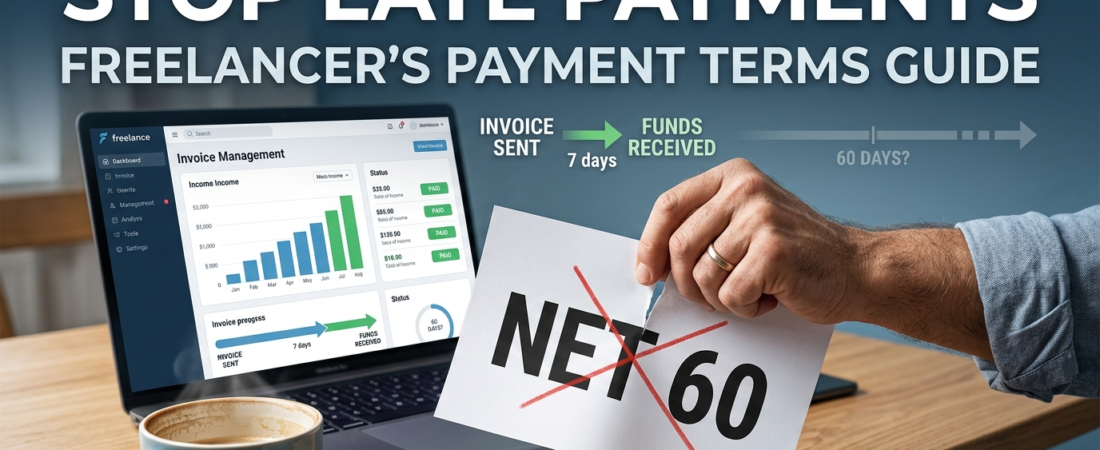
You delivered the final assets three weeks ago. The client launched the campaign, the team celebrated, and everyone is thrilled. Except you.
You’re sitting here checking your bank app at 7 AM, wondering why your invoice is still marked “pending.” You start second-guessing yourself. Should you email them again? Will you sound desperate? If invoices are ignored after delivery, the problem isn’t just a bad client—it’s a broken system. Learning how to master this Freelancer Payment Terms Guide starts long before a PDF is generated.
I used to let clients walk all over me. I once waited 75 days for a $4,000 payment while watching the client’s founder post vacation photos on Instagram. I was eating instant noodles, sending follow-up emails that started with “Hope you’re having a great week!”
Never again.
Table of Contents
THE BEHIND-THE-SCENES REALITY
Look, clients don’t wake up plotting how to steal your money.
The ugly truth ? They are just wildly disorganized.
When you hit “send” on an invoice, it doesn’t go to a magical vault where a finance director instantly wires money to your account. It goes to a project manager. That manager has 147 unread emails. If they actually see your email, they have to forward it to the Accounts Payable (AP) department.
AP departments run on rigid, soulless schedules. They process payments on the 15th and 30th of the month. If your invoice lacks a specific project code, or the line items don’t exactly match the initial quote, AP flags it. They email your manager. Your manager is in back-to-back Zoom meetings and ignores the email for three days.
Your payment gets pushed to the next cycle.
Cash flow juggling is a reality for every business. When cash gets tight, companies look at their stack of bills and pay the squeaky wheels first. They pay the software vendors who will shut off their servers. They pay the agencies threatening legal action.
Your polite, passive email sitting in a cluttered inbox ? That goes to the bottom of the pile.
THE CORE FREELANCE PROTECTION SYSTEM
A. Client Vetting
You can sniff out a late payer before you ever sign a contract. It all happens during the discovery phase. You need to watch how they handle basic friction.
Micro-scenario : The client demands an immediate kickoff. They say the project is on fire and needs to start yesterday. But when you send over a basic onboarding questionnaire and a request for a deposit, they take 6 days to reply.
Run.
People who rush the work but delay the paperwork will absolutely delay your payment. They don’t respect your process. Build a wall right at the front door. Check out how to structure your onboarding deeply using resources like our templates at How to Recover Unpaid Invoice Without Lawyer (Step-by-Step Guide)
B. Contract Structure
Contracts don’t need to be 40 pages of ancient Latin. They just need to establish the rules of the game in plain English.
I see freelancers agreeing to Net 60 terms just because a client asked for it. You are a freelancer, not a commercial bank. You don’t offer zero-interest credit lines to multi-million dollar corporations.
Make your payment terms brutally clear. “Payment is due upon receipt” or Net 7. Add a late fee clause. It doesn’t have to sound like an aggressive law firm. Keep it firm: “Invoices unpaid past 14 days will incur a 5% monthly late fee. Work on active milestones will pause until the balance is cleared.”
C. Invoice System Design
This is what 90% of freelancers do completely wrong. You make it hard for the client to give you money.
Micro-scenario: You send a bill with a single line item that just says “Design Work – $2,000”. The client’s accounting team shelves it for two weeks because they don’t know which department budget it hits, and there is no click-to-pay link on the PDF.
Your invoice needs to be idiot-proof. Accounts Payable departments use OCR (Optical Character Recognition) software to scan your PDFs. If the software can’t read your messy layout, a human has to intervene. Humans are slow.
Include the exact dates of service. Include the specific deliverable names. Add the internal contact who approved the work. Put a giant, impossible-to-miss button right in the middle of the page that lets them pay by credit card or direct bank transfer.
D. Frictionless Automation
You should never manually type out a follow-up email again. It drains your energy and makes you feel like a debt collector.
Set up polite but relentless automated reminders in your invoicing software. When the machine sends the email, it removes the personal emotion. It makes ignoring you highly uncomfortable for the client because the machine doesn’t stop.
Below is an interactive email generator you can use to build your escalation notices right now.
STEP-BY-STEP EXECUTION TIMELINE
You need a systematic approach that removes your anxiety from the equation.
Phase 1 : Pre-kickoff
Day -5 : Send the proposal and contract together. Don’t separate them.
Day -2 : Collect the deposit. Never, under any circumstances, begin work until the deposit is in your bank account. A screenshot of a wire transfer doesn’t count. A promise from their manager doesn’t count.
Phase 2 : Mid-project milestones
Day 15 (or 50% completion) : Send the midway invoice. If they don’t pay it within 48 hours, you stop working. You don’t ask for permission. You just say, “I’ll resume the project as soon as the milestone payment clears.”
Phase 3 : Post-delivery follow-ups
Day 0 : Send the final invoice the exact minute the final files are delivered. Tie the emotional high of the delivery to the invoice. Do not wait until Friday.
Day 7 : The first automated reminder hits. “Just floating this to the top of your inbox.”
Day 14 : The firm automated reminder. “This invoice is now one week past due. Please advise on payment status.”
Day 30 : You step in manually. You apply the late fee, send the updated invoice, and CC their accounting department.
Ask for Referral
UTILITY TOOL INTEGRATION (THE COST-OF-DELAY CALCULATOR)
Every day your client holds your money, you are actively losing cash.
Inflation eats your purchasing power. You lose the interest you could have made if that money was sitting in a high-yield savings account or reinvested into your business. Most importantly, you lose hours of unbillable time stressing and chasing down the payment.
Here is the raw math behind your Late Payment Burden:
LPB = ( Invoice Amount × Annual Inflation/Interest Rate ) ÷ 365 × Days Late + ( Hours Spent Chasing × Hourly Rate )
Use the tool below to see exactly how much a client’s “accounting delay” is costing you right now.
Cost of Delay Calculator
Discover your true Late Payment Burden (LPB)
Your Total Late Payment Burden is:
$0.00
$0.00
$0.00
Disclaimer : This tool is intended for educational purposes and risk management analysis. It does not replace formal legal counsel. For specific cross-jurisdictional contract disputes, always consult a certified attorney or local legal advocate.
REAL-WORLD COMMON CASE STUDY
Let’s look at how this plays out in the real world.
In the publishing and media space, the concept of “Payment on Publication” is a virus. Veteran freelance journalist Jai Breitnauer delivered a massive three-part case study project for a major UK national newspaper. She agreed to a fee of £1,400.
She delivered the work perfectly on deadline. The client sat on it.
When one piece of the story finally ran, she asked for her money. The commissioning editor tried to fob her off with a partial “interim payment” just to get her off their back. They ignored dozens of emails and calls.
The scenario : You deliver a high-value asset, the client uses it, and then they cite internal delays while ignoring your invoice.
She didn’t beg. She bypassed the editor entirely, went straight to the accounts department, cited specific late payment penalties and statutory interest, and noted she would pass the case to her union’s legal support. The editor sent angry texts, accusing her of threatening them.
The reality ? She got paid because she stopped treating the editor like a friend and started treating the publication like a business entity that owed a debt. You can read the full breakdown of how toxic this industry standard is at Press Gazette.
Citations needed if you wanted it LEGAL :
1. United States: E-Commerce & Payment Regulations
- Electronic Signatures in Global and National Commerce Act (E-SIGN Act of 2000) : At the federal level, the E-SIGN Act ensures that a signature, contract, or record relating to interstate or foreign commerce cannot be denied legal effect, validity, or enforceability solely because it is in electronic form (Ching, n.d.). This was a foundational shift for digital commercial transactions in the US.
- Official High-Trust Link : US GovInfo – Public Law 106-229 (E-SIGN Act PDF)
- Prompt Payment Act (PPA) : Specifically designed for federal government contracts, the Prompt Payment Act requires government agencies to pay a standard interest penalty on invoices that are not paid within a specified period after the payment is due (Renner, n.d.). This serves as a statutory incentive to ensure commercial vendors are paid on time.
- Official High-Trust Link : US Government Accountability Office (GAO) – Prompt Payment Resources (Note: PPA is codified under 31 U.S.C. Chapter 39)
2. United Kingdom : Commercial Debt Laws
- Late Payment of Commercial Debts (Interest) Act 1998 : To combat the severe cash-flow impacts of delayed payments on Small and Medium Enterprises (SMEs), this Act introduced a statutory right for businesses to charge interest on late payments for commercial debts (Wynarczyk, 2000). The legislation fundamentally shifted the leverage to creditors, allowing them to claim standard compensation and interest penalties when commercial clients delay payment beyond agreed terms.
- Official High-Trust Link: UK Parliament / GOV.UK – Impact Assessment on Late Payments
- Official High-Trust Link: UK Government (GOV.UK) – Late Commercial Payments Regulations
References
Ching, L. C. (n.d.). Electronic Signatures: A Comparison of American and European Legislation. Cited by: 9
Renner, M. J. (n.d.). Prompt Payment Act: An Interest(ing) Remedy for Government Late Payment. Cited by: 5
Wynarczyk, P. (2000). Late Payment of Commercial Debts (Interest) Act 1998: An Overview, 1994-1999. Regional Studies, 34, 87–89. https://doi.org/10.1080/00343400050005925 Cited by: 11
THE EVIDENCE TRAIL (WHAT TO SAVE)
If a payment dispute escalates, your memory means absolutely nothing. Only your paper trail matters.
You need an iron-clad archive for every project.
- Scope change confirmations : When the client asks for “just one more round of edits” on a Zoom call, you must follow up with an email stating the extra cost and get a “Yes” in writing.
- Signed agreements : Digital signatures are fully enforceable.
- Delivery logs : Keep the read receipts on your file transfer links.
- Email approvals : Save the exact email where they said “This looks perfect, approved!”
The US Electronic Signatures in Global and National Commerce Act (E-Sign Act) legally binds digital approvals just like ink. Bookmark congress.gov’s summary of the E-Sign Act so you know your digital trail represents real legal support.
CHANCES OF WINNING (THE RISK ASSESSMENT MATRIX)
Before you burn a bridge or hire legal support, you need to know if you can actually win.
| Scenario | Evidence Available | Recovery Likelihood |
| Iron-Clad | Signed contract, exact email approvals, tracked file delivery, clear invoice. | High. You will win easily. |
| Messy Middle | Verbal agreements, WhatsApp messages, vague email thread about scope. | Medium. A headache, but salvageable with pressure. |
| Ghost Town | No contract, no clear sign-off, client disputes the quality of the final work. | Low. Learn the lesson and rebuild your system. |
For a deep dive into pulling the trigger on the legal route, check our complete breakdown at Client Delaying Payment ? Use This Psychological Trick to Get Paid Fast
REGULATORY NUANCES: INDIA VS. GLOBAL REGIONS
Where you live dictates the specific hammer you can swing.
In India, the MSMED Act is a freelancer’s best friend (if registered as a micro-enterprise). It legally mandates buyers pay within 45 days. If they default, they owe compound interest at three times the RBI bank rate.
Globally, frameworks like the UK’s Late Payment of Commercial Debts Act and the US Prompt Payment Act give you the right to charge statutory interest and recovery costs. New UK legislation is actively moving to cap payment terms at 30 days for large businesses. Don’t guess your rights; know them. Dive into localized approaches at How Long Should Freelancers Wait Before Legal Action ? The Complete Execution Manual
REAL-WORLD INSIGHTFUL FAQ
Can I charge late fees on invoices ?
Yes. But you cannot invent them out of thin air on day 31. Late fees must be clearly stated in the contract your client signed before the work began. Keep them reasonable—usually 1.5% to 5% per month. If you try to slap a random 50% fee on an invoice, you will lose in small claims court.
What if a client completely ignores my invoice ?
You escalate. Stop sending passive-aggressive emails to the person you worked with. Call the company’s main phone line and ask directly for the Accounts Payable department. Send a physical, certified letter to their headquarters. Silence thrives in email inboxes; it dies when a physical letter requires a signature at the front desk.
How do I handle common payment excuses like accounting loops ?
When a client says, “It’s stuck in accounting,” you say, “I understand. Please provide the direct email and phone number for the accounting representative handling this invoice so I can supply any missing documentation they need.” Watch how fast the loop miraculously resolves itself when you threaten to talk to their finance team directly.
What if they complain about the work only after I ask for payment ?
This is a classic delay tactic. Refer back to your Evidence Trail. Reply with, “I’m surprised to hear this, as you explicitly approved the final deliverables on [Date]. As per our contract, the work is considered accepted, and the invoice remains due.”
Clear Thought :
Getting paid quickly isn’t about chasing people. It isn’t about begging for money you already earned.
It’s about establishing an iron-clad operational environment where delaying your money becomes incredibly inconvenient for the client. If they know you will automatically pause work, automatically send reminders, and automatically apply late fees, they will prioritize your invoice just to make the friction stop.
Stop acting like an employee hoping for a paycheck. Start acting like a business collecting a debt.
Author Biography
Adv. Sagar Haribhau Shirsat is an active legal professional specializing in commercial transaction architectures, cross-border corporate compliance, and digital debt recovery systems. He designs strategic asset-protection and recovery frameworks that help freelancers, independent contractors, and global agencies defend their cash flow and enforce their billing rights.
- Connect via his Official Professional LinkedIn Profile.
Disclaimer : This guide is intended for educational purposes and risk management analysis. It does not replace formal legal counsel. For specific cross-jurisdictional contract disputes, always consult a certified attorney or local legal advocate.