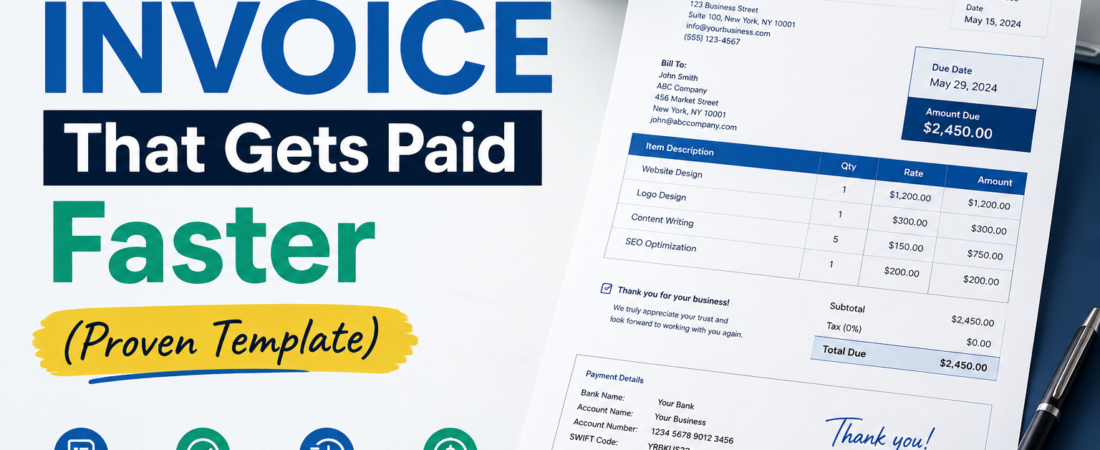
When most freelancers try to figure out how to write invoice that gets paid faster, they assume the problem is the invoice itself.
It is not.
Invoices don’t fail at the moment they are sent — they fail during client onboarding, pricing negotiation, and contract formation. By the time you generate a PDF invoice, your payment outcome is already 80% decided.
If you want to understand how to write invoice that gets paid faster, you must stop thinking like a bill sender and start thinking like a cash flow engineer.
Table of Contents
What is the fastest way to write invoice that gets paid faster?
The fastest method includes:
- Clear payment terms (Net 7 or Net 14)
- 50% upfront deposit before work starts
- Contract-backed invoice reference
- Late fee clause (1–1.5% monthly interest)
- Milestone-based billing structure
This system ensures invoices are treated as contractual obligations, not informal requests
The Client Risk Vetting Protocol
Securing your revenue begins long before you issue a document or write a line of code. It starts with an aggressive, objective client vetting process designed to uncover operational and financial red flags before signing a service agreement.
Most people trying to learn how to write invoice that gets paid faster ignore a critical truth : Clients don’t decide to pay invoices — they decide to respect your payment structure before work begins.
In corporate transactions, this is known as operational due diligence. For an independent service provider, it is your primary defense against bad actors, insolvent entities, and chronically disorganized clients.
Step-by-Step Execution : Auditing a Prospect’s Corporate Footprint
Before sending a contract, you must verify that the entity you are dealing with actually exists, is in good legal standing, and possesses the financial infrastructure to pay your fees.
- Verify Corporate Registration : Request the formal legal name of the entity, their registered corporate address, and their tax identification number (such as an EIN in the United States or a Corporate Identification Number in India). Cross-reference this information using official government registries like the SEC EDGAR system or the UK Companies House registry. If a client insists on using an unregistered trade name or refuses to provide their official corporate registration details, halt onboarding immediately.
- Examine Digital and Physical Presence : Cross-reference the executive team on LinkedIn. Match their email domains to registered corporate entities using WHOIS lookup tools to verify domain age. A company operating out of a newly registered domain with no verifiable physical address or corporate registration carries an incredibly high risk profile.
- Assess Procurement and Accounts Payable Workflows : During the initial discovery call, ask direct operational questions: “Who handles your accounts payable, what is their direct email address, and what specific documentation do they require to process payments within 7 business days?” If the prospect cannot answer this or states that “payments are handled informally by the founder,” you must adjust your contract risk parameters by requiring higher upfront milestones.
Real-Case Example : The Operational Cost of Skipping Vetting
The danger of ignoring early behavioral red flags is clearly demonstrated in major bankruptcy filings, such as the collapse of tech platform Fast. Service providers and vendors who failed to monitor credit indicators and structural instability lost millions when the company abruptly shut down operations.
Reviewing public case filings like the In re Fast Labs Inc. Chapter 7 Proceedings highlights a clear reality : companies facing cash crunches consistently exhibit erratic procurement behavior, push back on standard late-fee clauses, and demand highly compressed delivery schedules right before defaulting on their accounts payable.
The Ironclad Contract Architecture
An invoice is completely useless without a underlying contract framework to support it. To ensure your invoices are settled quickly, your master service agreement must be designed around strict payment gating mechanisms.
| Strategy | Effect on Payment Speed |
|---|---|
| 50% upfront deposit | Eliminates 80% risk |
| Net 7 terms | Forces urgency |
| Late fee clause | Creates penalty pressure |
| Milestone billing | Prevents final invoice disputes |
Crucial Contract Claues and Legal Protections
To protect your independent operation, every master services agreement must include three key provisions:
1. Late Fees and Statutory Interest Enforcement
You must explicitly define the consequences of late payments in your agreement. Specify that overdue invoices will accrue interest at an exact monthly rate compounded daily, or the maximum rate allowed by law, starting immediately after the due date.
Sample Legal Clause : "Any invoice not settled within seven (7) calendar days of issuance shall automatically accrue interest at a rate of 1.5% per month (18% per annum), calculated daily from the original due date until paid in full. Client shall additionally reimburse Consultant for all actual collection costs, including reasonable attorneys' fees, court costs, and third-party collection agency fees incurred during recovery efforts."
2. Clear Scope of Work (SOW) Boundaries and Change Orders
Scope creep is a primary cause of payment delays. If your Statement of Work contains ambiguous language like "including but not limited to general engineering support," your client can easily withhold final payment by claiming the deliverable is incomplete. Use objective, measurable terms to define completion:
[INCORRECT AMBIGUOUS SCOPE]: "Consultant will build a responsive e-commerce web application for the client."

[CORRECT STRUCTURAL SCOPE]: "Consultant will deploy a 5-page React web application containing: (1) Homepage, (2) Product Catalog with filtering, (3) Individual Product Detail View, (4) Stripe-integrated Shopping Cart, (5) Checkout Confirmation Page. Maximum iterations: 2 revision cycles within 14 calendar days of initial presentation. Any request outside these exact parameters requires a executed Change Order signed by both parties."
3. Intellectual Property (IP) Transfer Restrictions
Never transfer intellectual property rights when you sign a contract. IP transfer must serve as your primary leverage for final payment. Ensure your agreement states that all rights, titles, and interests in the work remain exclusively with you until the client settles all outstanding invoices.
Sample Legal Clause : "Subject to the terms and conditions of this Agreement, Consultant agrees to grant Client a non-exclusive, royalty-free, worldwide license to use the Deliverables. The absolute transfer of legal ownership of any Intellectual Property rights from Consultant to Client shall occur if and only when Consultant receives full, unconditioned, cleared payment of all outstanding invoices, fees, and expenses. Prior to final payment clearance, any unauthorized utilization, deployment, or public distribution of the Deliverables by Client constitutes a material breach of contract and willful infringement of copyright."
Cutting Through the Legal Clutter
Many independent contractors make the mistake of using generic, overly complex legal templates packed with confusing jargon. This unnecessary complexity can lengthen your sales cycle and confuse clients without adding any actual legal protection.
Focus your contract on clear operational definitions. Avoid confusing phrasing like "heretofore in perpetuity unless otherwise noted under section hereinabove." Instead, use clear, direct terms: "Work ceases immediately if an invoice is overdue by 7 days." Clarity is much easier to enforce in court than confusing legal double-speak.
The Milestone Operational Blueprint
To eliminate final invoice defaults, you must break down your projects into strict, progression-gated phases. This ensures you maintain positive cash velocity throughout the project lifecycle.
How to Write Invoice That Gets Paid Faster Using Milestone Systems
Never agree to payment structures where the client controls the timing of payments based on subjective criteria like "satisfaction." Instead, tie payments to clear project milestones. Here is an optimized 4-stage milestone schedule for a $20,000 engineering or creative campaign:
| Milestone Phase | Deliverable Asset / Trigger | Payment Obligation | IP Status |
| Phase 01: Onboarding | Execution of Contract & Architecture Mapping | 50% Upfront Deposit ($10,000) | Fully retained by Consultant |
| Phase 02: Initial Review | Delivery of Functional Wireframes / Prototypes | 25% Progress Milestone ($5,000) | Fully retained by Consultant |
| Phase 03: System Testing | Deployment to Isolated Private Staging Server | 15% Interim Milestone ($3,000) | Fully retained by Consultant |
| Phase 04: Public Handover | Production Launch & Source Asset Delivery | 10% Final Release ($2,000) | Transferred only upon payment clearance |
| Project Phase Target | Safe Funding Allocation | Operational Trigger Action |
|---|---|---|
| Phase 1: Upfront Security Lock | $0.00 | Retain prior to kickoff. Do not schedule discovery work. |
| Phase 2: Intermediate Progress Gating | $0.00 | Paid before opening access to private interactive staging servers. |
| Phase 3: Deep System Integration | $0.00 | Paid before executing final functional beta code deployments. |
| Phase 4: Production Handover Release | $0.00 | Paid before transferring live assets or master administrative credentials. |
The Logistics of Asset Retention
Never upload operational production code directly to a client’s live servers or send raw design assets before receiving final payment. Use staging environments to retain control of your work:
- For Software Engineers : Host beta deployments exclusively on isolated staging servers like Heroku, Vercel, or AWS instances under your control. Restrict access using authentication barriers. Only migrate code to the client's production repository once your bank clears their final milestone payment.
- For Creative Directors and Designers : Present design assets through interactive prototypes like Figma or watermarked low-resolution PDF proofs. Do not transfer Figma team ownership or provide high-resolution raw master formats (AI, PSD, Figma source files) while an invoice is pending.
The Automation of Boundary Enforcement
Removing emotion from collections is crucial for protecting your cash flow. If you manually track down late payments with polite emails, clients learn that your deadlines are flexible. Automate your billing boundaries to enforce your terms objectively.
Setting Up a Formal Notification System
Configure your billing software to automatically send payment reminders using an objective, systematic timeline. Here is a highly effective automated email sequence:
1. The Pre-Due Reminder (3 Days Before Due Date)
- Subject Line :
[Action Required] Invoice Remittance Notice: Invoice #[0000] - [Your Company Name] - Body Template :
2. The Due-Date Notice (Day of Due Date)
3. The 3-Day Overdue Warning (3 Days Past Due)
- Subject Line :
[Overdue Notice] Account Suspension Warning: Invoice #[0000] - Body Template :
Step-by-Step Execution to Solve This Pain
To help you put these concepts into practice, here is a step-by-step checklist you can use to protect your cash flow before kicking off your next client project :
Understanding how to write invoice that gets paid faster requires structural precision, not formatting software.
Phase A : Contractual Onboarding
1. Run a search on the client's business name using official government business registries to verify their legal identity.
2. Draft a clear Statement of Work (SOW) that outlines exact project requirements and defines clear, objective project milestones.
3. Make sure your contract includes explicit clauses for daily late interest fees and keeps all intellectual property rights under your control until final payment is cleared.
4. Get a digital signature on your Master Service Agreement through a secure, legally binding platform like DocuSign or Adobe Sign.
Phase B : Financial Initialization
1. Send a 50% upfront deposit invoice through your accounting platform before scheduling any work or project discovery sessions.
2. Confirm the funds have successfully cleared your bank account. Do not rely on email payment receipts or screenshots from the client.
Phase C : Milestone Governance
1. Deliver progress updates and review assets exclusively through private staging environments or watermarked proofing platforms.
2. Send progress milestone invoices as soon as you meet each predefined project trigger.
3. Automatically pause all work if a client fails to pay an interim invoice within 7 days. Do not resume work until the outstanding balance is completely paid.
Phase D : Closeout & Delivery
1. Issue your final milestone invoice while keeping your staging server locked and retaining all master design or source assets.
2. Once the final payment clears your bank account, send a formal written notice confirming the transfer of intellectual property rights and deliver the raw master files and production access.
What Evidence Works Best
If a client defaults on a payment and you need to take collection action or pursue legal remedies, having disorganized records can ruin your case. You need to collect and organize clear, objective evidence that proves your claims.
Key Evidence to Maintain for Fast Claims
Executed Contracts : A single Master Services Agreement signed through an authorized e-signature platform. This provides a clear audit trail that includes IP addresses and timestamps, proving the client accepted your terms.
Written Approvals : Email confirmations where the client explicitly signs off on specific milestones. For example : "Phase 2 looks excellent, please proceed with production engineering."
Complete Delivery Logs : Unaltered server logs, Git commit histories, and timestamped deployment records that prove you successfully delivered the work to your staging server or preview platform.
Admissibility of Digital Messaging in Commercial Claims
Many independent contractors wonder if casual conversations on platforms like WhatsApp or Slack hold up in court. If a client promises payment or approves a project change over chat, that evidence can be highly valuable—provided you preserve it correctly.
For a detailed analysis of how digital messaging is evaluated under modern commercial law, see the comprehensive breakdown in [Is a WhatsApp Conversation a Legally Binding Contract?](https://freelancerecovery.com/is-a-whatsapp-conversation-a-legally-binding-contract/).
To ensure chat logs are legally useful, do not rely on simple copy-pasted text. Export complete chat logs with raw timestamp metadata, keep full context threads intact, and follow up on critical chat agreements with a formal email confirmation.
Legal and academic citations
for both the United States and the United Kingdom regarding late payments on commercial debts.
United Kingdom (UK)
In the UK, late payments between businesses are stringently regulated by statutory framework and have been heavily studied due to their impact on small and medium enterprises (SMEs) (Paul & Boden, 2011).
Citations
- The Primary Statute : The governing framework is the Late Payment of Commercial Debts (Interest) Act 1998. This legislation grants businesses a statutory right to claim interest (currently 8% above the Bank of England base rate) plus fixed compensation for debt recovery costs.
- SME Impact : Academic research shows that despite these legislative measures, many micro and small businesses experience extreme stress and hesitate to enforce these statutory rights out of fear of damaging buyer relationships (Smith, 2022).
Reference List (APA 7)
Paul, S. Y., & Boden, R. (2011). Size matters: the late payment problem. Journal of Small Business and Enterprise Development, 18(4), 732–747. https://doi.org/10.1108/14626001111179776 Cited by: 85
Smith, A. M. (2022). An empirical study of the effects of regulatory systems on the collection of late payment of commercial debts owed to micro and small businesses in the UK (Doctoral dissertation, University of Plymouth). Cited by: 1
United States (US)
Unlike the UK, the US does not have a single, unified federal "Late Payment Act" for private commercial contracts. Instead, it relies on general contract law remedies, state-by-state statutory interest limits, and specific federal regulations for government procurement.
In-Text Citations
- Federal Government Procurement : For contracts where the US Federal Government is the buyer, late payments are strictly governed by the Prompt Payment Act (31 U.S.C. § 3901 et seq.). This law mandates that federal agencies pay interest on overdue invoices automatically.
- Private B2B Contracts & Interest Characterization : In private commercial disputes, statutory interest or penalties are heavily tied to state law. The US Supreme Court has historically litigated how late fees and extra interest charges are categorized—ruling in cases like Smiley v. Citibank that late payment fees can legally be classified as "interest" under specific national banking statutes (Mower, n.d.).
- International Variations : When US entities engage in cross-border trade, courts often look to international frameworks like Article 78 of the UN Convention for the International Sale of Goods (CISG) to determine interest obligations, because domestic state laws vary drastically on fixed statutory rates (Kizer, 1998).
Reference List (APA 7)
Kizer, K. L. (1998). Minding the gap: Determining interest rates under the U.N. Convention for the International Sale of Goods. The University of Chicago Law Review, 65(4), 1279. https://doi.org/10.2307/1600264 Cited by: 27
Mower, K. (n.d.). Smiley v. Citibank (South Dakota), N. A. : Banks find interest in credit card late payment fees. North Carolina Banking Record. Cited by: 0
💡 Key Difference: The UK has an explicit statutory framework protecting all B2B suppliers automatically with an 8% + base rate premium. The US requires interest provisions to be explicitly written into private commercial contracts; otherwise, a supplier must rely on fragmented state-specific statutory pre-judgment interest rates.
Chances of Winning
Before you spend time, money, and energy chasing a late payment through formal collections or legal channels, you must calculate your likelihood of success. Pursuing a client who has no money or is protected by complex corporate shielding can often cost more than the unpaid invoice itself.
Expected Recovery Value = (Debt Owed × Probability of Recovery) − Legal & Collection Fees
Use this framework to evaluate your chances of winning and recovering an unpaid balance :
Recovery Probability Assessment Framework
Evaluate your architectural leverage and strategic chances of winning before initiating recovery.
1. High Probability of Recovery
85% – 99% SuccessThe client is an active, operating business entity with verifiable assets or ongoing revenue. You have a signed contract that clearly outlines late fees and states that you retain intellectual property rights until paid. You also have clear email confirmations showing the client approved the milestones.
If automated reminders do not work, escalate the issue by sending a formal Demand Letter from an attorney. If the client does not respond, file a claim in small claims court or partner with a commercial debt collection agency.
2. Moderate Probability of Recovery
50% – 84% SuccessYou have clear email records approving the work, but you lack a formally signed contract. The client is still operating but is experiencing clear cash flow issues or internal management challenges.
Send a structured, time-sensitive settlement offer that waives interest fees if they pay the principal balance within 7 business days. For an effective collection timeline, follow the step-by-step approach in the Best Follow-Up Timeline for Unpaid Invoices.
3. Low Probability of Recovery
Under 50% SuccessThe client has completely cut off communication, shut down their corporate website, or filed for restructuring or bankruptcy protection. You also made the mistake of handing over production access or master files before getting paid, leaving you with zero operational leverage.
Review the strategies in the The Freelancers Legal Guide to Recovering Unpaid Invoices Without Expensive Lawsuits. If the client has completely ghosted you on communication apps, analyze your options for legal notification by reviewing What to Do When a Client Ghosts Your Final Invoice on Slack. If the total balance is small, it is often best to write off the debt as a bad business expense, reclaim your intellectual property, and fix your onboarding process to prevent it from happening again.
India Section :
For independent contractors and agency owners operating in India, the Ministry of Micro, Small and Medium Enterprises provides a powerful legal collection tool through the Micro, Small and Medium Enterprises Development (MSMED) Act of 2006.
If your business is registered under Udyam Registration, Section 15 of the Act mandates that clients must pay for services within 45 days of delivery. If a client misses this deadline, they are legally required to pay interest compounded monthly at three times the bank rate set by the Reserve Bank of India.
MSME Statutory Late Penalty = Owed Principal × (RBI Base Rate × 3) Compounded Monthly
If a client defaults on a payment, you can skip expensive civil court lawsuits and file a claim directly through the online MSME Samadhaan Portal. The regional Micro and Small Enterprises Facilitation Council (MSEFC) will step in to arbitrate the dispute, giving your independent business the same legal protections as a much larger corporation.
Proven Invoice Template Mechanics
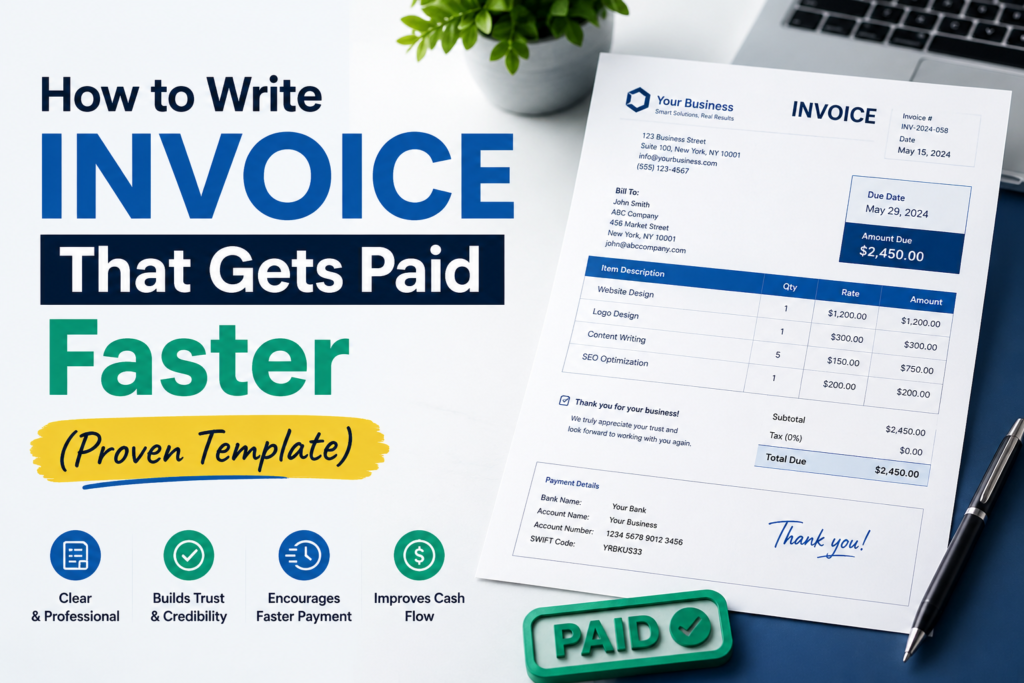
To guarantee speed, your physical invoice document must be a clear, unambiguous summary of your contract terms. Below is the exact, uncompromised structural configuration for a secure invoice layout :
FAQ's
How do I handle clients who demand Net-60 or Net-90 payment terms during negotiations ?
Net-60 or Net-90 terms are essentially interest-free corporate loans funded by your independent business. If a enterprise prospect insists on long payment terms during onboarding, respond with a firm choice that protects your cash velocity :
"We can certainly use your corporate Net-60 accounts payable workflow. However, to accommodate that timeline, we apply a 15% financing premium to the total project cost. Alternatively, we can maintain our standard project pricing by using our standard Net-7 progressive milestone framework, backed by a 50% upfront deposit."
What should I do if a client pushes back on the late fee clause in my contract ?
When a prospect asks you to remove late fee or interest clauses during onboarding, it is a clear indicator of upcoming payment issues. Stand firm on this requirement. Explain that these terms are a standard part of your business operations :
"Our late fee clauses are standard provisions required by our corporate council and underwriters to manage account stability. These terms only apply if an invoice becomes overdue, and they ensure our active clients receive prioritized scheduling and dedicated engineering availability."
Can I legally stop a client from using my work if they refuse to pay the final invoice ?
Yes, provided your contract explicitly states that intellectual property rights only transfer after full payment clears. If a client launches code or publishes designs without paying, they are committing copyright infringement. In this scenario, you can send a formal DMCA Take-Down Notice to their web hosting provider or cloud platform (such as AWS, Heroku, or digital advertising networks), forcing them to remove the unauthorized work while you pursue collection.
What should I do if a client says they are delaying payment because they aren't "satisfied" with the work ?
Clients often use vague dissatisfaction as a tactic to delay payments or demand discounts. Eliminate this excuse by using objective milestones in your contract. If the client approved a specific project phase via email, they cannot retroactively withhold payment based on subjective preferences. Point directly to their written approval and offer to address any new changes through a separate, paid Change Order once they settle the current invoice.
How do I manage collection efforts if my client is located in another country ?
International collections can be challenging, which is why your upfront payment framework is so critical. For international accounts, increase your deposit requirements—such as a 50% deposit and a 40% interim progress milestone—leaving only 10% due upon final delivery. If an international client defaults, your best option is to work with a commercial collection agency that has international offices or use global payment escrow services like Escrow.com to handle the funds securely.
How do I write invoice that gets paid faster ?
Use milestone billing, upfront deposits, and legally backed payment terms instead of simple PDF invoices.
Why do clients delay invoice payments ?
Because there is no financial penalty or contractual enforcement attached to the invoice.
About the Legal Architect
Advocate Sagar Haribhau Shirsat is a corporate legal engineering architect specializing in commercial contract frameworks, preventative asset structures, and international trade governance. His professional legal consulting work focuses on helping fast-growing independent agencies, software architecture firms, and digital enterprises protect their operations, eliminate payment risk, and build resilient corporate structures.
Connect with him for professional inquiries via his verified LinkedIn Professional Profile.