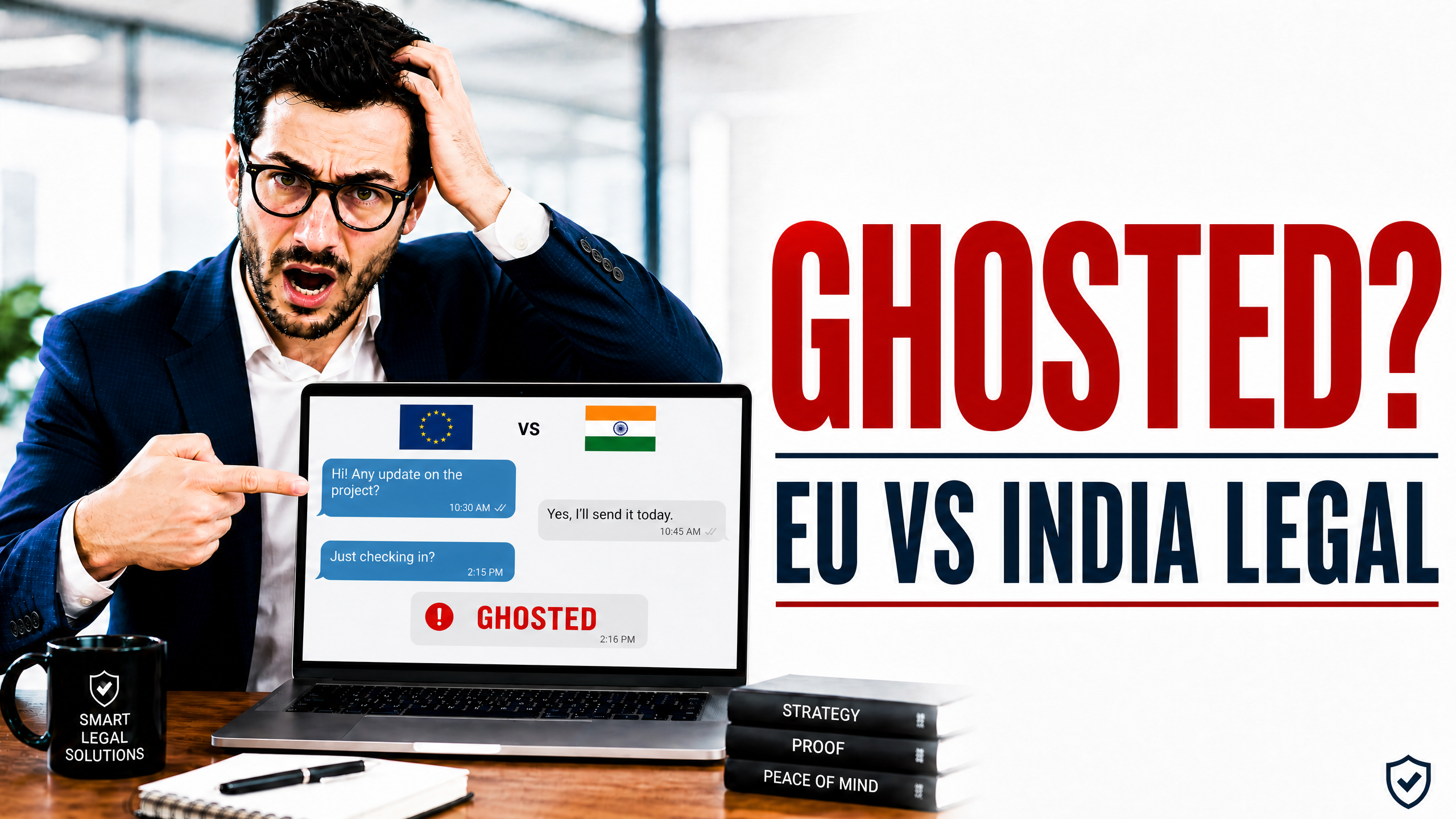
An unpaid invoice sitting in a foreign jurisdiction feels like a uniquely modern form of professional heartbreak. You hit send on the final deliverables, watch the Slack icon turn green, and then experience the crushing realization that a 7,000-kilometer geographic void suddenly stands between your business and its rightful compensation.
I’ve been there, sitting at my desk in Europe, watching an Indian agency completely ignore my emails while actively posting their new client wins on LinkedIn. Look, cross-border debt recovery isn’t a casual Friday afternoon administrative task that you can solve with a polite follow-up.
It requires a documented recovery strategy, measured escalation, and a clear understanding of the jurisdictional realities that apply when the client is based in India. If you want to know What to Do When an Indian Client Ghosts an EU Freelancer: Cross-Border Realities Explained, you have to stop thinking only like a creative and start thinking like a creditor who needs to preserve evidence, contractual rights, and realistic enforcement options.
Here’s the thing: Most European independent contractors assume that an unpaid international invoice means the money is permanently gone. It isn’t. But you simply cannot use standard EU logic to solve an Indian corporate dispute.
Table of Contents
The EU-India Contracting Gap
The first hurdle is acknowledging the distinct contracting cultures between the European Union and the Indian digital sector. In the EU, digital contractors heavily rely on standardized Master Services Agreements (MSAs) and strict GDPR-compliant vendor onboarding processes.
In India’s fast-paced agency ecosystem, multi-thousand-euro deals are frequently negotiated, finalized, and executed entirely over casual WhatsApp voice notes or scattered Slack threads. This creates a dangerous documentation vacuum when things inevitably go south and payments halt.
When an Indian client ghosts an EU freelancer, the initial panic usually stems from the realization that no formal, wet-ink contract actually exists.
However, the absence of a traditional signed paper contract does not automatically mean there is no enforceable agreement. Under Indian contract law, the existence and terms of an agreement can depend on the surrounding evidence, including offers, acceptances, agreed commercial terms, conduct, invoices, delivery records, and electronic communications. Whether a particular WhatsApp, email, or Slack exchange establishes a binding contract is ultimately fact-specific.
If you are wondering Can You Sue a Client Without a Contract ? Real Legal Answer (2026), the answer is yes, provided your digital trail is pristine.
Do not selectively preserve only the messages that support your position. Keep the complete conversation, including revisions, disagreements, approvals, payment discussions, complaints, and any messages that could be unfavorable to your claim. A complete evidentiary record is more credible than a carefully curated one.
I routinely advise freelancers to learn How to Turn an Email Trail into a Legally Defensible Invoice Statement.
Email correspondence, digital sign-offs, invoices, delivery records, and other electronic communications can be important evidence in a commercial payment dispute. But an invoice or message should not automatically be described as a legally binding acknowledgment of debt; its evidentiary value depends on the surrounding facts, the parties’ conduct, the contractual relationship, and the applicable rules of evidence and procedure.
The problem isn’t usually proving they owe you; it’s proving it in a format that Indian corporate legal teams actually respect. Often, the client will retroactively demand strange concessions just to release your funds.
If you encounter this, review How to Handle a Client Who Retrospectively Demands an Uncontracted NDA Before Clearing an Invoice. Do not sign away your rights just because you are desperate for international cash flow.
Assessing the Value Threshold for Enforcement Actions

Before you start drafting aggressive legal threats, you must coldly calculate the financial reality of cross-border enforcement. International litigation is incredibly expensive, and pursuing a €500 invoice through formal Indian legal channels is a fast track to financial ruin.
Before spending money on cross-border enforcement, separate the question of how much is owed from the question of which legal remedy is actually available.
The Insolvency and Bankruptcy Code, 2016 (IBC) can provide a route for an eligible operational creditor to commence a Corporate Insolvency Resolution Process (CIRP) against a qualifying corporate debtor, but the applicable monetary threshold and all other statutory requirements must be checked against the law in force when the proceeding is contemplated. The amount of an invoice alone does not automatically entitle a creditor to an NCLT insolvency proceeding.
Section 9 of the IBC contains a specific process for an operational creditor, including statutory notice and other procedural requirements. There can also be a genuine pre-existing dispute that affects whether an insolvency application is maintainable. For that reason, an unpaid invoice should not be treated as an automatic route into insolvency proceedings merely because it crosses a particular rupee threshold.
For debts that do not fit an insolvency strategy, civil recovery may be more appropriate. Depending on the contract, documents, nature of the claim, and applicable jurisdiction, a creditor may consider procedures such as a summary suit under Order XXXVII of the Code of Civil Procedure, 1908, where the claim falls within the scope of that procedure.
Order XXXVII is not simply a rule that prevents a debtor from defending a case. It provides a special procedure in which the defendant must follow specific steps to obtain leave to defend, and the court decides the matter according to the requirements of the rule and the facts of the dispute. Whether it is available and commercially sensible should therefore be assessed by Indian counsel before proceedings are started.
The practical lesson is simple: do not choose the remedy solely by invoice value. Consider the contract, evidence, dispute status, debtor’s legal structure, jurisdiction, limitation, procedural requirements, likely costs, and whether the debtor has assets worth pursuing.
If you are unsure whether your current situation warrants this escalation, read up on When is it Officially Time for a Freelancer to Take Legal Action? Waiting too long severely diminishes your leverage, especially across international borders.
Interactive Tool: Cross-Border Recovery ROI Calculator
I built this basic logic framework to help my peers decide if pursuing an Indian client is mathematically viable.
Utilizing Local Indian Counsel and Legal Demand Drafts
Never attempt to send a European cease-and-desist template to an Indian corporate entity. It signals to their accounting department that you lack local jurisdiction knowledge, allowing them to comfortably ignore you.
Instead, consider having an Indian advocate familiar with commercial recovery matters review the file and, where appropriate, issue a formal demand or legal notice tailored to the contract, debtor, applicable law, and proposed forum. The advocate can also assess whether a civil recovery proceeding, arbitration, or another remedy is realistically available.
A properly drafted Indian legal notice can make the dispute materially more serious for the debtor because it identifies the contractual basis of the claim, the amount demanded, the evidence supporting it, and the legal remedies the creditor may consider. If civil proceedings under Order XXXVII are potentially available, the notice can refer to that possibility without confusing the demand notice itself with the court proceeding.
Often, a company will pretend they never received your bills. If you face this, check out Client Says Your Invoice Was Lost? How to Get Paid by Corporate Accounts Payable. They play this game because cross-border verification is notoriously difficult.
your Indian advocate can determine the appropriate method of service and send the notice to the debtor’s verified registered office or other legally appropriate address. For a company or LLP, corporate-registration information can be checked through the Ministry of Corporate Affairs (MCA) system, but the correct service method should be selected based on the proposed proceeding and applicable procedural rules rather than assumed in advance.
Once the debtor realizes that the creditor has obtained advice from counsel familiar with Indian procedure, the dispute may receive more serious internal attention. A local advocate can also ensure that any proposed escalation follows the applicable procedural and evidentiary requirements.
If they try to buy you off with a small token payment to delay legal action, remember The Partial Payment Trap: Why Accepting 10% of a Late Invoice Can Sometimes Erase Your Legal Leverage.
If you prefer to manage the initial escalations yourself before spending money on lawyers, you can explore How to Recover an Unpaid Invoice Yourself (Without Hiring a Lawyer). Just know that local counsel is your ultimate trump card.
The Threat of Corporate Petitions and Public Registries
The Indian corporate ecosystem is highly sensitive to regulatory compliance and public image. Most established digital agencies rely heavily on their standing with foreign clients, making reputational risk highly effective.
If the client is registered as a Private Limited Company or LLP, they fall under the strict governance of the Ministry of Corporate Affairs (MCA).
The Ministry of Corporate Affairs (MCA) has regulatory and corporate-governance functions, but an unpaid commercial invoice should not automatically be framed as an MCA complaint or a regulatory violation. If there is evidence of a genuine statutory or corporate-law issue, an advocate can assess whether any regulatory complaint is appropriate. For an ordinary payment dispute, however, contractual and civil recovery mechanisms may be more relevant.
Furthermore, if your work is live on their servers, you have unique technical leverage. Have a look at The Client Has Your Code on AWS and Won’t Pay : The Code-Audit Breakdown.
Technical leverage can sometimes matter in a payment dispute, but restricting access to a client’s servers, accounts, production systems, or data can create serious contractual and security risks. Before disabling, deleting, withholding, or modifying access, check the contract and any applicable professional, confidentiality, data-protection, and cybersecurity obligations. Where necessary, obtain legal advice first.
If they are continuing to use your work after a payment dispute, first determine what the contract says about ownership, licensing, payment conditions, and permitted use. Non-payment does not automatically mean that every subsequent use is copyright infringement, particularly where the client received a contractual licence or other rights. If the client’s use exceeds the rights actually granted, however, intellectual-property remedies may become relevant. Review What to Do When a Client Uses Your Work But Refuses to Pay You before taking action.
Always secure your deliverables upfront. I highly recommend learning How to Structure a Proposal So It Functions Like a Real Legal Defense Contract. It is infinitely easier to prevent ghosting than it is to chase international debt.
Real-World Case Study : The Berlin to Bangalore Blackout
Illustrative scenario: The following example is hypothetical and is included to demonstrate how a cross-border recovery strategy might operate. It is not presented as a reported court case, published judgment, or identifiable client matter.
The lawyer drafted a formal demand notice setting out the contractual basis of the €12,000 claim and explaining that, if the debt remained unpaid, the designer could consider appropriate civil proceedings, including an Order XXXVII proceeding if the claim and jurisdiction satisfied the relevant requirements.
If you’ve experienced this silence, consult My Client Ghosted Me After I Sent the Invoice—What Do I Do Now? The designer stopped emailing and retained a Bangalore-based commercial lawyer for a flat €400 fee.
The lawyer drafted a severe Legal Notice under Order 37 of the CPC, explicitly stating that if the €12,000 wasn’t wired within 15 days, a formal summary suit would be filed in the Bangalore City Civil Court.
In this hypothetical example, the agency’s finance team responded shortly after receiving the notice and the parties resolved the payment dispute without litigation. The lesson is not that every Indian debtor will respond within 48 hours; it is that a properly documented and jurisdiction-aware demand can sometimes resolve a dispute before formal proceedings become necessary.
USA vs Global Debt Recovery (The India Context)

When we compare cross-border collections between the United States and India, the structural disparities become jarringly evident. In the US, freelancers routinely rely on Small Claims Courts or aggressive private debt collection agencies.
In the United States, certain debt-collection activities are regulated by federal and state laws, including the Fair Debt Collection Practices Act (FDCPA) in circumstances covered by that statute. Those rules do not, by themselves, give a US collection agency jurisdiction to enforce a claim against an Indian company in India.
However, a US collection agency cannot assume that its domestic collection authority gives it automatic enforcement power against an Indian entity. Cross-border enforcement depends on the governing contract, applicable law, forum, recognition and enforcement rules, and the debtor’s assets and location.
If you are considering outsourcing this, read Should You Hire a Debt Collection Agency? (Real Cost, Risks & When It Actually Works).
A collection agency based outside India may have limited practical leverage if the debtor and its assets are located in India, particularly where the agency has no local enforcement mechanism. That does not mean an overseas collection agency is universally ineffective; the appropriate approach depends on the contract, jurisdiction, available remedies, and whether local counsel or a local collection partner is required.
In contrast, India does not have an equivalent, robust culture of private collection agencies for B2B debt. Instead, India relies on statutory tribunals (like the NCLT for debts over ₹1 Crore) and the formal judiciary system.
A foreign arbitral award may be capable of enforcement in India where the relevant statutory requirements are satisfied, including the framework governing foreign awards under Indian law and India’s treaty arrangements. Foreign court judgments are subject to separate recognition and enforcement rules, and the result can depend on the originating court, applicable law, jurisdiction, procedural history, and the statutory conditions for enforcement in India.
For that reason, an EU freelancer should not assume that a home-country judgment or arbitral award will automatically translate into quick recovery in India. Before commencing proceedings abroad, compare the cost and enforceability of the available forums with the possibility of resolving the dispute through a properly drafted demand and negotiated settlement.
If you are operating across borders regularly, study How to Protect Yourself When Working With International Clients.
The core lesson is to negotiate jurisdiction, governing-law, dispute-resolution, and enforcement provisions deliberately before work begins. A clause favoring your home forum is not automatically the best option if obtaining practical enforcement against an Indian client would be difficult. The strongest clause is one that balances legal validity, cost, convenience, and realistic enforceability.
Tactical Escalation : The Communication Architecture
When ghosting occurs, your communication must transition from collaborative partner to strict auditor.
You cannot afford emotional outbursts or contradictory demands; you need a professional, chronological paper trail showing what was agreed, what was delivered, what remains unpaid, and how you gave the client a reasonable opportunity to respond.
I strongly advise utilizing an automated follow-up sequence. Check out Unpaid invoice follow-up email templates ( Day 1 to Day 30 System ). Systematizing this removes your emotional anxiety and clearly telegraphs professional resolve to the debtor.
If they cite project revisions as an excuse for non-payment, direct them to your scope limits. For more on this, see Stop Working for Free : How to Prevent Scope Creep From Eating Your Profits.
Sometimes they claim their internal accounting software is broken. This is a classic delay tactic. You can counter this by reading Stuck in an “Accounting Loop”? Try This Psychological Trick to Get Paid Fast.
To prevent this altogether in the future, restructure your invoices to be flawlessly compliant with enterprise AP systems. Study How to Design an Invoice That Accounts Payable Teams Can’t Ignore.
If you need a final warning script before escalating to your Indian counsel, I use a very specific template. Grab it here: Final Notice Before Legal Action : Copy-Paste Script That Forces Payment.
The Evidence Checklist for Indian Recovery
If you are handing a file over to an Indian advocate, they cannot work with vague complaints. They require a highly organized dossier of evidence that clearly establishes a legally binding commercial transaction.
- The Master Contract : Signed MSA, Statement of Work (SOW), or a verified digital trail of terms agreed upon via email.
- Proof of Delivery : Timestamped delivery logs, GitHub commits, Google Drive access logs, or client approval emails.
- The Invoice : Clearly outlining the agreed scope, tax identification numbers, and international SWIFT/IBAN payment instructions.
- The Follow-Up Timeline: Preserve dated copies of your collection attempts and the client’s responses, if any. This helps demonstrate the history of the dispute and the opportunities given to the client to resolve the account. Do not assume that sending a particular number of reminders is a universal legal prerequisite.
- Client Identification: Record the client’s correct legal name, entity type, Corporate Identification Number (CIN) where applicable, registered office, and relevant authorized representatives or directors. Verify the information against reliable corporate records before sending formal legal communications.
Implementing Financial Defenses Upfront
The brutal truth is that once an international client ghosts you, you are already playing from a severe disadvantage. The only true cure for cross-border non-payment is architectural prevention during the onboarding phase.
Avoid extending generous Net-30 or Net-60 credit terms to a new international client without first assessing the client’s identity, reputation, financial reliability, contract structure, and payment history.
Review the Freelancer Payment Terms Guide : Avoid Net 60 & Late Payments.
Where commercially appropriate, structure milestone payments and clearly define when ownership or licence rights in intellectual property transfer. Your contract should also explain what happens if a milestone remains unpaid.
If you are working on a retainer model, define in advance what happens when the balance reaches zero or an invoice becomes overdue. Depending on the contract and the service involved, that may include pausing future work or access where you are contractually entitled to do so. Avoid unilateral technical actions that could breach contractual, security, confidentiality, or data-protection obligations.
Learn to implement The Retainer Exhaustion Warning: How to Auto-Notify Clients When Their Balance Hits $0.
Cross-Border Risk Matrix (EU to India)
| Risk Category | Typical Scenario | Practical Recovery Outlook | Sensible Next Step |
|---|---|---|---|
| High Cost / Low Evidence | No clear written terms, fragmented communications, disputed work, and a relatively small invoice. | Often commercially weak | Preserve the evidence, send a measured final demand, and compare likely legal costs with the amount realistically recoverable. |
| Moderate Risk / Strong Evidence | Clear agreement, documented delivery, undisputed invoice, and an identifiable Indian business entity. | Potentially strong | Obtain Indian legal advice and assess a formal demand, negotiation, arbitration, or civil recovery route based on the contract and facts. |
| High Value / Strong Documentation | Substantial commercial claim, signed agreement, clear proof of performance, and identifiable debtor/assets. | Potentially strong, but procedure matters | Obtain jurisdiction-specific advice before selecting arbitration, civil proceedings, or an insolvency remedy. Do not assume invoice value alone determines the correct forum. |
Quick Decision Section : What to Do Today
If you are currently staring at an unpaid invoice from an Indian client who has gone completely dark, do not respond with increasingly emotional messages. Move from informal collection to structured documentation and proportionate escalation.
- Review the contract first. Check governing law, jurisdiction, arbitration, payment terms, termination rights, intellectual-property provisions, and any contractual notice requirements.
- Pause further work where the contract permits it. Do not automatically disable production systems, delete files, revoke client access, or interfere with infrastructure without checking your contractual and legal obligations first.
- Compile your evidence dossier. Preserve the agreement, emails, Slack messages, invoices, delivery records, approvals, payment history, and relevant access or project logs.
- Verify the debtor. Confirm the client’s legal entity name, registered office, and other corporate details from reliable sources.
- Send a structured final demand. State the amount claimed, contractual basis, relevant invoice, payment deadline, and the consequences you may pursue if payment remains outstanding. Keep the language factual rather than threatening.
- Obtain local advice before escalating. An Indian advocate can assess whether negotiation, a legal notice, arbitration, civil recovery, or another remedy is appropriate for the particular claim.
- For future engagements, strengthen the contract. Address payment milestones, late-payment consequences, IP transfer or licensing, dispute resolution, governing law, jurisdiction, and the procedure for suspending future work when invoices become overdue.
For future engagements, ensure your contracts clearly stipulate late payment penalties.
Whether a late-payment provision is enforceable and how much can realistically be recovered will depend on the governing contract and applicable law. Even where a contractual late-payment clause is valid, it should be drafted carefully rather than treated simply as negotiation padding.
Jurisdiction and Legal-Information Note
This article discusses general legal and commercial considerations for an EU-based freelancer dealing with a client or business entity in India. It is not a substitute for advice on a particular dispute.
The appropriate remedy can depend on the client’s legal structure, the governing-law and jurisdiction clauses in the contract, the existence of an arbitration agreement, the nature of the dispute, the evidence available, the amount claimed, limitation periods, the location of assets, and the law applicable at the time action is taken.
EU freelancers should also consider the law of their own country and any applicable tax, VAT, data-protection, professional, or regulatory requirements. Before commencing litigation, arbitration, insolvency proceedings, or public allegations, obtain advice from appropriately qualified counsel in the relevant jurisdiction.
Frequently Asked Questions
Can I file a police complaint for fraud in India against an unpaid client ?
A simple failure to pay an invoice does not automatically amount to cheating or fraud. A contractual payment dispute will often have a civil dimension, but the facts can be different where there is evidence of conduct satisfying the elements of a criminal offence. In particular, the legal analysis can depend on what the client intended when the transaction was entered into and what representations were made at that time.
Do not label an ordinary commercial dispute as criminal fraud merely to increase pressure. If you genuinely believe fraudulent conduct occurred, have an Indian advocate assess the evidence and the appropriate remedy before approaching law-enforcement authorities.
Will hiring a European lawyer help me recover money from an Indian agency ?
It can help, particularly with reviewing the contract, governing law, arbitration clause, evidence, and the freelancer’s obligations in their home jurisdiction. But a European lawyer cannot simply assume that their domestic legal authority gives them enforcement power in India.
Where the debtor and relevant assets are in India, obtaining advice from an Indian advocate may be important for understanding Indian procedure and practical enforcement. The most efficient strategy may involve both jurisdictions, depending on the contract and facts.
What is the minimum amount required to force a company into insolvency in India ?
The answer should not be treated as a permanent one-number rule. The monetary threshold for an operational-creditor insolvency application under the Insolvency and Bankruptcy Code can depend on the law and notifications applicable at the relevant time. In addition, the creditor must satisfy the other statutory and procedural requirements, and a genuine pre-existing dispute can materially affect maintainability.
Before relying on an IBC proceeding, verify the current threshold and requirements with an Indian insolvency professional or advocate. A large unpaid invoice does not automatically mean that NCLT insolvency proceedings are available.
Can I publicly shame the Indian client on LinkedIn or X (Twitter) ?
I would strongly advise against turning an unpaid-invoice dispute into a public naming-and-shaming campaign.
Public accusations can create separate legal and commercial risks, particularly if statements are inaccurate, misleading, or presented as established facts when they are actually allegations. They can also make a negotiated settlement harder.
Keep the recovery process factual and private where possible. If you believe public reporting is necessary for a legitimate reason, obtain jurisdiction-specific legal advice before publishing allegations about a company or individual.
Is a WhatsApp message legally valid as a contract in India ?
A WhatsApp conversation can be relevant evidence of a contract, but a WhatsApp message is not automatically a legally binding contract merely because it is electronic.
The key questions are whether the messages, viewed together with the surrounding evidence, establish the necessary contractual elements and whether the electronic record can be properly proved and admitted under the applicable evidentiary rules. The identity of the parties, authenticity of the messages, completeness of the conversation, offer and acceptance, agreed terms, consideration, and subsequent conduct can all matter.
For a cross-border dispute, preserve the original messages and relevant metadata or device records where possible rather than relying only on screenshots. If the amount is significant, have counsel assess the evidence before assuming the WhatsApp trail is sufficient by itself.
About Author :
Adv. Sagar Haribhau Shirsat is an Indian advocate writing about commercial contracts, unpaid invoices, cross-border payment disputes, and legal risk management for freelancers and independent businesses. His content focuses on practical legal frameworks for documenting transactions, preserving evidence, communicating with debtors, and evaluating proportionate recovery options.
Where an article concerns a specific jurisdiction or legal procedure, readers should verify the current law and obtain advice from a qualified professional before taking legal action.
Connect via his Official Professional LinkedIn Profile.
Disclaimer: This article provides general educational information about cross-border commercial payment disputes and is not legal advice for any particular person, company, transaction, or jurisdiction. Laws, procedures, monetary thresholds, court rules, and enforcement practices can change, and the appropriate remedy depends on the specific facts and governing law. EU-based freelancers dealing with an Indian client should obtain advice from appropriately qualified counsel before commencing litigation, arbitration, insolvency proceedings, making criminal allegations, disabling access to systems, or publishing allegations about a debtor.