Table of Contents
An unpaid invoice is not just an administrative annoyance; it is an interest-free loan you never agreed to grant. When you look at your invoice terms, you are looking at the throttle of your business’s financial engine. Choose incorrectly, and you starve your business of the liquidity required to pay taxes, fund software seats, or clear your own monthly draws.
For independent creators, developers, and agency owners, deciding between Net 15 vs Net 30 vs Net 45 is often treated as a superficial choice—a minor detail copied and pasted from a generic template found online. This operational oversight is precisely how businesses with healthy paper revenues collapse into sudden bankruptcy.
Understanding how your choice between Net 15 vs Net 30 vs Net 45 impacts your baseline survival requires looking past the corporate jargon. We must evaluate the strict, unyielding laws of cash velocity and accounts payable psychology.
The Core Mechanics of Cash Velocity
Cash flow velocity measures the speed at which cash travels through your business loop—from the moment you spend a dollar on operational overhead to the moment that dollar returns to your bank account via client fulfillment.
The Blueprint of Cash Velocity Erosion
Operational expenses and labor float accumulate immediately from this point forward.
Project lifecycle wraps up. Invoice is generated and formally entered into the client’s AP system.
Capital sits trapped inside internal corporate routing, balance verification loops, and batch payout pools.
Funds clear. Working capital cycle hits completion, and run-rate risks reduce back to zero.
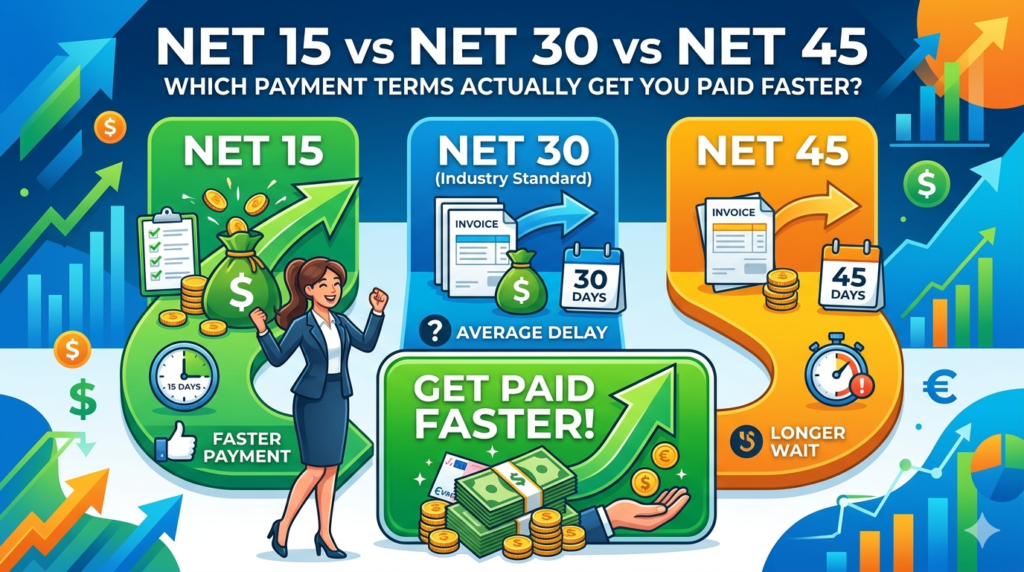
When you extend credit to a client, you are delaying this velocity. The terms “Net 15,” “Net 30,” and “Net 45” signify the total number of calendar days a client has to clear an outstanding invoice balance after the invoice date.
The hidden risk lies in the structural mechanics of corporate Accounts Payable (AP) departments. A Net 30 designation rarely means you receive cash on the 30th day. Most corporations run batch-processed payment cycles. If an enterprise AP desk processes payouts only on the 1st and 15th of each month, a Net 30 invoice submitted on the 2nd of the month will miss the current cycle. It will sit dormant until the next batch run, effectively morphing into a Net 45 or Net 50 settlement window.
Consider the compounding impact on your working capital requirements :
| Payment Term | Typical Real-World Settlement | Working Capital Impact | Run-Rate Risk Exposure |
| Net 15 | 17–22 Days | Ultra-low float. Capital is rapidly returned to cover immediate project-specific expenses. | Minimal. Puts client stalling behavior on a highly visible, hyper-short fuse. |
| Net 30 | 35–45 Days | Standard market float. Forces you to maintain a capital reserve of at least 1.5x monthly expenses. | Moderate. Allows client internal inefficiencies to delay your basic operational liabilities. |
| Net 45 | 50–60 Days | High-risk institutional float. Your business funds client operations for up to two full months. | Severe. One late or defaulted milestone can completely paralyze an independent studio. |
If your monthly fixed operational costs are $10,000, operating under Net 45 terms means you must constantly carry at least $20,000 in cash reserves just to float ongoing client work before seeing a single dollar of return. When you evaluate Net 15 vs Net 30 vs Net 45, you are not just selecting a due date; you are determining how much personal capital you must risk to keep your business alive.
The Client Behavior Diagnostic Matrix
Clients do not demand specific invoice payment terms at random. Their payment behavior is governed by distinct corporate motivations, financial stresses, and structural bottlenecks. Navigating these requires understanding the psychology of the entity sitting on the other side of your ledger.
Category A : The Massive Enterprise
Enterprise clients possess deeply rigid, bureaucratic AP workflows. They demand Net 45 or Net 60 terms because their internal validation systems require multiple tiers of managerial approvals, purchase order (PO) matching, and compliance reviews.
To bypass or compress these windows, you must leverage a “Fast-Pay” discount. When executing agreements, introduce an alternative tier:
“Standard corporate procurement terms are Net 45, but we offer a 2% discount if settled via ACH within Net 10.”
To an enterprise procurement officer, a 2% reduction on a $50,000 contract is an immediate win for their quarterly cost-savings metrics. This incentive easily motivates them to fast-track your invoice through an expedited payment run.
Category B : The Mid-Sized Agency
Mid-market agencies frequently experience extreme cash flow crunches. In my practice, we observe that mid-market agency clients leverage Net 45 terms explicitly to float their own operational payroll on your interest-free backing. They wait to collect cash from their end-enterprise clients before passing a fraction of those receipts down to you.
When dealing with this segment, you must enforce strict structural boundaries. Never accept a “pay-when-paid” clause in your service agreement. Tie your milestones strictly to Net 15 frameworks, and make the delivery of final production assets or source code contingent on the clearance of the final milestone payment.
Category C : The Predatory Staller
This client uses deliberate silences, administrative excuses, or bad-faith requests for revisions on previously approved work to intentionally delay payment. If a client goes dark immediately after asset delivery or begins questioning line items that were signed off weeks prior, they are stalling.
Recognizing this pivot point early is vital. You must immediately stop work on all active projects and transition from account management to a formal collection protocol.
To help evaluate the precise cost of these delays on your business, use the interactive diagnostic tool below to calculate your true cash flow velocity loss.
The Financial Accountability Calculator
Quantify the real-world operational erosion caused by delinquent client payment delays.
The Evidence & Collection Protocol
When a client blows past your established payment terms, your priority must shift entirely away from "maintaining the relationship" and focus squarely on securing documented leverage. If you eventually need to file suit, present a claim to an insurance carrier, or hand an account over to debt collection specialists, you will need a clean, undeniable trail of evidence.
The Evidence & Collection Protocol Pipeline
Day 0. Clear payment terms, due dates, and late interest policies are stamped explicitly on the document.
Day +1. Initial administrative flag issued to client contact and automated AP routing queues.
Day +7. Client confirms invoice accuracy in writing, effectively waiving their future right to dispute project quality.
Day +15. Late fees assessed. Formal communication specifies contract terms breached and lists outstanding balances.
Day +26. Final administrative ultimatum served. Establishes the foundation for immediate collection agency handover or court arbitration.
Establish the Groundwork Early
The collection process actually begins before an invoice is even marked late. Every single invoice must explicitly state the exact date payment is due, the preferred payment method (such as ACH or wire transfers), and a clearly outlined late fee policy.
To implement a bulletproof system, your accounts receivable workflow should stick to a strict tracking cadence:
- Day -5 (Pre-Due Reminder): A brief, automated system notification verifying that the invoice has been successfully processed by their accounts payable queue.
- Day +1 (First Past-Due Notice): A direct, formal email notification that pauses all active operational work or software access until the balance is cleared.
- Day +7 (The Written Acknowledgment Push): A targeted message designed to get the client to explicitly confirm that they owe the balance in writing.
Getting a client to acknowledge the debt in writing is incredibly valuable for your collection efforts. If a client replies to an email or message saying, "We acknowledge receipt of invoice #1042, the balance is accurate, but we are facing short-term cash constraints," they have effectively waived their right to later claim that your work was defective or incomplete.
If you are wondering whether informal digital communications hold up during these disputes, reviewing guidelines on how a WhatsApp conversation can be a legally binding contract provides clear, practical insights into securing valuable written admissions.
Maintain Absolute Professional Discipline
Never call a delinquent client on the phone without instantly following up via a written communication channel. Every verbal agreement, phone promise, or video call assurance must be documented in writing. After hanging up, immediately send a summary email detailing exactly what was discussed:
"To confirm our conversation just now, you stated that payment for Invoice #1042 ($4,500) will be processed via ACH this coming Thursday afternoon, and that no additional deliverables are required from our end to clear this transaction."
If the client goes completely silent across all communication tools, your tactical approach must evolve. For an actionable breakdown on handling sudden silence from a client, reading through strategies for when a client ghosted on a final invoice via Slack will give you a clear roadmap for protecting your business.
Statutory Interest & Late Fees
When your text outlines how to apply late payment interest (under Section 4 of the article), you can cite these concrete statutory frameworks:
- United States (State-Level Usury & Commercial Codes):
- Citation: U.C.C. § 2-709 (Action for the Price)
- Application: This gives a seller the legal right to recover the full price of accepted goods or services plus incidental damages when a buyer fails to pay.
- Citation: California Civil Code § 3287 or New York CPLR § 5001
- Application: These statutes dictate that interest is recoverable as a matter of right upon a clear breach of contract for a sum certain, setting default statutory pre-judgment interest rates (e.g., 9% per annum simple interest in New York).
- United Kingdom & European Union:
- Citation: Late Payment of Commercial Debts (Interest) Act 1998 (UK)
- Application: Imposes an automatic statutory right for small businesses to charge 8% above the Bank of England base rate for late commercial payments, alongside fixed compensation costs for debt recovery.
The 3-Stage Invoicing Escalation Ladder
Escalating a payment dispute requires a calculated, unemotional approach. Moving through an intentional escalation ladder ensures you maintain complete legal leverage while protecting your professional reputation.
Stage 1 : The Automated Operational Halt (Days 1–10 Past Due)
The moment your payment terms expire, send an immediate notification confirming a temporary pause on all active project work.
Operational Reality: "As per our standard service terms, active work on the engineering roadmap has been paused due to outstanding invoice #1042. Project sprints will resume immediately once our finance team confirms receipt of the pending balance."
This approach avoids sounding combative; it simply frames the work pause as an automated operational reality of your business. If your deliverables involve hosted staging environments, APIs, or cloud platforms, you should also temporarily restrict access to those environments.
Stage 2 : Asserting Late-Payment Interest (Days 11–25 Past Due)
If the client ignores your initial notifications, you must formally implement late-payment fees and interest charges. Under commercial collection statutes, you have a legal right to assess interest on overdue balances, provided this policy was clearly outlined in your initial agreement or invoice terms.
For a complete, deep-dive timeline on executing these notifications effectively, you can follow the best follow-up timeline for unpaid freelance invoices, which outlines structural milestones for your collection communication.
Update the outstanding invoice to include your standard late fees, and send it directly to both your primary point of contact and their general accounts payable email address:
"Pursuant to Section 4 of our signed Master Services Agreement, interest charges of 1.5% per month (or the maximum allowable statutory rate) are now actively accruing on the past-due balance of $8,500. Please find the revised statement attached."
Stage 3 : The Formal Final Legal Notice (Days 26–30 Past Due)
If a client remains uncooperative past Day 25, you must issue a final, formal legal notice before pursuing formal collections or legal arbitration. This document signals to their executive leadership and legal counsel that continuing to ignore the debt will result in costly public litigation.
To quickly generate a formal demand letter, utilize the custom interactive tool below to input your specific invoice details and instantly build a professional notice.
Formal Demand Instrument Generator
Input the core parameters of the breach to compile a structured, legally sound Final Demand Notice.
If the deadline in your demand letter passes without payment, you must follow through on your escalation path. Transitioning the debt to specialized collectors or filing a claim in small claims court are both powerful, low-cost options for enforcing your agreements.
To explore self-represented legal recovery methods further, you can consult the freelancers' legal guide to recovering unpaid invoices without expensive lawsuits for a comprehensive breakdown of your available recovery strategies.
Summary Strategy : Choosing the Right Invoice Terms
Optimizing your invoicing approach requires balancing clear boundaries with operational flexibility. Use this checklist to align your payment terms with your business needs:
- Default to Shorter Terms: Implement Net 15 as your standard baseline to accelerate your cash flow velocity and keep tighter control over outstanding balances.
- Handle Enterprise Requests Strategically: If a major corporate client requires Net 45 or Net 60 terms, negotiate an incentive like a 2% Fast-Pay discount for payment within 10 days to keep cash moving through your business.
- Protect Final Deliverables: Ensure your master service contracts explicitly state that ownership of intellectual property or production assets only transfers to the client after the final invoice clears.
- Establish a Clean Trail of Evidence: If an invoice is past due, ensure every single update, reminder, and timeline adjustment is clearly documented in writing.
Strategic FAQ
How do I handle a client who explicitly signs an agreement with Net 15 terms but pays according to a Net 30 schedule anyway ?
This behavior constitutes a clear breach of contract. When a client unilaterally ignores your agreed-upon terms, send an immediate notification:
"Our contract specifies a Net 15 payment cycle. Payouts received on a Net 30 schedule create structural resource strains on our end. Moving forward, all active project work will be paused if balances remain unsubmitted by Day 16."
If you choose to accept their delayed timeline, ensure you formally issue updated invoices that apply late fees to protect your margins.
Am I legally allowed to charge late fees if they weren't explicitly detailed in the original contract?
Yes, in many jurisdictions you can claim statutory interest on overdue commercial debts under standard commercial codes, even without a specific contract clause. However, your collection position is vastly stronger if your late fee structure is explicitly outlined in your master contract and clearly visible on every single invoice you issue.
What should I do if a client claims they cannot pay because their own customer hasn't paid them yet?
A client's internal cash constraints do not clear them of their legal obligation to pay for your completed work. Unless your agreement explicitly contains a valid "pay-when-paid" clause, their operational dependencies are irrelevant to your debt. Respond firmly: "Our service agreement is structured directly between our companies. Your internal settlement timelines with third parties do not alter the strict due dates for our completed milestones."
Is it worth hiring an attorney to collect an unpaid invoice that is under $5,000?
Hiring an attorney on an hourly basis for a $5,000 dispute is rarely cost-effective. Instead, you can look into alternative collection approaches:
File a claim in your local small claims court, where you can present your documented trail of evidence directly without needing expensive legal representation.
Hand the account over to a commercial debt collection agency that operates on a contingency-fee basis, meaning they only take a percentage of the funds they successfully recover for you.
Can I legally revoke access to software code, live sites, or design files if a client refuses to clear a Net 30 invoice?
You can absolutely revoke access, provided your contract specifies that intellectual property rights only transfer to the client upon full payment. If you still control the hosting environments or repository permissions, you have a legal right to pause access to those staging platforms until your outstanding balances are settled in full.
About the Author
Advocate Sagar Haribhau Shirsat is a legal engineering architect and veteran commercial recovery strategist who designs bulletproof operational frameworks for independent professionals and growing service agencies worldwide.
Connect with him for advanced structural consulting and corporate recovery strategies on his Professional LinkedIn Profile.