
An unlimited-revisions clause can look harmless when it appears inside an otherwise ordinary Master Services Agreement (MSA).
It may say that you must make revisions “until final approval,” “until accepted by the Client,” or “to the Client’s satisfaction.” Sometimes the contract never uses the words “Unlimited Revisions in a Master Services Agreement” at all.
The commercial problem is simple: a fixed-price project can become an open-ended obligation if the contract does not clearly define what counts as a revision, how many revision rounds are included, what constitutes acceptance, and how additional work will be priced.
The short answer
If a client sends you an MSA containing an unlimited or open-ended revision obligation, do not automatically sign it and do not automatically accuse the client of acting improperly.
First, compare the MSA against the Statement of Work (SOW), proposal, pricing schedule, acceptance provisions, change-order mechanism, and governing-law clause.
Then try to replace the open-ended obligation with objective terms such as:
- a defined number of revision rounds;
- a clear definition of what constitutes a revision;
- objective acceptance criteria;
- a written change-order process for work outside the original scope; and
- an hourly or fixed additional fee for approved out-of-scope work.
This approach is consistent with the broader principle that contractual scope and changes should be documented rather than left entirely to informal expectations. For example, U.S. federal contracting rules expressly recognize contract modifications as mechanisms for changing contractual terms and, in relevant contexts, documenting changes in scope and payment. Those government-contracting rules do not automatically govern private freelancer agreements, but they illustrate why documented scope changes are commercially useful.
If you are still building your contracting system, it is also worth reviewing our guide on [how to structure a proposal so it functions like a legal defense contract] how to structure a proposal so it functions like a legal defense contract and our broader guide on [preventing scope creep from eating your profits] preventing scope creep from eating your profits.
Important: This article is general educational information, not a substitute for advice about a particular contract. The effect of a revision clause depends on the contract wording, applicable law, governing jurisdiction, type of services, and surrounding facts.
Table of Contents
1. Why an Unlimited-Revisions Clause Creates Financial Risk

The central problem is not the word “revision.”
The problem is uncertainty.
A fixed-fee project assumes that the freelancer can estimate the amount of work required to produce the agreed deliverables. If the client can require an unlimited number of changes without an additional fee, the freelancer may have difficulty predicting the actual amount of labor required.
For example, imagine a $10,000 branding project that was estimated to require 100 hours.
If the contract includes two defined revision rounds, the freelancer can price the project around a reasonably identifiable workload.
If the contract instead says:
“Contractor shall make all revisions reasonably requested by Client until final approval.”
the economic risk becomes much harder to quantify.
The client may make reasonable requests. The problem is that reasonable does not necessarily mean inexpensive or unlimited.
The same issue can arise in:
- website development;
- video production;
- copywriting;
- UI/UX design;
- software development;
- branding;
- photography;
- animation;
- consulting;
- marketing services; and
- other professional services.
If the commercial arrangement depends on a defined scope, the contract should make that scope identifiable.
This is closely related to the [one-quick-fix scope-creep problem and how to charge for additional work without unnecessarily damaging the client relationship]how to charge for scope creep without losing the client.
2. Do Not Search Only for the Words “Unlimited Revisions”
One of the easiest mistakes is searching the MSA for the exact phrase “unlimited revisions.”
The obligation may be created by different language.
Look for provisions referring to:
- “Client satisfaction”;
- “sole satisfaction”;
- “final approval”;
- “acceptance”;
- “corrections”;
- “modifications”;
- “necessary changes”;
- “reasonable changes”;
- “customary revisions”;
- “conforming work”;
- “until accepted by Client”;
- “until approved by the Client”;
- “rework”; or
- “corrections at no additional cost.”
None of these phrases is automatically invalid or unfair.
The important question is:
What does the clause require, and how does it interact with the rest of the contract?
For example, a clause requiring correction of genuine defects may be commercially reasonable. That is different from a clause requiring the freelancer to develop entirely new concepts without additional compensation.
That distinction should be reflected in the contract.
A useful risk matrix
| Contract language | Potential concern | What to examine |
|---|---|---|
| “Unlimited revisions” | Very high | Whether there is any meaningful scope or time limit |
| “Until Client is satisfied” | High | Whether satisfaction is subjective and whether objective criteria exist |
| “Until final acceptance” | Medium to high | Who provides acceptance, by when, and under what standard |
| “Corrections required to meet specifications” | Potentially manageable | Whether the specifications are clearly defined |
| “Two rounds of revisions” | Lower | Whether revision is properly defined |
| “Additional revisions billed hourly” | Lower | Whether the rate and authorization process are clear |
The key is not to label every client-friendly provision as “dangerous.”
Instead, evaluate the interaction between scope, acceptance, pricing and change control.
3. Revision vs. Scope Change: The Distinction That Protects Your Pricing
A strong contract should distinguish an ordinary revision from a material change in scope.
A revision generally modifies an existing deliverable within the original project parameters.
A scope change may introduce a new deliverable, new concept, substantially different objective, additional functionality, or materially different requirements.
Examples
| Client request | Possible classification | Why |
|---|---|---|
| Fix a spelling mistake | Revision/correction | Corrects an existing deliverable |
| Adjust an agreed color | Revision | Modifies an existing element |
| Change the font | Revision | Usually modifies an existing design |
| Rewrite the entire campaign concept | Potential scope change | May require new creative development |
| Add five new landing pages | Scope change | Adds deliverables |
| Build a mobile app after agreeing to a website | Scope change | Changes the nature of the project |
| Add a new integration | Potential scope change | May require additional technical work |
| Change the target audience completely | Potential scope change | May materially change the original brief |
| Correct work that fails the agreed specification | Correction | May fall within the original obligation |
The exact classification depends on the contract and facts.
That is why your SOW should not simply say:
“Three revisions included.”
It should explain what a revision means.
For freelancers dealing with growing projects, our guide on [how to prevent scope creep before it starts]stop working for free and prevent scope creep provides a broader framework.
4. Compare the MSA With the SOW Before You Redline Anything
Do not review the revision clause in isolation.
Read these documents together:
- MSA;
- SOW;
- proposal;
- quotation;
- pricing schedule;
- project brief;
- acceptance criteria;
- change-order provisions;
- payment terms; and
- governing-law and dispute-resolution provisions.
The MSA may contain general obligations while the SOW contains the project-specific scope.
You therefore need to determine which document controls if the language conflicts.
Questions to ask
- Does the SOW expressly limit revision rounds?
- Does the MSA override the SOW?
- Is the SOW incorporated into the agreement?
- Is there an order-of-precedence clause?
- Does the acceptance provision impose a separate obligation?
- Does the contract allow written change orders?
- Is there a stated hourly rate for additional work?
- Does the client have a deadline for providing feedback?
- Does silence constitute acceptance?
- Can different client representatives provide contradictory feedback?
- What happens if the client requests a materially different deliverable?
If the contract documents conflict, do not assume the document you prefer automatically wins.
Contract interpretation is jurisdiction-specific.
5. How to Redline an Unlimited-Revisions Clause
Once you identify the problem, avoid sending an emotional email.
You are negotiating a commercial provision.
Open the document in Word or another appropriate document editor, enable tracked changes, and make the proposed revision easy for the other side’s legal or procurement team to understand.
A balanced revision clause
A practical starting point could be:
“Contractor will provide up to three (3) rounds of revisions for each applicable deliverable, provided that such revisions remain consistent with the approved project brief and agreed specifications. Requests that materially change the scope, deliverables, specifications, or project objectives will be treated as additional services and will require written approval of the applicable change order or additional-fee arrangement before such work is performed.”
This is better than simply writing:
“Unlimited revisions are deleted.”
Why?
Because you are not merely removing a protection for the client.
You are replacing uncertainty with a workable operating mechanism.
Alternative: Two rounds plus hourly billing
If your pricing model supports it:
“The project fee includes two (2) rounds of revisions per deliverable. Additional revisions that remain within the original scope will be billed at Contractor’s then-current hourly rate. Material changes to scope or deliverables will be subject to a separate written change order.”
Alternative: Milestone acceptance
For larger projects, revision rounds may not be enough.
You may instead use:
- submission;
- client review period;
- consolidated feedback;
- revision;
- final acceptance;
- change-order process.
This can be particularly useful where several stakeholders are involved.
6. Three Things Your Revision Clause Should Define
A strong revision clause should answer three questions.
1. How many rounds are included?
For example:
“Three rounds.”
2. What is a revision?
For example:
“A revision means a modification to an existing deliverable that remains substantially consistent with the approved project brief.”
3. What happens after the included rounds?
For example:
“Additional revisions are billed at $X per hour or under an agreed fixed-fee change order.”
Without the third element, the revision cap may not solve the problem.
A three-round limit without a mechanism for additional work simply creates another negotiation later.
7. What If Client Legal Says, “Our MSA Cannot Be Changed”?
Do not immediately assume that statement is dishonest.
Large organizations often use standardized contracting processes.
The correct response is commercial rather than confrontational.
You can say, in substance:
“I understand that the company uses a standard MSA. My concern is that the current revision provision creates an uncapped obligation that is inconsistent with the fixed project fee. If the revision language cannot be amended, could we address the issue in the SOW or pricing schedule by defining the included revision rounds and the rate for additional services?”
That gives the client multiple ways to solve the problem.
The goal is not:
“Your lawyers are wrong.”
The goal is:
“Here is the commercial uncertainty. Here are three workable ways to eliminate it.”
Contract modifications and written amendments are standard mechanisms for documenting changes to contractual arrangements. Government contracting rules are not automatically applicable to private contracts, but federal regulations illustrate the importance of documenting material modifications and associated payment adjustments.
8. What If the Client Refuses to Change the MSA ?
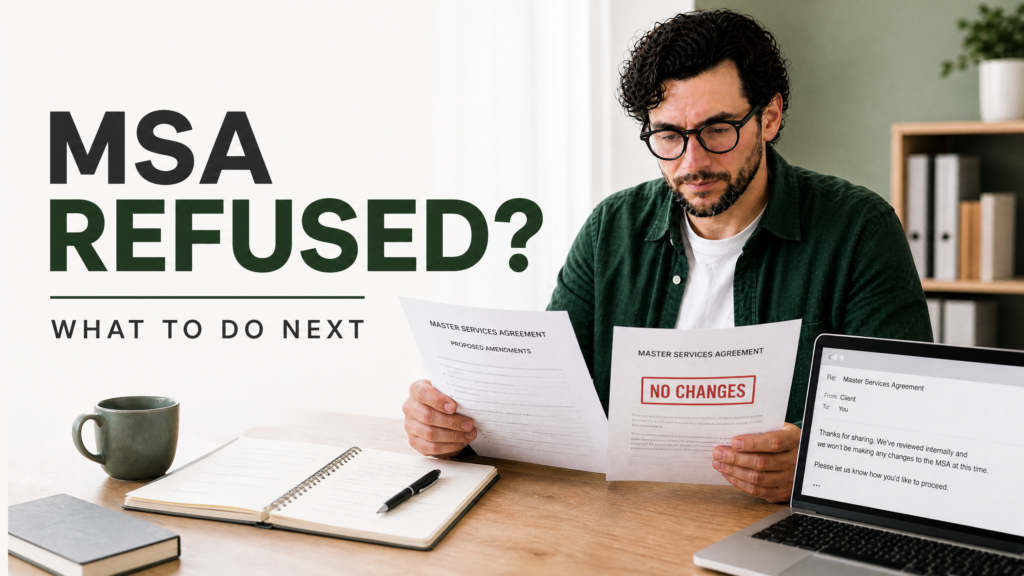
You then have a business decision.
Before signing, calculate the worst-case exposure.
Ask:
How much work could this clause theoretically require?
Then compare that exposure with:
- the project fee;
- expected hours;
- client value;
- payment schedule;
- reputation value;
- opportunity cost;
- termination rights;
- limitation of liability;
- ability to stop work;
- likelihood of recurring work.
You may decide to accept the clause.
You may decide to increase the price.
You may propose hourly billing.
You may request a narrower SOW.
Or you may decide that the risk is unacceptable.
The important point is that you should make that decision before signing, not after the dispute begins.
If payment risk is also part of your concern, review your [freelancer payment terms guide for avoiding problematic Net 60 arrangements]freelancer payment terms guide and [Net 15 vs. Net 30 vs. Net 45 payment terms]Net 15 vs. Net 30 vs. Net 45 payment terms.
9. The Budget Defense: Explain the Economics, Not the Emotion
One of the strongest negotiation arguments is straightforward:
“The fixed project fee is based on a defined scope. An uncapped revision obligation makes the amount of labor required uncertain.”
That is much stronger than:
“I don’t want to do unlimited revisions.”
You can then offer alternatives.
Option A: Fixed fee + capped revisions
“$10,000 includes three revision rounds.”
Option B: Fixed fee + hourly additional work
“$10,000 includes three rounds. Additional work is billed at $150/hour.”
Option C: Milestone pricing
“Discovery: $2,000. First production milestone: $4,000. Final production: $4,000.”
Option D: Retainer
For continuing work, a retainer may be more appropriate than trying to squeeze unlimited revisions into a single fixed-price project.
If you use a retainer, define what happens when the balance is exhausted. Our guide on [automatically notifying clients when a retainer balance reaches $0]The Retainer Exhaustion Warning explains one practical way to manage that boundary.
10. Do Not Let Multiple Stakeholders Create an Accidental “Unlimited” Obligation
This is one of the most overlooked problems.
Suppose your contract says:
“Three rounds of revisions.”
The marketing director provides feedback.
Then the VP provides new feedback.
Then the CEO requests another change.
Then the product team asks for a technical modification.
The contract may technically contain a revision cap, but the workflow can still become chaotic if it does not identify:
- who provides consolidated feedback;
- when a round begins;
- when a round ends;
- how feedback must be delivered;
- whether contradictory feedback resets the process;
- whether new stakeholders can introduce new requirements.
Consider adding:
“Client will provide consolidated feedback through one designated representative. A revision round will be deemed completed when Contractor has incorporated the consolidated feedback reasonably falling within the applicable scope.”
This won’t eliminate every dispute.
But it gives the parties a practical operating rule.
11. What If the Client Changes the Entire Project?
This is where revision clauses frequently collide with scope.
Imagine you agree to produce a 60-second promotional video.
After two rounds, the client says:
“We actually want a three-minute documentary-style brand film.”
That is not necessarily just another revision.
It may represent a material change in:
- duration;
- concept;
- production requirements;
- editing time;
- scripting;
- voiceover;
- music;
- footage;
- deliverables;
- licensing;
- schedule.
Before doing that work for free, compare the request against the agreed scope.
Our article on [what to do when a client changes the entire project and won’t pay]Client Changed the Entire Project and Won’t Pay goes deeper into that dispute pattern.
For video-specific projects, also see [what to do when a production client runs out of money before post-production ends]Video production client runs out of money.
12. What If You Already Signed the Unlimited-Revisions Clause?
This is different from negotiating before signature.
If you already signed, do not assume that the clause is automatically unenforceable.
At the same time, do not assume that every client request necessarily falls within the clause.
Start with the actual contract.
Step 1: Read the exact revision language
Do not rely on memory.
Find the exact clause.
Step 2: Read the SOW
Identify the original deliverables and specifications.
Step 3: Check the acceptance mechanism
Determine:
- who accepts the work;
- how acceptance occurs;
- whether there is a review period;
- whether acceptance can be withheld indefinitely;
- whether defects are treated differently from preference changes.
Step 4: Identify the governing law
The governing-law provision may materially affect how the contract is interpreted.
Step 5: Preserve the project history
Save:
- proposal;
- MSA;
- SOW;
- emails;
- briefs;
- approval messages;
- revision requests;
- versions;
- invoices;
- change-order discussions.
Our guide on [turning an email trail into a legally defensible invoice statement] can help with the documentation side of a later payment dispute.
Step 6: Separate contractual performance from new requests
If the client requests something that appears materially different from the original brief, ask for written clarification before performing substantial additional work.
Step 7: Obtain jurisdiction-specific advice when the stakes are material
If refusing the work could expose you to a breach claim, do not rely on a generic internet article to make the final decision.
A lawyer reviewing the actual contract can assess the applicable law and facts.
13. The Evidence File You Should Build Before the Project Starts
A good contract is only one part of your protection.
Create a project record containing:
- the executed MSA;
- executed SOW;
- proposal;
- project brief;
- pricing;
- deliverable specifications;
- revision history;
- dated versions;
- approval messages;
- change-order requests;
- invoices;
- payment records;
- important client instructions.
For a serious dispute, reconstructing the chronology later can be much harder than maintaining it from day one.
If a client communicates important approvals through Slack, WhatsApp or another platform, preserve those communications in an organized project record rather than assuming you will always be able to find them later.
You can also review [whether WhatsApp conversations can form legally binding contracts]WhatsApp conversations and contracts and [whether a Slack agreement can create contractual issues]Slack agreement and unpaid invoices.
14. Keep Version Control
Version control is not merely a technical habit.
It can help demonstrate how the deliverable evolved.
Use a consistent naming convention such as:
- Project_V1;
- Project_V2;
- Project_V3;
- Client-Revision-01;
- Client-Revision-02;
- Final-Approved.
Do not casually overwrite files.
If a client later claims that you ignored feedback, you should be able to identify:
- what was delivered;
- what feedback was received;
- what changes were made;
- when the revised version was delivered; and
- whether the request represented a new scope.
This is particularly important for developers and designers. If the dispute involves code or digital assets, our guides on [a client using your website code without paying]Client stole my website code and [a client holding code on AWS while refusing payment]Client has your code on AWS and won’t pay cover related evidence and recovery issues.
15. Copyright and IP: Do Not Assume Non-Payment Automatically Decides Ownership
This area requires particular caution.
A freelancer should not assume that:
“The client has not paid, therefore I definitely own everything.”
Nor should a client assume:
“We paid for the files, therefore we automatically own every copyright interest.”
The answer depends on applicable law and the contract.
Under U.S. copyright law, copyright initially vests in the author subject to statutory exceptions such as works made for hire. Copyright ownership can also be transferred by agreement.
For U.S. copyright transfers, 17 U.S.C. §204 generally requires a signed writing for a transfer of copyright ownership.
The U.S. Copyright Office also explains that copyright ownership is distinct from ownership of the physical object or copy embodying the work.
Therefore, your MSA should address IP expressly.
Consider defining:
- pre-existing materials;
- newly created deliverables;
- licences;
- assignments;
- third-party materials;
- source files;
- working files;
- payment conditions;
- portfolio rights;
- usage restrictions;
- rights that remain with the freelancer.
For U.S.-oriented readers, the [U.S. Copyright Office’s copyright ownership and transfer guidance]U.S. Copyright Office — Copyright Ownership and Transfer and [17 U.S.C. §204 on transfers of copyright ownership]17 U.S.C. §204 are useful primary sources.
You can also review our related guides on [clients using work without paying]Client Used Your Work but Didn’t Pay, [protecting video-script copyright]Client Used My Video Script Without Permission, and [protecting unpaid UI wireframes]Copyright infringement claim for unpaid UI wireframes.
16. Be Careful With the “Withhold the Final Files” Strategy
Whether you can withhold files, suspend services, revoke access, or otherwise restrict delivery depends on the contract and applicable law.
Do not treat “I haven’t been paid” as a universal legal authorization to take technical action.
For example, disabling a client’s server, deleting data, removing a live website, or revoking access can create additional legal and commercial risks.
If you are considering suspension, review the contract first.
Our guide on [using a notice of suspension of services without permanently damaging the client relationship]Notice of Suspension of Services provides a safer framework for thinking about the issue.
For specific technical-access situations, see our guides on [legally pausing an unpaid Shopify project]Unpaid Shopify project and [whether shutting down a client’s server for non-payment is legally safe]Can I shut down a client’s server for non-payment?.
17. A Better Redline Email
Keep the negotiation calm.
You do not need to accuse the client of trying to exploit you.
A practical email can say:
Subject: MSA Review — Revision and Change-Order Provision
Hi [Client Name],
Thanks for sending the MSA. I’ve reviewed the agreement and made a limited redline relating to revisions and additional scope.
Because the project is being priced on a fixed-fee basis, I’d like to define the included revision rounds and establish a change-order mechanism for requests that materially depart from the approved project brief.
My proposed language is intended to keep the project predictable for both sides while still allowing reasonable revisions within the agreed scope.
I’ve included the proposed language in tracked changes for your legal/procurement team to review.
Happy to discuss if they would prefer to address the same issue in the SOW or pricing schedule instead.
Best,
[Your Name]
Notice what this email does not say.
It does not say:
- “Your lawyers are wrong.”
- “This clause is illegal.”
- “You are trying to exploit me.”
- “I refuse to sign your contract.”
It gives the other side a commercially reasonable path to agreement.
18. What If the Client Says “Just Make It Pop”?
Vague feedback is difficult to price and document.
Instead of replying emotionally, convert the feedback into a specific question.
For example:
“Happy to refine this. To keep the revision within the current round, could you clarify whether you mean stronger contrast, a different typography treatment, a faster edit, or a different visual direction?”
This creates a written record of what the client actually wants.
It also prevents the word “revision” from becoming a substitute for a completely new creative direction.
For broader examples involving disputed creative work, see [the client who claims the “vibe changed” to avoid paying the asset fee]Client refuses to pay because the vibe changed.
19. Quick Decision Test: Should You Sign?
Before signing, ask these questions.
Scope
- Is the deliverable clearly defined?
- Is the original project brief incorporated?
- Are exclusions identified?
Revisions
- Is the number of included rounds stated?
- Is “revision” defined?
- Are corrections distinguished from new work?
Acceptance
- Who approves the work?
- Is there an acceptance period?
- Are objective criteria specified?
Pricing
- What happens after the included revisions?
- Is there an hourly rate?
- Is a written change order required?
Payment
- When are invoices issued?
- What are the payment terms?
- Is payment tied to acceptance?
- Can the client withhold the entire invoice because of a disputed item?
For payment-risk planning, compare your arrangement against our [early-payment discount strategy]Early payment discounts for freelancers and [invoice design guide for accounts payable teams]Invoice design that accounts payable teams can’t ignore.
Liability and dispute provisions
Do not stop at revisions.
Also examine:
- limitation of liability;
- indemnification;
- warranties;
- termination;
- confidentiality;
- IP;
- dispute resolution;
- governing law;
- venue;
- insurance requirements;
- data-security obligations.
A well-defined revision clause does not make the entire MSA safe to sign.
20. A Three-Level Risk Framework
You can use this practical framework before accepting an MSA.
Low revision risk
The contract contains:
- defined deliverables;
- defined revision rounds;
- objective acceptance criteria;
- a clear change-order process;
- an additional-work rate.
Moderate revision risk
The contract contains:
- some scope definition;
- an acceptance provision;
- limited revisions;
but leaves uncertainty around:
- stakeholder feedback;
- approval deadlines;
- additional work;
- change-order pricing.
This deserves clarification before signing.
High revision risk
The contract combines:
- fixed pricing;
- unlimited or open-ended revisions;
- subjective satisfaction;
- no acceptance deadline;
- no change-order mechanism;
- no clear SOW;
- no additional-work rate.
That combination creates substantial uncertainty.
The solution is not necessarily to reject the entire contract.
First try to make the commercial obligations measurable.
21. What If the Client Uses the Work Before Paying?
This becomes a separate payment and IP issue.
Do not automatically assume that use of the work proves copyright infringement or automatically entitles you to a particular remedy.
Instead, examine:
- what the contract says about licence or assignment;
- whether rights are conditioned on payment;
- whether a licence was granted;
- whether the client received permission to use drafts;
- what law governs;
- what rights actually exist in the work.
For related recovery situations, see [what to do when a client uses your work but refuses to pay]What to do when a client uses your work but refuses to pay and [how to respond when a client uses a design without paying]Client Used Your Design Without Paying.
The U.S. Copyright Office confirms that copyright rights can be transferred and that ownership questions can depend on assignments and work-made-for-hire rules.
22. International Clients: Do Not Assume One Rule Applies Everywhere

If the client is outside your country, review the governing-law and jurisdiction clauses carefully.
An MSA may specify:
- New York law;
- California law;
- English law;
- Singapore law;
- Indian law;
- arbitration;
- a particular court;
- another dispute-resolution mechanism.
The same contractual wording can have different consequences under different legal systems.
This is particularly important when your client, your business, and the place of performance are in different countries.
For broader risk management, see [how to protect yourself when working with international clients]Protect yourself when working with international clients.
Do not use the CISG as a general shortcut for international freelance-service contracts. UNCITRAL states that the CISG governs qualifying international sales of goods and excludes sales of services.
23. Primary Sources Worth Checking
Because contract and copyright rules can be jurisdiction-specific, readers should verify important propositions against primary or authoritative sources.
For U.S. copyright questions:
- [U.S. Copyright Office — Copyright Ownership and Transfer]U.S. Copyright Office — Copyright Ownership and Transfer
- [17 U.S.C. §201 — Ownership of Copyright]17 U.S.C. §201 — Ownership of Copyright
- [17 U.S.C. §204 — Execution of Transfers]17 U.S.C. §204 — Execution of Transfers
- [U.S. Copyright Office — Works Made for Hire]U.S. Copyright Office — Works Made for Hire
For U.S. legal research, Cornell Law School’s Legal Information Institute provides accessible explanations and statutory/regulatory material:
- [Cornell Legal Information Institute — Contract Modification]Cornell Legal Information Institute — Contract Modification
- [Cornell Legal Information Institute — Federal Contract Modification Rules]Cornell Legal Information Institute — Federal Contract Modification Rules
These resources are useful starting points, not substitutes for jurisdiction-specific legal advice.
FAQs: Unlimited Revision Clauses in MSAs
Can a client legally include an unlimited-revisions clause ?
A client can propose such a provision, but whether it is enforceable, how it is interpreted, and what work it actually requires depends on the contract and applicable law.
Do not assume that the label “unlimited” answers every legal question.
Read the provision together with the SOW, acceptance language, pricing and change-order provisions.
What should I do if I have not signed yet ?
Ask for a defined revision mechanism.
A practical structure is:
two or three included revision rounds;
a definition of revision;
objective or measurable acceptance criteria;
written change orders for material scope changes;
an additional hourly or fixed fee for approved extra work.
What if the client refuses to change its MSA ?
Ask whether the same commercial protection can be placed in the SOW, pricing schedule or another incorporated document.
If the client refuses every modification, evaluate the risk before signing.
You may choose to increase the price, change the billing structure, negotiate a narrower scope, or decline the engagement.
What if I already signed ?
Do not simply stop performing.
First review the exact contract, SOW, governing law, acceptance mechanism and revision history.
Then document the client’s requests and determine whether they appear to fall within the contractual scope.
If the financial or litigation risk is material, obtain advice on the actual agreement.
How many revisions should I include ?
There is no universal legal number.
Two or three rounds may be commercially workable for some projects, while milestone-based acceptance or hourly billing may be better for others.
The important point is to define the mechanism rather than assume a universal “industry standard.”
What counts as a revision ?
A revision generally changes an existing deliverable within the original scope.
A new deliverable, materially different concept, new functionality, substantially changed objective or other major departure from the approved brief may instead be a scope change.
The contract should define the distinction.
Should I always take a 50% deposit ?
An upfront deposit can reduce exposure, but corporate procurement systems may use milestone billing, purchase orders or post-delivery payment terms.
Choose a payment structure that fits the project and client
Can the client sue me if I refuse a tenth revision ?
A client could potentially assert a breach-of-contract claim if the contract requires the work.
Whether such a claim would succeed depends on the agreement, applicable law and facts.
Do not assume either that the claim will succeed or that it cannot be made.
Does non-payment automatically mean I own the copyright ?
No.
Copyright ownership and payment rights are related but distinct legal questions.
The applicable law and contract may determine whether rights were assigned, licensed, retained or otherwise allocated.
For U.S. copyright, see the Copyright Office and federal statutory sources cited above.
What if the client uses my work without paying ?
Review the contract first.
Determine what rights were granted, whether transfer or licensing was conditioned on payment, what work is protected, and what remedies may be available under applicable law.
Our [freelancer’s legal guide to recovering unpaid invoices]Freelancer’s legal guide to recovering unpaid invoices provides a broader recovery framework.
The Practical Rule to Remember
The goal is not to eliminate every client revision.
The goal is to make the commercial relationship measurable.
A strong project agreement should make it possible to answer:
What are we delivering?
How many revision rounds are included?
What counts as a revision?
Who gives consolidated feedback?
When is the work accepted?
What happens when the client wants something outside the original scope?
How is additional work priced?
When does payment become due?
What happens if either party wants to terminate?
If the contract answers those questions clearly, you have significantly reduced the uncertainty that causes many scope and payment disputes.
If it does not, the problem is not necessarily that the client is acting in bad faith.
The problem is that the contract may not adequately allocate the risk.
And that is exactly what you should fix before you sign.
Conclusion: Redline the Risk Before You Accept the Work
An unlimited-revisions clause does not automatically mean that a client is trying to exploit you.
It does mean you should understand the obligation before agreeing to it.
Read the MSA together with the SOW.
Define the deliverables.
Define the revision rounds.
Define acceptance.
Create a change-order mechanism.
Set the price for additional work.
Document approvals.
Preserve the project record.
And if the contract has already been signed, analyze the actual language before deciding that a particular client request is outside your obligations.
For a freelancer, the strongest protection is rarely an aggressive email after the dispute begins.
It is a clear agreement before the work begins.
If a payment dispute nevertheless develops, you can move from prevention to recovery using our [complete freelancer guide to recovering unpaid invoices without expensive lawsuits]Freelancer’s legal guide to recovering unpaid invoices.
And if you are already facing a disputed invoice, our guide on [recovering an unpaid invoice yourself without hiring a lawyer]Recover an unpaid invoice yourself explains the documentation and escalation process in greater detail.
Author
Adv. Sagar Haribhau Shirsat
Legal professional and creator of Freelancer Recovery, writing about contract risk, freelancer payment disputes, commercial documentation, digital work, and practical recovery strategies.
The articles on Freelancer Recovery are intended to provide general educational information and practical risk-management guidance. They are not a substitute for legal advice based on the specific facts, contract language, governing law, and jurisdiction of an individual matter.
For cross-border contracts or disputes involving significant financial exposure, readers should obtain advice from a qualified lawyer or advocate familiar with the applicable jurisdiction.