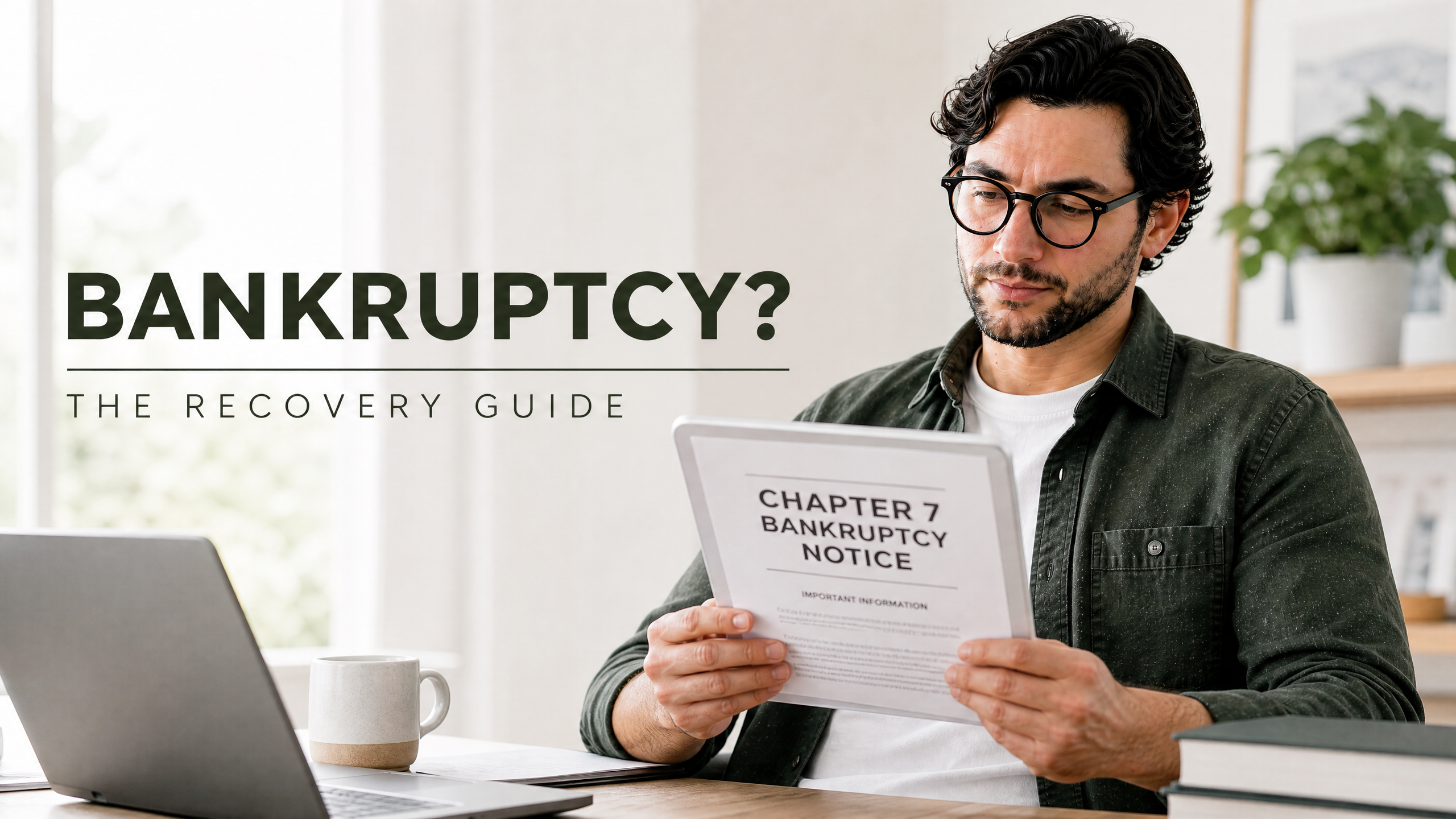
Did you just open your email to find a formal notice that your biggest non-paying client has filed for Chapter 7 bankruptcy?
Take a breath—and stop your ordinary collection workflow before doing anything else.
A Chapter 7 filing generally triggers the automatic stay under 11 U.S.C. § 362. The stay ordinarily stops efforts to collect prepetition debts and can also restrict actions involving property of the bankruptcy estate. The stay has statutory exceptions, so do not assume that every possible communication or contractual remedy is automatically prohibited. Instead, treat the bankruptcy filing as a signal to stop and verify your next step before acting.
Your immediate checklist is:
- Pause payment demands and other ordinary collection activity.
- Read the bankruptcy notice carefully and identify the case number, trustee, court, and applicable claims deadline.
- Preserve your contract, invoices, communications, delivery records, and digital work files.
- Review the intellectual-property provisions in your written agreement before assuming who owns the deliverables.
- Determine whether you have a monetary claim, a potential ownership/title issue, or both.
- File a Proof of Claim when the case and applicable procedure require or permit one.
This is where a normal unpaid-invoice strategy ends and bankruptcy procedure begins.
Chapter 7 is principally a liquidation proceeding. A trustee generally administers the debtor’s bankruptcy estate and, in an asset case, liquidates available nonexempt property and distributes proceeds according to the Bankruptcy Code. Many Chapter 7 cases are no-asset cases, meaning unsecured creditors may receive no distribution from the estate.
The important point for a freelancer is this:
A bankruptcy filing does not necessarily mean your invoice is worthless. It means your recovery strategy has changed.
Your contractual rights, the nature and priority of your claim, the existence of estate assets, the applicable claims deadline, and any separate intellectual-property rights can materially affect what you should do next.
Important legal notice: This article provides general information about U.S. bankruptcy and copyright principles for educational purposes. It is not a substitute for legal advice about a particular bankruptcy case. Deadlines, claim treatment, stay issues, intellectual-property rights, contract interpretation, and available remedies can depend on the specific case, contract, jurisdiction, court orders, and facts. Always verify the official bankruptcy notice and docket before relying on a deadline or taking action.
Table of Contents
The Automatic Stay Wall: What It Means and Why You Must Stop Ordinary Collection Activity

The filing of a bankruptcy petition generally triggers the automatic stay under 11 U.S.C. § 362.
The stay ordinarily prevents creditors from commencing or continuing many actions to recover claims that arose before the bankruptcy filing. It also restricts certain acts involving property of the bankruptcy estate.
For a freelancer, that means your normal collection workflow should go on hold.
Do not continue sending payment demands, threatening litigation, initiating collection proceedings, or taking other steps designed to recover the prepetition invoice without first determining whether the automatic stay applies to the proposed action.
The stay is broad, but it is not absolute. Section 362 contains statutory exceptions, and creditors can in appropriate circumstances seek relief from the stay through the bankruptcy court.
So the safest practical rule is:
Once you receive reliable notice of the bankruptcy, stop your ordinary collection workflow and verify your next action before sending, filing, terminating, repossessing, offsetting, or otherwise acting against the debtor or estate property.
If you were preparing a final demand letter, don’t send it automatically.
Your recovery strategy has now moved from ordinary invoice collection into the bankruptcy process.
For your broader pre-bankruptcy collection workflow, see my [freelancer’s legal guide to recovering unpaid invoices].
Freelancer’s Legal Guide to Recovering Unpaid Invoices
Chapter 7 vs. Chapter 11: What Changes for a Freelancer?
Understanding the bankruptcy chapter matters because Chapter 7 and Chapter 11 serve different purposes.
Chapter 7: Liquidation
Chapter 7 is principally a liquidation proceeding, rather than a long-term debt-restructuring process.
A Chapter 7 trustee generally administers the bankruptcy estate and, where nonexempt assets are available, liquidates those assets and distributes the proceeds according to federal bankruptcy priorities.
That does not necessarily mean every business instantly stops every operation on the day of filing. The practical administration of a business Chapter 7 case depends on the debtor’s assets, contracts, operations, and the trustee’s actions.
For an unsecured freelancer, the more useful questions are:
- Is this an asset or no-asset case?
- Do I have a valid prepetition claim?
- Is my claim secured, priority, or general unsecured?
- Is there a separate ownership or intellectual-property issue?
- Has the court established a deadline for proofs of claim?
- Is there a post-petition issue requiring separate treatment?
Many Chapter 7 cases are no-asset cases. In an asset case, unsecured creditors may receive a distribution if they hold an allowed claim and comply with the applicable claims procedure.
Chapter 11: Reorganization
Chapter 11 generally focuses on reorganization rather than straightforward liquidation.
A business debtor may continue operating while attempting to restructure its financial obligations under bankruptcy-court supervision. The treatment of individual creditors depends on the case, the debtor’s plan, court orders, and applicable bankruptcy law.
In some Chapter 11 cases, a debtor may seek authority to continue paying certain critical vendors. But “critical vendor” is not a status that every freelancer can simply demand. Treatment is case-specific and may require bankruptcy-court approval.
Quick Comparison
| Parameter | Chapter 7 | Chapter 11 |
|---|---|---|
| Primary purpose | Liquidation and administration of the bankruptcy estate | Reorganization or restructuring |
| Management | Trustee generally administers the Chapter 7 estate | Debtor generally remains in possession in ordinary Chapter 11 cases, subject to court oversight |
| Business operations | May cease or be limited depending on the case | May continue during reorganization |
| Freelancer impact | Determine claim status and whether a proof of claim is required | Monitor claims, plan, proposed treatment, and court orders |
| Recovery process | Distribution from estate assets if available | Treatment generally determined through the reorganization process |
The practical lesson is simple:
Chapter 7 usually means you are participating in a liquidation process. Chapter 11 may give the business a path to continue operating and reorganize its debts.
Are Freelancers Unsecured Creditors?
Often, yes—but not automatically in every case.
If you performed services for a client before the bankruptcy filing and are owed money without collateral securing the debt, your invoice will commonly be treated as a general unsecured claim.
That does not mean you should simply assume your legal position.
You should first determine whether:
- you have a valid security interest;
- a statutory lien may exist;
- a contractual right of setoff may apply;
- the debt qualifies for a statutory priority;
- part of the claim arose post-petition;
- or you have a separate ownership or title dispute concerning intellectual property.
The Bankruptcy Code establishes priority rules for certain categories of claims. Administrative expenses allowed under § 503(b), for example, receive priority under § 507(a)(2), while certain employee wage claims and other specified claims receive different statutory priorities.
The Bankruptcy Priority Ladder
A simplified framework looks like this:
- Valid secured claims — claims supported by enforceable collateral rights, subject to the Bankruptcy Code.
- Administrative expenses — qualifying expenses allowed under § 503(b).
- Certain priority unsecured claims — categories specified by § 507.
- General unsecured claims — many ordinary unpaid invoices and trade debts without collateral or statutory priority.
- Subordinated or other lower-priority interests, depending on the case.
This is only a simplified explanation. Actual distribution calculations can be considerably more complicated.
If the estate contains $50,000 but higher-priority claims and administrative expenses consume the available funds, a general unsecured creditor may receive little or nothing.
That is one reason why filing a valid claim is important when a claims process applies.
How to Determine Whether Your Invoice Is Actually Unsecured
Start with your contract.
Look for:
- security-interest language;
- collateral descriptions;
- lien rights;
- payment provisions;
- retention-of-title language;
- intellectual-property provisions;
- assignment provisions;
- license provisions;
- setoff language;
- termination rights;
- dispute-resolution provisions.
A contract does not automatically create a valid secured claim merely because it contains aggressive payment language.
Likewise, an intellectual-property ownership provision does not automatically transform an invoice into a secured claim.
These are different legal concepts.
If your unpaid invoice is simply a debt for services with no enforceable collateral or statutory priority, you will commonly be dealing with a general unsecured claim.
For broader contract protection, see my guide on [how to structure a proposal so it functions like a real legal defense contract].
How to Structure a Proposal So It Functions Like a Real Legal Defense Contract
The Intellectual-Property Question: Does the Client Actually Own Your Unpaid Work?
This is where freelancers can make one of the most dangerous assumptions in a bankruptcy case.
You should never automatically assume:
Unpaid invoice = freelancer owns copyright.
That is too simplistic.
Copyright ownership can depend on the Copyright Act, work-made-for-hire rules, written assignments, licenses, and the exact contract between the parties. The U.S. Copyright Office explains that copyright initially belongs to the author in ordinary circumstances, but works made for hire are an important exception, and ownership can also change through transfers.
A transfer of copyright ownership generally requires a written instrument signed by the owner or authorized agent.
Therefore, the correct question is not:
“Did the client pay?”
It is:
“What does the governing agreement legally say about ownership, licensing, assignment, work made for hire, and payment?”
A Strong Conditional IP Clause
Suppose your written contract says:
“Copyright ownership in the final deliverables transfers to Client only upon Client’s full payment of all amounts due for those deliverables.”
If that provision is legally enforceable and applies to the work at issue, the payment status may be highly relevant to the ownership analysis.
But that does not mean every unpaid freelancer automatically owns every piece of work they created.
You must also consider:
- whether the work is a work made for hire;
- whether copyright was already assigned;
- whether the client received a license;
- whether the clause covers the specific deliverable;
- whether there are separate pre-existing materials;
- whether the contract is governed by another jurisdiction;
- whether the bankruptcy estate disputes your claimed ownership.
The Bankruptcy Code defines property of the estate broadly as including the debtor’s legal or equitable interests in property at the commencement of the case.
That means a dispute over whether the debtor actually owned a particular copyright or other intellectual-property interest can become a title and estate-property question, rather than merely an unpaid-invoice dispute.
For copyright-specific issues, see my guides on [unpaid UI wireframes and copyright claims] and [what to do when a client uses your work without paying].
Can You File a Copyright Infringement Claim for Unpaid UI Wireframes?
What to Do When a Client Uses Your Work But Refuses to Pay You
Do Not Treat the Trustee’s Sale as Automatically Being Copyright Infringement
Suppose the trustee proposes selling a software platform containing code you created.
Do not immediately write:
“You are committing copyright infringement.”
That may be legally premature.
First establish:
- Who owns the copyright?
- Was there a written assignment?
- Was the work made for hire?
- Did the client receive a license?
- What does the contract say about payment and ownership?
- What exactly is being sold?
- Does the debtor have legal or equitable rights in the material?
- What relief, if any, is available through the bankruptcy court?
If you have a documented ownership position, you should preserve the evidence and consider promptly notifying the appropriate bankruptcy participants.
The better language is:
“I have a contractual and/or statutory basis to dispute the estate’s claimed ownership of these deliverables.”
That is substantially stronger than making an unsupported accusation of infringement.
Hypothetical Example: The $18,500 Design and Code Claim
The following is a hypothetical example, not a report of an actual bankruptcy case.
Imagine a UI/UX designer and developer named Marcus.
Marcus completes a SaaS company’s redesign and custom frontend development.
His final invoice is:
$18,500
The contract contains a clause stating that copyright in specified final deliverables transfers only after the client has paid the applicable fees in full.
The client fails to pay.
Two weeks later, Marcus receives notice that the client has filed Chapter 7.
The Initial Mistake
Marcus immediately considers:
- shutting down the client’s server;
- deleting repository access;
- revoking access to the live application;
- sending a demand letter to the CEO;
- threatening litigation.
That is exactly where he should stop.
The bankruptcy filing has changed the legal environment.
Actions designed to collect the prepetition debt may implicate the automatic stay, and actions involving estate property can create additional bankruptcy issues.
The Better Approach
Marcus should instead:
- Preserve the complete contract.
- Preserve invoices and payment records.
- Preserve evidence showing what was delivered.
- Identify the precise IP clause.
- Determine whether the clause actually conditions transfer on payment.
- Determine whether any work-made-for-hire language applies.
- Identify the bankruptcy trustee.
- Read the bankruptcy notice and docket.
- Determine whether the case is an asset case.
- Determine whether and when a proof of claim should be filed.
- Document any legitimate ownership dispute separately from the monetary claim.
- Avoid unilateral technical actions against estate property.
If the trustee later proposes selling assets containing disputed intellectual property, Marcus can present his documented ownership position through the appropriate legal process.
The point of this example is not that every freelancer can obtain a settlement from a Chapter 7 trustee.
The point is that:
A properly documented ownership dispute can be legally different from a simple unsecured invoice claim.
For technical infrastructure disputes, see my guides on [client code hosted on AWS] and [whether shutting down a client’s server for non-payment is legal].
The Client Has Your Code on AWS and Won’t Pay: The Code-Audit Breakdown
Can I Shut Down a Client’s Server for Non-Payment?
Step-by-Step: Filing Official Bankruptcy Form B 410
If you have a claim that should be filed in the bankruptcy case, the official form is B 410, Proof of Claim.
The U.S. Courts identify B 410 as an Official Bankruptcy Form.
Official U.S. Courts B 410 — Proof of Claim
But there is an important distinction:
Do not assume that every Chapter 7 creditor should immediately file Form B 410.
Many Chapter 7 cases begin as no-asset cases. If there are no assets available for unsecured creditors, a proof of claim may initially be unnecessary. If the trustee later determines that assets may be distributed, creditors can receive notice establishing a claims deadline.
That is why your first job is to read the bankruptcy notice.
Step 1: Identify the Bankruptcy Case
Locate the official bankruptcy notice.
Record:
- debtor’s exact legal name;
- case number;
- bankruptcy chapter;
- bankruptcy court;
- petition date;
- trustee’s name;
- trustee’s contact information;
- whether the notice indicates an asset or no-asset case;
- claims deadline, if one has been established.
Do not rely solely on a Google search, an email from the debtor, or a third-party bankruptcy database.
The official notice and court docket should control your procedural decisions.
Step 2: Determine Whether a Proof of Claim Is Required
Federal Rule of Bankruptcy Procedure 3002 generally requires creditors to file proofs of claim for claims to be allowed, subject to specified exceptions. In a voluntary Chapter 7 case, the current rule generally provides a 70-day filing period from the order for relief, while involuntary Chapter 7 cases generally use a 90-day period. The rule also contains exceptions and mechanisms concerning later-discovered assets and insufficient notice.
That means the old simplistic advice:
“Just add 70 days to the bankruptcy filing date.”
is not good enough.
Your actual case may involve:
- an asset case;
- a no-asset case;
- a later-discovered asset;
- an involuntary filing;
- conversion from another chapter;
- a court order affecting the claims process;
- insufficient notice;
- a special claims procedure.
Use the actual notice and docket.
Step 3: Calculate a Preliminary Reference Date
You can use the calculator below as a reference tool, but not as a substitute for the official bankruptcy notice.
Proof of Claim Deadline Calculator
The calculator is based on the current Rule 3002(c) framework, but the article deliberately does not call the calculated date the legal deadline.
Step 4: Complete Form B 410 Carefully
Use the current official form rather than an outdated internet template.
Download Official Form B 410 from U.S. Courts
When preparing your claim, carefully identify:
- creditor information;
- debtor and case information;
- amount of the claim;
- basis for the claim;
- whether the claim is secured, unsecured, or entitled to priority;
- whether the amount is contingent, unliquidated, or disputed;
- supporting documentation;
- applicable signatures and certifications.
Do not invent a priority classification simply because your invoice is large.
Do not label an IP ownership dispute as a “secured claim” unless you actually have a legally enforceable security interest.
And do not include post-petition services in the prepetition invoice claim merely because the services were part of the same project.
Step 5: Attach Supporting Documentation
A clean claim file should normally include the documents necessary to establish the debt and its basis.
Consider preserving:
- executed Master Services Agreement;
- Statement of Work;
- purchase orders;
- unpaid invoices;
- payment history;
- time records;
- delivery confirmations;
- acceptance emails;
- project-management records;
- relevant Slack or email communications;
- evidence of work completion;
- applicable IP clauses;
- evidence supporting any collateral or lien rights.
Do not casually dump your entire client history into the claim.
Provide the documentation required by the form, rules, court procedures, or claims agent instructions, and retain the complete evidence file separately.
For evidence organization, see [how to turn an email trail into a legally defensible invoice statement].
How to Turn an Email Trail into a Legally Defensible Invoice Statement
Step 6: File Through the Correct Channel
Depending on the case, claims may be filed through:
- the bankruptcy court;
- an approved electronic claims system;
- a designated claims agent;
- another procedure specifically stated in the case notice.
Do not assume that every bankruptcy case uses the same filing process.
For example, the District of Delaware provides electronic claim-filing resources and explains that certain administrative-expense requests should not be submitted using Form B 410.
Follow the instructions applicable to the specific case.
Important: Administrative Expenses Are Not Automatically Part of Form B 410
Suppose the trustee asks you to perform work after the bankruptcy filing.
Do not simply add that post-petition work to your old invoice and call the entire amount a normal prepetition claim.
Administrative-expense treatment is governed by § 503, and the statute provides a procedure for requesting payment of qualifying administrative expenses.
The better question is:
Does the post-petition expense qualify for administrative treatment under the Bankruptcy Code?
That can depend on the nature of the services, authorization, benefit to the estate, and other facts.
Interactive Tool: IP Ownership Notice Generator
If your contract contains a potentially enforceable provision conditioning IP transfer on payment, you may need to communicate your position to the trustee.
But do not use a generic generator as though it were a court filing or definitive legal opinion.
Use this tool as a drafting aid, then review the output against the actual contract and bankruptcy case.
Notice the difference between this version and the original.
It does not automatically declare:
“The debtor has no legal title.”
Instead, it preserves the creditor’s position without pretending that a template can resolve a contested bankruptcy/IP issue.
That is much safer.
The Preference Clawback Trap: 11 U.S.C. § 547
Now consider a different problem.
Suppose your client finally pays your $10,000 overdue invoice.
Three months later, the client files Chapter 7.
Later, the trustee contacts you and asks you to return the payment.
You may be dealing with a preference claim.
Section 547 allows a trustee, subject to statutory requirements and defenses, to avoid certain transfers made before bankruptcy that satisfy the preference provisions. One major period for ordinary creditors is the 90 days before the petition date.
This does not mean:
“Every payment received within 90 days must be returned.”
That would be incorrect.
The statute contains several defenses and exceptions.
Three Important Preference Defenses
1. Ordinary Course of Business
A qualifying payment made in the ordinary course of the parties’ business and according to the statutory requirements may fall within § 547(c)(2).
For example, if your client routinely paid your invoices late and the payment pattern remained consistent, that history may become relevant.
It does not automatically eliminate preference exposure.
The statutory elements must be examined.
2. Subsequent New Value
Section 547 also contains a defense concerning qualifying new value provided after the challenged transfer.
The accounting can become complicated.
Do not simply subtract the value of your later work from the original payment and assume that is the final liability.
3. Contemporaneous Exchange for New Value
A qualifying substantially contemporaneous exchange may receive protection under § 547(c)(1).
Again, the statutory requirements matter.
The lesson is:
A trustee’s preference demand is not necessarily the end of the analysis.
If you receive one, preserve the demand, your payment history, invoices, communications, and work records before responding.
For another perspective on partial payments, see my [Partial Payment Trap guide].
Do Not Accept a Last-Minute Settlement Without Understanding the Consequences
A client approaching insolvency may suddenly offer:
“We’ll pay you 20% today if you close the account.”
That can be tempting.
But a payment shortly before bankruptcy can raise preference issues, while a settlement can also affect contractual claims and other rights depending on the language used.
Never assume:
“Money received = problem solved.”
Before signing a release or accepting a settlement from a financially distressed client, understand:
- what claims you’re releasing;
- whether the payment is conditional;
- whether the agreement contains an admission;
- whether the client has already filed bankruptcy;
- whether the payment could later become the subject of a preference demand;
- whether the settlement affects IP rights;
- whether the agreement contains a waiver of future claims.
Comprehensive Evidence Checklist for a Bankruptcy Claim
Bankruptcy claims are evidence-driven.
Create one clean folder containing:
- Master Services Agreement
- Statements of Work
- Purchase orders
- Unpaid invoices
- Payment records
- Delivery confirmations
- Client acceptance emails
- Relevant Slack/email communications
- Time records
- Git commits or repository records
- Figma/project-management records
- IP ownership clauses
- License or assignment agreements
- Evidence of payment history
- Bankruptcy notice
- Case number
- Trustee information
- Proof-of-claim documentation
- Evidence supporting any secured or priority status
Do not modify old evidence merely to make it look cleaner.
Preserve original records and maintain a separate working copy.
If the debt was agreed through email rather than a formal contract, see [Can You Sue a Client Without a Contract?].
Can You Sue a Client Without a Contract? Real Legal Answer (2026)
Insolvency Risk Matrix for Freelancers
The best bankruptcy strategy is sometimes the strategy you use before bankruptcy.
Watch your clients for financial distress.
| Risk Level | Warning Indicators | Practical Response |
|---|---|---|
| LOW | Consistent payments, clear communication, normal project activity | Maintain ordinary billing and documentation |
| MEDIUM | Repeated payment delays, accounting excuses, reduced communication | Tighten payment milestones and document outstanding balances |
| HIGH | Ghosting, missed payroll reports, layoffs, funding problems, repeated demands for unpaid work | Pause new exposure where contractually permitted, review the agreement, preserve evidence, and consider legal advice |
If a client is already running out of money during a project, see my [client runs out of money mid-project guide].
Client Runs Out of Money Mid-Project? Legal & Smart Recovery Guide for Developers
You can also review [what to do when a video production client runs out of money].
What to Do When a Video Production Client Runs Out of Money Before Post-Production Ends
Before Bankruptcy: Reduce Your Exposure
Bankruptcy is a reminder that invoice recovery begins before the invoice becomes overdue.
Useful contract protections include:
- milestone billing;
- deposits;
- clear payment deadlines;
- written IP-transfer conditions;
- limited licenses;
- suspension provisions;
- late-payment provisions;
- clearly defined deliverables;
- acceptance procedures;
- change-order requirements;
- dispute-resolution provisions.
For payment-term planning, see [Freelancer Payment Terms Guide].
Freelancer Payment Terms Guide: Avoid Net 60 & Late Payments
And if you need to suspend work because of non-payment before a bankruptcy filing, review [how to use a Notice of Suspension of Services].
How to Use the Notice of Suspension of Services Without Ruining the Client Relationship Permanently
The key distinction is important:
A contractual suspension before bankruptcy is a different legal situation from taking unilateral action against a debtor or estate after bankruptcy has begun.
What About Digital Assets, Servers, GitHub and Cloud Accounts?
This is where freelancers can accidentally create serious problems.
Suppose the client owes you $20,000 and has your code deployed on AWS.
Before bankruptcy, you might have contractual rights concerning access or suspension depending on your agreement and applicable law.
After bankruptcy, however, the automatic stay and bankruptcy estate rules can materially change the risk.
Do not assume that:
“It’s my code, so I can shut down their server.”
That is not a safe universal rule.
Similarly, do not:
- delete production databases;
- destroy backups;
- revoke essential access;
- remove repositories;
- erase cloud resources;
- redirect domains;
- disable customer accounts;
- delete hosted files;
simply because an invoice is unpaid.
The bankruptcy estate can include the debtor’s legal and equitable interests in property as of commencement of the case.
For a technical dispute, preserve evidence first.
Then determine what the contract, copyright law, bankruptcy law, and applicable court orders permit.
See also [how to revoke Figma access after non-payment].
How to Revoke Access to Figma Files After Non-Payment (Safe & Legal Method)
A Critical Distinction: Your Invoice Claim vs. Your Property Rights
This is probably the most important conceptual distinction in the entire article.
You may have two separate legal questions:
Question 1: How much money does the debtor owe me?
That is your monetary claim.
Question 2: What legal rights do I have in the work I created?
That may involve:
- copyright;
- licensing;
- assignment;
- work made for hire;
- trade secrets;
- contract rights;
- possession;
- title;
- other intellectual-property interests.
Do not collapse these questions into one.
For example:
“The client owes me $15,000, therefore I own everything I created.”
That conclusion does not automatically follow.
Likewise:
“The client filed bankruptcy, therefore the trustee owns everything I created.”
That conclusion does not automatically follow either.
The answer comes from the contract, applicable law, and facts.
For code ownership disputes, see [Client Stole My Website Code].
Client Stole My Website Code: Legal Steps to Respond, Prove Ownership, and Recover Access
Quick Decision Matrix: What Should You Do Next?
Use this as a practical triage tool—not as a substitute for case-specific legal advice.
If there is no bankruptcy filing yet and the client is simply delaying payment, you can use a normal recovery workflow.
For that situation, see [How to Recover an Unpaid Invoice Yourself].
How to Recover an Unpaid Invoice Yourself (Without Hiring a Lawyer)
What If the Bankruptcy Case Is International?
Chapter 7 is a U.S. bankruptcy procedure.
If your client is located in another country, do not assume the U.S. Chapter 7 framework applies.
Cross-border insolvency can involve:
- recognition of foreign proceedings;
- jurisdictional questions;
- local insolvency law;
- choice-of-law issues;
- enforcement of judgments;
- international insolvency treaties or regulations;
- foreign claims procedures.
If your client is outside the United States, start with the governing jurisdiction rather than trying to force the dispute into Chapter 7 terminology.
For broader cross-border protection, see [How to Protect Yourself When Working With International Clients].
How to Protect Yourself When Working With International Clients
Frequently Asked Questions
1. Does a Chapter 7 filing automatically mean I will never get paid?
No.
Your recovery depends on the case, the debtor’s assets, your claim, its priority, applicable exemptions and liens, the claims process, and the amount available for distribution.
Many Chapter 7 cases are no-asset cases, in which unsecured creditors receive no distribution. But an asset case can produce distributions to qualifying creditors.
2. Can I still email the client after they file bankruptcy?
Do not continue ordinary payment-collection communications without first determining whether the automatic stay applies.
The safest approach is to pause collection activity and communicate through the appropriate bankruptcy process.
The automatic stay is broad and can prohibit acts to recover prepetition claims, while statutory exceptions exist.
3. Does non-payment mean I automatically retain copyright?
No.
Copyright ownership depends on the applicable law, work-made-for-hire rules, assignments, licenses, and the governing agreement.
A written copyright transfer generally requires a signed writing under 17 U.S.C. § 204, but that is only one part of the analysis.
4. What if my contract says copyright transfers only after full payment?
That provision may be highly important.
If it is valid, applicable to the deliverables, and enforceable under the governing law, the client’s failure to pay may affect whether ownership transferred.
But you should still examine:
- work-made-for-hire language;
- other assignment clauses;
- licenses;
- pre-existing materials;
- amendments;
- governing law;
- the precise definition of “deliverables.”
Do not treat one contract sentence as resolving every possible copyright question.
5. Can the trustee sell my code?
The answer depends on what rights the debtor actually holds in the code.
The bankruptcy estate generally includes the debtor’s legal or equitable interests in property as of the commencement of the case.
If you have a genuine ownership or title claim, preserve your documentation and raise the issue through the appropriate bankruptcy process.
Do not assume that sending an aggressive email or shutting down the debtor’s infrastructure is the correct remedy.
6. Do I always need to file Form B 410 immediately?
No.
In a typical Chapter 7 no-asset case, unsecured creditors may not initially need to file proofs of claim because there is no expected distribution. If assets later become available, the court can provide notice and establish a claims deadline.
If a proof of claim is required, use the current official B 410 form and follow the applicable court instructions.
7. Is the 70-day period always the deadline?
No.
Federal Rule of Bankruptcy Procedure 3002(c) generally provides a 70-day period in a voluntary Chapter 7 case and 90 days in an involuntary Chapter 7 case, subject to exceptions. Later-discovered assets, insufficient notice, conversion, and other circumstances can affect the claims process.
Always verify the actual deadline applicable to the case.
8. What if the trustee asks me to perform new work after bankruptcy?
Do not automatically add the new work to your old prepetition invoice.
Post-petition expenses may require separate treatment, and administrative-expense status depends on the Bankruptcy Code and the facts of the case. Section 503 establishes the framework for administrative expenses.
Get the request in writing and determine who authorized the work, what the work is for, and how payment will be handled.
9. Can I accept a payment from a client shortly before bankruptcy?
You can receive payments in ordinary commercial relationships, but payments received shortly before bankruptcy can potentially raise preference questions.
Section 547 contains both the preference provisions and several defenses, including statutory protections for qualifying ordinary-course transactions, contemporaneous exchanges, and subsequent new value.
If you receive a trustee demand seeking return of a payment, preserve the entire payment history before responding.
10. Should I hire a bankruptcy lawyer?
It depends.
Legal advice becomes particularly valuable where:
- the claim is substantial;
- the trustee disputes your claim;
- the claim may be secured or priority;
- the case involves valuable intellectual property;
- the trustee proposes selling disputed assets;
- there is a preference demand;
- there are setoff issues;
- the contract contains complex assignment or licensing provisions;
- the debtor disputes the amount;
- you may need relief from the automatic stay.
The cost-benefit calculation depends on the facts—not merely on whether the invoice is above or below an arbitrary dollar amount.
Official Bankruptcy and Copyright Resources
For a legal article, readers should be able to verify the underlying primary authorities themselves.
U.S. Courts — Chapter 7 Bankruptcy Basics
U.S. Courts — Chapter 7 Bankruptcy Basics
U.S. Courts — Bankruptcy Process
U.S. Courts — Bankruptcy Basics: The Bankruptcy Process
U.S. Courts — Official Form B 410
U.S. Courts — Official Form B 410 Proof of Claim
Federal Rule of Bankruptcy Procedure 3002
Cornell Law School — Federal Rule of Bankruptcy Procedure 3002
11 U.S.C. § 362 — Automatic Stay
Cornell Law School — 11 U.S.C. § 362
11 U.S.C. § 503 — Administrative Expenses
Cornell Law School — 11 U.S.C. § 503
11 U.S.C. § 507 — Bankruptcy Priorities
Cornell Law School — 11 U.S.C. § 507
11 U.S.C. § 541 — Property of the Bankruptcy Estate
Cornell Law School — 11 U.S.C. § 541
11 U.S.C. § 547 — Preferences
Cornell Law School — 11 U.S.C. § 547
17 U.S.C. § 204 — Copyright Transfers
Cornell Law School — 17 U.S.C. § 204
U.S. Copyright Office — Copyright Ownership
U.S. Copyright Office — What Is Copyright?
U.S. Copyright Office — What Writers Should Know About Copyright
U.S. Copyright Office — What Writers Should Know About Copyright
These primary sources are much better for a YMYL legal article than relying exclusively on secondary legal blogs.
The Freelancer’s Final Chapter 7 Checklist
If you receive a Chapter 7 bankruptcy notice from a client who owes you money:
- Stop ordinary collection activity.
- Do not send a new payment demand.
- Do not threaten litigation without checking the stay.
- Record the exact bankruptcy case number.
- Identify the bankruptcy court.
- Identify the trustee.
- Read the entire bankruptcy notice.
- Determine whether the case is currently an asset or no-asset case.
- Identify the applicable claims procedure.
- Do not rely solely on an online calculator for the bar date.
- Preserve the contract.
- Preserve invoices.
- Preserve payment records.
- Preserve emails and Slack communications.
- Preserve delivery and acceptance evidence.
- Review copyright assignment provisions.
- Review work-made-for-hire provisions.
- Review licenses and pre-existing IP provisions.
- Determine whether you have a secured, priority, or general unsecured claim.
- Separate your monetary claim from any ownership/title dispute.
- Use Official Form B 410 when applicable.
- Follow the bankruptcy court or claims-agent filing instructions.
- Preserve evidence of any payments received during the 90-day preference period.
- Do not assume every payment is a preference.
- Do not assume every payment is protected.
- Treat post-petition work separately.
- Do not delete or disable the client’s digital assets without legal review.
- Monitor the bankruptcy docket.
- Seek bankruptcy counsel if the claim or IP dispute is substantial.
Bottom Line
A Chapter 7 filing changes the rules of the game.
Your old collection strategy—emails, reminders, final notices, lawsuits, payment threats—may no longer be the appropriate path once the bankruptcy petition triggers the automatic stay.
But that does not mean you should simply abandon the invoice.
Instead:
Stop ordinary collection activity. Identify the bankruptcy procedure. Preserve your evidence. Determine your claim classification. Review your contract’s IP provisions carefully. Follow the applicable claims process. And treat any separate ownership or preference issue as a distinct legal problem.
The biggest mistake a freelancer can make is reacting emotionally.
The second biggest mistake is assuming that bankruptcy automatically destroys every right they have.
Neither is true.
Your job is to identify exactly what you are owed, exactly what rights you possess, and exactly where those rights must now be asserted.
And remember:
A $20,000 unpaid invoice is one problem. A $20,000 invoice plus disputed copyright ownership plus a bankruptcy trustee plus a potential preference claim is four different legal problems.
Separate them.
Document them.
Then deal with each one through the correct legal process.
Author
Adv. Sagar Haribhau Shirsat is a legal professional writing about commercial contracts, digital work, freelancer payment disputes, and practical debt-recovery systems for independent professionals and agencies.
Disclaimer
This article is provided for general educational and informational purposes only. It does not create an attorney-client relationship and does not constitute legal advice for any specific bankruptcy, contract, copyright, collection, or insolvency matter.
U.S. bankruptcy and copyright law can vary significantly depending on the facts, jurisdiction, contract language, procedural posture, and court orders. Readers dealing with an actual bankruptcy case should verify the applicable rules, notices, deadlines, and docket and should consider obtaining advice from a qualified bankruptcy or intellectual-property attorney where appropriate.