
According to recent data from the Freelancers Union, the average independent worker loses over $6,000 a year to unpaid labor. That is a staggering number.
Think about what you could do with an extra six grand. You could upgrade your gear. You could take a real vacation. You could finally build an emergency fund.
Instead, that money vanishes into the void of “just one more quick edit.” Stop Working for Free !
Look, I have been there. I know exactly how it feels to stare at an email at 11 PM, stomach in knots, because a client asked for another favor.
You want to be helpful. You want to deliver great work. You want to avoid conflict.
But you have to stop working for free. It drains your bank account, ruins your schedule, and quietly destroys your passion for the work.
Today, I am going to show you exactly how to fix this. No legal jargon. No aggressive boardroom tactics. Just real, practical steps to protect your time and your money.
Table of Contents
The Midnight “Quick Favor” Trap
Let me tell you a story. A few years ago, I landed what looked like a dream client. The pay was decent. The project was interesting.
The initial agreement was simple. I would deliver a core set of assets. They would review it once. We would finalize it.
But then the emails started.
“Hey, could we just try this in a different shade of blue?”
“Actually, my partner thinks we should add a new section here.”
“I know this wasn’t in the brief, but can you just quickly mock this up?”
I said yes to the first one. It took ten minutes. No big deal, right?
But saying yes established a dangerous baseline. I accidentally taught them that my boundaries were entirely flexible.
Before I knew it, my hourly rate had plummeted. I was essentially working for minimum wage.
I was burning out, and it was entirely my own fault. I hadn’t set the rules of the game.
If you want to survive in this business, you need to learn how to identify these tiny requests before they snowball.
For more on spotting these issues early, check out our guide on identifying red flags.
Dont worry. Whats as contracts .
What Actually Is Scope Creep ?
Scope creep is the slow, continuous expansion of a project’s requirements beyond the original agreement.
It rarely happens all at once. Clients don’t usually wake up and decide to exploit you.
Instead, it happens in inches. It is a slow leak in your business’s tire.
Most freelancers fail to stop it because they confuse boundary-setting with being difficult.
Here is the truth : professionals have boundaries. Amateurs have infinite flexibility.
When you set firm boundaries, clients actually respect you more. They trust your expertise.
To do this right, you need a solid freelance contract. But a contract is just paper if you don’t enforce it.
The Psychology of Unpaid Work
Why do we do it ? Why do we agree to do extra work without extra pay ?
Fear. Pure and simple.
We are afraid the client will get angry. We are afraid they will leave a bad review. We are afraid they will withhold the final payment.
This fear puts us in a defensive posture. We start acting like employees instead of business owners.
But you are a business owner. Your time is your inventory. Giving it away for free is like a retail store leaving their doors open at night.
You have to shift your mindset. You are not a subordinate. You are an equal partner in a business transaction.
Case Study : The Delayed Payment Trap
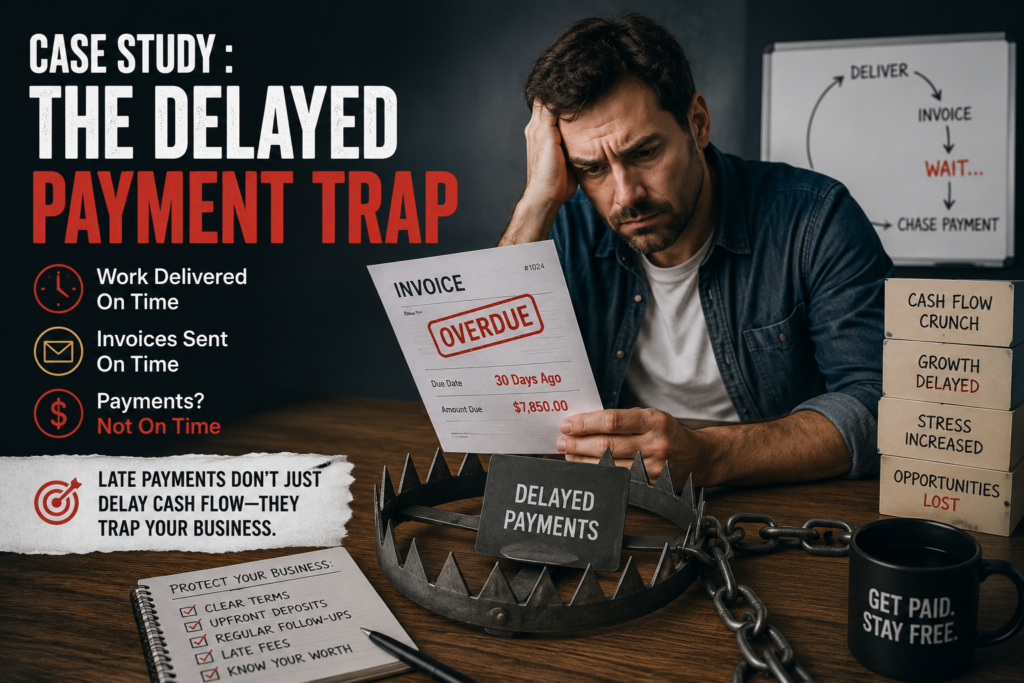
Let’s look at a real-world scenario. Let’s call our freelancer Alex, a web developer.
Alex agreed to build a five-page website for a local business. The fee was $3,000.
Fifty percent upfront, fifty percent on delivery. A standard, safe setup. Or so Alex thought.
Alex delivered the site on time. It looked great. The client loved it and immediately pushed it live.
Then came the invoice for the final $1,500.
The client replied : “The site looks great! We just need you to integrate this new CRM tool before we close out the invoice.”
Integrating that tool was never discussed. It would take Alex two full days to code and test.
The client was holding the final payment hostage. They were using Alex’s fear of not getting paid to extract free labor.
Because the site was already live, the client had all the leverage so we have to recover money if client ghosted.
Alex panicked. He did the work. He spent two miserable days coding for free.
He eventually got his $1,500, but his effective hourly rate took a massive hit. Plus, the client kept coming back for “tiny fixes” for months.
This happens every day. If you don’t know the late payment laws in your region, you are incredibly vulnerable to this tactic.
The Non-Linear Breakdown : Where Projects Derail
Projects don’t usually fail at the end. They fail at the beginning.
There are three main points of failure where scope creep sneaks in.
1. The Vague Proposal If your proposal says “Design a logo,” you are doomed. That could mean one sketch or fifty revisions. Be painfully specific.
2. The Casual Chat Clients love to assign work via WhatsApp or quick phone calls. It feels informal, so it bypasses your formal review process.
3. The “We’re Almost There” Phase This is the deadliest phase. The project is 95% done. The client wants to endlessly tweak the final 5%.
You must have a system for handling infinite revisions. If you don’t, you will get stuck in the 95% loop forever.
The Risk Matrix : Assessing Client Requests
Not all extra requests are toxic. Sometimes, a tiny favor builds great long-term goodwill.
The trick is knowing the difference. I use a simple Risk Matrix to evaluate every request.
Low Risk (Do it for free, but document it)
- Takes less than 15 minutes.
- Doesn’t require new software or assets.
- Is requested politely, not demanded.
- Action: Do it, but clearly state it is a courtesy. “Happy to handle this one-off update for you at no charge!”
Medium Risk (Flag it, estimate it)
- Takes 15 to 60 minutes.
- Requires opening old files or altering core structures.
- Feels like a slight shift in project direction.
- Action: Pause. Tell them it’s out of scope. Offer a quote. “I can add that feature! It will add $150 to the final invoice. Shall I proceed?”
High Risk (Full stop, renegotiate)
- Takes over an hour.
- Fundamentally changes the project goal.
- Client demands it as part of the original price.
- Action: Stop work. Get on a call. Redraw the boundaries.
If you struggle with the financial side of this, brush up on pricing your freelance services. Confidence starts with knowing your numbers.
India vs. Global : How the Rules Change
I work with freelancers all over the world. The mechanics of scope creep are universal, but the legal safety nets vary wildly.
Let’s look at the differences, especially if you are operating out of India compared to the US or UK.
In the United States and UK In the US, freelancers often rely on small claims courts or specific state labor laws. The UK is brilliant because of the Late Payment of Commercial Debts Act.
Under UK Gov laws, you can legally charge statutory interest and a fixed debt recovery cost if a client delays payment over scope arguments. It gives you massive leverage.
In India In India, things operate differently. The Indian Contract Act of 1872 recognizes verbal agreements, but good luck proving them in court without years of litigation.
However, if you are registered as an MSME (Udyam registered), you have a powerful tool: the MSME Samadhaan portal.
If a client delays payment beyond 45 days, you can file a case through the portal. The government mandates compound interest at three times the bank rate.
This is a game-changer for Indian creatives and consultants. It forces corporate clients to take your invoices seriously.
Regardless of where you live, relying on the courts should be your absolute last resort.
For more on taking legal steps , read our small claims court guide.
The Action System : How to Lock Down Your Scope
You need a repeatable system. You cannot rely on willpower when a client is pressuring you.
Here is my exact, tested system to stop working for free.
Step 1 : The Bulletproof Scope of Work (SOW)
Your proposal must explicitly state what is included AND what is NOT included.
Don’t just write “Includes 3 revisions.”
Write: “Includes 3 revision rounds. Additional revisions will be billed at $85/hour. New feature requests will require a separate quote.”
Step 2 : Control the Communications
Never accept project changes via text message. Ever.
If a client texts you a request, reply with this: “Great idea. Please drop that in an email so I can track it and check the timeline.”
This creates friction. Friction stops casual scope creep in its tracks. It is essential for setting communication boundaries.
Step 3 : The “Yes, And” Technique
When a client asks for extra work, never say no. Say yes, with a price tag.
Client: “Can we add a blog section to the site?”
You: “Yes, absolutely! I can build that out for you. Let me send over a quick quote for that addition so we can get started.”
Nine times out of ten, they will suddenly realize they don’t actually need that blog section right now.
Step 4 : Stagger Your Payments
Never leave more than 20% of the project fee tied to the final, final delivery.
If you do, the client holds all the leverage. They will use that 20% to force infinite tweaks.
I prefer a 40/40/20 split, or simply billing strictly based on time milestones rather than subjective approvals.
Learn more about the psychology of getting paid upfront. It changes everything.
Important Citations for you :
United Kingdom : Commercial Debt & Insurance
The UK has established a stringent framework to penalize the late payment of commercial debts. Specifically, regulatory impact assessments by HM Treasury underscore the government’s objective to mandate prompt payments in commercial settings, extending to insurance claims, where insurers are legally incentivized to pay within a reasonable timeframe (Treasury, n.d.).
Furthermore, international tribunals and commercial courts increasingly award pre-judgment and post-judgment interest at market rates to fully compensate aggrieved parties for the loss of use of their money due to delayed payments (Gotanda, n.d.).
United States : Freelance & Gig Economy Protections
In the US, the protection of gig economy workers and freelancers from non-payment has become a legislative priority at the state and municipal levels.
The New York City Freelance Isn’t Free Act (FIFA) was a landmark statute requiring hiring parties to provide written contracts for services exceeding $800 over a 120-day period, though early analyses noted ambiguities in its jurisdictional reach and definitions (Baranowski, n.d.).
This framework has since expanded, with the state-wide New York FIFA taking effect in 2024 and California enacting similar protective measures for an estimated workforce of nearly 60 million independent contractors (Saracino, n.d.).
Much of this legislative push responds to the broader misclassification of gig economy workers, where employers classify workers as independent contractors to withhold traditional benefits and offload operational costs (Brown II, n.d.).
References
Baranowski, C. M. (n.d.). THE HIGH COST OF NEW YORK CITY’S FREELANCE ISN’T FREE ACT ON HIRING PARTIES – BrooklynWorks. Access here Cited by: 4
Brown II, B. A. (n.d.). YOUR UBER DRIVER IS HERE, BUT THEIR BENEFITS ARE NOT: THE ABC TEST, ASSEMBLY BILL 5, AND REGULATING GIG ECONOMY EMPLOYERS – BrooklynWorks. Access here Cited by: 12
Gotanda, J. Y. (n.d.). A Study of Interest – Digital Repository. Access here Cited by: 8
Saracino, J. (n.d.). NEW YORK LAW DEVELOPMENTS – THE AGE OF THE FREELANCE WORKER. Access here Cited by: 0
Treasury, H. M. (n.d.). Impact assessment – Late payment of insurance claims – UK Parliament. Access here Cited by: 0
The Evidence Checklist
If things go bad, you need a paper trail. The freelancer with the best documentation always wins.
Make sure you have saved:
- The original, signed Scope of Work.
- Written approval of major milestones.
- Emails where the client requested extra work.
- Emails where you stated the extra work would cost more.
- Time-stamped drafts or code commits showing you delivered the original request.
Do not rely on your memory. Do not rely on phone calls. If it isn’t written down, it didn’t happen.
Quick Decision Engine : Should I Do This For Free?
I promised you practical tools. Use this quick logical flow when a request comes in.
1. Is it explicitly in the original contract ? If yes -> Do the work. If no -> Go to question 2.
2. Will it take less than 15 minutes total ? If yes -> Do it as a documented courtesy. If no -> Go to question 3.
3. Is this client a high-value, long-term retainer client ? If yes -> Consider doing it, but log the hours and show them the zeroed-out invoice so they see the value. If no -> Stop. Issue a change order and charge your rate.
Tools to Protect Your Business
I want to give you two concrete tools you can use right now.
Tool 1 : The Scope Creep Cost Calculator
If you want to see exactly how much money you are losing, use this simple calculator logic.
When you see that number in bright red, it changes how you look at “quick favors.”
Tool 2 : The Polite Pushback Email Generator
You don’t need to be aggressive. You just need to be professional.
When a client asks for out-of-scope work, copy and paste this template :
Subject: Re: Updates to [Project Name]

Hi [Client Name],

Thanks for sending over these new ideas! They sound great.

Looking at the list, these requests fall outside our original Scope of Work.

I'd love to help you implement them. I estimate this will take about [Number] hours, which would add $[Amount] to the project total.

Would you like me to go ahead and add this to the invoice, or should we stick to the original plan for now?

Best,
[Your Name]
It is calm. It is trustful. It puts the decision entirely in their hands without you having to be the bad guy.
Real Talk on Losing Clients
Here is the part most business coaches won’t tell you.
When you start enforcing boundaries, you might lose a client or two.
Good.
Let them go. Clients who rely on exploiting your free labor are blocking you from finding clients who respect your value.
The first time you push back, your heart will pound. You will stare at your screen waiting for their angry reply.
But usually, they just say, “Oh, my bad. Let’s stick to the original plan.”
And just like that, you took your power back.
Frequently Asked Questions (FAQs)

What if the client claims the extra work was implied in the brief ?
This is why vague briefs are dangerous. If they claim it was implied, refer back to your itemized deliverables list. Calmly explain that you only execute on explicit, written deliverables to ensure quality and budget control.
Should I charge upfront to avoid payment delays ?
Yes. Always take a deposit. I recommend at least 50% upfront for new clients. If they refuse to pay a deposit, they were never going to pay your final invoice anyway.
How do I handle a client who calls me constantly with “small tweaks” ?
Move them to asynchronous communication. Stop picking up the phone immediately. Let it go to voicemail. Reply later via email: “Got your message! Please send all requested tweaks in a single email so I don’t miss anything.”
What if the project is already a disaster and I’ve done too much free work ?
Draw a line in the sand today. Send an email stating: “To ensure we hit our final deadline, any new requests from this date forward will require a separate change order.” You can’t change the past, but you can control tomorrow.
Is a verbal agreement legally binding if they promise to pay me later ?
Technically, yes, in many jurisdictions like the US, UK, and India. Practically ? No. Verbal agreements are notoriously difficult to prove. Always, always get financial promises in writing. An email confirmation is the bare minimum.
Closing the Loop
You don’t have to live like that. Freelancing is supposed to give you freedom, not turn you into a 24/7 support desk for demanding clients.
The moment you decide to stop working for free is the moment your business actually begins.
It takes practice. You will mess up. You will accidentally say yes to a quick favor and kick yourself later.
That is okay. I still do it sometimes. We are human.
But armed with clear contracts, written boundaries, and the willingness to say “I can do that for a fee,” you become unstoppable.
Protect your time. It is the only thing you truly own.
Author Biography
Adv. Sagar Haribhau Shirsat is an active legal professional specializing in commercial transaction architectures, cross-border corporate compliance, and digital debt recovery systems. He designs strategic asset-protection and recovery frameworks that help freelancers, independent contractors, and global agencies defend their cash flow and enforce their billing rights.
- Connect via his Official Professional LinkedIn Profile.
Disclaimer : This guide is intended for educational purposes and risk management analysis. It does not replace formal legal counsel. For specific cross-jurisdictional contract disputes, always consult a certified attorney or local legal advocate.