
If a client stops paying but their website is still running on your server, you are effectively funding their business.
This is one of the most common problems freelancers and DevOps professionals face today — unpaid hosting, unpaid maintenance, and live systems that still consume your money every second.
Definition :
Server suspension for non-payment refers to the controlled restriction or termination of hosting, API, or infrastructure services when a client fails to meet agreed payment terms under a valid contract.
So the real question is:
Can you legally shut down or restrict a client’s server for non-payment ?
(You don’t need technical knowledge to understand this — this applies to any freelancer managing client hosting or websites.)
The short answer is yes — but only if it is done under a proper contract and through controlled service suspension, not sudden shutdown or data deletion.
Table of Contents
In this guide, you will learn a legally safe, structured method to handle non-paying clients using throttling, suspension notices, and escalation protocols without exposing yourself to legal risk.
Quick Answer:
Yes, you can shut down or restrict a client’s server for non-payment only if your contract allows it. The safest method is controlled service degradation (throttling), not deletion or sudden shutdown.
Here is the exact institutional process I use. Let’s look at the solution first.
What Happens If You Keep Paying for a Client’s Hosting Yourself ?
Many freelancers unknowingly become long-term financiers of their clients’ infrastructure.
If you continue paying for hosting, APIs, or cloud infrastructure after non-payment, you are effectively subsidizing a business that is in breach of contract.
Many freelancers eventually realize that shutting down a client’s server for non-payment is not just a technical decision, but a contractual and legal one.
This creates financial loss, tax complications, and weakens your legal position if a dispute escalates.
The correct approach is not emotional shutdown, but structured service suspension tied to billing status.
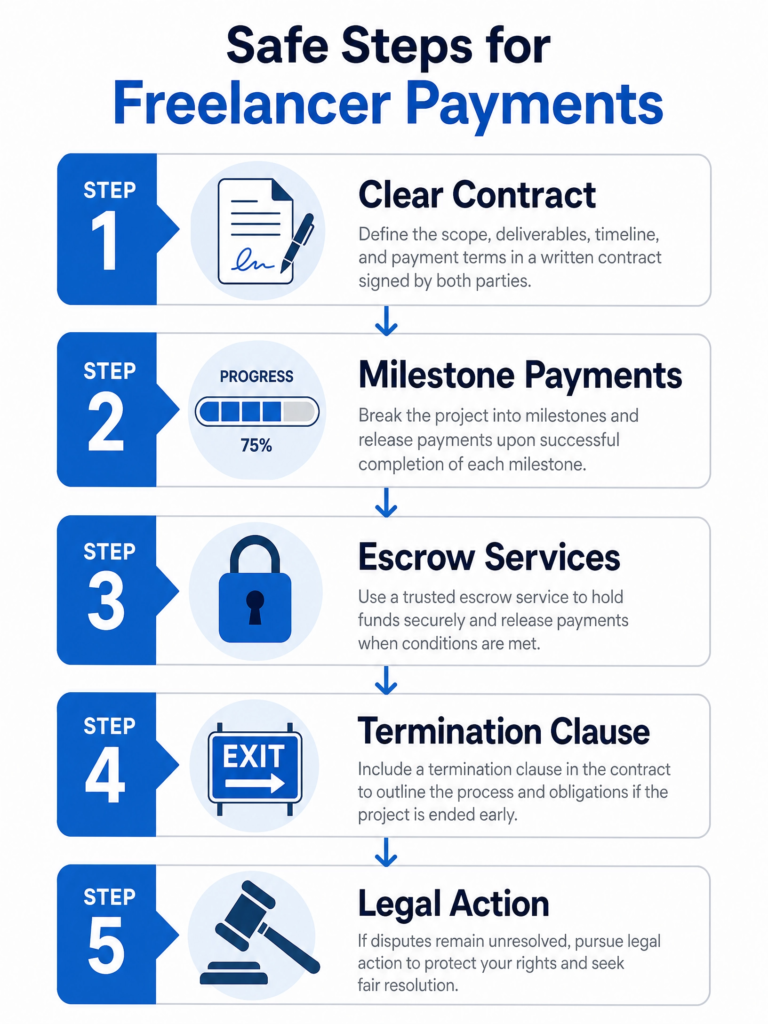
How to Shut Down a Client Server for Non-Payment (Legal Tiered Method)
A sudden blackout looks like sabotage. A scheduled, documented throttling protocol looks like standard corporate compliance.
What should freelancers do when a client stops paying for hosting or server costs ?
In practice, many freelancers prefer to follow to follow a structured escalation timeline, I do not threaten them. I follow a strict timeline that restricts their server resources sequentially.
Day 1-15 (Post-Invoice) : Normal operations. I send standard reminders. Check out The Exact Follow-Up Timeline for Late Freelance Invoices (That Actually Works). No technical action is taken.
Day 16-30 : I restrict non-essential API calls. I implement controlled, contract-based service limitations such as rate limiting or reduced performance tiers, only where explicitly permitted by the service agreement.. The site still works, but it feels slightly sluggish.
Day 31 : I prepare to Issue a Notice of Code Suspension. This is a formal declaration. It shifts the liability back to them.
Day 45 : Caching is disabled. Backend access is heavily restricted.
Why do I do this ? Because a slow database gets a CEO’s attention faster than a polite email. It forces the accounting loop to close without destroying their underlying assets.
If they vanish completely, you need a backup plan. You might wonder My Client Ghosted Me After I Sent the Invoice—What Do I Do Now?. The answer is always procedural escalation.
When to Issue a Notice of Code Suspension
Let me share a quick diary entry from my early days. I was managing a sprawling Kubernetes cluster for an agency.
Whether you can suspend a client’s server when they don’t pay depends on your contract terms.
They were 60 days late on a five-figure invoice. I was terrified. I thought if I touched the servers, I was committing a crime.
Here’s the thing : DevOps engineers and infrastructure managers have unique leverage. But we also have unique liabilities. We hold the keys to the castle.
If a graphic designer stops working, the client just gets no new logos. If I stop maintaining a server, the client’s entire business crashes.
This dilemma paralyzes freelancers. They keep paying the hosting fees out of their own pockets. They become involuntary investors in their client’s business.
You must view server access as a leased utility. When the lease isn’t paid, the utility is restricted. It is a simple, cold, institutional reality.
If a client is profiting while you suffer, the dynamic must change. It reminds me of the exact steps on What to Do When a Client Uses Your Work But Refuses to Pay You.
Is It Legal to Shut Down a Client’s Server for Non-Payment ?
We need to look at the law. Do not confuse code suspension with ransomware. They are legally distinct concepts.
What are the legal rules for restricting or shutting down client servers due to non-payment ?
Ransomware encrypts data and extorts money. Legal code suspension relies on documented access revocation based on contract breach.
In the US, the Computer Fraud and Abuse Act (CFAA) targets unauthorized access. If your contract states you maintain authorization until payment, revoking your own services is generally permissible.
In the UK, the Computer Misuse Act 1990 operates similarly. You must not permanently delete client data without a clear contractual right.
All actions described must be explicitly permitted under your service agreement or contract. Unauthorized access or restriction may violate applicable laws.
The Legal Landscape : US vs. UK
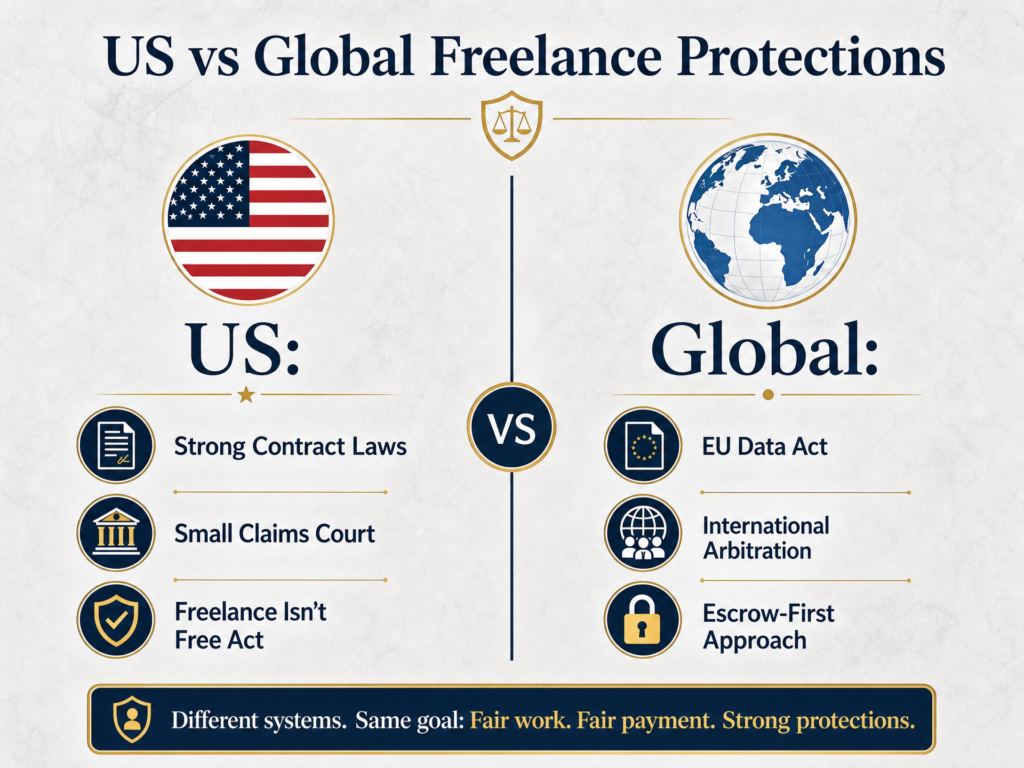
1. The United States : The CFAA Boundary
In the US, the Computer Fraud and Abuse Act (CFAA) is the primary federal statute governing unauthorized computer access. The Supreme Court’s decision in Van Buren v. United States narrowed the scope of what constitutes “exceeding authorized access,” generally focusing on technological barriers rather than mere contractual violations (Leahy, 2023).
- The Risk: If you break through a technological barrier or circumvent security to “shut down” a client’s system, you risk CFAA liability.
- The Strategy: Ensure your contract explicitly defines your right to modify, restrict, or suspend server resources upon a documented “material breach” (such as non-payment). If the restriction is implemented via the server’s native configuration (e.g., rate limiting via Nginx or API quotas) rather than by “hacking” back into a system you no longer manage, you are on firmer ground.
2. The United Kingdom: Computer Misuse Act 1990
The UK’s Computer Misuse Act 1990 criminalizes unauthorized access and unauthorized modification of computer material.
- The Risk: Courts in the UK focus on whether your actions constitute “unauthorised modification” of data or obstruction of service (Urbas, n.d.). If your actions result in data loss or permanent damage, you could be liable under criminal law.
- The Strategy: Always issue formal notice. Transparency is your greatest defense. A “Notice of Intent to Suspend” sent to a client’s registered address serves as evidence that your actions were a response to a civil dispute (contractual non-payment) rather than a malicious attack on their systems.
Resources & Citations
For your records and to provide professional justification for your actions, refer to these academic and legal frameworks:
- Leahy, G. F. (2023). Keeping Gates Down: Further Narrowing the Computer Fraud and Abuse Act in the Wake of Van Buren v. United States. William & Mary Business Law Review, 14(2), 215–245. https://scholarship.law.wm.edu/cgi/viewcontent.cgi?article=1245&context=wmblr
- Insight: Argues that CFAA should be limited to technological breaches, not contractual ones.
- Cited by: 6
- Urbas, G. (n.d.). An Overview of Cybercrime Legislation and Cases in Singapore (Comparative analysis on UK Computer Misuse Act origins). Asian Law Institute. https://law1a.nus.edu.sg/asli/pdf/WPS001.pdf
- Insight: Details the thresholds for “unauthorised modification” of computer contents.
- Cited by: 10
- McGuire, M. (n.d.). A review of the evidence: Cyber-dependent crimes. UK Government Home Office. https://assets.publishing.service.gov.uk/media/5a7c83c1ed915d48c241043f/horr75-chap1.pdf
- Insight: Defines the scope of “pure” cybercrimes vs. business disputes.
- Cited by: 540
Practical Advice for Professionals
- Do Not Delete : Permanent deletion of client data is almost always indefensible in court and can lead to civil lawsuits for damages.
- Use Automated Limits : Instead of “shutting down,” use infrastructure tools (rate limits, bandwidth throttling) that naturally degrade performance based on account status.
- Document Everything : Maintain a log of all communications. A dispute over a server bill is a civil matter; turning it into a “system lockout” without notice makes it look like a criminal matter to a judge.
Disclaimer: I am an AI, not your attorney. These insights are for educational purposes. Laws regarding digital infrastructure vary significantly by jurisdiction and specific contract language. Always consult with a local legal professional when drafting “Service Suspension” clauses for your contracts.
How to Issue a Notice of Code Suspension Safely
Look, you need a paper trail. If you are going to throttle a server, you must Issue a Notice of Code Suspension formally.
This notice must be cold, factual, and free of emotion. I never write “pay me or else.” I write “service levels will be adjusted to reflect account status.”
Here is the exact institutional template I use.
Compliance Notice Generator
Sometimes, you have to handle these things directly. You can learn How to Recover an Unpaid Invoice Yourself (Without Hiring a Lawyer) just by adopting this institutional tone.
Important Legal Note :
All server restriction or suspension actions must be explicitly authorized in your service agreement. Unauthorized access, modification, or disruption of systems may violate applicable cybercrime laws and lead to legal consequences.
Executing the Reconnection Fee
When they finally pay, they will expect the site back to full speed instantly. Do not do this for free.
I always include a Reconnection Fee in my contracts. Re-provisioning servers, scaling databases back up, and clearing throttles takes my time.
If they delayed payment, they broke the workflow. Restoring that workflow is billable work.
I charge a standard $250 to $500 reconnection fee. It is a corporate penalty for letting their account lapse.
You can also apply legal interest. I highly recommend reading about whether Can You Legally Charge Interest on Late Invoices ? (US,UK, & India Rules) applies to your specific jurisdiction.
Case Study : The Graceful E-commerce Throttle
Let’s look at a real-world scenario from my diary. I had a client running a mid-sized Shopify backend API integration.
They owed me $4,500 for backend API maintenance. They kept delaying. “Accounting is looking at it,” they said.
I didn’t argue. On day 30, I followed the escalation protocol. I didn’t shut off the API. I just rate-limited it.
Instead of processing 100 orders a minute, it processed 1 order every 10 seconds. The site slowed down. Customers complained.
The client’s CEO called me in a panic. I remained calm. I explained that unpaid accounts are automatically moved to shared, low-tier bandwidth.
I told them the system is simply allocating resources based on cleared payments. I offered to restore premium access immediately upon invoice settlement.
The invoice was paid within 45 minutes. They also paid the $300 reconnection fee to get back on the premium tier.
If a client takes the site live and locks you out of billing, you have to act decisively. This is very similar to Client Launched the Site But Cancelled My Stripe Subscription : How to Freeze a Live Domain Legally.
Risk Matrix for Infrastructure Throttling
You must evaluate your risks. Here is my internal compliance matrix for handling unpaying clients on live servers.
Infrastructure Risk Calculator
Evidence Checklist : Before You Throttle
Before you touch a single line of server configuration, you must gather your evidence.
Institutional compliance requires a paper trail. I never act on emotion. I act on documented facts.
- Signed contract detailing your right to suspend service for non-payment.
- Proof of initial invoice delivery with timestamps.
- Proof of at least three polite follow-ups.
- A full, encrypted backup of the client's current data stored off-site.
- A copy of the formal Notice of Intent to Suspend Operations sent to the client.
If you have this checklist completed, you are shielded. You can proceed with the technical degradation calmly.
Knowing when to escalate is a skill. Many wonder When is it Officially Time for a Freelancer to Take Legal Action?. With servers, you act before court becomes necessary.
Quick Decision Section : The Throttling Flowchart
Are you stuck on what to do right now ? Let me break it down into a simple, logical flow.
If they still refuse to pay after the throttle, you might be dealing with intentional fraud.
The Psychological Toll of Server Hostage Situations
I want to talk more about the psychological toll this takes. It is easy to write about legal compliance. It is hard to live through it.
Every morning, you wake up and check the server logs. You see thousands of active users. You see the client's business thriving.
Then you check your bank account. The invoice is still pending. The anger builds up. This is a dangerous state of mind.
When you operate on anger, you make mistakes. You might impulsively SSH into the server and delete a database table. That is a critical error.
By using a tiered escalation template, you grant yourself relief. You do not have to make a daily decision about whether to pull the plug.
The calendar makes the decision for you. The procedure absorbs the stress. This is how large corporations operate. They do not get angry; they get procedural.
The Technical Implementation of Throttling
How do you actually throttle safely? You do not want to break the site; you just want to degrade it.
If you use Nginx, you can implement limit_req zones. It is a beautiful, built-in way to simulate heavy load.
You set the request limit to 1 request per second. Anything over that gets a 503 Service Unavailable error.
If you are managing databases, you can artificially limit connection pooling. Drop the maximum connections down to a bare minimum.
The application will still function for a handful of users. But as soon as traffic spikes, the database will throttle the requests.
This ensures you are not actively destroying data. You are simply refusing to provide high-availability computing resources for free.
Suspension Generator Tool
I want to give you something practical. I built a mental model for generating these notices. Here is a simple interactive tool concept you can use.
Use that framework every time. Keep it dry. Keep it professional.
NOTICE: AUTOMATED SERVICE SUSPENSION
To: [Client Name]
Date:
This is a formal compliance notification regarding your server infrastructure management.
Your account currently has an outstanding balance of [Amount], which is [Days] days past the contractual due date.
As per our service agreement, we are initiating our standard delinquency protocol. Unless payment is received by [Insert Date 48hrs from now], we will Issue a Notice of Code Suspension and proceed with the following measures:
- Restriction of non-essential API endpoints.
- Implementation of resource throttling on all production instances.
- Transition to a minimum-tier maintenance configuration.
This action is intended to align service availability with current payment status. Please be advised that no data will be deleted during this period. Full service provisioning will be restored immediately upon settlement of the outstanding invoice.
For payment instructions, please refer to Invoice #[Insert Invoice ID].
Regards,
Infrastructure Operations
The Post-Suspension Meeting
Eventually, the throttling will work. The client will pay the invoice, pay the reconnection fee, and demand a meeting.
I call this the post-suspension debrief. It is a critical psychological moment. You must handle it perfectly.
The client will likely be defensive or angry. They might accuse you of being unprofessional for slowing down their site.
Here is my diary insight on this: You must remain completely unbothered. You are the professional who followed the contract.
I always start the meeting by confirming the receipt of funds. I then confirm that all server resources have been restored to premium tiers.
When they complain about the suspension, I refer them back to the automated compliance schedule. I blame the process, not the person.
"As outlined in the notice, our systems automatically restrict bandwidth on accounts 30 days past due. It is a standard protocol."
By framing it as an automated security protocol, you remove the personal animosity. It wasn't you attacking them; it was the system functioning normally.
FAQs About Code Suspension

Can I delete the code if they never pay ?
I never delete code. Deletion destroys the asset. It invites lawsuits under the Computer Fraud and Abuse Act. I simply remove it from the live environment and archive it securely.
Do I need a lawyer to send the notice ?
No. A compliance notice is administrative. It establishes your timeline. You only need legal counsel if they sue you or if you plan to sue them for the debt.
What if I am paying the AWS or DigitalOcean bill directly ?
This is common. If your credit card is on file, you have the ultimate right to spin down the instances. Give them 7 days notice to migrate, then shut it off.
Will throttling hurt my reputation as a freelancer ?
It hurts your reputation with bad clients. Good clients pay their bills. Establishing firm boundaries actually increases your respect in the corporate world.
How do I explain the slow site to their users ?
You do not. That is not your problem. If their users complain about slow APIs, the client must deal with the PR fallout of their own unpaid bills.
Final Takeaway
If you are wondering whether you can shut down a client’s server for non-payment, the answer depends entirely on your contract — but the safest industry practice is controlled, documented service suspension, not abrupt termination.
Whether or not you can shut down a client’s server for non-payment depends entirely on contractual authorization and documented service terms.
Freelancers who follow structured escalation protocols protect both their income and legal standing, while avoiding unnecessary disputes or liability.
Author Box
Adv. Sagar Haribhau Shirsat is an active legal professional specializing in commercial transaction architectures, cross-border corporate compliance, and digital debt recovery systems. He designs strategic asset-protection and recovery frameworks that help freelancers, independent contractors, and global agencies defend their cash flow and enforce their billing rights.
Connect via his Official Professional LinkedIn Profile or visit our About Us page.
Disclaimer : This guide is intended for educational purposes and risk management analysis. It does not replace formal legal counsel. For specific cross-jurisdictional contract disputes, always consult a certified attorney or local legal advocate.