Table of Contents
Most freelancers don’t realize this until it’s too late.
You deliver the work. The client launches it. Everything looks successful from the outside.
But your invoice? Still unpaid.
At that moment, you are no longer running a business — you are unknowingly financing someone else’s.
Cash flow is not just “important.” It is survival.
The longer a payment is delayed, the more your business starts bleeding silently — covering software costs, taxes, and living expenses without any incoming capital.
And here’s the uncomfortable truth:
Many corporate clients already understand this dynamic. They know independent professionals rarely have the time, money, or legal structure to aggressively enforce payments. So they delay. Not by accident — but by design.
If you keep sending polite “just checking in” emails, you are playing a game that is already rigged against you.
To break this cycle, you need to stop behaving like a vendor waiting for approval — and start operating like a business enforcing a financial obligation.
That shift happens with one move:
A structured, legally grounded final notice before legal action.
Not an emotional message.
Not a reminder.
A controlled, authoritative escalation that signals one thing clearly:
This is no longer a request. This is now a liability.
And when executed correctly, this single step can force even the most unresponsive clients to prioritize your payment immediately.
The Client Stalling Diagnostic Matrix
Non-payment is rarely a matter of a forgotten invoice. It is a strategic allocation of capital. Corporate accounts payable teams operate on a simple mandate: maximize their own cash ratios by delaying outflows for as long as possible. To defeat this tactic, you must diagnose whether you are dealing with systemic corporate bureaucracy or deliberate predatory avoidance.
Dismantling Corporate Bureaucracy vs. Predatory Avoidance
- Administrative Inertia : The client claims the invoice is “stuck in accounting,” “awaiting CFO sign-off,” or delayed due to a “system migration.” These are standard stalling mechanisms designed to exhaust your patience.
- Predatory Avoidance : The client abruptly challenges deliverables they approved weeks ago, reduces communication density, or cuts off contact entirely across Slack and email.
When dealing with administrative inertia, your leverage relies on escalating the internal cost of their delay. This means introducing statutory late payment interest and contractually mandated liquidated damages directly into the discussion. Most accounting departments operate under strict key performance indicators (KPIs). The moment an invoice begins accruing documented, daily legal interest, it flags an audit risk. Suddenly, delaying your payment costs them more than processing it.
To instantly quantify this leverage, use the interactive calculator below to determine exactly how much statutory interest and liquidated damages have accrued on your outstanding balance.
The Comprehensive Evidence & Communication Audit
Before delivering a formal demand for payment, you must systematically secure your evidentiary perimeter. If a client intends to default or force a settlement, they will look for procedural loopholes, unapproved deliverables, or ambiguities in scope.
Securing Admissions of Debt
Your objective is to lock the client into a position where they cannot legally contest the validity of the invoice. This is achieved by extracting an explicit written admission of debt.
When tracking accounts receivable, every communication must be engineered to elicit confirmation that the work was completed satisfactorily and that the invoice balance is correct. If a client replies to an email or a message saying, "We are waiting on a client payment before we can clear your $12,000 invoice," they have legally admitted the debt exists and is due.
Tactical Rule: Never argue about project details over the phone. If a client calls to discuss a late invoice, listen, take notes, and immediately follow up with a written summary.
The Legal Standing of Alternative Channels
Many independent digital service providers wonder: is a whatsapp conversation a legally binding contract? Under contemporary commercial litigation standards across most global jurisdictions, electronic communications—including WhatsApp messages, Slack threads, and SMS—are treated as enforceable written evidence. If your client has acknowledged an invoice amount or approved a milestone via Slack, that record holds legal weight.
If a corporate client ghosted final invoice slack sue tactics become necessary, your first step is exporting those chat logs. Download full CSV or PDF archives of these conversations immediately. Do not rely on active channels; a client can deactivate your guest access to their Slack workspace or delete messages to obscure the paper trail. Export the data, match it against your master accounts receivable register, and file it securely before initiating your formal demand sequence.
United States Statutory Citations
When recovering debt from a corporate entity in the United States, commercial collection leverage is established through a combination of federal prompt payment standards and individual state codifications.
- Federal Authority: 31 U.S.C. § 3902(a) (The Prompt Payment Act). This statute codifies the legal requirement that commercial entities must pay interest penalties automatically on late invoices for property or services delivered, establishing that interest penalties accumulate from the day after the required payment date until the date payment is cleared.
- The Federal Interest Reference Rate: 91 FR 5035 / Contract Disputes Act of 1978, sec. 12 (Public Law 95-563). This establishes the baseline for calculation of late claims at the specific per annum rate set by the Secretary of the Treasury. For the current operational period of January 1 to June 30, 2026, the official prompt payment interest rate is legally fixed at 4 1/8% per annum ($4.125\%$).
- State-Level Enforcement (e.g., New York): N.Y. State Finance Law § 179-F. Known as the New York Prompt Payment Act, this requires corporate and public entities to process proper invoices within 30 calendar days. Failure to do so triggers mandatory interest accrual based on corporate tax overpayment rates.
- Evidence and Admissibility: Federal Rules of Evidence (FRE) Rule 801(d)(2). This rule governs the admissibility of "Opposing Party Statements." It dictates that text messages, Slack archives, or WhatsApp acknowledgments from your client's representatives confirming an invoice balance are legally non-hearsay and serve as an absolute written admission of debt in federal court.
United Kingdom Statutory Citations
The United Kingdom provides some of the most aggressive, pro-supplier commercial debt recovery laws in the world. If your debtor operates under English law, your final notice must explicitly reference these instruments to activate statutory penalties.
- The Core Statutory Right: Late Payment of Commercial Debts (Interest) Act 1998. This implies an unalterable statutory term into all business-to-business contracts for the supply of goods or services, granting the creditor an automatic right to claim simple interest on a qualifying debt.
- The Statutory Interest Penalties: Section 6(1), Late Payment of Commercial Debts (Interest) Act 1998. This gives you the right to charge 8% plus the Bank of England base rate. This rate is calculated using the baseline reference rate in force on either 30 June or 31 December immediately preceding the date the invoice went overdue.
- Statutory Compensation for Debt Recovery Costs:Late Payment of Commercial Debts Regulations 2013 / Section 5A. In addition to interest, you are legally entitled to claim a fixed statutory compensation fee to cover administrative debt collection costs. This fee is tiered by the size of the debt:
- £40 for unpaid balances under £1,000.
- £70 for unpaid balances between £1,000 and £9,999.99.
- £100 for unpaid balances totaling £10,000 or more.
- Pre-Action Insolvency Leverage: Section 123(1)(a) of the Insolvency Act 1986. This governs the issuance of a formal Statutory Demand. It states that if a corporate entity fails to pay or secure a debt exceeding £750 within 21 days of receiving a formal demand, they are legally deemed "unable to pay their debts," opening the door for winding-up petitions.
The 3-Stage Invoicing Escalation Ladder
A single, sudden threat of litigation rarely works. It looks reactionary. True leverage is built through a systematic escalatory progression that signals to the non-paying client that you are executing a deliberate, highly organized legal protocol.
| Escalation Phase | Timeline | Primary Objective | Communication Channel |
| Phase 1: Operational Reminder | Day 1–14 Past Due | Surface administrative errors, re-verify invoice parameters, and re-establish standard payment terms. | Primary Point of Contact (Email/Slack) |
| Phase 2: Statutory Intervenient | Day 15–30 Past Due | Introduce legal interest penalties, escalate to financial decision-makers, and revoke active licenses. | Accounts Payable & Department Head (Email & Certified Mail) |
| Phase 3: Formal Collections Ultimatum | Day 31+ Past Due | Issue a binding legal notice, cease all operational dialogue, and initiate third-party recovery transitions. | Legal Counsel / C-Suite Executive Officer |
Phase 1 : The Operational Reminder (Day 1 to 14 Past Due)
The moment an invoice crosses its due date, send a crisp, automated, yet firm notification. Assume a structural breakdown on their end, but maintain strict boundaries. Do not use apologetic phrases like "Just checking in" or "I know you're busy." State the invoice number, the overdue amount, and request an immediate payment confirmation code or transaction receipt. For optimal long-term results, establish an immutable operational cadence by following the best follow-up timeline for unpaid freelance invoices the us restitution and recovery manual.
Phase 2 : The Statutory Intervenient (Day 15 to 30 Past Due)
If the invoice remains unpaid past Day 14, the tone shifts from administrative to transactional enforcement. You will now formally apply the statutory late payment interest rates calculated by your financial ledger or contract terms. Under statutory frameworks like the UK’s Late Payment of Commercial Debts (Interest) Act or individual state-level prompt payment statutes in the United States (such as the New York Prompt Payment Act), commercial entities are legally penalized for delaying payments to small suppliers. Send an updated invoice detailing the principal amount plus the daily accruing interest penalties.
Phase 3 : The Formal Collections Ultimatum (Day 31+ Past Due)
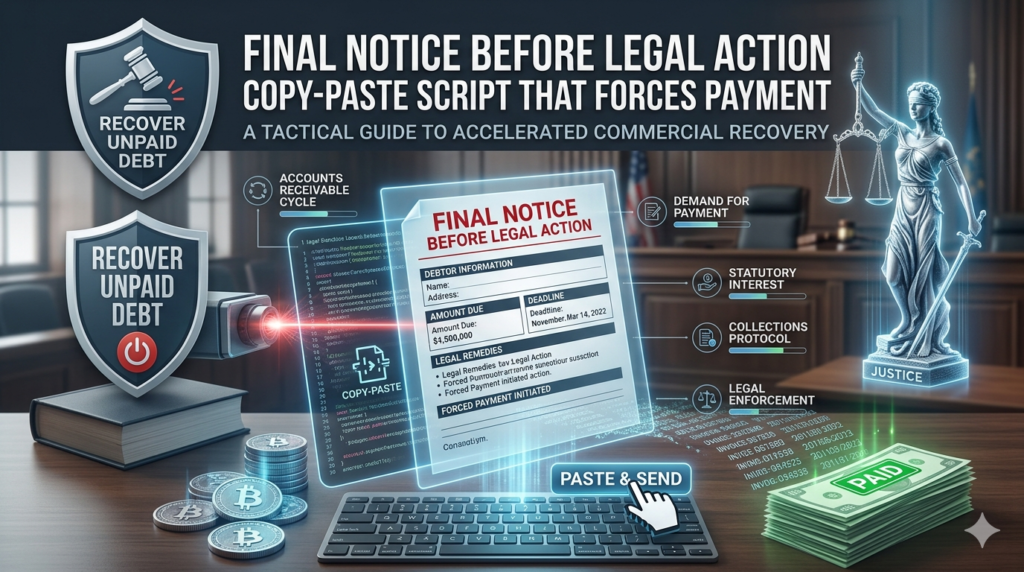
At this juncture, regular operational dialogue terminates. The account is moved to a formal default status. You are no longer negotiating; you are establishing a hard timeline before external enforcement begins. This is where you deploy your final notice before legal action: copy-paste script that forces payment.
The Ultimate Legal Enforcement Pivot
When entering the final enforcement stage, you must draw a hard line. Any further informal emails or casual calls break your leverage, showing the client that your deadlines lack real consequences. Communication must now be formal, written, and structured exclusively as a legal demand.
The Mechanics of the Statutory Demand for Payment
A formal statutory demand is a powerful pre-litigation asset. It is not an informal request; it is a structured document that gives a corporate debtor a fixed window (typically 14 to 21 days depending on local rules) to clear the debt or face aggressive recovery proceedings. If the debtor fails to pay or file an application to dismiss the debt within this window, it serves as statutory proof of insolvency. This allows you to bypass protracted contract disputes and move straight toward freezing orders or winding-up petitions.
To generate a precise, legally sound notice without incurring upfront attorney fees, use the automated tool below. This dashboard builds an ironclad final notice, ready to export and deliver via certified mail.
Low-Cost Recovery Paths Without Large Attorney Fees
Litigation does not have to mean a multi-year courtroom battle that drains your bank account. Independent contractors have access to several cost-effective legal tools designed specifically for rapid commercial recovery:
- Small Claims Court (Magistrates' Court): Most local jurisdictions feature an expedited small claims track with highly accessible filing limits (frequently up to $10,000 or $15,000 in various US states, and up to £10,000 in the UK). You do not need to hire an expensive corporate law firm to file a small claims action; the process is designed for business owners to represent themselves using clear documentation.
- Commercial Debt Collection Agencies: If you want to avoid court entirely, you can assign the debt to a commercial collection agency. These agencies typically work on a contingency fee basis (retaining roughly 15% to 33% of recovered funds). Their involvement immediately shifts the debt onto the client's commercial credit bureau reports, protecting your time while putting serious pressure on their financial standing.
For a deeper dive into self-representation and navigating small claims systems efficiently, read the freelancers legal guide to recovering unpaid invoices without expensive lawsuits.
Strategic Frequently Asked Questions (FAQ)
Can I legal charge late fees if they were not explicitly written into the initial freelance contract ?
Yes. Even if your contract lacks a specific late fee provision, you can typically leverage statutory interest. Most jurisdictions provide a default framework for commercial transactions, such as state-level prompt payment statutes or the UK's Late Payment of Commercial Debts Act. These laws allow businesses to collect interest on unpaid debts automatically, ensuring small suppliers are protected regardless of their contract's fine print.
What should I do if a client offers to pay 50% of the overdue invoice as a "final settlement" ?
Never accept a partial payment offer without a signed, conditional settlement agreement. If you agree to a partial payment via email without explicit terms, a court may view it as an accord and satisfaction—meaning you waive your right to pursue the remaining 50%. If you choose to accept a reduced amount to preserve cash flow, ensure the agreement explicitly states that the remaining balance is forgiven only if the partial payment hits your account by a strict, non-negotiable deadline.
Can I legally shut down a client's live website or app if they fail to clear my final invoice ?
Your right to pull production files or revoke access keys depends entirely on your contract's intellectual property (IP) clause. Standard commercial agreements state that ownership of deliverables passes to the client only upon full payment of all outstanding invoices. If your contract includes this provision and the client defaults, you still own the code, design, or assets. In that scenario, revoking access is an exercise of your property rights, not an illegal action.
How does a corporate client bankruptcy affect my outstanding accounts receivable recovery ?
If a client files for corporate restructuring or bankruptcy protection, an automatic stay is triggered. This halts all independent collection efforts, including lawsuits and demand letters. You must immediately file a Proof of Claim with the bankruptcy court as an unsecured creditor. Because unsecured service providers are usually lower on the payment priority list, this underscores the importance of sending your final notice early—recovering your money before a client collapses into insolvency.
Does sending an invoice to a collection agency damage my professional reputation in the creative industry ?
No. Enforcing your rights as a business owner enhances your reputation as a professional entity. Deliberate non-payers rely on freelancers feeling too intimidated or uncomfortable to pursue collections. Shifting an overdue account to an agency signals that you run a disciplined operation. It protects your business interests and deters clients who seek to take advantage of independent providers.
Author Profile
Advocate Sagar Haribhau Shirsat
Advocate Sagar Haribhau Shirsat is a seasoned legal engineer and commercial recovery strategist specializing in contractual compliance, asset preservation, and debt litigation frameworks for independent businesses, technology agencies, and scaling enterprise providers. His work focuses on building practical tools and legal workflows that help digital service providers protect their cash flow and enforce their rights against non-paying entities. Connect with him for professional insights and updates on commercial debt recovery strategies via his Professional LinkedIn Profile.