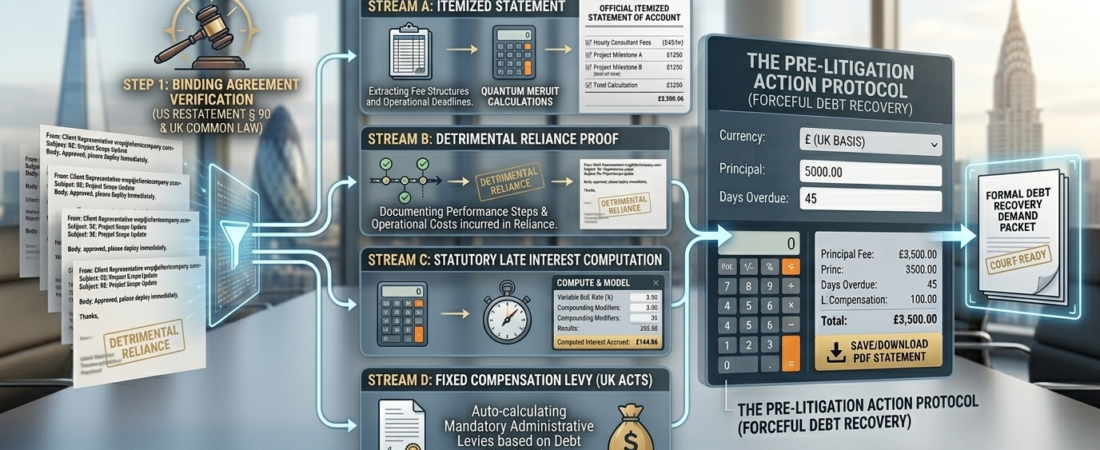
Table of Contents
The Accidental Contract in Your Inbox
It is a scenario intimately familiar to independent consultants, software engineering agencies, and creative freelancers across the United States and the United Kingdom. A project begins with mutual enthusiasm. Brief, informal emails fly back and forth.
“Can you spin up three more layout variations by Friday evening ? “ asks the client.
“Sure, that will require roughly ten additional billing hours outside our initial scope,” you replied.
The client types a rapid response from their mobile device: “Perfect, do whatever it takes to get it done. Just log it, and we will square up at the end of the month.”
Fast forward thirty days. The deliverables are embedded inside the client’s live production servers, but your formal invoice is met with sudden corporate amnesia or outright silence. The accounts payable desk claims there is no signed “Master Services Agreement” on file, or that the additional tasks were simply part of the baseline budget.
When a transactional relationship fractures in this manner, many business operators assume their funds are permanently lost due to the lack of a formal corporate contract. This is an expensive mistake.
Under established common-law doctrines in both US and UK courts, your raw email trail can be transformed into a legally defensible, binding itemized statement. By utilizing specific statutory framework mechanics, you can hold delinquent clients fully accountable using nothing more than the electronic text files stored inside your mail server.
so exactly How to Turn an Email Trail into a Legally Defensible Invoice Statement ?
Topics you may interested in – Is a WhatsApp Conversation a Legally Binding Contract ? The Ultimate US & UK Judicial Guide
The Doctrine of Promissory Estoppel : The Shield Against Exploitation
When a formal written contract is missing or deemed technically incomplete, contract law invokes a powerful equitable safety valve to prevent injustice : Promissory Estoppel.
In plain terms, this doctrine dictates that if a client makes a clear promise to pay for services, and you reasonably rely on that promise by investing your time, labor, and capital to deliver those services, the client is legally barred (estopped) from backing out of their obligation. They cannot escape payment by pointing to a missing signature on a standard piece of paper.
The US Standard : Restatement (Second) of Contracts § 90
In the United States, your email trail is backed by one of the most heavily cited sections of contract law: Section 90 of the Restatement (Second) of Contracts.
To successfully assert a claim of promissory estoppel using your email history in a US civil court or small claims matrix, your documentation must establish four clear criteria:
- A Clear and Definite Promise: The client must have made a statement over email that a reasonable person would interpret as an intent to compensate you (e.g., “Proceed with the code build, we will cover the hours”).
- Reasonable and Foreseeable Reliance: The client must have reasonably expected that you would take physical action based on their text (e.g., they knew you would write software or hire a subcontractor to hit their deadline).
- Detrimental Reliance / Actual Injury: You must prove that you suffered a measurable financial detriment because you acted on their email promise (e.g., you spent 40 hours of billable time that could have been allocated to a paying client, or you paid out-of-pocket for hosting infrastructure).
- Injustice Can Only Be Avoided by Enforcement: The court must determine that allowing the client to walk away with free assets while you hold the losses is fundamentally unfair.
The UK Standard : High Trees and Equitable Estoppel
Across the UK, English common law approaches this under the doctrine of Proprietary/Promissory Estoppel, anchored by the historic legal precedent established in Central London Property Trust Ltd v High Trees House Ltd [1947] KB 130.
Under English commercial doctrines, if a corporate entity leads an independent service provider to believe that a specific financial arrangement will be honored, and the provider modifies their position in reliance on that representation, the courts will lock the promisor into their word.
Furthermore, the UK Late Payment of Commercial Debts (Interest) Act 1998 provides statutory teeth here. Once an email trail establishes that a commercial service was requested and executed, you possess the automatic legal right to issue an itemized accounting statement supplemented by statutory interest penalties—regardless of whether a traditional multi-page contract exists.
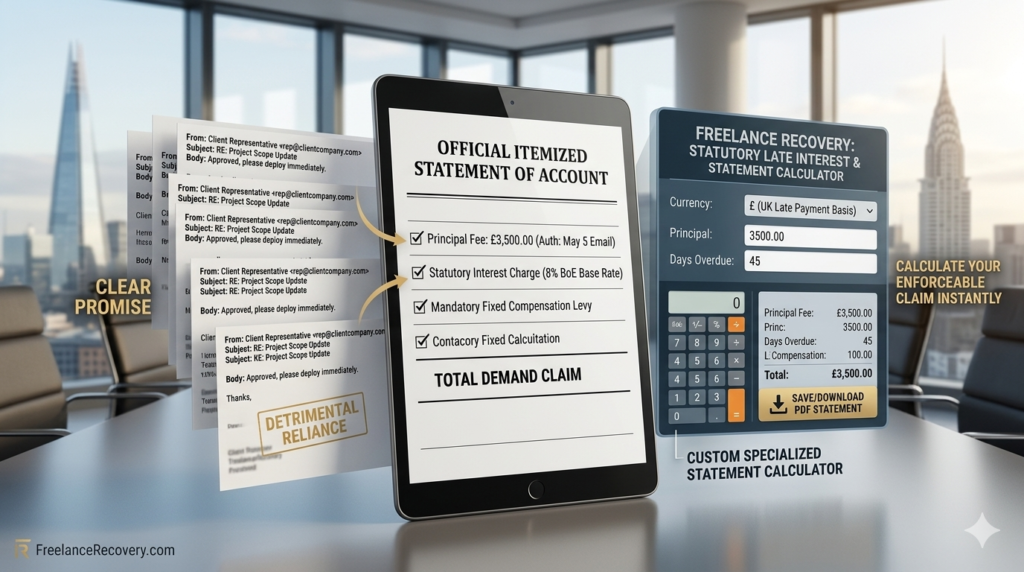
Anatomy of an Enforceable Email Trail : The 5 Evidentiary Elements
Before you can confidently threaten legal action or issue a statutory demand notice, you must systematically audit your email history. An automated crawler or a human small-claims judge scans an electronic conversation for five specific metadata elements.
| Evidentiary Element | What the Court Looks For | Why It Matters for Enforcement |
| 1. Identity & Apparent Authority | Clean, matching email headers showing the domain of the client corporate infrastructure (e.g., name@clientcompany.com). | Proves the message was sent by an authorized representative, not an unverified personal account. |
| 2. Definitive Scope of Work | Contextual text or attached project briefs that specify exactly what tasks are being requested. | Eliminates claims that the scope was ambiguous or that you performed unauthorized work. |
| 3. Explicit or Implied Value | A mention of an hourly rate, a fixed project fee, or phrases like “at your standard rates” or “bill us for it.” | Establishes the baseline financial metric for calculation under the principle of quantum meruit. |
| 4. Date & Time Stamp Sequencing | A linear, chronological thread showing a request, an estimation, and a subsequent green-light reply. | Demonstrates a clear timeline of offer, modification acceptance, and operational reliance. |
| 5. Evidence of Receipt & Acceptance | Messages acknowledging delivery of files, log-in credentials provided, or live usage of the assets. | Destroys the client’s defense that they never received the deliverables or that the work was defective. |
Step-by-Step Blueprint : Reconstructing Chat logs into an Itemized Statement
If your audit confirms these elements are present, you must execute a structural conversion process. You cannot simply forward a chaotic, messy giant pile of unformatted emails to a client’s accounts payable department and expect a payout. You must synthesize the data into a formal, legally defensible itemized invoice statement. Follow this precise blueprint:
Step 1 : Export and Verify the Electronic Metadata
Do not modify the raw text or fix spelling typos inside the original emails. Download the message files in a raw format containing their full metadata headers (such as .eml or .msg file types). These contain the authentic internet routing codes that act as an un-tampered digital signature under modern electronic evidence acts.
Step 2 : Establish the Timeline Reference Index
Create a clear, chronological narrative mapping your email trail to specific outcomes. For example :
- Item 01 (May 4, 2026) : Client representative requests structural modification to Database Architecture (See attached Email Exhibit A-1).
- Item 02 (May 5, 2026) : Operator responds with cost estimation of 15 billing hours at $75/hr (See attached Email Exhibit A-2).
- Item 03 (May 5, 2026) : Client authorizes performance via text: “Approved, please deploy immediately” (See attached Email Exhibit A-3).
Step 3 : Compute Statutory Late Interest Penalties
In both the US and UK, once a debt balance is considered overdue, you have a legal foundation to apply interest. Under the UK’s Late Payment of Commercial Debts Act, this rate is fixed at a powerful 8% above the Bank of England base rate. In the US, dynamic state statutes govern statutory interest formatting (typically ranging between 1% to 1.5% per month on commercial accounts receivable).
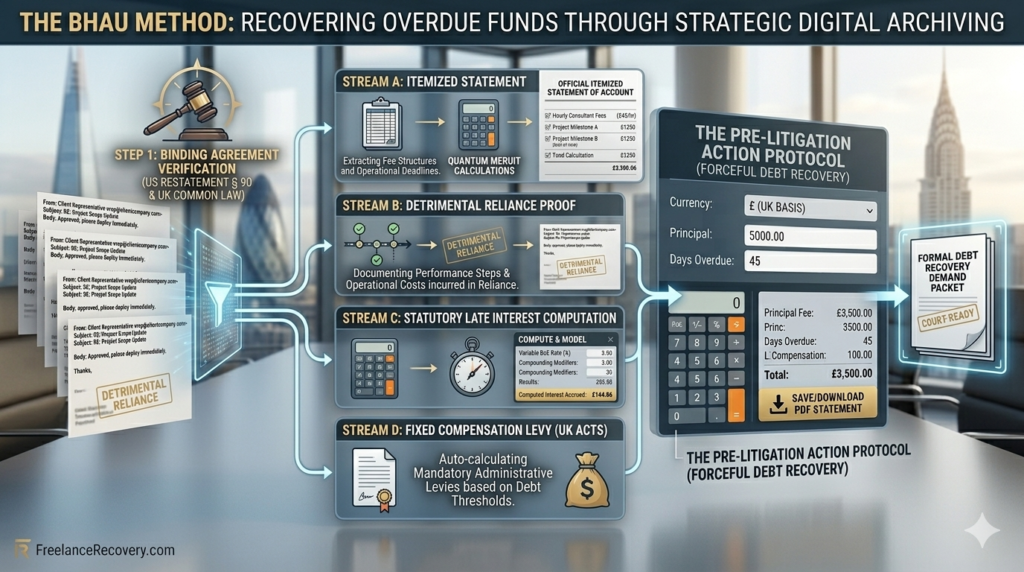
Interactive Tool : Statutory Late Interest & Statement Formatter
Use our specialized operational calculator to transform your raw digital metrics into a courtroom-ready itemized financial calculation statement. Input your baseline project coordinates below to compute interest allocations instantly.
Statutory Late Interest & Itemized Statement Calculator
Input your outstanding email-approved transaction balances to instantly compute dynamic interest allocations and build an official structural billing record.
Real Court Precedents : Where Emails Broken into Millions Overturned Corporate Denials
Many legal counsel desks try to scare off individual consultants by telling them an informal email cannot hold up against corporate legal frameworks. Both US and UK courts have repeatedly rejected this claim, ruling that an email chain is an ironclad, binding agreement.
The United States Standard : Bazak International Corp. v. Tarrant Apparel Group
In this prominent corporate dispute, the court analyzed whether an exchange of electronic summaries and emails could bind two organizations under the Uniform Commercial Code (UCC) Statute of Frauds. Tarrant Apparel argued that because no formal signature contract was stamped by their executive directors, the arrangement was a non-binding negotiation. You can read full case here .
The court completely rejected the company’s defense. It ruled that explicit, written summaries transmitted via electronic paths act as a merchant’s confirmatory memorandum. Because the recipient read the logs and failed to object in writing within ten business days, the email record achieved full contractual validity. This precedent allows any modern business owner to hold a non-paying corporate client accountable.
The United Kingdom Standard: Aitken v Bradley [2023] EWHC 521 (Ch)
In this recent English High Court scenario, a property developer claimed that an exchange of emails detailing fee allocations for professional real estate advisory management did not form a binding commitment. They argued it was merely casual commercial communication. You can read full case here .
The High Court analyzed the text parameters and ruled that the emails explicitly satisfied the criteria of a contract. The judge confirmed that the individual advisory steps taken by the claimant constituted immediate detrimental reliance based on the developer’s email assurances. The court ordered the developer to pay the full itemized balance based on the email history, dealing a blow to corporate tactics that exploit smaller contractors.
Frequently Asked Questions
What happens if a client deletes or retracts their emails ?
Intentional deletion or retraction of email trails during a business dispute constitutes spoliation of evidence. In civil courts, judges penalize this behavior with an “adverse inference ruling,” assuming that the destroyed logs completely validated your claim. To protect yourself, always export your email strings into permanent, secure offline formats (like .eml or authenticated PDF logs) the moment a relationship sours.
What is the legal distinction between quantum meruit and promissory estoppel?
Promissory Estoppel prevents a client from denying their explicit promise to pay when you have suffered a detriment by relying on it. Quantum Meruit is a closely related equitable remedy that translates to “as much as he has deserved.” If your email trail proves you performed authorized professional work, but the exact payment amount was left vague, a judge uses quantum meruit to order the client to pay the standard market rate for your services.
Can an electronic signature disclaimer at the bottom of an email prevent a contract from forming?
Many corporate emails include standard automated footers stating: “This email does not constitute a formal agreement unless signed by an executive officer.” However, courts analyze the actual text inside the message body. If a director writes clear text instructions like “Proceed immediately with the project updates, I authorize the budget,” their actions override the automated disclaimer. This renders the communication a legally binding corporate commitment.
Author Profile
Adv. Sagar Haribhau Shirsat is an active legal professional specializing in commercial transaction architectures, cross-border corporate compliance, and digital contract enforcement protocols. He develops strategic recovery frameworks that help freelancers, independent contractors, and global agencies protect their cash flow and enforce their billing rights.
- Connect via his Official Professional LinkedIn Profile.
Disclaimer: This guide is intended for educational purposes and risk management analysis. It does not replace formal legal counsel. For specific cross-jurisdictional contract disputes, always consult a certified attorney or local legal advocate.