
When a client stops responding to emails, another reminder can feel almost pointless.
You have sent the invoice. You have followed up. You may have confirmed that the project manager received it, only to hear that accounting is “looking into it.”
Then the silence starts.
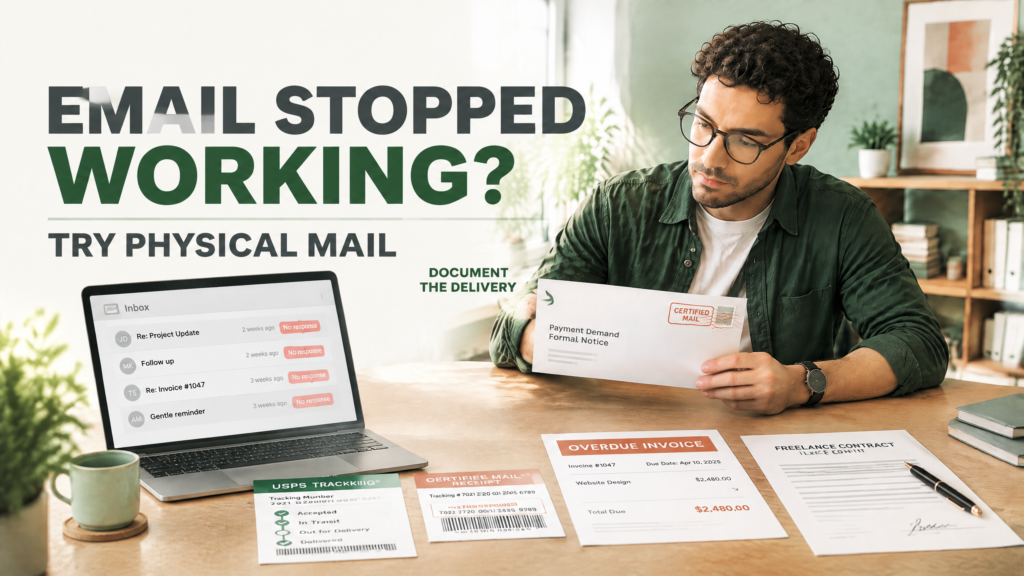
For freelancers, the problem is not merely that an invoice is late. The bigger problem is creating a reliable record of what you sent, when you sent it, where you sent it, and what happened afterward.
That is where a physical demand letter can become useful.
A certified or otherwise trackable letter does not magically make an unpaid invoice legally enforceable, and it does not guarantee payment. Its practical value is that it can create additional evidence of mailing, delivery or attempted delivery and give your demand a more formal paper trail.
That distinction matters.
This guide explains when a physical demand letter makes sense, what it can and cannot prove, how to prepare one, and how to avoid common mistakes when dealing with a corporate client.
Short answer: Yes, a certified or trackable letter can be a useful escalation tool when email has stopped producing results. But do not confuse proof of delivery with proof that you are legally entitled to the money. Your contract, applicable law, notice provisions and jurisdiction still matter.
The Case of the “Lost” $12,000 Invoice
A few years ago, I dealt with a web-development project where the final milestone had been approved and the final invoice remained unpaid.
The project manager said the invoice had been forwarded to accounting.
Accounting said it had not been located.
Follow-up emails produced little progress.
After several digital reminders, I decided to create a formal physical record of the demand. I printed the invoice and supporting documents, prepared a concise demand letter, and sent the package using a trackable postal service with delivery confirmation.
The client paid shortly after the letter was received.
That experience taught me something important:
The useful part of the physical letter was not that certified mail somehow created liability. The useful part was that the demand became harder to overlook and easier to document.
That is the principle this article is built around.
If your invoice has disappeared into an accounting department, first consider whether the problem is administrative rather than adversarial. Our guide on [what to do when a corporate client claims your invoice was lost in accounting] can help you work through that possibility before escalating.
Likewise, if you have already sent multiple reminders, review [the exact follow-up timeline for late freelance invoices] before deciding that physical mail is the next appropriate step.
1. Why Physical Mail Can Help When Email Stops Working
Email is not inherently weak evidence.
In the United States, electronic records and signatures can have legal effect in many commercial transactions, subject to the applicable law and exceptions. Electronic communications can also become important evidence when they show agreement, delivery, acknowledgment, performance or a payment dispute.
So do not make the mistake of thinking:
Email = no legal value.
That is wrong.
The better distinction is:
Email may create evidence. Certified or trackable mail may create additional evidence about the physical transmission and delivery of a particular document.
That can be valuable when a dispute later develops.
For example, your file might contain:
- the original invoice;
- the contract or proposal;
- emails discussing payment;
- messages acknowledging the work;
- a final demand;
- a postal receipt;
- a tracking record;
- a delivery or attempted-delivery record; and
- subsequent communications from the client.
Together, those records can create a much clearer chronology than a collection of disconnected reminders.
If your client has repeatedly claimed that accounting never received your invoice, compare this approach with [how to get paid when a corporate accounts-payable department says your invoice was lost].
And if the client simply ignores your messages while remaining active elsewhere, see [what to do when a client ignores your Slack messages but posts on LinkedIn].
2. What Certified Mail Actually Proves — and What It Does Not
This is the most important distinction in the entire article.
USPS describes Certified Mail as providing evidence of mailing and delivery or attempted delivery. When Return Receipt is purchased, the sender can obtain delivery information including the date and the signature of the recipient or authorized agent.
That can be useful evidence.
But it does not automatically prove every legal proposition in your dispute.
Certified or trackable mail may help establish:
- that you mailed a particular document;
- the date on which the item entered the postal system;
- the destination address used;
- delivery or an attempted delivery;
- the date of delivery;
- the signature recorded by the postal service when applicable;
- that you made a documented demand for payment.
It does not automatically establish:
- that the invoice is legally valid;
- that the client admits owing the money;
- that the client breached the contract;
- that your requested amount is correct;
- that interest or late fees are legally recoverable;
- that a particular notice requirement has been satisfied;
- that you have completed service of process;
- that constructive notice exists;
- or that you will win a lawsuit.
That distinction is essential.
A delivery record is evidence about delivery.
It is not a substitute for proving the underlying claim.
For a broader evidence strategy, see [how to turn an email trail into a legally defensible invoice statement].
3. Certified Mail Is Not the Same Thing as “Constructive Notice”
This is one of the most misunderstood concepts in online discussions about legal letters.
Constructive notice is a legal doctrine under which the law may treat a person as having notice even when they did not actually receive the information, if the circumstances and applicable legal rules justify that conclusion.
That does not mean:
“I sent a certified letter, therefore constructive notice automatically exists.”
It does not work that way.
Whether constructive notice applies depends on the particular legal rule and circumstances.
Similarly, actual notice, constructive notice and formal service of process are different concepts.
If your dispute has reached litigation, you must follow the service rules that apply to that proceeding. A demand letter sent before litigation should not casually be described as equivalent to serving a lawsuit.
For U.S. federal civil litigation, the Federal Rules of Civil Procedure contain specific rules governing service of pleadings and other papers. The applicable rules can differ depending on the document and stage of the proceeding.
So use precise language:
“This mailing creates evidence of the demand and its delivery.”
Do not promise:
“This automatically creates constructive notice.”
That single distinction makes your legal guidance substantially more reliable.
4. Why a Physical Demand Can Receive More Attention
There is also a practical, non-legal reason to consider physical mail.
A corporate inbox can contain thousands of messages.
A physical envelope addressed to a finance, accounts-payable or appropriate legal contact may interrupt that routine.
That does not mean a company is legally required to respond simply because you sent a certified letter.
It means the communication may become more visible internally.
A documented physical demand can also help you move the matter from:
“I sent another reminder.”
to:
“I formally documented the outstanding balance and preserved evidence of the escalation.”
That is a much stronger business process.
If your problem began because the client repeatedly delayed payment, you may also benefit from [the accounting-loop strategy for getting a delayed invoice moving again].
And if the relationship has already deteriorated significantly, compare the physical-demand approach with [a notice of suspension of services].
5. When Should You Send a Physical Demand Letter?
There is no universal legal rule saying that every freelancer should wait 31 days before mailing a demand.
Your contract may specify:
- the payment deadline;
- a notice period;
- a cure period;
- a contractual address for notices;
- an approved delivery method;
- a dispute-resolution process;
- arbitration requirements; or
- other pre-litigation procedures.
Read those provisions first.
A practical framework is:
Before the invoice is due
Use ordinary billing and reminder procedures.
If you want to reduce late payments before they happen, review [how to design an invoice that accounts-payable teams can’t ignore].
You can also use [early-payment discounts for freelancers] if they fit your business model.
Shortly after the due date
Confirm that the invoice was received and ask whether there is an administrative problem.
Do not immediately assume bad faith.
After repeated non-response
Move from informal reminders toward a clear written demand.
Your [unpaid invoice follow-up email templates] can help structure the earlier stages.
When the dispute becomes material
Consider a formal demand letter, including physical delivery if appropriate.
If you are already considering litigation or collection, read [when it is officially time for a freelancer to take legal action] and [how to recover an unpaid invoice yourself without hiring a lawyer].
The exact timing should be based on the contract, amount involved, client behavior and applicable law—not an arbitrary day count.
6. Before Mailing Anything, Read Your Contract
This step is frequently skipped.
Before preparing the envelope, look for the contract’s notice clause.
It may specify:
- where notices must be sent;
- whether email is permitted;
- whether notices must be written;
- whether courier delivery is permitted;
- whether certified mail is required;
- when notice becomes effective;
- who must receive the notice;
- and which law governs the agreement.
If you negotiated only through emails, messages or a proposal, that does not automatically mean you have no enforceable rights.
See [Can you sue a client without a contract?] for a deeper discussion of agreements formed through communications and conduct.
And if the project was agreed through WhatsApp, read [whether a WhatsApp chat can count as a legally binding contract].
Likewise, a freelancer whose entire agreement exists through Slack should preserve the relevant messages and review [what to do when a client ghosts a final invoice agreed through Slack].
7. Build the Demand Package Before You Visit the Post Office
Do not simply print an invoice and put it in an envelope.
Prepare a clean, chronological package.
A useful package may contain:
- Cover letter
- Outstanding invoice
- Statement of account
- Contract, proposal or relevant agreement
- Relevant payment-term provision
- Concise proof of completed work
- Important supporting correspondence
- Prior payment reminders
- Calculation of any legally supportable interest or late fee
- Clear response/payment deadline
Do not overwhelm the recipient with 200 pages of unrelated material.
The goal is clarity.
The reader should be able to answer five questions quickly:
Who is demanding payment?
What invoice is unpaid?
Why is the amount allegedly owed?
What documents support the demand?
What should the recipient do next?
For a deeper evidence-building approach, use [the freelancer’s legal guide to recovering unpaid invoices].
8. The Cover Letter Should Be Boring
That is a compliment.
A strong demand letter is usually factual rather than emotional.
Include:
- your name or business name;
- the client’s correct legal/business name;
- address;
- invoice number;
- invoice date;
- contractual due date;
- amount outstanding;
- relevant contract/payment provision;
- short description of the work;
- previous attempts to resolve the issue;
- requested payment date;
- payment instructions;
- and a statement reserving your rights where appropriate.
Avoid:
“You have completely destroyed my business.”
Prefer:
“As of the date of this letter, Invoice No. 1047 remains outstanding in the amount of $12,000.”
If you need a stronger escalation document, compare this with [the final notice before legal action].
9. Be Careful With Interest and Late Fees
Do not automatically add a late fee because the invoice is overdue.
Whether you can charge interest or a late fee may depend on:
- the contract;
- applicable statute;
- governing law;
- the nature of the transaction;
- agreed payment terms;
- and potentially the jurisdiction.
Before putting a number into your demand letter, review [how to charge late fees legally in the US, UK and India] and [whether you can legally charge interest on late invoices].
If the contract says Net 30, for example, that does not necessarily mean every legal consequence associated with late payment automatically begins on Day 31.
Read [Net 15 vs. Net 30 vs. Net 45 payment terms] for the contractual side of the issue.
10. What If the Agreement Exists Only Digitally?
Do not panic.
Contracts are not necessarily invalid merely because the parties communicated electronically.
Depending on the jurisdiction and transaction, emails, electronic records, proposals, messages, approvals and payment records can all become relevant evidence.
Your job is to preserve the evidence.
Create a chronology:
Proposal → Negotiation → Acceptance → Work → Approval → Invoice → Due Date → Reminder → Client Response → Demand
That chronology can be more valuable than printing every message you ever exchanged.
If the client disputes the existence of an agreement, see [Can a WhatsApp conversation count as a legally binding contract?]
If there was no conventional contract at all, see [Can you sue a client without a contract?]
11. Label Your Supporting Documents
A professional package is easier to understand when the documents are organized.
For example:
Exhibit A — Agreement / Proposal
Exhibit B — Invoice
Exhibit C — Approval of Final Deliverable
Exhibit D — Relevant Payment Communications
Exhibit E — Prior Payment Demand
You do not need to create a theatrical courtroom exhibit package for a $500 invoice.
But when the amount is substantial or the dispute is serious, organized documentation can make the underlying story much easier to understand.
This approach is particularly important if the client claims that you did not complete the work.
For disputes involving digital deliverables, see [what to do when a client uses your work but refuses to pay].
For code disputes, see [what to do when a client has your code on AWS and won’t pay].
12. Physical Mail Pre-Flight Checklist
Before sending the package, verify:
- Correct client legal/business name
- Correct physical address
- Contractual notice address checked
- Invoice number included
- Original due date confirmed
- Amount independently calculated
- Contract/payment terms attached
- Relevant proof of work attached
- Prior demands preserved
- Response deadline stated
- Payment instructions checked
- Applicable interest/late fee verified
- Copy of final letter saved
- Postal receipt retained
- Tracking number recorded
- Delivery/attempted-delivery record preserved
- Return receipt preserved where purchased
The goal is not intimidation.
The goal is documentation.
13. USPS Certified Mail and Return Receipt
For U.S. domestic mail, USPS Certified Mail can provide evidence of mailing and delivery or attempted delivery. A Return Receipt can provide additional delivery information, including the recipient’s signature or the signature of an authorized agent, depending on the service and circumstances.
USPS also provides electronic delivery records for applicable services.
The important point is to preserve the records.
Save:
- the mailing receipt;
- tracking number;
- scanned copy of the letter;
- delivery confirmation;
- Return Receipt if purchased;
- and any subsequent response.
Do not throw the receipt away after the envelope disappears into the postal system.
For current USPS service details and pricing, check USPS directly because postal fees and procedures can change.
14. A Return Receipt Is Evidence — Not a “Trump Card”
A signed return receipt can be valuable.
But it does not transform an invoice into a judgment.
Suppose your client signs for the letter.
That may help establish:
“A document was delivered to this address on this date and accepted by the recorded recipient or authorized agent.”
It does not automatically establish:
“The client admits owing $12,000.”
Those are completely different propositions.
This distinction is especially important if you eventually end up in court.
A judge may still ask:
- Was there a contract?
- Was the work completed?
- Was payment due?
- Was the amount correct?
- Were contractual conditions satisfied?
- Was there a legitimate dispute?
- Was notice required?
- Was the notice properly given?
The postal receipt addresses only part of that story.
15. What If the Client Refuses or Does Not Accept the Letter?
Do not write:
“Refusal automatically equals successful legal service.”
That is too broad.
Instead, preserve the postal record showing what happened.
A delivery attempt, refusal, return, or other postal event may become relevant evidence, but its legal effect depends on the applicable notice or service rules.
If the matter is already heading toward litigation, obtain jurisdiction-specific legal advice rather than assuming that a refused letter has the same effect as formal service.
Remember:
A demand letter and service of process are not automatically the same thing.
16. Who Should Receive the Letter?
Do not blindly send every dispute to the CEO.
Start with the contract.
If the contract specifies a notice recipient or address, follow it unless applicable law or professional advice indicates otherwise.
If there is no contractual requirement, a practical business escalation might include:
- Accounts Payable;
- Finance;
- Controller;
- appropriate executive;
- or legal department where appropriate.
Addressing a letter to the correct entity and location is more important than creating maximum drama.
If the person who originally hired you has stopped responding, your objective is to make sure the demand reaches the organization through a sensible and documented channel.
17. Don’t Manufacture Pressure
Avoid threats you are unwilling or unable to carry out.
Do not write:
“Pay me in 48 hours or I will destroy your website.”
Do not threaten:
- unlawful access;
- public shaming;
- unauthorized deletion;
- disruption of servers;
- improper copyright claims;
- false reports;
- or harassment of employees.
A demand letter should create a record of a legitimate commercial dispute, not create a second legal problem.
If the client controls your code or infrastructure, read [Can I shut down a client’s server for non-payment?] before taking any technical action.
If the client wants your editable files before payment, see [what to do when a client asks for PSD or AI files before payment].
And if a client wants access to your Figma files while withholding payment, review [how to revoke Figma access after non-payment safely].
18. What If the Client Demands a New NDA Before Paying?
This is a different dispute.
Do not assume that sending a certified letter resolves it.
If the client suddenly asks you to sign a new document that was not part of the original agreement, examine whether that document changes your existing obligations.
See [how to handle a client who retrospectively demands an uncontracted NDA before clearing an invoice].
The important principle is simple:
Do not accidentally surrender an existing contractual position merely because you want the invoice paid quickly.
19. What If the Client Has Already Used Your Work?
An unpaid invoice and unauthorized use of intellectual property can be related but legally distinct issues.
For example, a client might:
- use unpaid website code;
- publish unpaid articles;
- distribute an unpaid video;
- use unpaid designs;
- upload unpaid media;
- or deploy work before the agreed payment milestone.
Do not automatically assume that non-payment gives you the right to disable, delete or destroy the client’s systems.
Instead, preserve evidence and evaluate the contractual and intellectual-property position.
For code disputes, see [client stole my website code: legal steps to prove ownership and recover access].
For GitHub disputes, see [how to file a DMCA takedown on your own code repository].
For published writing, see [what to do when a client published your article but didn’t pay].
For video work, see [what to do when a client uses your video without paying].
For design disputes, see [what to do when a client uses your design without paying].
20. Certified Mail vs. Other Communication Methods
The right question is not:
“Which communication method is legally strongest?”
The better question is:
“Which combination of communication methods gives me the clearest, most reliable record for this particular dispute?”
| Method | What it can help document | Main limitation |
|---|---|---|
| Sending, communications, acknowledgments and electronic records | Delivery and authenticity may become disputed | |
| Slack / messaging | Project communications and acknowledgments | Context, retention and authentication can become issues |
| Standard mail | Physical transmission | Limited delivery evidence |
| Certified/trackable mail | Mailing plus delivery/attempted-delivery records | Does not prove the underlying debt |
| Return Receipt | Additional delivery/signature information | Signature does not equal admission of liability |
| Courier with signature | Delivery and signature evidence | Legal effect depends on contract and applicable rules |
| Formal service | Service of documents according to applicable procedural rules | Usually a different process from a pre-litigation demand |
There is no universal “best” method.
The contract and applicable law come first.
21. U.S. Notice and Service Are Different Concepts
This distinction deserves its own section because freelancers often mix them together.
A pre-litigation demand is generally an attempt to resolve a commercial dispute before filing a lawsuit.
Service of process is a procedural mechanism used in litigation.
The requirements for service depend on the proceeding and applicable procedural rules.
For example, the Federal Rules of Civil Procedure contain specific rules concerning service of pleadings and other papers in federal litigation.
Therefore:
Do not tell a freelancer that mailing a certified demand letter is equivalent to serving a lawsuit.
It isn’t automatically.
If litigation has already begun, follow the applicable procedural rules.
If litigation has not begun, the demand letter is generally part of the pre-litigation record.
22. What About the UK, India, Canada or Australia?
The practical idea of creating a documented demand can travel across borders.
The legal rules do not.
The terminology, acceptable notice methods, contractual requirements, service rules, limitation periods and pre-action procedures can differ significantly.
United States
For U.S. disputes, USPS Certified Mail and Return Receipt can provide useful evidence concerning mailing and delivery. But the legal significance of that evidence depends on the claim, contract and applicable law.
United Kingdom
Do not assume that a U.S.-style certified-mail analysis automatically applies. A contractual notice clause and any applicable pre-action requirements should be checked before sending a formal demand.
India
Do not assume that U.S. concepts such as USPS Certified Mail or the UCC apply. Indian contract, procedural and evidentiary rules must be considered separately.
Canada and Australia
Again, local rules and contractual notice provisions matter.
For cross-border work, read [how to protect yourself when working with international clients] before sending a demand.
The safest global principle is:
Use the delivery method required by the contract or applicable law where possible, and preserve evidence of the communication and delivery.
23. The Evidence File You Should Keep
Create one folder for the dispute.
A useful structure is:
01 — Contract
02 — Proposal
03 — Scope Changes
04 — Deliverables
05 — Invoice
06 — Payment Communications
07 — Demand Letter
08 — Postal Receipt
09 — Delivery Record
10 — Client Response
This becomes especially valuable if the client later changes its explanation.
If the client says:
“We never received the invoice.”
you have one record.
If they later say:
“The invoice was disputed.”
you have another.
If they then say:
“We never agreed to the work.”
your original contract and project communications become relevant.
The objective is not to overwhelm the client.
It is to make your own evidence organized before you need it.
24. When a Certified Letter Is Probably Not the Best Next Step
A physical demand is not appropriate for every dispute.
Consider a different strategy when:
The invoice is genuinely disputed
If the client claims defective work, missed milestones or breach, sending the same demand again may not solve the underlying problem.
The contract has a mandatory dispute procedure
Follow the contractual process.
The amount is very small
The time and cost of formal escalation may outweigh the benefit.
The client is already negotiating in good faith
A physical demand may unnecessarily escalate a relationship that is being resolved.
Litigation has already started
Do not improvise service procedures.
Intellectual-property rights are involved
A payment demand may need to be accompanied by a separate legal analysis.
For example, if a client uses work without paying, read [what to do when a client uses your work but refuses to pay].
25. What If the Client Makes a Partial Payment?
Be careful.
A partial payment may be useful, but accepting it can sometimes create questions about what the payment represents and whether the parties intended it as full or partial settlement.
Do not casually write:
“Thanks, this settles the matter.”
unless you actually intend that result.
For a deeper discussion, see [the partial-payment trap and why accepting a small percentage of a late invoice can sometimes affect your leverage].
If the client offers 10% with conditions attached, read the proposed terms carefully before accepting.
26. What If the Client Suddenly Changes the Scope?
Do not allow a payment dispute to erase a scope dispute.
If the client claims that additional work was included in the original price, compare the original scope, change requests and approvals.
See [how to charge for scope creep without losing the client].
You should also review [how to stop working for free and prevent scope creep from eating your profits].
The physical demand letter should describe the amount you can actually support—not every frustration accumulated during the project.
27. What If the Client Is Running Out of Money?
A certified letter cannot create money where there is none.
If the company is genuinely experiencing financial distress, the timing of your escalation matters.
Read [what happens to your invoice if your corporate client goes bankrupt].
If the project is still ongoing and the client has stopped funding it, review [what to do when a client runs out of money mid-project].
If you are working on a video project that cannot continue because the client has exhausted its budget, see [what to do when a video-production client runs out of money before post-production ends].
The earlier you identify financial distress, the more options you may have.
28. A Better Escalation Ladder
A physical demand letter works best as part of a larger recovery process.
A sensible escalation ladder can look like this:
Stage 1 — Invoice
Send a clear invoice with the contractual due date.
Stage 2 — Confirmation
Confirm that the client received it.
Stage 3 — Friendly reminder
Give the client an opportunity to identify an administrative problem.
Stage 4 — Firm demand
State the amount, due date and payment deadline.
Stage 5 — Operational response
Where contractually permitted, consider suspension of additional work.
See [how to use a notice of suspension of services without permanently damaging the client relationship].
Stage 6 — Formal demand
Prepare a documented demand letter.
Stage 7 — Collection or legal process
Depending on the amount, jurisdiction, contract and economics, consider collection, arbitration, mediation or litigation.
See [whether you should hire a debt collection agency for unpaid invoices].
This ladder is better than jumping directly from:
“Hey, just checking in!”
to:
“PAY ME OR YOU WILL HEAR FROM MY LAWYER!”
29. A Practical Physical Demand Letter Structure
Your actual letter can be short.
Paragraph 1 — Identify the debt
State the invoice number, amount and due date.
Paragraph 2 — Identify the underlying agreement
Reference the contract, proposal or agreed scope.
Paragraph 3 — Confirm performance
Briefly identify the work delivered and relevant approval.
Paragraph 4 — State previous attempts
Mention earlier payment reminders without writing an emotional history.
Paragraph 5 — Demand payment
State the amount currently claimed and a reasonable deadline consistent with the contract and applicable law.
Paragraph 6 — Preserve rights
State that you reserve any rights and remedies available under the agreement and applicable law, without threatening remedies you do not actually intend or have authority to pursue.
Paragraph 7 — Provide payment instructions
Make it easy for the client to resolve the dispute.
That is enough.
30. Example of the Tone You Want
Avoid:
“You have ignored me for six weeks and I am sick of this nonsense.”
Prefer:
“Despite previous communications, Invoice No. 1047 remains outstanding in the amount of $12,000. Please arrange payment or provide a written explanation of any specific dispute concerning the invoice by [date].”
That is stronger precisely because it is calmer.
31. The Corporate Client Does Not Have to Be Your Enemy
This matters.
A late invoice may be caused by:
- an incorrect purchase-order number;
- a vendor onboarding problem;
- a missing tax form;
- an invoice sent to the wrong address;
- an approval bottleneck;
- an accounting error;
- a budget dispute;
- a change in personnel;
- or deliberate non-payment.
Your first objective should be identifying which situation you are dealing with.
If the problem is simply administrative, a formal physical demand may be unnecessary.
If the client has repeatedly ignored documented requests, however, a more formal record can be appropriate.
32. The Physical Letter Is About Evidence, Not Fear
This is the mindset I recommend.
Do not send a certified letter because you want the CFO to panic.
Do not send it because you want to “scare legal into action.”
Send it because:
- the invoice is genuinely due;
- you have supporting evidence;
- ordinary communication has failed;
- the contract and applicable law have been considered;
- you want a clear written record;
- and you are prepared to take the next legitimate step if the dispute remains unresolved.
That is professional escalation.
33. Five Mistakes to Avoid

Mistake 1: Calling certified mail “bulletproof”
It is not.
It is evidence.
Mistake 2: Treating delivery as an admission of liability
A signature does not mean:
“I agree that I owe this money.”
Mistake 3: Ignoring the contract’s notice clause
This can undermine an otherwise carefully prepared demand.
Mistake 4: Threatening remedies you cannot legally use
Do not create a second dispute.
Mistake 5: Sending a giant emotional narrative
Keep the demand factual.
Your evidence should tell the story.
34. What If the Client Uses Your Unpaid Work?
A payment dispute can sometimes overlap with intellectual-property rights.
For example:
- a video may be publicly distributed before payment;
- an article may be published;
- code may be deployed;
- designs may be printed;
- a voiceover may be used beyond the agreed scope.
But do not assume that every unpaid invoice automatically gives you a right to issue a copyright claim or shut down the client’s systems.
The contractual and intellectual-property facts matter.
For a voiceover usage dispute, see [what to do when a client uses your voiceover for a national TV advertisement beyond the agreed scope].
For unpaid articles, see [how to recover money when a client publishes your article without paying].
For unfinished documentary footage, see [what to do if an unpaid client airs your unfinished documentary at a film festival].
35. What If the Client Has Your Files but Has Not Paid?
Again, separate the issues.
You may have contractual rights concerning delivery, ownership, licensing or payment milestones.
But technical control over files does not automatically mean you can delete, sabotage or disable the client’s systems.
If the client has a live Shopify project, see [how to legally pause access to an unpaid Shopify project].
If the client has your domain or hosting assets, see [the legal risks around shutting down or freezing a client’s domain].
Use contractual rights carefully.
36. When a Physical Demand Makes the Most Sense
A documented physical demand is particularly useful when:
- the invoice is materially overdue;
- the contract is clear;
- the work was completed;
- the client has acknowledged the debt or work;
- ordinary reminders have failed;
- you have a reliable business address;
- the amount justifies formal escalation;
- and you want a stronger documentary trail before considering collection or litigation.
It is less useful when the fundamental problem is a genuine contract or performance dispute.
37. The Final Evidence Checklist
Before escalating, ask yourself:
Contract
- Do I have the agreement?
- What does it say about payment?
- What does it say about notices?
- What law governs the agreement?
- Is there an arbitration or mediation clause?
Invoice
- Is the invoice accurate?
- Was it sent correctly?
- Is the due date correct?
- Is the amount supported?
Performance
- Can I prove delivery?
- Did the client approve the work?
- Are there emails or messages confirming acceptance?
Demand
- Have I clearly stated the amount?
- Have I given a reasonable response deadline?
- Have I avoided unsupported legal claims?
Delivery
- Did I use the method required by the contract?
- Did I preserve the postal receipt?
- Did I save the tracking information?
- Did I preserve the delivery record?
Escalation
- Am I actually prepared to take the next legitimate step?
- Have I checked the applicable jurisdiction?
- Would collection, mediation, arbitration or litigation make economic sense?
If you can answer these questions confidently, your demand package will be much stronger.
Frequently Asked Questions
1. Does certified mail guarantee that I will get paid?
No.
Certified or trackable mail can strengthen the documentary record surrounding your demand, but it does not guarantee payment or establish that the client is legally liable.
2. Does certified mail prove the client owes the invoice?
No.
It can help prove that a particular document was mailed and delivered or that delivery was attempted. You still need evidence supporting the underlying debt.
3. Does a signed Return Receipt mean the client admitted liability?
No.
A signature generally concerns receipt or delivery. It is not automatically an admission that the recipient agrees with the contents.
4. Is certified mail the same as formal service of a lawsuit?
No.
A pre-litigation demand and service of process are different concepts. If litigation has started, follow the applicable procedural rules.
5. What if the client refuses delivery?
Preserve the postal record showing the refusal or delivery attempt. The legal effect of refusal depends on the applicable law and the type of notice involved.
6. Should I send the letter to the CEO?
Not automatically.
Check the contract’s notice provision first. Otherwise, a relevant finance, accounts-payable or legal contact may be appropriate depending on the circumstances.
7. Can I send a demand letter by email instead?
Possibly.
Electronic communication can create useful evidence, and electronic records can have legal significance. Whether email satisfies a particular contractual or statutory notice requirement depends on the applicable rules.
8. How much does certified mail cost?
Postal pricing changes. Check the current USPS rates and available Certified Mail and Return Receipt options before mailing.
9. Should I send a physical letter before hiring a collection agency?
Often, a documented demand can be a sensible step, but there is no universal rule requiring it. Compare the cost, amount owed, contract, jurisdiction and likely recovery with the economics of collection.
For a deeper analysis, read [Should You Hire a Debt Collection Agency?].
10. Should I send a certified letter before filing a lawsuit?
It can be useful, but do not assume it is legally mandatory or sufficient. Check the contract and applicable pre-litigation requirements for the particular dispute.
Final Thoughts: Use the Letter to Create a Record, Not a Threat
The strongest reason to send a physical demand letter is not that a green postal receipt somehow scares a corporation into paying.
It is much simpler.
A properly prepared demand creates a cleaner record.
It can show:
- what you demanded;
- how much you demanded;
- when you demanded it;
- where you sent it;
- whether delivery was attempted or completed;
- and what happened afterward.
That can matter enormously if the dispute continues.
The best escalation strategy is therefore not:
Email → anger → threats → certified letter.
It is:
Invoice → documented reminders → clear demand → evidence preservation → appropriate formal escalation.
If you are still in the early stages, start with [how to recover an unpaid invoice yourself without hiring a lawyer].
If your client has already gone silent, see [my client ghosted me after I sent the invoice].
If the dispute has become serious, review [the freelancer’s legal guide to recovering unpaid invoices without expensive lawsuits].
And if you are considering formal legal action, understand the contract, jurisdiction, notice requirements and economics before taking the next step.
A certified letter can be a useful tool.
Just remember what it actually is:
a documented communication and potential piece of evidence—not a judgment, not a magic legal trigger, and not a guarantee of payment.
About the Author
Adv. Sagar Haribhau Shirsat is an Indian advocate who writes about contract, payment-recovery and legal-risk issues affecting freelancers, independent contractors and digital businesses.
His work focuses on practical documentation, dispute prevention, payment recovery and risk-management strategies for modern freelance and cross-border commercial relationships.
Because notice, evidence, enforcement and service rules can vary by jurisdiction, readers should verify the applicable law before relying on a particular procedure.
Disclaimer: This article is provided for general educational and risk-management purposes. It is not a substitute for legal advice concerning a specific dispute. The legal effect of a demand letter, certified mail, electronic communication, notice or delivery record depends on the applicable contract, jurisdiction and law. Cross-border disputes may involve additional rules. Consult a qualified lawyer in the relevant jurisdiction when the amount, legal rights or potential litigation justify professional advice.
Cornell Law School — Constructive Notice
U.S. Courts — Federal Rules of Civil Procedure