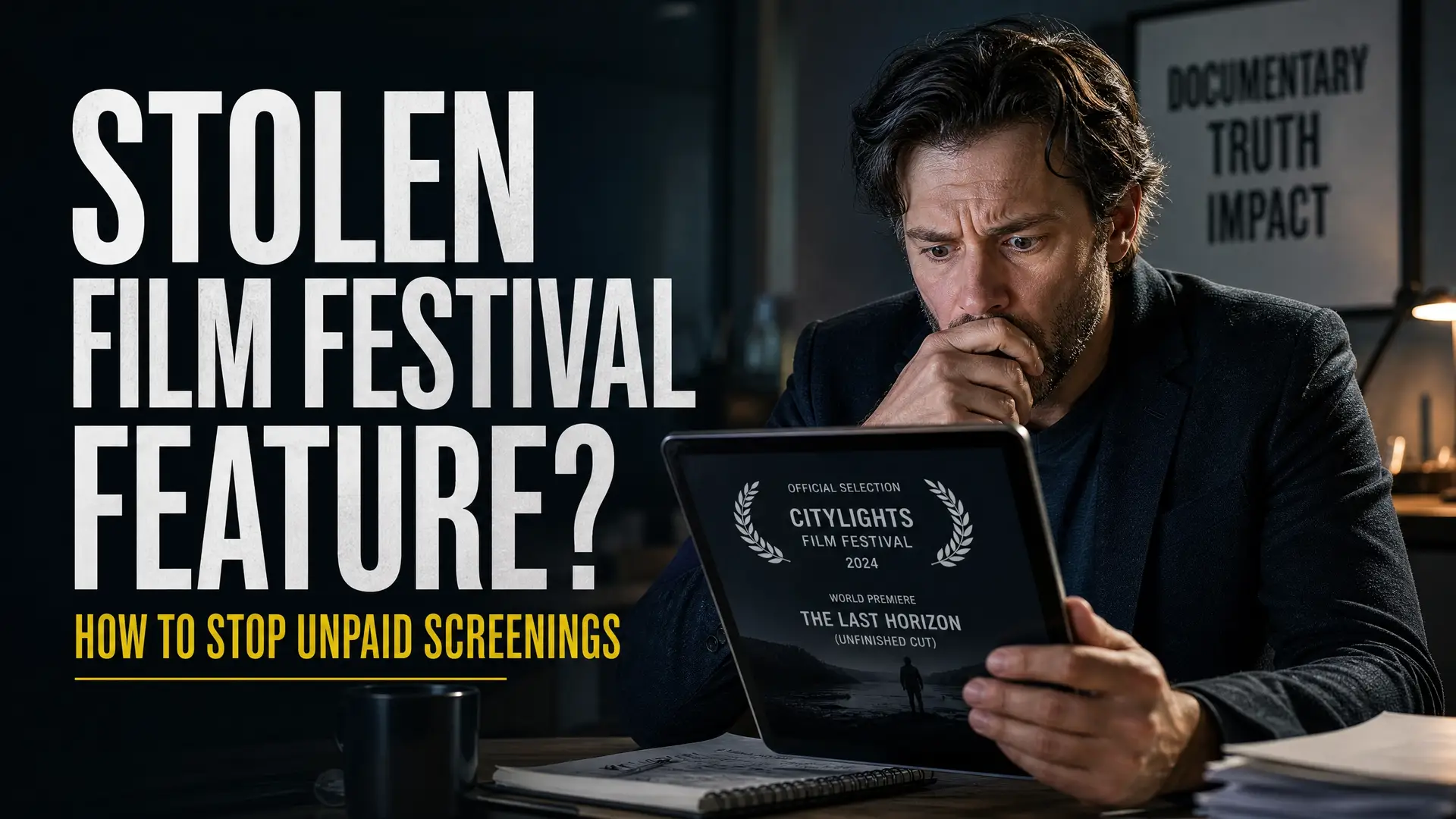
Imagine scrolling Instagram on a Tuesday night. You are exhausted, just trying to wind down.
Then, you see a post from that client who owes you $15,000.
They are standing on a stage at an indie film festival. They look thrilled. The audience is clapping.
Behind them, playing on a massive screen, is the documentary you poured your soul into.
The color grading is a mess. The audio isn’t mixed. It is the rough cut you sent them three months ago.
And your invoice is 60 days past due.
My phone rings with this exact panic at least twice a year. Freelancers completely freeze up when they see their unfinished work in public.
Here is exactly what you do right now.
Do not call the client to scream at them. Do not send an emotional text message demanding your money.
Instead, consider promptly sending a professional notice to the film festival explaining that ownership or licensing rights to the film are disputed, where the facts and your contract support that position.
Rather than focusing only on the client, you may also notify the organization planning to exhibit the work if it could unknowingly be screening material over which rights are genuinely disputed.
In this guide, I refer to this practical escalation framework as the “Festival Injunction Strategy.”
It is not a formal legal doctrine, but a risk-management approach that may be appropriate in some copyright and contract disputes.
Look, if you let this slide, two things happen. First, your industry reputation gets attached to a sloppy, unfinished product.
Second, once the film screens, the client gets exactly what they wanted. Your leverage vanishes.
If the screening goes ahead before the dispute is addressed, your negotiating leverage may be significantly reduced, making recovery of the remaining payment more difficult.
Here is how we fix it, step by step.
Table of Contents
Public Screening Piracy
We need to reframe how you look at this situation.
When a client publicly screens a film despite an unresolved payment dispute, the situation may involve more than a simple contract dispute.
Depending on the contract, copyright ownership, licence terms, and governing law, it may also raise copyright infringement issues.
Whether you retain copyright depends primarily on your contract and the governing law.
Many freelance agreements transfer rights only after payment, while others assign copyright immediately or classify the work as a work made for hire.
Many freelance agreements provide that intellectual property transfers only after full payment.
However, some contracts assign rights earlier, so you should always review the specific wording before assuming ownership remains with you.
If you are wondering what happens when a client used my video without paying, the law is actually on your side.
If you remain the copyright owner or exclusive license holder under the applicable agreement, the U.S. Copyright Act generally grants you the exclusive right to authorize public performances and other protected uses of the work.
If they publicly exhibit the work without the necessary copyright authorization, the exhibition may constitute copyright infringement under applicable law.
A pending invoice means they do not have a license.
It really is that simple. I have had to explain this to countless agency owners over bad coffee.
Many clients mistakenly assume that paying for creative services automatically transfers copyright. In reality, ownership depends on the contract and applicable copyright law.
In the landmark case Community for Creative Non-Violence v. Reid, the Supreme Court made it clear.
Independent contractors retain copyright unless a work-for-hire agreement is explicitly signed and conditions are met.
Whether payment affects ownership depends on the wording of the agreement.
Many freelance contracts make payment a condition for transferring rights, but this is not universal.
If you still own the copyright or the client lacks permission to exhibit the work, the screening may amount to unauthorized use of copyrighted material.
You are not begging for a favor. You are enforcing a legal boundary.
Notifying Film Festival Directors of Clouded Titles about Unpaid Client Airs Your Unfinished Documentary
This is where the magic happens.
Film festivals generally seek to avoid disputes involving copyright ownership, licensing, or chain-of-title because such issues can expose them to legal and reputational risk.
They certainly do not want to be named as co-defendants in a copyright infringement lawsuit.
Your goal is to inform the festival that the film’s title is “clouded.”
This means the ownership rights are currently in dispute.
Once a festival becomes aware of a genuine ownership or licensing dispute, it may pause the screening, seek additional documentation, consult legal counsel, or, in some cases, remove the film from the program.
You do not need a law degree to do this. You just need to know how to recover an unpaid invoice without a lawyer.
You find the contact information for the festival’s programming director and their legal counsel.
Then, you send a highly professional, entirely emotionless email.
Tell them the film contains unlicensed, copyrighted material owned by you.
For purposes of this guide, I refer to this practical escalation approach as the “Content Kill Strategy.”
It is simply a descriptive label for notifying downstream exhibitors of a legitimate rights dispute.
Do not complain about the client being a jerk. Stick strictly to the facts of ownership.
State that if they proceed with the screening, they will be knowingly exhibiting infringing material.
In many cases, involvement of the festival encourages the client to address the dispute more quickly because the screening itself may be placed at risk.
The Festival Take-Down Sequence
Here is a simple flow of how this escalation works in real-time.
Cease-and-Desist Demands for Public Exhibitions
Once you notify the festival, you finally turn your attention to the client.
This is when you send the formal cease-and-desist letter.
A lot of freelancers get this wrong. They send angry rants that sound like journal entries.
A proper C&D is cold. It is clinical. It lists facts, dates, and legal statutes.
If you know how to send a cease and desist when a client steals code or designs, the framework for a film is exactly the same.
You state that they are in violation of Title 17 of the United States Code, Section 106.
This section grants you the exclusive right to show the work publicly.
Give them a hard deadline. Usually, 24 to 48 hours is appropriate for a live festival scenario.
Tell them they must withdraw the film and pay the outstanding balance immediately.
If the client ghosted after the invoice previously, A properly drafted legal notice often prompts a response, particularly when an upcoming public screening is involved.
Here’s the thing: you must be prepared to stand your ground.
Do not accept a partial payment in exchange for letting the screening happen.
If you want to know when to take legal action, this is the moment.
If they refuse, you escalate. In many disputes, pressure created by a pending public exhibition encourages both sides to negotiate a resolution before the event.
Free Notice of Clouded Title Generator
I built this simple tool so you don’t have to overthink the wording. Just fill in the blanks and copy the text.
🛡️ Notice of Clouded Title Generator
Fill in the details below to generate a formal notice to the festival director. This effectively puts the festival on legal notice.
Damages for Early, Unauthorized Derivative Showings
Let’s talk about money. What happens if you are too late and the film already screened ?
You are no longer just fighting for your unpaid invoice. You are fighting for damages.
An unfinished cut is legally considered an unauthorized derivative work.
Depending on the circumstances, publicly exhibiting an unfinished version may create additional legal and reputational issues beyond the unpaid invoice itself.
This causes actual harm to your professional reputation.
It is very similar to when a client refuses to pay the creative director asset fee after launching a campaign.
You can sue for actual damages (the money they owe you plus any lost business).
Or, if your contract is properly registered, you can sue for statutory damages.
The availability of statutory damages depends on factors such as registration requirements, jurisdiction, and the specific claims being pursued.
If the judge finds they did it willfully, that number can jump to $150,000.
I always remind freelancers to review their freelancer payment terms guide to ensure they have penalty clauses built in.
Late fees and infringement penalties give you massive leverage during settlement negotiations.
If they try to ignore you, you remind them how expensive a federal lawsuit will be.
Litigation can be expensive for all parties, which is one reason many commercial disputes ultimately resolve through negotiation or settlement.
Case Study : The Brooklyn Rough Cut Disaster
Let me tell you about Maya.
Maya is a brilliant documentary editor based in Brooklyn. She took a flat-fee gig for $20,000.
The client paid half upfront. Maya delivered the fine cut, just needing final color and sound mix.
The client promised the final $10,000 was on the way. Then, silence.
Maya assumed the project was just stalled. That happens in indie film all the time.
Three months later, a colleague texts her a link.
The client had submitted Maya’s unfinished, un-color-corrected cut to a major regional festival.
And it had been accepted as a premiere.
Maya was furious. She didn’t want her name on something that looked terrible.
She was also dealing with classic scope creep because the client kept asking for “tiny tweaks” before disappearing.
Maya didn’t call the client. She called me.
We immediately drafted a Notice of Clouded Title and sent it to the festival’s legal team.
The festival director emailed the client within three hours, threatening to pull the premiere.
The client called Maya, completely hysterical, accusing her of ruining his career.
Maya stayed totally calm. She just said, “Pay the invoice, and I will release the rights.”
The client wired the $10,000 that same afternoon. Maya emailed the festival to clear the title.
It was a brutal 24 hours, but she got paid, and she retained her self-respect.
US vs. Global Copyright: The “Moral Rights” Leverage

The strategy I just outlined works flawlessly in the United States. Our legal system is heavily transactional. It’s built on the “Work for Hire” doctrine, where, under US Copyright Office guidelines, the focus is almost entirely on who holds the economic keys to the castle.
But if you are dealing with international festivals, the rules shift fundamentally.
You have to stop thinking like a contractor and start thinking like an author.
If you want to protect your work—and your reputation—with international clients, you need to understand the concept of Moral Rights.
The Berne Convention and Your “Moral” Leverage
In the US, copyright is often treated as a commodity that can be sliced, diced, and sold.
But under the Berne Convention, which governs international copyright standards for most of the world, creators hold rights that exist independently of the money.
These are your Moral Rights. They are your “soul” rights.
They generally consist of two big pillars:
- The Right of Paternity: You have the legal right to be identified as the author of the work. If they cut you out of the credits or put someone else’s name on it, they aren’t just stiffing you on payment—they are violating your identity.
- The Right of Integrity: This is the weapon you need. This is the right to object to any distortion, mutilation, or other modification of the work that would be “prejudicial to your honor or reputation.”
The “Derogatory Treatment” Trap
This is where the rough cut becomes a legal liability for the festival.
The UK Government Intellectual Property Office provides clear guidance on this. They protect creators from “derogatory treatment” of their work.
Think about it: A rough cut is missing audio levels, color grading, and maybe even critical pacing adjustments. It is objectively worse than the final product you intended to deliver.
If a client forces a festival to screen this mess, they are essentially taking your art, dragging it through the mud, and telling the world, “Look what this professional created.”
That is, by definition, an attack on your professional honor and reputation.
When you contact a European or international festival, don’t just send a generic “I haven’t been paid” email.
Where the applicable law recognizes moral rights, explain professionally why you believe those rights may be affected by the public exhibition of an unfinished version of the work.
State clearly that the public exhibition of an unfinished, unapproved rough cut constitutes “derogatory treatment” of your work under the Berne Convention.
Why Festivals Will Drop the Film Instantly
Festivals are risk-averse creatures.
In the US, they might tell you to “work it out with the producer” because they are only worried about the contract.
In Europe and other jurisdictions with strong moral rights protections, the festival itself can be held liable for hosting a work that violates the creator’s integrity.
Many festivals will carefully review the issue with their legal advisors before deciding whether the screening should proceed. to avoid a formal legal dispute over moral rights.
It’s not about the money anymore—it’s about the legal hazard of showing a “mutilated” work.
Here is how you frame the email to them:
“Please be advised that the version of [Film Title] currently scheduled for exhibition is an unfinished rough cut. Publicly exhibiting this work without my final approval violates my Moral Rights, specifically the Right of Integrity, as it subjects my professional output to derogatory treatment in its current incomplete state.”
Depending on the facts and local law, that communication may function as formal notice of a rights dispute rather than merely expressing dissatisfaction.
It tells them they are walking into a minefield.
For further reading on how these rights are interpreted globally, you can review the WIPO (World Intellectual Property Organization) archives on the Berne Convention.
Understanding these differences separates the freelancers who get rolled over from the ones who control the distribution of their own work.
Risk Matrix : Handling Unauthorized Screenings
Before you make your next move, you need to assess the risk level of your specific situation.
Not every response should be nuclear. Measure the scenario.
| Threat Level | Client Action | Your Strategy | Risk to Your Cash Flow |
| Low | Client uploads private rough cut to a password-protected Vimeo link. | Send standard late payment reminder. Do not escalate to legal threats yet. | Low. The work is not public. Leverage is still intact. |
| Medium | Client uses short clips of the unfinished film on social media to build hype. | Send C&D to client only. Demand immediate payment for final delivery. | Moderate. They are testing boundaries. Time to tighten the leash. |
| High | Client submits the full rough cut to a public film festival without paying you. | Execute Festival Injunction Strategy. Notify festival legal team immediately. | Critical. If it screens, you lose all leverage and reputation takes a hit. |
Look, I know confrontation is uncomfortable.
But dealing with a client who used your copy but refused to pay—or in this case, your film—requires a spine.
You have to protect your business. No one else is going to do it for you.
Evidence Checklist for Film Freelancers
Before you fire off any legal notices, you must have your ammunition organized.
If the festival or the client pushes back, you need to prove your ownership instantly.
Here is what you must have saved in a specific folder on your desktop today:
- The Original Contract : Even if it is just an email thread agreeing to terms and a rate.
- The Unpaid Invoice : Showing the exact date it was issued and the overdue status.
- Time-stamped Project Files : Screenshots of your Premiere or Resolve timelines proving you created the edit.
- Delivery Logs : Emails or transfer links (like Frame.io or WeTransfer) proving when you sent the rough cut.
- Screenshot of the Festival Lineup : Capture the web page showing the film is scheduled, just in case they delete it later.
Maintaining this documentation significantly strengthens your position if the dispute later escalates.
I’ve seen freelancers panic when a corporate client goes bankrupt, thinking all is lost.
Insolvency proceedings can complicate enforcement, but copyright ownership and contractual rights should be analyzed separately under the applicable law.
The intellectual property rights remain yours until paid for.
Your evidence is your leverage. Guard it with your life.
Quick Decision Section
Feeling overwhelmed ? I get it. Let’s simplify your next five minutes.
If the festival is weeks away :
Draft the Notice of Clouded Title. Send it to the festival director today. Do not warn the client.
If the festival is tomorrow :
Call the festival box office. Ask for the programming director. Follow up immediately with the written notice via email.
If the film already screened :
It is too late for an injunction. Calculate your total invoice plus a 20% late fee. Send a final demand letter outlining statutory damages.
If they offer partial payment to let the screening proceed :
Carefully evaluate any settlement proposal. Depending on your objectives and legal position, accepting partial payment may or may not be appropriate.
A partial payment legally muddies the water. Demand 100% of the balance via wire transfer before releasing the hold.
The Reality of Creative Leverage
Here is the hard truth about the freelance creative industry.
Clients will only respect the boundaries you actively enforce.
They push to see what they can get away with.
When they take an unfinished documentary and put it on a big screen, they are disrespecting your craft.
More importantly, they are disrespecting your livelihood.
I’ve learned that if you let a client use your work without paying once, they will do it again.
They will tell other producers that you are soft. That you can be pushed around.
The Festival Injunction Strategy isn’t just about getting this one invoice paid.
It is about establishing a reputation that you do not play games with your money.
Once you successfully execute this maneuver, you will walk a little taller.
You will realize that the law actually provides you with massive defensive weapons.
You just have to be willing to pick them up and use them.
Stop waiting for clients to do the right thing. Force them to do the legal thing.
When This Strategy May Not Apply
The approach discussed in this guide is not appropriate in every dispute. Before relying on copyright ownership as leverage, review your contract carefully.
This strategy may not apply if :
• Your agreement expressly assigned copyright upon signing rather than upon payment.
• The project qualifies as a valid work made for hire under applicable law.
• You granted the client a licence allowing exhibition before final payment.
• Local copyright law in the relevant jurisdiction treats ownership differently.
Where any of these situations exist, your strongest remedies may arise from contract law rather than copyright law. If significant amounts or international rights are involved, obtaining jurisdiction-specific legal advice is strongly recommended.
Frequently Asked Questions
Will contacting the festival ruin my relationship with the client ?
Yes, probably. But a client who steals your work and refuses to pay you is not a relationship worth saving. They are a liability.
What if the client claims the rough cut is actually the “final” cut ?
It doesn’t matter what they call it. If the final invoice attached to that deliverable remains unpaid, they do not have the license to screen it publicly.
Do I need to register my copyright before sending the notice to the festival ?
No. Copyright exists the moment you create the work in a tangible medium. Registration is only required if you actually file a lawsuit in federal court.
Can the festival sue me if I make a false claim ?
If you lie about owning the rights, yes, you could face tortious interference claims. But if you have an unpaid invoice and no signed release, your claim is valid and factual.
What if the client paid me 90% but owes the last 10% ?
Unless your contract explicitly states rights transfer pro-rata, rights usually transfer upon full payment. Withholding 10% still means the title is clouded.
Author Box
Adv. Sagar Haribhau Shirsat is an active legal professional specializing in commercial transaction architectures, cross-border corporate compliance, and digital debt recovery systems. He designs strategic asset-protection and recovery frameworks that help freelancers, independent contractors, and global agencies defend their cash flow and enforce their billing rights.
Connect via his Official Professional LinkedIn Profile.
Disclaimer : This guide is intended for educational purposes and risk management analysis. It does not replace formal legal counsel. For specific cross-jurisdictional contract disputes, always consult a certified attorney or local legal advocate.