The True Cost of Small Claims Court: A Realistic Line-Item Math Sheet for Freelancers
You finally won. The judge banged the gavel, looked at your deadbeat client, and ruled in your favor.
You feel vindicated. The system works. Justice is real.
But then you walk out of the courthouse, check your bank app, and realize something terrible.
Your balance is exactly the same as it was yesterday.
Here is a brutal truth nobody tells you about small claims court : winning does not mean you get paid immediately.
A judgment gives you a legal right to payment, but collecting that judgment can require additional steps, time, and money. The exact enforcement options depend on the jurisdiction and the debtor’s circumstances. Cornell Legal Information Institute: Small Claims Court
Look, I get it. When a client uses your work and ghosts you, it feels deeply personal. Your pride is bruised.
You want to drag them to court just on principle. But business is not about ego. It is about math.
Before you rush to file paperwork over a $1,500 unpaid invoice, we need to sit down and do the actual math.
I am going to walk you through the real financial ledger of suing a client. It isn’t always as cheap as you think.
If you are wondering when it is officially time for a freelancer to take legal action, this guide is your reality check.
Table of Contents
The Case Study: The $1,500 Pyrrhic Victory
Let’s use a hypothetical freelancer named David.
David is a talented motion graphics designer. He creates a brilliant 60-second explainer video. The client loves it, downloads the final file, and then completely ghosts him.
The invoice is for $1,500.
David sends emails, leaves voicemails, and finally decides he is taking the client to small claims court. He wants justice.
Before filing, David could have explored how to recover an unpaid invoice yourself without hiring a lawyer.
Instead, he files the suit.
And he wins.
But let’s break down exactly what that “win” could actually cost him.
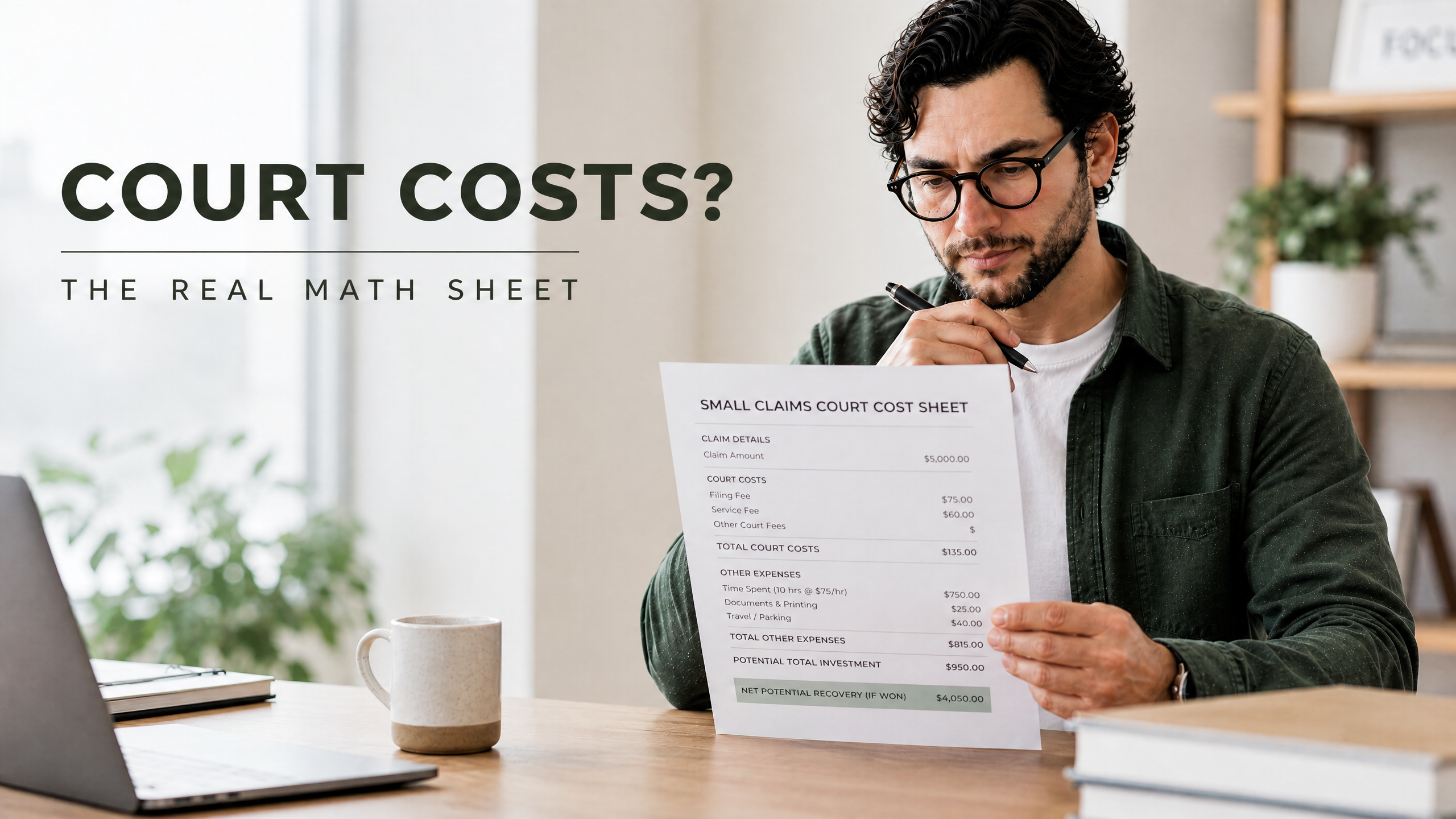
Suppose David spends $345 in direct costs and roughly 25 billable hours dealing with the dispute.
At his rate of $75 an hour, that is $1,875 in opportunity cost.
He has spent more than $2,200 pursuing a $1,500 invoice.
And the worst part?
The client may still not voluntarily pay. If the debtor has moved money, has limited reachable assets, or otherwise cannot satisfy the judgment, David may need additional enforcement steps.
This is the loss-aversion trap. We are so terrified of losing what we are owed that we sometimes throw good money after bad.
Let’s break down the true line-item costs so this doesn’t happen to you.
1. The Filing Fee Reality Check
The very first hurdle is the entry fee.
Small claims court isn’t free.
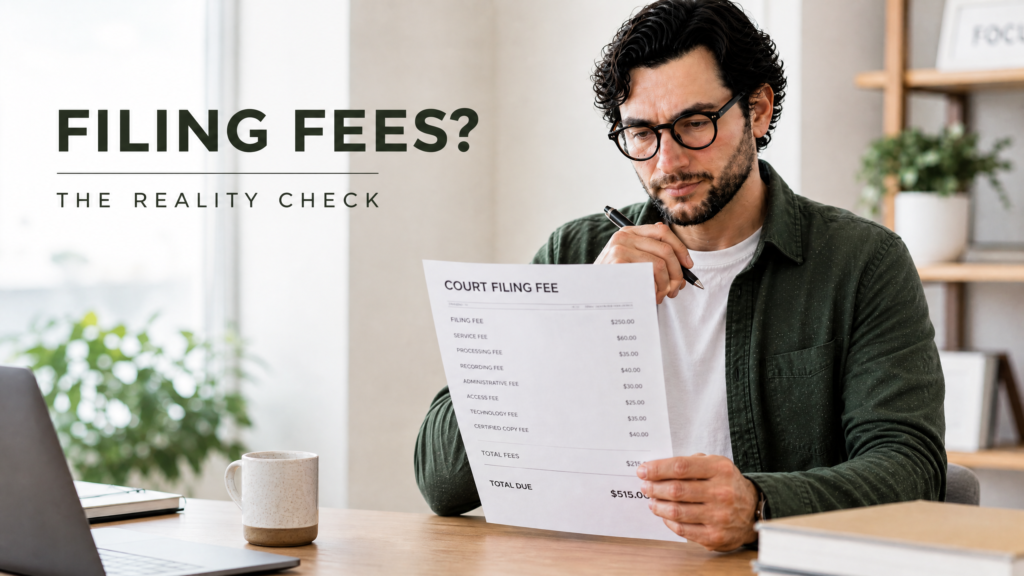
Courts require filing fees to process claims, and those fees vary depending on the jurisdiction and the amount being claimed.
For example, California’s current small-claims guidance lists filing fees of $30 for claims up to $1,500, $50 for claims over $1,500 and up to $5,000, and $75 for claims over $5,000 and up to $12,500.
That does not mean every state uses the same fee schedule.
It doesn’t.
Small-claims limits, filing fees, service rules, hearing procedures, and recoverable costs can all vary by state. Cornell Legal Information Institute: Small Claims Court
It sounds small, right?
Fifty bucks is nothing if you are recovering thousands.
But remember, this is out-of-pocket cash you have to spend now, with no guarantee that the defendant will voluntarily pay you after judgment.
You may also have to navigate government e-filing systems, court forms, deadlines, and local procedures.
Some courts permit online filing; others may require different filing methods. California’s official guidance, for example, notes that some courts allow e-filing while others may require filing by mail or at the courthouse.
Before you pay a court fee, you should always try a final notice before legal action and give the client a clear opportunity to resolve the account.
Often, a professional final demand can produce payment without the cost and friction of litigation.
And if the client is still working with you, a notice of suspension of services may create leverage without immediately escalating the dispute.
2. Service of Process Expenses
Here is a fun legal quirk.
You cannot simply text your client and say:
“Hey, I’m suing you.”
The court generally requires formal service of the lawsuit according to applicable procedural rules. Service of process exists to provide the defendant with legally sufficient notice of the proceeding, and the precise rules vary by jurisdiction. Cornell Legal Information Institute: Service of Process
For example, California’s small-claims rules do not allow the plaintiff to personally serve the claim. The server must generally be at least 18 and not be a party to the case.
But do not turn that California rule into a universal rule for every state.
Your jurisdiction may allow different methods.
Certified Mail
In some jurisdictions, certified mail or another form of mail service may be available.
California, for example, allows the court clerk to serve small-claims papers by certified mail in courts that offer that service, with a current $15 fee.
But certified mail isn’t automatically the answer everywhere.
The precise service method, who may serve, timing requirements, and proof-of-service requirements depend on the applicable rules.
Hiring a Process Server
If personal service is required, or another permitted method is more practical, you may need a professional process server or sheriff.
A process server’s fee depends on the jurisdiction, location, urgency, and number of attempts.
If your client is dodging service, hiding behind a gate, or working odd hours, those attempts can add up quickly.
Suddenly, you are spending meaningful money on a lawsuit before the case has even reached the hearing stage.
If you are dealing with a company that went silent, you might want to read what to do when a client uses your work but refuses to pay.
Sometimes, however, the better strategy is to examine what lawful leverage you already possess under your contract.
3. Calculating the Opportunity Cost of Missing Billable Hours
This is the silent killer.
It is the math most creatives completely ignore.
When you are fighting a legal battle, you are not working.
Every hour you spend researching laws, filling out forms, organizing exhibits, communicating with the court, or waiting at a courthouse is an hour you may not be billing a paying client.
Let’s use a conservative illustrative breakdown for a small-claims dispute:
- Case preparation and gathering evidence: 4 hours
- Filing the paperwork: 2 hours
- Arranging service of process: 1 hour
- Mediation or settlement discussions: 3 hours
- Attending the actual court hearing, including travel and waiting: 4 hours
That is 14 hours of your life gone.
If your hourly freelance rate is $80, that is $1,120 in opportunity cost.
Now ask yourself:
Is chasing a $1,500 invoice worth potentially losing $1,120 in billable time?
Sometimes yes.
Sometimes no.
The answer depends on the strength of your case, the likely recoverability of the judgment, your actual time cost, and the cost of the alternatives.
For an ongoing project, a smarter move might be using a notice of suspension of services if your contract permits suspension for non-payment.
Leverage is often cheaper than litigation.
And if scope problems are contributing to the unpaid balance, address them before they turn into a larger dispute. Stop working for free and learn how to prevent scope creep from eating your profits.
4. Is the Judgment Actually Collectible?
Okay, let’s say you endured the fees.
You wasted the hours.
You went to court.
And you won.
The judge enters a judgment in your favor.
Congratulations.
Now comes the question many freelancers forget to ask:
Can you actually collect it?
A judgment does not necessarily mean money automatically appears in your bank account.
For example, California’s official small-claims guidance expressly explains that the person who wins generally has to take steps to collect the judgment.
Depending on the jurisdiction and facts, enforcement may involve tools such as a bank levy, wage garnishment, or a lien, subject to applicable law and exemptions.
A court does not simply become your personal collection agency.
And you may need information about the debtor’s assets before deciding which enforcement mechanism is worthwhile.
If the client operates as an LLC and the business bank account is empty, your judgment may have little immediate economic value.
This is why collection probability belongs in the math.
If you are thinking about hiring professional help at this stage, read Should You Hire a Debt Collection Agency?.
Collection agencies may work on contingency arrangements, flat fees, or other structures. The actual cost varies by agency, debt type, jurisdiction, age of debt, and likelihood of recovery.
Do not assume a single percentage applies to every agency.
USA vs. Global Small Claims Systems
It is important to note that the math changes depending on where you live.
Small claims is primarily a state-level concept in the United States, and limits and procedures vary considerably.
In the USA
Small claims courts are handled at the state and local level.
Claim limits can vary dramatically.
For example, California currently generally allows individuals to bring claims up to $12,500 in small claims court, while a business generally has a $6,250 limit, subject to exceptions. California also explains that a person who wins must take steps to collect the judgment.
That is why you should never assume that a rule you found for California automatically applies in New York, Texas, Florida, or another state.
If you are working with an out-of-state client, jurisdiction and service become even more important.
And if your dispute involves an international client, read How to Protect Yourself When Working With International Clients before assuming a U.S. small-claims action is available.
In the UK (England & Wales)
England and Wales use the Small Claims Track for qualifying lower-value civil claims. The Civil Procedure Rules generally place the small-claims financial threshold at £10,000, subject to the rules and exceptions applicable to the particular claim.
Money claims can be made online when the claim meets the eligibility requirements. GOV.UK currently lists court fees ranging from £35 for claims up to £300 to £455 for claims above £5,000 and up to £10,000. Additional fees may arise later, including for hearings or enforcement.
If a defendant does not pay after judgment, England and Wales provide formal enforcement routes, and GOV.UK explains that a judgment creditor can ask the court to take enforcement action, subject to the applicable procedure and fee.
The important lesson is the same:
Winning the case and collecting the money are separate stages.
In India
India does not use the U.S. small-claims-court model as a single nationwide localized system.
Commercial disputes can fall under different procedural and jurisdictional frameworks depending on the nature and value of the dispute.
For qualifying commercial disputes, Indian law also provides a statutory framework concerning pre-litigation mediation in specified circumstances. The Mediation Act, 2023 expressly refers to pre-litigation mediation for commercial disputes of specified value under Section 12A of the Commercial Courts Act, 2015.
If you are an Indian freelancer dealing with a foreign client, the better starting point is usually to examine the contract, governing-law clause, jurisdiction clause, payment terms, and available enforcement mechanisms rather than assuming that a U.S.-style small-claims process is available.
You should also understand how to charge late fees legally in the US, UK and India before adding interest or late charges to an invoice.
The Risk and Complexity Matrix
To make this perfectly clear, here is a better way to think about the decision.
Do not look at the invoice amount alone.
Look at amount + evidence + solvency + jurisdiction + cost + time.
| Dispute Amount | Client / Asset Position | Evidence | General Economic Approach |
|---|---|---|---|
| Under $500 | Unknown or weak assets | Weak or disputed | Demand payment first; litigation may be uneconomic |
| $500–$2,000 | Solvent individual or small business | Strong | Compare expected recovery against total costs |
| $2,000–$5,000 | Solvent business | Strong | Formal demand and litigation may become more economically rational |
| $5,000+ | Identifiable assets / established company | Strong | Consider formal legal advice and a detailed enforcement plan |
This is not a legal rule or guarantee of recovery.
It is simply a decision-making framework.
A $400 claim against a solvent company with excellent evidence may make more economic sense than a $20,000 claim against an insolvent business.
The debtor’s ability to pay matters.
Evidence Checklist: Do You Even Have a Case?
If you look at that matrix and still decide to sue, you need organized evidence.
Judges do not decide cases based simply on how angry you are.
They decide based on the applicable law, evidence, testimony, credibility, and the facts established in the proceeding.
Your frustration may explain why you filed the case.
Your evidence is what helps prove it.
Do not walk into a courtroom without understanding your court’s requirements for exhibits and evidence.
At a minimum, organize:
- The signed contract: Or other communications that may establish the agreement.
- Clear scope of work: Proving exactly what you were hired to do.
- Proof of delivery: Git logs, Figma timestamps, delivery records, email attachments, or other evidence showing the work was delivered.
- Client acceptance: An email from the client saying “This looks great” or “Approved” can be useful evidence, depending on the dispute.
- The unpaid invoice: Showing the original due date and outstanding balance.
- Record of communication: A chronological log of your payment requests and the client’s responses.
If there is no formal contract, read Can You Sue a Client Without a Contract?.
A written contract is not the only possible evidence of an agreement. Emails, messages, proposals, invoices, and conduct may matter depending on the applicable law. Cornell’s Legal Information Institute notes that contract law is primarily governed by state law in the United States, so the precise requirements can differ. Cornell Legal Information Institute: Contract
And if your email trail is doing most of the evidentiary work, see How to Turn an Email Trail into a Legally Defensible Invoice Statement.
You need to prove the core deliverables were met and establish why the amount you are claiming is legally recoverable.
If the client is claiming they won’t pay because of a bug, read about the unfinished feature trap before going to court.
The Freelancer ROI Calculator
You need to know your exact exposure before filing.
I use a simple formula to calculate the True Cost of Litigation (TCL).
But there is one important improvement:
Do not assume you have a 100% chance of collecting the judgment.
A more realistic calculation is:
Expected Recovery = Invoice Amount × Estimated Collection Probability
Then:
Expected Net Value = Expected Recovery − Cash Costs − Opportunity Cost
For example:
$1,500 invoice
× 60% estimated collection probability
= $900 expected recovery
If your cash costs are $150 and your opportunity cost is $900:
$900 − $150 − $900 = -$150 expected value
That doesn’t mean you can predict the future with mathematical precision.
It simply forces you to account for the risk that a judgment may not translate into cash.
You can use this simple tool layout for your own internal audits. Save this code and run it in any basic HTML viewer to see your real numbers.
Litigation ROI Calculator
Calculate hard fees, lost billable time, and expected recovery probability.
Run your own numbers.
If the calculator shows you are going deeply into the red, stop and reconsider whether litigation is the best economic choice.
You may have better leverage through a demand letter, settlement, contractual suspension rights, or another lawful recovery strategy.
For example, if the client has already used your work, read What to Do When a Client Uses Your Work But Refuses to Pay.
And if the problem is simply that the client keeps delaying payment, consider the exact follow-up timeline for late freelance invoices before escalating.
Frequently Asked Questions
Can I sue for emotional distress or lost time ?
Not automatically.
In a typical commercial contract dispute, the principal claim is generally based on the financial loss caused by the breach, and the damages available depend on the applicable law and the legal theory involved. Contract damages are generally designed to compensate for legally recognized losses rather than simply reimburse every hour a claimant spends pursuing the dispute. Cornell Legal Information Institute: Damages
Your personal time spent preparing a lawsuit is therefore not automatically an amount you can simply add to the invoice.
What if I do not have a formal contract ?
It is harder, but it is not necessarily impossible.
You may have evidence of an agreement through emails, Slack messages, proposals, invoices, payment history, and other communications.
If you are wondering if you can sue a client without a contract, the answer depends on the facts and applicable law.
Will a small-claims judgment hurt their credit ?
It can have consequences because judgments are public legal records, but you should not treat a judgment as an automatic credit-reporting mechanism.
Credit-reporting treatment depends on applicable reporting rules and the circumstances.
Do not tell a client that a judgment will automatically damage their credit as a collection tactic.
Can I hire a lawyer for small claims ?
It depends on the jurisdiction.
California, for example, generally does not allow lawyers to represent parties in the small-claims courtroom, although a person can consult a lawyer before appearing.
Other jurisdictions have different rules.
Even where representation is permitted, you should compare the expected recovery with the cost of professional representation.
What if the client lives in another state ?
This can become much more complicated.
You need to examine jurisdiction, venue, service of process, contractual forum-selection clauses, and the rules governing enforcement.
Do not assume that you can simply file wherever you live because the client owes you money.
If the client is outside your country, read How to Protect Yourself When Working With International Clients before deciding where to pursue the dispute.
The Quick Decision Logic: Should You Sue ?
If you are sitting on the fence right now, let's make this simple.
Answer these questions honestly.
Is the debt large enough to justify the expected cost?
Do you have strong evidence of the agreement, work performed, delivery, and amount owed?
Do you have a reasonable basis to believe the client can actually satisfy a judgment?
Can you sue in a jurisdiction that makes economic and legal sense?
Have you compared litigation with a demand letter, settlement, mediation, or another lawful recovery route?
If the answers are mostly no, put the court papers down for a moment.
Do not confuse being legally right with having an economically worthwhile lawsuit.
Instead, switch to defense mode.
If they are using your web code without authorization, first determine whether you actually own the relevant rights and whether the use is infringing. If those conditions are satisfied, a copyright-based remedy may be available; it should not simply be treated as a substitute collection weapon.
For example, if the dispute genuinely involves unauthorized use of your code, you can read Client Stole My Website Code: Legal Steps to Respond, Prove Ownership, and Recover Access.
If the facts genuinely support a DMCA claim, see When Clients Ghost on GitHub: How to File a DMCA Takedown on Your Own Code Repository.
But remember:
A payment dispute and a copyright dispute are not automatically the same thing.
If the client has a valid license or ownership rights, a copyright takedown may not be appropriate.
Use leverage, not unnecessary litigation.
Protect your cash flow by tightening up your initial proposals. Structure your proposal so it functions like a real legal defense contract.
And before the next invoice becomes a collection problem, build stronger payment terms. Your Freelancer Payment Terms Guide can help you think through the structure.
Stop chasing bad money when the numbers no longer make sense.
Focus your energy on finding better clients, improving your payment terms, and creating a recovery process that makes escalation the exception rather than the default.
Your bank account will thank you.
Author
Adv. Sagar Haribhau Shirsat is a legal professional and advocate writing about commercial disputes, freelancer payment recovery, contracts, and digital business risks. His work focuses on practical legal and risk-management strategies for freelancers, independent contractors, and digital agencies.
Connect via his professional LinkedIn profile.
Disclaimer
This guide is intended for educational purposes and general risk-management analysis. It is not a substitute for formal legal advice and does not create an attorney-client relationship.
Small-claims limits, filing fees, service rules, damages, enforcement procedures, copyright remedies, and jurisdictional requirements vary by location and can change over time. Always verify the current rules and fees with the relevant court or government authority before filing a claim.
For specific cross-jurisdictional contract disputes, consult a qualified attorney or other appropriately licensed legal professional in the relevant jurisdiction.