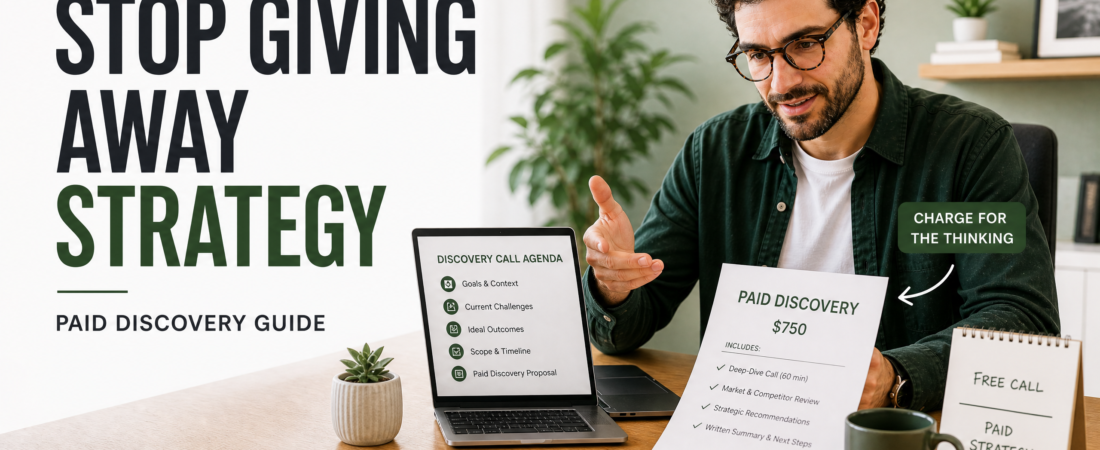
I sat in my home office looking at a Zoom gallery grid with four corporate faces staring back at me.
They had invited me to a “30-minute intro call” for a potential $50,000 strategy overhaul.
By minute 45, I was screen-sharing my proprietary analytical framework.
By minute 75, their Lead Engineer was taking detailed notes while I diagnosed their technology stack, explained conversion problems, and suggested specific fixes.
I felt smart.
I felt validated.
I thought I was winning the deal.
Two days later, I received a short email:
“We’ve decided to take this project in-house. Thanks for your time!”
That was the moment I realized I had made a costly mistake.
I had confused client interest with client intent.
I wasn’t pitching anymore. I was consulting for free.
The problem wasn’t that I demonstrated expertise. The problem was that I crossed the line between proving that I could solve the problem and actually solving the prospect’s problem before they paid me.
That distinction matters for freelancers, consultants, designers, developers, marketers, strategists, agencies, and other knowledge-based professionals.
Your sales call should demonstrate your ability to solve a problem.
It should not automatically become an unpaid diagnostic engagement.
And there is an important legal point here: you should not assume that every idea, method, framework, or strategy you mention during a sales call is automatically protected by copyright or trade-secret law.
In the United States, copyright generally protects original expression fixed in a tangible medium, but not ideas, procedures, processes, systems, or methods of operation.
Trade-secret protection is different. It generally depends on the information actually qualifying as a trade secret and on reasonable measures being taken to preserve its secrecy.
That is why the safest business strategy is not:
“Say everything and sue later.”
It is:
“Give enough information to establish credibility, reserve detailed diagnosis for a paid engagement, and use contracts and confidentiality measures where appropriate.”
This guide explains how to do exactly that.
Table of Contents
1. The Free-Consulting Sales Call Trap
The most dangerous sales call usually does not feel dangerous.
It begins with a flattering email.
“We’ve seen your work.”
Then comes the impressive title:
“Our VP of Marketing would love to speak with you.”
Then the apparently harmless request:
“It will only take 30 minutes.”
Thirty minutes becomes 60.
Then 90.
Then someone asks:
“If you were in our position, what exactly would you change?”
You answer.
Then:
“Can you show us how you’d structure that?”
You demonstrate it.
Then:
“Could you quickly look at our funnel?”
You screen-share.
Then:
“What would you change in the implementation?”
You start solving.
At that point, you are no longer conducting a normal discovery call.
You are delivering unpaid consulting.
The five-stage exploitation pattern
1. Prospect Inbound
A seemingly attractive project arrives.
The proposed contract might be worth $10,000, $25,000, $50,000, or more.
2. “Quick Intro Call”
The prospect proposes a short introductory conversation.
There is no problem with that by itself.
3. Diagnostic Expansion
The conversation gradually changes from:
“Tell us about your experience.”
to:
“Tell us exactly what you would do to fix our business.”
4. Strategic Disclosure
You reveal:
- detailed recommendations;
- technical architecture;
- conversion opportunities;
- campaign structures;
- proprietary workflows;
- custom research;
- wireframes;
- detailed roadmaps;
- implementation sequences.
5. The Hiring Decision Disappears
The prospect eventually says:
“We’ve decided to handle this internally.”
You are left with:
- no contract;
- no payment;
- no project;
- and potentially a prospect holding a substantial amount of your unpaid thinking.
That is the real free-consulting sales call trap.
And if this pattern starts appearing alongside requests for unpaid assignments, be particularly careful. The same commercial dynamic can arise when a company uses your interview assignment without paying.
The principle is simple:
A prospect is entitled to evaluate your competence. That does not automatically mean they are entitled to receive a finished consulting engagement for free.
2. Credibility vs. Free Consulting: Where Is the Line?
The easiest way to protect yourself is to create a mental firewall.
Give away credibility.
Charge for diagnosis.
Charge even more for implementation.
That doesn’t mean you should become secretive or evasive.
A good sales call should provide genuine value.
But the value should demonstrate capability, not deliver the entire solution.
What you can generally discuss during a normal discovery call
You can explain:
- the types of problems you solve;
- your methodology at a high level;
- previous project outcomes;
- broad industry observations;
- relevant case studies;
- your process;
- expected project phases;
- likely timelines;
- your experience with similar problems;
- what information you would need before making detailed recommendations.
What should usually trigger paid discovery
Be cautious when a prospect asks you to:
- audit their live systems;
- analyze their confidential data;
- build a custom roadmap;
- produce a detailed strategy deck;
- write implementation specifications;
- create detailed wireframes;
- debug their production system;
- design their complete campaign architecture;
- produce custom research;
- identify every problem and prescribe every solution.
That’s no longer merely a conversation about whether you are a good fit.
It is potentially consulting work.
And the same principle applies after the sales call. If a prospect starts adding “just one more thing,” your ability to stop working for free and prevent scope creep should begin before the contract is even signed.
3. What Copyright Can—and Cannot—Protect
This is where freelancers frequently make an important legal mistake.
They assume:
“I created the strategy, therefore I own the strategy under copyright.”
That statement is too broad.
Copyright protects expression—not every underlying idea
Under U.S. copyright law, copyright protection applies to qualifying original works fixed in a tangible medium. Section 102(b), however, expressly excludes ideas, procedures, processes, systems, methods of operation, concepts, principles, and discoveries from copyright protection.
The U.S. Copyright Office explains the distinction directly: an author’s written or visual expression of an idea may be protected even though the underlying idea, system, or method is not.
For example, imagine you create a 30-page presentation explaining a new conversion strategy.
Different components may receive different treatment:
| Material | Potential legal treatment |
|---|---|
| Original written explanation | Potential copyright protection |
| Original diagrams | Potential copyright protection |
| Original presentation graphics | Potential copyright protection |
| Original photographs | Potential copyright protection |
| Underlying marketing idea | Generally not protected by copyright merely because you expressed it |
| General business method | Generally not protected by copyright merely as a method |
| Confidential proprietary information | May potentially receive trade-secret/confidentiality protection if legal requirements are met |
| Contractual restrictions on use | Depends on the agreement and applicable law |
This distinction is critical.
If you create a slide explaining a strategy, copyright may protect the expression contained in the slide.
That does not necessarily mean copyright gives you a monopoly over the underlying strategy.
The official U.S. Copyright Office states that copyright protection does not extend to ideas, methods, or systems.
For additional academic background, Duke University School of Law’s materials on trade secrecy also emphasize that trade-secret law intersects with copyright and other intellectual-property regimes rather than simply replacing them.
Why this matters for your sales call
Don’t tell prospects:
“You cannot use anything I say because it is copyrighted.”
That may be legally inaccurate.
Instead, create a commercial boundary:
“Detailed custom strategy, analysis, implementation architecture, and deliverables are provided through our paid discovery engagement.”
That is a much stronger business model.
4. When Trade-Secret and Confidentiality Principles May Matter
Trade-secret law can sometimes be relevant to proprietary business information, but simply calling something “confidential” does not automatically make it a trade secret.
Under the U.S. Defend Trade Secrets Act, a trade secret generally requires, among other things, that the owner take reasonable measures to keep the information secret and that the information derive independent economic value from not being generally known or readily ascertainable through proper means.
The statute also defines misappropriation in circumstances involving improper acquisition or certain unauthorized use or disclosure where the required knowledge and duties exist.
That creates an important practical lesson:
Don’t merely label information confidential.
Actually treat it as confidential.
That may include:
- limiting who receives it;
- avoiding unnecessary disclosure;
- using confidentiality provisions where appropriate;
- marking documents appropriately;
- controlling access;
- maintaining records;
- separating public methodology from proprietary information;
- sharing sensitive information only when necessary.
The European Union’s Trade Secrets Directive follows a similar conceptual structure: information must be secret, possess commercial value because it is secret, and have been subject to reasonable steps to keep it secret.
So your strategy should be:
confidentiality by design, not confidentiality by label.
5. The Paid Discovery Model
The cleanest solution to the free-consulting problem is to turn detailed diagnosis into a product.
Call it whatever fits your business:
- Paid Discovery;
- Strategy Audit;
- Diagnostic Engagement;
- Consulting Assessment;
- Technical Discovery;
- Conversion Audit;
- Architecture Review;
- Strategic Roadmap;
- Research Sprint.
The name matters less than the structure.
A practical four-stage model
Stage 1: Qualification Call
20–30 minutes
Discuss:
- objectives;
- broad problem;
- budget range;
- decision-makers;
- timeline;
- current situation;
- whether your expertise is relevant.
No detailed audit.
Stage 2: Paid Discovery
Fixed scope + fixed price
You investigate the actual problem.
Possible deliverables include:
- findings;
- diagnosis;
- prioritized opportunities;
- technical assessment;
- strategic roadmap;
- implementation priorities;
- executive presentation.
Stage 3: Implementation Proposal
Once discovery is complete, you provide the full implementation proposal.
Stage 4: Execution
The prospect either:
- hires you for implementation; or
- retains the discovery deliverables according to the agreed terms.
This approach also protects your time from the prospect who continually asks for “one quick fix.”
If that starts happening after engagement, your existing resource on charging for scope creep without losing the client becomes directly relevant.
6. How to Price a Paid Discovery Engagement
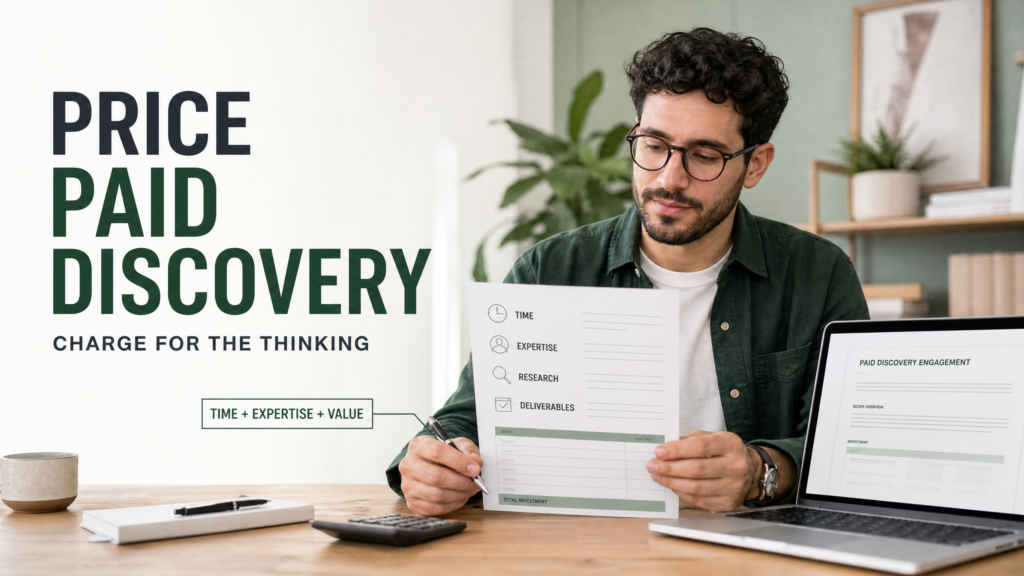
There is no universal legal or market formula that says discovery must cost a particular percentage of the eventual project.
Your price should reflect:
- expected hours;
- expertise;
- complexity;
- access requirements;
- research burden;
- business value;
- urgency;
- deliverables;
- opportunity cost;
- liability and responsibility involved.
A useful starting framework is:
Discovery price = estimated effort × target effective rate + complexity premium
For example:
If your target effective rate is $200/hour and the discovery requires approximately 15 hours:
15 × $200 = $3,000
You might then adjust the fixed fee based on scope and complexity.
The important point is that the number should be presented as your commercial price, not as a legally mandated amount.
Paid Discovery Pricing Calculator
Use the following calculator to estimate how much unpaid strategic work may be consuming your month.
Inputs
- Target hourly rate
- Hours spent preparing each pitch
- Number of unpaid pitches per month
Formula
Estimated monthly opportunity cost = hourly rate × hours per pitch × monthly unpaid pitches
Example:
$200 × 6 hours × 3 pitches = $3,600
That doesn’t mean you have legally “lost” $3,600.
It means you have spent approximately $3,600 worth of billable capacity on unpaid sales activity using your chosen internal rate.
That distinction matters.
7. How to Stop an Unpaid Interrogation During a Sales Call
You don’t need to become hostile.
You need to redirect the conversation.
Script #1: The Soft Pivot
“That is exactly the kind of issue we would investigate during the discovery phase. I can explain how we approach it, but I wouldn’t want to give you a rushed recommendation without reviewing the underlying data.”
Script #2: The Professional Enterprise Version
“We separate qualification from diagnosis. On this call, I’m happy to explain our methodology and relevant experience. The detailed architecture would be part of the paid discovery engagement so that the recommendations are based on a proper review rather than a quick call.”
Script #3: When They Ask for a Free Custom Roadmap
“I can absolutely prepare that. Because it requires analysis specific to your systems and objectives, we treat the roadmap as a paid discovery deliverable rather than a complimentary sales document.”
Script #4: When They Say “We Need It to Evaluate You”
“That makes sense. For evaluation, I can provide relevant case studies, examples of previous outcomes, our methodology, and a high-level project plan. The custom diagnosis itself is part of the engagement.”
Script #5: When They Keep Pushing
“I don’t want to give you an incomplete strategy based on limited information. If you want the actionable version, the next step is our paid discovery engagement.”
That last sentence is powerful because it doesn’t accuse the prospect of bad faith.
It simply establishes your process.
8. What to Put in Your Proposal Before Sharing Detailed Strategy
Your proposal is not merely a sales document.
It can also establish important commercial expectations.
A well-structured proposal should clearly distinguish:
1. Evaluation material
What the prospect receives to assess your capabilities.
2. Paid deliverables
What they receive after payment.
3. Ownership
Who owns what, and when.
4. License
Whether the prospect receives a license to use particular materials.
5. Confidentiality
What information must remain confidential.
6. Restrictions
Any agreed restrictions on copying, disclosure, or use.
7. Payment
When payment becomes due.
8. Acceptance
How the parties accept the proposal and its terms.
A useful resource on this subject is how to structure a proposal so it functions like a real legal defense contract.
The objective isn’t to turn every proposal into a 30-page contract.
The objective is to remove ambiguity.
If a prospect later claims:
“We thought the strategy deck was free.”
you want the documents to tell a different story.
And if the dispute eventually becomes a payment dispute, an organized record can matter. See how to turn an email trail into a legally defensible invoice statement.
9. Evidence Checklist for Strategy Pitches
If you routinely sell high-value consulting services, build a record before the sales process becomes contentious.
Before the call
- Save the final version of your pitch deck.
- Preserve the date and version.
- Identify confidential material.
- Separate public methodology from proprietary information.
- Check whether an NDA or confidentiality agreement is appropriate.
- Review the prospect’s requested use of your materials.
- Avoid sending complete implementation plans unnecessarily.
During the call
- Keep detailed recommendations within the agreed scope.
- Don’t provide unnecessary credentials or production access.
- Don’t disclose unrelated client information.
- Be careful with confidential information supplied by the prospect.
- If recording, comply with applicable recording and consent requirements.
After the call
- Send a concise follow-up email.
- Confirm the agreed next step.
- Preserve the proposal and presentation.
- Record what was disclosed.
- Note any request for additional unpaid work.
- Keep copies of relevant correspondence.
If you use visual work during your pitch, watermarking UI/UX deliverables without ruining the presentation can provide an additional practical layer of attribution and deterrence.
Remember, however, that a watermark is evidence and a deterrent—not a substitute for a contract or applicable intellectual-property rights.
10. Strategy Call Risk Matrix
| Risk | Warning Signs | What It May Mean | Recommended Response |
|---|---|---|---|
| High | Detailed custom roadmap requested before engagement | Prospect wants substantial consulting before hiring | Offer paid discovery |
| High | Multiple long “intro” calls | Qualification process is consuming consulting time | Set a call limit |
| High | Live debugging requested | You are being asked to perform professional work | Stop and scope paid work |
| High | Full custom deck requested | Deliverable is being requested before payment | Provide a paid discovery option |
| Medium | Detailed case studies requested | Normal evaluation activity | Provide relevant examples |
| Medium | High-level methodology questions | Normal sales activity | Explain your process |
| Low | Questions about timeline and availability | Normal qualification | Answer directly |
| Low | Questions about past results | Normal credibility check | Provide evidence where available |
The key is not to treat every demanding prospect as dishonest.
A sophisticated procurement team may ask difficult questions for legitimate reasons.
Your goal is to distinguish:
evaluation
from
unpaid execution.
11. Illustrative Case Study: The $40,000 E-Commerce Teardown
The following example is illustrative, not a report of an independently verified real-world settlement.
Marcus is a hypothetical senior conversion-rate consultant.
An e-commerce company with approximately $10 million in annual revenue invites him to discuss a potential $40,000 engagement.
The company asks for a preliminary teardown.
Marcus prepares a 35-slide presentation containing:
- 12 checkout recommendations;
- customer-flow observations;
- specific UX changes;
- testing priorities;
- implementation suggestions.
During the call, the marketing team asks detailed questions.
Marcus answers all of them.
The prospect ultimately decides not to hire him.
Three weeks later, Marcus notices several changes to the checkout process that closely resemble recommendations contained in his presentation.
What should Marcus do?
Step 1: Preserve evidence
He should retain:
- the original presentation;
- version history;
- email correspondence;
- meeting invitations;
- the proposal;
- timestamps;
- screenshots;
- relevant communications;
- evidence of the subsequent implementation.
Step 2: Identify what was actually copied
This is crucial.
He should distinguish between:
his original expression
and
the underlying business ideas or methods.
Copyright does not automatically protect the underlying idea merely because it appeared in his presentation. U.S. copyright law expressly distinguishes protected expression from ideas, processes, systems, and methods.
Step 3: Examine confidentiality and contractual terms
Was there:
- an NDA?
- confidentiality language?
- proposal terms?
- restrictions on use?
- a license?
- a written statement concerning ownership?
These facts can substantially affect the analysis.
Step 4: Obtain jurisdiction-specific legal advice
If the facts support a potential claim, the appropriate remedy depends on:
- applicable law;
- jurisdiction;
- contractual terms;
- nature of the material;
- evidence;
- whether the information qualifies for a particular form of protection;
- how the prospect obtained and used it.
The lesson isn’t:
“Every stolen strategy automatically creates a copyright lawsuit.”
The lesson is:
Don’t disclose valuable custom work casually when you can instead structure the sales process so that detailed diagnosis is paid work.
If a client has actually used your completed work without paying, your next steps may be different. See what to do when a client uses your work but refuses to pay.
12. What to Do If a Prospect Uses Your Pitch
Suppose you discover that a prospect appears to have implemented recommendations from your presentation.
Don’t immediately send an angry email.
Don’t threaten criminal prosecution.
Don’t publicly accuse the company.
Instead, follow a controlled process.
Step 1: Preserve the evidence
Create a chronological record.
Include:
- what you created;
- when you created it;
- what you disclosed;
- who received it;
- what terms applied;
- what the prospect subsequently did.
Step 2: Compare the materials
Identify the similarities.
Be precise.
Instead of saying:
“They stole my strategy.”
document:
“Slide 17 proposed X, Y and Z. The prospect subsequently implemented X, Y and Z in the same sequence.”
Specific evidence is more useful than accusations.
Step 3: Review the agreement
Look at:
- NDA;
- proposal;
- MSA;
- SOW;
- email terms;
- licensing language;
- ownership provisions;
- confidentiality provisions.
If the prospect later tries to impose a new confidentiality obligation after the work has already been delivered, that’s a different issue. See how to handle a client who retrospectively demands an uncontracted NDA before clearing an invoice.
Step 4: Determine the legal theory carefully
Potential issues may include:
- copyright;
- breach of contract;
- breach of confidentiality;
- trade-secret misappropriation;
- other applicable claims.
Not every dispute supports every claim.
Step 5: Send a measured communication
A professional notice should identify:
- the material;
- when it was provided;
- the relevant contractual terms;
- the observed use;
- the action you are requesting;
- a reasonable deadline.
If the situation develops into a genuine unauthorized-use dispute, a carefully drafted cease-and-desist letter for stolen code or designs may be more appropriate than an emotional message.
13. United States, United Kingdom, European Union and India
Because freelancers increasingly work internationally, a strategy-pitch dispute can involve multiple jurisdictions.
There is no universal “international pitch theft law.”
Different legal systems protect different interests through different mechanisms.
United States
Copyright
U.S. copyright law protects qualifying original expression fixed in a tangible medium, while Section 102(b) excludes ideas, procedures, processes, systems, methods of operation, concepts, principles, and discoveries from copyright protection.
This means a presentation may contain copyright-protected expression even though the underlying business strategy may not itself be protected by copyright.
The U.S. Copyright Office also explains that copyright generally exists once qualifying expression is fixed, while registration provides important enforcement-related benefits for U.S. works.
For U.S. works, registration is generally required before bringing a federal copyright infringement action, subject to statutory rules and exceptions.
Trade secrets
The Defend Trade Secrets Act provides a federal civil cause of action for qualifying trade-secret misappropriation connected with interstate or foreign commerce.
But the information must actually qualify as a trade secret.
Under 18 U.S.C. § 1839, relevant requirements include reasonable measures to maintain secrecy and independent economic value derived from the information not being generally known or readily ascertainable through proper means.
Therefore:
A confidentiality label alone is not a magic legal shield.
United Kingdom
The UK has copyright legislation under the Copyright, Designs and Patents Act 1988, together with other legal principles that may become relevant depending on the circumstances. The official legislation is available through the UK’s legislation portal.
Confidential-information disputes can involve questions such as:
- whether information was confidential;
- whether circumstances imposed an obligation of confidence;
- whether the information was used improperly;
- whether contractual obligations existed.
The precise cause of action should therefore be assessed from the facts rather than reduced to a simple “pitch theft” rule.
European Union
EU trade-secret protection is addressed through Directive (EU) 2016/943 concerning undisclosed know-how and business information.
The Directive defines a trade secret using three core elements:
- the information is secret;
- it has commercial value because it is secret;
- reasonable steps have been taken to keep it secret.
The Directive also addresses unlawful acquisition, use and disclosure, including situations involving breach of confidentiality or contractual limitations on use.
However, EU Member States implement the framework through national law, so a specific dispute still requires jurisdiction-specific analysis.
India
India requires particularly careful analysis because there is no simple equivalent to saying:
“Section 70 protects all stolen pitch strategies.”
Section 70 of the Indian Contract Act, 1872 addresses the obligation of a person who enjoys the benefit of a non-gratuitous act. The official India Code identifies Section 70 under that heading.
Whether Section 70 applies to a particular unpaid strategy or consulting dispute depends on the facts and legal requirements.
It should therefore not be described as a general statutory “pitch theft” provision.
Depending on the facts, Indian disputes may involve contractual principles, copyright, confidentiality obligations, unjust-enrichment/quantum-meruit concepts, or other applicable causes of action.
The important practical rule is:
Do not promise a legal remedy merely because a prospect appears to have used an idea you disclosed. First determine what was created, what was communicated, what contractual terms existed, what was actually used, and which jurisdiction governs.
14. Quick Decision Guide: Pitch or Interrogation?
Use this framework during your next sales call.
Question 1: Are they asking “Why?”
Example:
“Why do companies usually experience this conversion problem?”
Action
Answer at a high level.
That’s credibility-building.
Question 2: Are they asking “How would you solve our specific problem?”
Example:
“Which three changes would you make to our checkout?”
Action
Give a high-level observation.
Then explain that detailed diagnosis belongs in paid discovery.
Question 3: Are they asking you to inspect their systems?
Example:
“Can you log into our analytics and tell us what’s wrong?”
Action
Stop.
That is potentially consulting work.
Question 4: Are they asking for a detailed custom deck?
Action
Offer a paid discovery engagement.
Question 5: Are they refusing to discuss budget but demanding detailed strategy?
Action
Qualify the commercial opportunity before investing further time.
Question 6: Are they genuinely evaluating expertise?
If they’re asking about:
- previous projects;
- credentials;
- methodology;
- timelines;
- process;
- team;
- case studies;
Action
Answer.
That is normal procurement behavior.
15. Frequently Asked Questions
1. Can a prospect use an idea I mentioned during a sales call?
Potentially, depending on the circumstances and applicable law.
An idea itself is not automatically protected by copyright merely because you expressed it. U.S. copyright law expressly excludes ideas, processes, systems and methods of operation from copyright protection.
Other legal protections may become relevant if there is protected expression, a contractual restriction, a confidentiality obligation, or qualifying trade-secret information.
2. Does putting “Confidential” on my pitch deck protect everything inside it?
No.
A confidentiality notice can communicate your expectations and may be useful evidence, but it does not automatically transform every piece of information into a legally protected trade secret.
Trade-secret regimes generally require substantive conditions concerning secrecy, commercial value and reasonable protective measures.
3. Should I put an NDA in front of every prospect?
Not necessarily.
An NDA can be useful when genuinely sensitive information needs to be disclosed.
But many sales conversations do not require disclosure of trade secrets or highly confidential information.
A better strategy is often:
Don’t disclose what doesn’t need to be disclosed.
Then use confidentiality agreements when the circumstances justify them.
4. Can I copyright my consulting methodology?
You may be able to protect the original expression of a methodology in qualifying materials, but copyright does not generally give you exclusive rights over the underlying idea, method, process or system itself under U.S. law.
Other forms of protection may apply depending on the nature of the information and your contractual arrangements.
5. What if the client wants a custom strategy deck before hiring me?
You have three choices:
Option A: Provide a high-level proposal
Show:
- methodology;
- experience;
- expected phases;
- broad recommendations.
Option B: Sell the strategy phase separately
Offer a paid discovery engagement.
Option C: Decline
If the prospect insists on receiving substantial unpaid consulting, walking away may be commercially rational.
6. Does charging for discovery scare away good corporate clients?
It can eliminate some prospects.
That’s not necessarily bad.
A legitimate corporate buyer may ask why discovery costs money.
Explain that:
“Discovery is where we perform the detailed research and diagnosis that allows us to build the implementation plan.”
You’re not charging them for answering a basic question.
You’re charging for a professional service.
7. What if the prospect records my sales call?
Don’t assume that recording automatically gives you a legal remedy.
Recording and consent rules vary by jurisdiction.
If you are concerned about recording, review the applicable law and your platform’s terms before the call.
Most importantly, behave as though anything you say could later be replayed.
That means:
Don’t disclose information you wouldn’t want circulated.
8. What if the client implements my strategy after ghosting me?
First, preserve the evidence.
Then examine:
- your presentation;
- your proposal;
- correspondence;
- contractual terms;
- confidentiality provisions;
- what was actually implemented;
- the jurisdiction involved.
Do not automatically assume that implementation of an idea equals copyright infringement.
If actual protected work was copied or contractual/confidentiality obligations were breached, the analysis may be different.
9. What if I already gave away the entire strategy?
Don’t panic.
Immediately preserve:
- your original files;
- timestamps;
- version history;
- emails;
- meeting records;
- screenshots;
- messages;
- proposals;
- agreements.
Then identify exactly what you disclosed.
If the prospect later uses your actual copyrighted work, code, designs, videos, written materials, or other protected expression without authorization, the appropriate response may differ from a situation involving only a general business idea.
For example, developers facing unauthorized use of their code may need a different strategy, including the issues discussed in what to do when a client steals your website code.
10. What if the client puts my code on AWS before paying?
That becomes a different category of dispute involving access, licensing, contractual rights, and potentially intellectual-property issues.
Do not respond by taking unauthorized technical action against the client’s infrastructure.
Document the situation and review the contract first.
For a deeper discussion, see the client has your code on AWS and won’t pay.
11. What if the prospect used my UI wireframes?
The legal analysis depends on what was created, how it was delivered, the agreement, and what was copied.
If you are dealing with unpaid wireframes, can you file a copyright infringement claim for unpaid UI wireframes? provides a more focused discussion.
12. What if the prospect asks for my source files before paying?
Treat that as a commercial and contractual issue rather than simply handing everything over.
Your agreement should specify:
- when source files are delivered;
- whether payment is a condition of delivery;
- what rights transfer;
- whether editable files are included;
- what license the client receives.
If a design client asks for PSD or AI files before payment, see what to do when a client asks for PSD or AI files before payment.
13. Can I sue a prospect who never signed a contract?
Possibly, but whether you have a viable claim depends heavily on the facts and applicable law.
There is no universal rule that says:
“No written contract means no legal remedy.”
There may be other evidence or legal theories.
However, litigation should not be your first-line sales strategy.
A useful starting point is can you sue a client without a contract?.
14. What should I do if the prospect simply ghosts me?
Don’t immediately assume theft.
They may have:
- changed budgets;
- selected another vendor;
- delayed the project;
- gone internal;
- changed priorities.
Send a professional follow-up.
If the situation involves an actual invoice or completed paid work, the recovery process is different. See what to do when a client ghosts after an invoice.
15. Should I stop giving any free advice?
No.
That would be the wrong lesson.
A good consultant should demonstrate expertise.
The goal is not:
“Give nothing away.”
The goal is:
“Give enough away to demonstrate expertise without accidentally delivering the product you’re trying to sell.”
That is the difference between marketing and consulting.
16. Final Takeaway
Your sales call should answer one fundamental question:
“Can this person solve our problem?”
It does not necessarily need to answer:
“Can we extract the complete solution from this person before deciding whether to hire them?”
That distinction can protect your time, your positioning, and your commercial leverage.
Use your sales call to demonstrate:
- expertise;
- experience;
- methodology;
- relevant results;
- understanding of the problem.
Reserve detailed:
- audits;
- custom roadmaps;
- implementation architecture;
- technical diagnosis;
- research;
- strategy decks;
for a properly scoped engagement.
And remember the legal distinction:
An idea is not automatically copyright-protected simply because you thought of it or explained it.
A presentation, written document, diagram, graphic, or other qualifying expression may receive copyright protection even though the underlying idea or method does not.
Trade-secret protection can require secrecy, commercial value, and reasonable measures to preserve confidentiality.
So the strongest protection isn’t waiting until after the prospect has your entire strategy.
It is designing the sales process so that the prospect never receives the entire strategy for free in the first place.
The simple rule:
Sell the confidence that you can solve the problem. Charge for actually solving it.
If a prospect wants a detailed diagnosis, make that the beginning of the engagement—not the end of the sales call.
And if a client relationship has already moved into non-payment, unauthorized use, or a contractual dispute, don’t improvise. Document the facts, review the agreement, identify the applicable legal rights, and obtain jurisdiction-specific legal advice where necessary.
Author
Adv. Sagar Haribhau Shirsat is an Indian advocate and legal-content creator focusing on practical legal issues affecting freelancers, independent contractors, digital professionals, and online businesses, including contracts, payment disputes, intellectual-property issues, and recovery strategies.
His work focuses on translating complex legal and commercial concepts into practical frameworks that independent professionals can use to identify risk, document transactions, and make better decisions.
Legal Disclaimer
This article is provided for general educational and informational purposes only. It is not a substitute for legal advice from a qualified lawyer in the jurisdiction applicable to your circumstances.
Copyright, confidentiality, trade-secret, contract, recording-consent, and payment laws vary by country, state, and individual facts. The discussion of U.S., UK, EU, and Indian law is intended as a high-level overview and should not be treated as a definitive legal opinion or prediction of how a court will decide a particular dispute.
If a prospect or client has actually copied, disclosed, used, or commercially exploited your work, preserve the evidence and obtain advice from a qualified lawyer before sending threats, filing a claim, terminating access, or taking technical or legal action.