Has a client ever sent you a sudden email demanding your native, layered source design files right before they pay your final invoice?
This situation — where a Client Asking for PSD files before payment or AI files before payment—is more common than most freelancers expect.
Did they claim that their accounting department absolutely needs the raw assets to verify the work before initiating the bank transfer?
Does your stomach drop when you realize you might lose your only real point of leverage if you click send?
Look, I have been there. It is one of the most frustrating moments in a creative career.
Most freelancers hesitate at this exact moment—not because they don’t understand the risk, but because they don’t want to lose the client at the final step.
But here is the thing: you can breathe a sigh of relief. You are not trapped, and you do not have to give in to corporate pressure.
The law, the industry standards, and the actual physical possession of the files are entirely on your side.
You hold the keys to the kingdom until that wire transfer hits your bank account.
Let me show you exactly how to navigate this exact situation safely, professionally, and cleanly.
Short Answer :
Never send raw .PSD or .AI files before receiving final payment unless an escrow system is in place. These files are your primary leverage and often include intellectual property not covered in standard deliverables.
Table of Contents
The Case of the Missing Milestone : A Real-World Scenario

Let us look at how this problem typically plays out in the wild.
Elena was an independent illustrator who spent six weeks designing a complex brand identity system for a growing consumer goods startup.
The project total was $8,000, split into a 50% upfront deposit and a 50% final milestone payment.
The contract explicitly stated that final assets would be delivered upon receipt of the final payment.
Elena completed the vector illustrations and sent flat, high-resolution preview images to the client for final approval.
The client loved the artwork. They replied with glowing praise and asked for the final invoice.
Elena sent the invoice immediately. She expected a swift bank transfer within a couple of days.
Instead, she received a short, formal email from the operations manager requesting the raw files before payment.
The manager stated that their design team needed the raw Adobe Illustrator (.AI) and Photoshop (.PSD) files immediately.
They claimed their internal group needed to test the layer organization before releasing the funds.
The Project Breakdown
Let us dissect exactly what was happening behind the scenes in Elena’s project.
The client was using a a common corporate delay pattern to shift the balance of power in their favor.
By demanding the source files before paying, they were attempting to shift leverage in their favor.
If she handed over the files, they would have everything they needed to launch their product line.
Elena’s final invoice would immediately drop to the bottom of their corporate priority list.
She would be forced to chase them for weeks without any bargaining chips left in her hand.
The Practical Takeaway
Elena held her ground. She sent a calm, polite response offering a secure file inspection instead.
She explained that source files are handed over only after the final invoice is cleared.
The client pushed back briefly—but the wire transfer was completed within forty-eight hours.
They needed the files for their launch, and they realized Elena was too smart to agree without proper safeguards.
This guide is designed to give you that same structural confidence.
The Source File Power Struggle

The moment a project nears completion, an invisible shift in leverage occurs between you and the buyer.
During the design phase, the client holds the financial leverage because they have your deposit.
If a client is demanding source files before paying, they are not just making a request—they are shifting financial risk onto you.
But once the work is done, you hold the asset leverage.
The raw files are your ultimate security deposit.
The Project Leverage Shift
Visualizing the real-world power dynamics as a creative engagement progresses from start to finish.
The upfront deposit is paid. The client holds financial leverage while you invest active labor into the creative execution.
The work is done. You hold maximum asset leverage using your unreleased raw source files as your ultimate security deposit.
The financial wire transfer clears. Leverage equalizes completely as pristine native files are exchanged for verified funds.
When a client asks for raw .PSD or .AI files before paying, they are trying to break this equilibrium.
They want the assets while keeping the cash.
If you give up the native files early, you are relying entirely on their goodwill.
In business, relying on goodwill is a quick path to cash flow problems.
Many clients do not have bad intentions, but they do have competing financial priorities.
If they already have the raw design components, your payment becomes a secondary issue for them.
You must maintain your boundary to ensure your business remains sustainable and respected.
Always remember that professional clients understand that goods are delivered only after the transaction is fully complete.
Why Source Files Cost Extra (The IP Premium)
Many independent illustrators and designers do not realize that source files are not standard deliverables.
When you sell a design, you are typically selling the end product, such as a finished JPEG or PDF.
The raw .PSD or .AI files contain your proprietary workflow, organized layers, and editable intellectual property
A breakdown of what elements are actually contained within your design distribution hierarchy:
Giving away source files means giving the client the ability to modify, remix, and reuse your work forever.
They no longer need to hire you for future design updates or extensions.
That capability has massive economic value, which is why it is called the Intellectual Property (IP) Premium.
In many jurisdictions, the copyright of a creative work remains with the creator by default.
According to the U.S. Copyright Act, specifically 17 U.S.C. § 204(a), a transfer of copyright ownership must be in writing.
Similarly, the UK’s Copyright, Designs and Patents Act 1988 protects original graphic works from unauthorized corporate exploitation.
However, the exact application of these rights depends on your written contract and jurisdiction.
If your contract does not explicitly include source files, the client has no legal right to demand them.
You are entirely within your rights to charge an extra fee for those editable production files.
Think of it like a restaurant selling a signature dish.
The customer pays for the meal, not the secret recipe used in the kitchen.
If they want the recipe to replicate it themselves, they need to pay a much higher price.
Make sure your clients understand this distinction from day one of your engagement.
If a dispute arises later over what was agreed upon, check if Can a WhatsApp Chat Count as a Legally Binding Contract? (US & UK Law) applies to your project communications.
The Low-Res Delivery Protocol
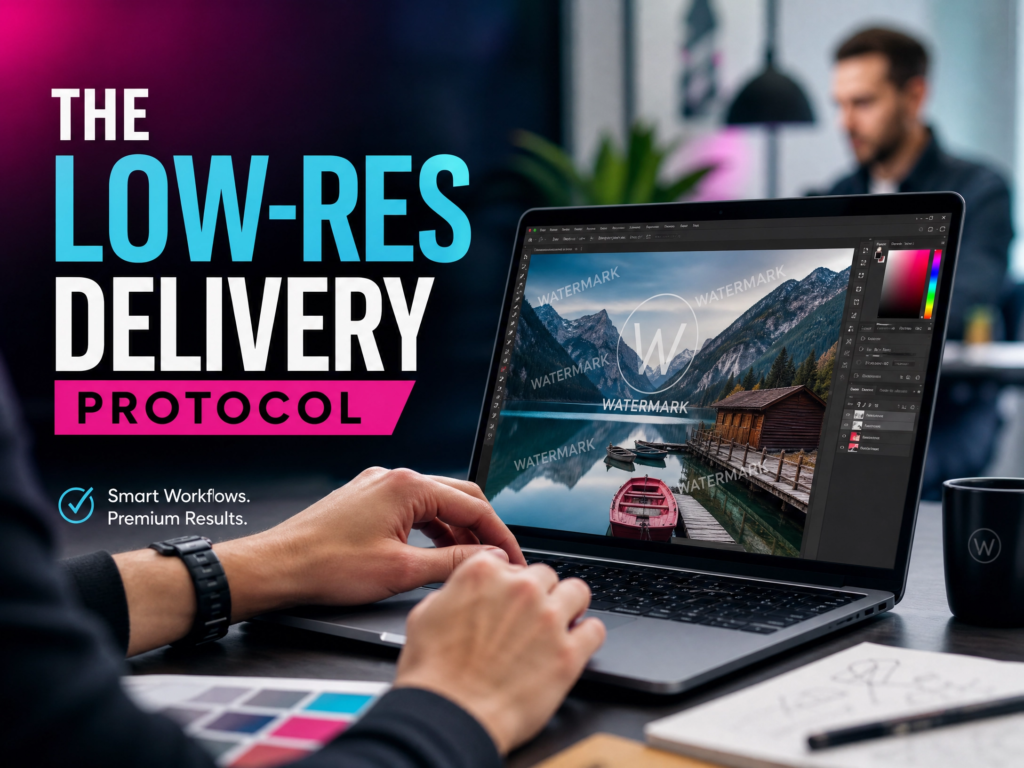
To prevent sudden file demands, you need a strict preview delivery system throughout your design process.
Never send high-resolution, unflattened files to a client for review or final sign-off.
Instead, use the Low-Res Delivery Protocol to protect your un-cleared intellectual property.
First, export all presentation drafts as low-resolution, flattened images or locked, non-editable PDF files.
Second, apply clean visual identifiers across the layout to signal that the work is a draft.
To do this correctly without hurting your presentation quality, review How to Watermark Your UI/UX Deliverables Without Ruining the Presentation.
Third, host your review assets on platforms where you control access dynamically at all times.
If you are a digital product designer, learn How to Revoke Access to Figma Files After Non-Payment (Safe & Legal Method) to protect your cloud workspaces.
This protocol ensures the client can fully review your design quality without taking the underlying assets.
It keeps the focus on checking the visual output rather than accumulating file assets early.
If they want to inspect the technical setup of the layers, use a live screen-share call.
Open the file on your computer and show them the pristine organization of your layers directly.
This shows transparency while keeping the physical .AI or .PSD files safely on your local hard drive.
It completely removes the excuse that they need the files just to verify your work quality.
The Source File Escrow Guide

If you are dealing with a high-value design contract, the risk of payment delays increases significantly.
When thousands of dollars are on the line, you cannot rely on simple promises or email assurances.
This is where structured file distribution systems become an essential part of your business operations.
The Source File Escrow Guide is a precise process designed to eliminate transaction risk for both parties.
It ensures that the client’s money is secure, while your proprietary design files remain fully protected.
The Escrow Process Flow
Let us look at how to structure a secure file exchange using a neutral third-party platform.
This system prevents either side from taking advantage of the other during the final milestone phase.
- Select a Verified Platform : Prerequisite.
Choose a dedicated creative escrow service or a neutral legal escrow platform agreed upon by both parties.
2. Client Deposits Funds : ( Step 1. )
The client transfers the remaining invoice balance into the secure third-party escrow account where it is held safely.
3. Upload Source Files : ( Step 2. )
You upload the verified, pristine .PSD or .AI files directly into the encrypted escrow storage area.
4. Automated Release : ( Step 3. )
The escrow system verifies the upload and automatically releases the funds to you and the source files to the client simultaneously.
The Economic Value of Escrow
Using this framework turns an emotional, high-stress power struggle into a clean, automated business transaction.
The client can no longer claim they are worried about your file delivery reliability.
You no longer have to worry about whether their final wire transfer will actually go through.
If a client refuses to use an escrow system for high-value assets, pay close attention.
That refusal is a massive red flag that they may have intended to delay your payment.
A legitimate business with cash on hand will rarely object to a neutral, protected settlement process.
Source File Release Risk & Pricing Assistant

Use this calculator to determine the risk level and the recommended intellectual property premium for releasing native source files.
Global Framework Comparison : USA vs. International Markets
The legal protections surrounding creative source files and copyright transfers vary significantly across geographic borders.
As an independent creator, understanding these operational differences helps you protect your business when working with global clients.
| Legal & Operational Metric | Indian Jurisdiction Framework | US / UK / Western Market Framework |
| Default Copyright Ownership | Remains with the creator under Section 17 of the Indian Copyright Act, 1957, unless created under a contract of service. | Varies by region; generally remains with the creator unless a clear written assignment or “work-for-hire” clause exists. |
| Validity of Digital Agreements | Upheld under the Information Technology Act, 2000; digital footprints and clear emails can establish terms. | Highly formalized; strict compliance with local statutes like the statute of frauds for IP transfers. |
| Late Payment Protections | Micro and Small Enterprises can leverage the MSMED Act, 2006 for statutory interest on delayed business invoices. | Dependent on explicit contract provisions or local civil collection codes and small claims structures. |
| Source File Deliverable Norms | Frequently demanded as a default expectation by local clients unless explicitly restricted in writing. | Widely recognized as a premium, non-standard asset that requires an independent financial transaction. |
The Strategic Risk Matrix
Every file request carries a different level of underlying risk to your business cash flow.
Use this risk matrix to evaluate your client’s behavior and choose the safest operational path forward.
Strategic Risk Matrix
Assess your client’s behavior patterns against these three operational risk tiers.
Demands native, layered files immediately, aggressively rejects neutral escrow options, or has an incredibly vague or non-existent original contract framework.
Requests files slightly ahead of time citing a sudden internal executive rush or launch deadline, despite having a standard project contract in place.
The final milestone invoice has been fully cleared and verified inside your business bank account, and source files were explicitly accounted for and paid for.
High-Risk Characteristics
- The client demands unflattened .AI or .PSD files immediately while ignoring your final invoice emails completely.
- They aggressively reject using neutral escrow options or safe screen-share reviews.
- The original contract has zero mention of source files, but they expect them for free.
- If you face this extreme situation, read What to Do When a Client Uses Your Work But Refuses to Pay You immediately.
Medium-Risk Characteristics
- The project went smoothly, but an internal manager suddenly requests source files early to meet a launch deadline.
- The contract lacks clear delivery terms, creating a grey area regarding final ownership.
- To protect your cash flow here, learn about managing your standard terms by reading Net 15 vs. Net 30 vs. Net 45: Which Payment Terms Protect Your Cash Flow ?.
Low-Risk Characteristics
- The final wire transfer has already cleared and is visible inside your business bank account.
- The contract explicitly details the exact file formats to be delivered upon completion of payment.
- The client understands and respects standard creative industry billing workflows without pushback.
Here is exactly how to respond when a client demands source files before payment :
Your Step-by-Step Implementation Framework
If a client is currently pushing you to deliver raw source files before paying, do not panic.
Follow this structured communication framework to handle the conversation calmly, professionally, and effectively.
Step 1: Verify the Original Contract Terms
Open your project contract and look for clauses regarding file formats and intellectual property transfers.
If your contract does not mention raw .PSD or .AI files, you have no obligation to provide them.
Knowing this gives you complete confidence when drafting your next response to their management team.
Step 2 : Send a Process-Oriented Response
Reply to their file request using a calm, helpful, and completely professional tone.
Explain that your business process requires all final milestone invoices to clear before production files are released.
Here is a clean, non-aggressive message template you can use:
“Look, I want to make sure your internal design team gets exactly what they need for a successful launch. Our standard creative business process is to deliver all editable source files (.AI and .PSD) immediately after the final milestone invoice clears. I will have the package ready to transfer the moment the wire is confirmed.”
Step 3 : Offer a Live Technical Walkthrough
If the client insists they need the files to audit your layer quality, offer an alternative.
Suggest a quick fifteen-minute video call where you share your screen and walk through the files together.
This addresses their stated technical needs perfectly while keeping your physical asset leverage entirely secure.
Step 4 : Pivot to an Escrow System if Deadlocked
If the client continues to stall payment while demanding the files, offer a neutral escrow option.
This removes all remaining excuses and forces them to demonstrate they actually have the funds available.
If they continue to stall, read Stuck in an “Accounting Loop”? Try This Psychological Trick to Get Paid Fast to break the corporate administrative deadlock.
The Creative Freelancer’s Evidence Checklist
If a client relationship begins to deteriorate over a source file dispute, you must document everything.
Collect and organize these specific pieces of evidence to secure your business position:
- [ ] The Original Signed Agreement : Keep a pristine copy of your initial creative contract detailing the original scope of work.
- [ ] Written Communications : Export all emails, client messages, and project briefs discussing file formats and delivery milestones.
- [ ] The Final Work Invoice : Keep a dated copy of your final milestone invoice showing the exact unpaid balance due.
- [ ] Time-Stamped Previews : Save copies of all low-resolution, watermarked previews you sent to the client for structural review.
- [ ] Proof of Work Value : Document your creation process, including early sketches and progress drafts, to prove your authorship.
If the client cuts off communication after receiving your previews, read My Client Ghosted Me After I Sent the Invoice—What Do I Do Now? for step-by-step guidance.
The Quick Decision Matrix
Use this quick guide to make the right operational choice when a file demand hits your inbox.
The Quick Decision Matrix
Follow this step-by-step logic to determine your next exact operational move.
If the client chooses to use your low-resolution previews commercially without paying, you must take immediate action.
Learn how to handle copyright violations by reading How to Write a Clean Cease-and-Desist Letter If a Client Steals Your Code or Designs.
If you need to recover your money independently without incurring massive legal bills, use the strategies outlined in How to Recover an Unpaid Invoice Yourself (Without Hiring a Lawyer).
For situations where the payment delay stretches out over weeks, find out when it is appropriate to escalate the issue legally by reading When is it Officially Time for a Freelancer to Take Legal Action?.
You can also look into your right to apply late fees by reviewing Can You Legally Charge Interest on Late Invoices ? (US,UK, & India Rules).
To prevent similar resource disputes on future projects, implement the protection practices found in Stop Working for Free : How to Prevent Scope Creep From Eating Your Profits.
At the end of the day, this is not about being difficult—it is about running a sustainable creative business where payment and ownership move together.
Frequently Asked Questions (FAQs)
What if the client claims they cannot initiate a wire transfer without verifying the source files first ?
This is almost always an administrative excuse used to gain asset leverage.
Offer to show them the files via a live video screen-share or upload them to a secure escrow platform.
This proves your files are complete without giving up physical possession before receiving payment. This is one of the most common scenarios where clients ask for AI or PSD files before payment under internal approval excuses.
Can a client sue me for withholding source files if they have paid a 50% deposit ?
No, a deposit covers the cost of initiating the work and securing your creative availability.
Full legal ownership and delivery rights are tied to the completion of the entire agreed-upon contract balance.
Unless your contract says otherwise, you are legally protected when withholding deliverables for non-payment.
How do I handle a situation where I forgot to exclude source files in my initial project contract ?
If the contract is silent on source files, default copyright laws protect you as the creator.
Explain to the client that raw working files are proprietary tools, not final deliverables.
Offer to add them to the delivery package for an additional intellectual property premium.
Is it safe to send high-resolution flattened files instead of layered source files before payment ?
Sending high-resolution flat files still carries significant financial risk.
A client can easily crop, print, or use high-quality flat graphics for their final product launch without paying you.
Always stick to low-resolution, watermarked files for all final review stages.
What should I do if a client launches a website using my design drafts while refusing to pay ?
This constitutes copyright infringement and a clear breach of your creative agreement.
Document the unauthorized use immediately by taking dated screenshots of the live assets.
Send a formal notification to their hosting provider or prepare a clear cease-and-desist letter to protect your work.
About the Author
Adv. Sagar Haribhau Shirsat is an active legal professional specializing in commercial transaction architectures, cross-border corporate compliance, and digital debt recovery systems. He designs strategic asset-protection and recovery frameworks that help freelancers, independent contractors, and global agencies defend their cash flow and enforce their billing rights.
Connect via his Official Professional LinkedIn Profile and or About US page.
Disclaimer : This guide is intended for educational purposes and risk management analysis. It does not replace formal legal counsel. For specific cross-jurisdictional contract disputes, always consult a certified attorney or local legal advocate.