
It happens on a random Tuesday morning. You are drinking your coffee, reviewing your pipeline.
You check a client’s live domain just out of curiosity.
They told you they needed time to “review the budget” last week. They asked for a pause.
Instead, you see your work.
Every pixel, every custom function, every layout you sweated over.
The site appears to have been duplicated and published without final payment being completed.
Look, I’ve been there. Early in my career, I lost a $4,000 project exactly like this.
In real situations, this part is usually messy. You’re not even sure yet whether it’s intentional or just poor handling — at least in the beginning.
I thought about hacking the site. I wanted to send an explosive, threatening email.
But anger is a terrible business strategy. Panic pays zero bills. And to be honest, most people get at least one step wrong here the first time. That’s normal.
Do not send that angry email yet.
Every hour that passes, search engines are indexing your stolen work.
They are building SEO authority on your unpaid labor.
If you don’t secure your evidence right now, they can just claim they built it themselves.
Here’s how this usually plays out in real situations, and what you can actually do about it.
No boardroom jargon. No corporate fluff.
The steps below are general industry practices used by freelancers and agencies in similar disputes.
Just practical steps to get you paid or get the stolen site taken down.
Not every case goes all the way to a takedown or legal notice. Sometimes a simple, well-worded message with evidence is enough — and sometimes it isn’t. There’s no clean pattern here.
This guide focuses on practical enforcement steps, legal principles, and evidence handling rather than emotional reactions.
If you are currently staring at a stolen site, wondering What to Do When a Client Uses Your Work But Refuses to Pay You, take a deep breath.
Table of Contents
This is the practical way most freelancers handle it.
“Legal Response to Client Stole My Website Code ?” – The Staging Clone Theft
In practice, this doesn’t always look neat — it usually starts with a small delay in communication or a ‘we’ll get back to you’ type message.. It always starts with a simple, honest mistake.
You wanted to impress the client. You wanted a smooth feedback loop.
This usually starts very innocently — a staging link shared too early, or a “quick review” request. In practice, that’s often where things go wrong.

You built the site on your staging server.
You didn’t protect the directory with a password.
You didn’t disable right-click or block site-ripper bots.
You just sent them a raw, open link and said, “Let me know what you think!”
I did the exact same thing for years. It feels like good customer service.
But it leaves your front door wide open.
What usually happens next is predictable — the communication slows down, and then stops.
The client clicked the link and realized the site was essentially finished.
Maybe they used a free tool like HTTrack.
Maybe they hired a cheap developer online to scrape your HTML, CSS, and JS.
They lifted your front-end assets and hosted them elsewhere.
Then, the emails stopped. They started ignoring your calls.
You are now dealing with a non-responsive client continuing to operate the site.
From a legal standpoint, things look slightly different than how clients often assume.
Here is the raw truth: Until they pay your final invoice, they do not own the site.
Under both US and international law, the creator holds the copyright upon creation.
By copying your staging server to their live server without paying, Legally, this often leans toward copyright issues — but in practice, the exact position depends on your contract and how the work was delivered.
And this is where many freelancers realize they never clearly defined ownership terms upfront.
This isn’t just a simple breach of contract.
It is the literal theft of digital property.
They do not have a license to use that code. In many cases, the creator retains strong legal rights until payment and licensing terms are completed..
If a client has duplicated your website code without authorization? What to Do Next
You cannot just accuse them blindly. Clients who steal sites will lie to your face.
They will claim a “new agency” built it from scratch over the weekend.
At this stage, you’ll need solid evidence, not assumptions.
You need to prove that they physically extracted the files from your specific server.
One common way to verify this is by checking server logs.
Every web server keeps a detailed diary of exactly who visits and what they download.
Here is the technical system to track them down.
Start by pulling your server logs. Most hosting dashboards (cPanel, etc.) have a raw access log section — don’t overthink it.
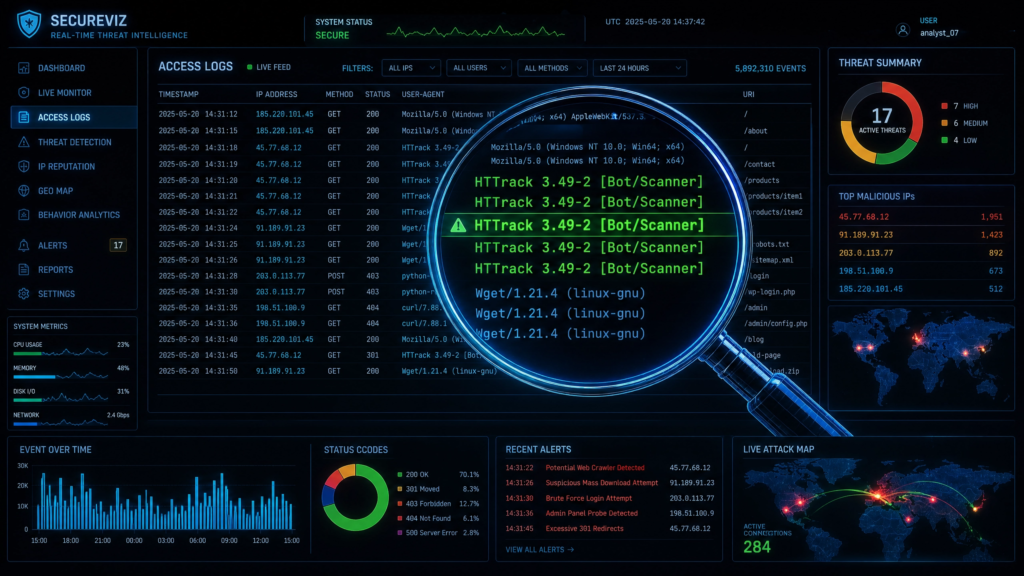
Log into your cPanel or server dashboard. Look for the “Raw Access Logs” section. This is your digital server log environment. Do not clear or delete anything.
Download logs for the dates when the staging link was active. That time window matters more than anything else.
Download the compressed log files for the exact dates the client had access to the staging link. Unzip these files to a local folder on your machine.
Do Search for Asset Ripping Bots
Open the logs in a basic text editor. Search for user-agents like “HTTrack”, “Wget”, or “SiteSucker”. If you see these, they used an automated tool.
Check whole code to Identify Mass Image Downloads
Look for a single IP address downloading hundreds of .png, .jpg, and .css files in a matter of two seconds. Normal humans do not browse like this.
check suspicious Cross-Reference the IP Address
Take that suspicious IP address and run it through a free IP lookup tool. Compare it to the IP address the client used when they opened your emails.
Once you match their geographic location to the rapid-fire server downloads, the position is legally strong.
You aren’t guessing anymore. This can sometimes provide supporting evidence of unauthorized access.
If you have been chatting on informal channels and wonder if your earlier warnings matter, Can a WhatsApp Chat Count as a Legally Binding Contract ?.
Copyright Vesting Rules in Staging Assets
Let’s look at the legal mechanics of this theft.
A lot of freelancers assume that because they were hired for a job, the client automatically owns the output.
This is a dangerous myth.
Unless your contract has a “Work for Hire” clause that has been fully executed by payment.
At a basic level, ownership doesn’t shift just because a project was commissioned.
Copyright vests in the author the exact moment the work is fixed in a tangible medium.
Writing code in VS Code makes it yours.
Uploading it to your digital ocean droplet keeps it yours.
The client only receives a legal license to use that work after the funds clear your bank account.
If they scrape the site before payment, This could be considered unlicensed use of copyrighted material in many cases.
Important Legal Citations
To back this up legally, look at the U.S. Copyright Act, 17 U.S.C. § 201(a).
It states clearly that copyright vests initially in the author.
In the UK, the Copyright, Designs and Patents Act 1988 (CDPA) follows a nearly identical rule.
The creator is the first owner. Full stop.
If you ever need to forcefully take the site down from their new host, you rely heavily on the Digital Millennium Copyright Act (DMCA) 17 U.S.C. § 512.
USA, UK and India Comparison
Let’s look at how this plays out depending on where you and your client operate. Cross-border theft is incredibly common. The rules shift slightly when you cross oceans, but the core protections remain on your side.
| Feature | United States / UK | India |
| Default Ownership | Creator owns until written transfer | Creator owns, but Section 17 of Copyright Act has employment nuances |
| Takedown Process | DMCA Takedown Notice to Web Host | Legal Notice under Information Technology Act |
| Damages | High, if formally registered | Moderate, requires proving actual financial loss |
| Enforcement Speed | Fast (Hosts fear liability) | Slower (Hosts often request court orders) |
In the US, statutory rights are anchored by the U.S. Copyright Office. If you want to dive deep into how the law defines ownership, check the legal breakdowns hosted by Cornell Law School. They detail how protection applies the moment code hits the disk.
For UK creators, the framework is managed via official UK Government Copyright Guidance. Meanwhile, Indian developers find their primary statutory backing directly through the Copyright Office of India.
If you operate across borders, things get slightly more complex. But the core, universal rule remains the same: unpaid work is stolen work. Your position may be stronger when documentation, timestamps, and payment history are clearly established.
The Evidence Gathering Checklist
If you are wondering what to do when a client has duplicated your website code, the first step is to secure evidence before taking any action.
Before you send a single message, you must build your case file.
In real cases, this is where things usually get messy.
If you tip them off too early, they will panic and delete the server logs or hide the site behind Cloudflare.
Gather this evidence quietly and methodically.
In most real cases, people quietly gather a few key things first — original files with timestamps, server logs, and screenshots of both versions. Nothing fancy, just enough to show a clear overlap.
Do not skip the evidence phase. It is your shield.
How Freelancers Typically Escalate Unpaid Digital Work Disputes

Now, we move from the system to the outcome.
You have the proof. You understand the law.
It is time to enforce your rights and get your money.
You are going to send them a highly specific, totally unemotional letter.
Not every client reacts the same way here.
I call this the ‘Pay or Pull’ letter.
They have two simple choices: pay the invoice today, or you pull the site down via their web host.
Step 1 : Find Their Host
Go to a free site like WHOIS or HostingChecker.
Type in their stolen live domain name.
Find out exactly who is hosting their website.
It might be GoDaddy, HostGator, AWS, or Bluehost.
Every single major host has a legal abuse department. They hate hosting stolen content.
If they are running a complex DNS setup and you need to stop them at the registrar level, Client Launched the Site But Cancelled My Stripe Subscription : How to Freeze a Live Domain Legally.
Step 2 : Draft the Notice
Your email to the client needs to be cold, professional, and incredibly firm.
Do not swear at them. Do not threaten them with public Twitter shaming.
Threaten them with a formal legal DMCA takedown.
The Email Generator Tool
I built this simple tool so you don’t have to overthink the wording.
Save this HTML snippet to your desktop, open it in Chrome, and generate your exact email copy.
‘Pay or Pull’ Email Generator
Construct an airtight, professionally structured framework to protect billable legal rights and recover outstanding balances.
Use it. It works. It removes emotion and replaces it with consequences.
Risk Matrix : Evaluating Your Client Target
Before you hit send on that email, evaluate the risk profile of your thief.
Not every client requires the exact same level of aggression.
At this point, freelancers often hesitate — and that delay usually matters.
You need to read the room.
| Client Profile | Risk Level | Your Recommended Action |
| Small Local Business | Low | Send the ‘Pay or Pull’ letter. They usually panic, apologize, and pay immediately. |
| Mid-Sized Agency | Medium | CC their accounting department. Remind them gently of the copyright violation and liability. |
| Anonymous Offshore Buyer | High | Skip the email entirely. Go straight to the web host with a formal DMCA takedown. |
If you are dealing with a massive corporate entity that simply laughs at your emails, you might need to escalate.
To know exactly when to pull the trigger on a real lawsuit, When is it Officially Time for a Freelancer to Take Legal Action ?.
How Agencies Secure Staging Environments Before Client Review
The absolute best way to handle staging theft is to ensure it never, ever happens in the first place.
You need to lock your digital doors.
Never send a raw staging link to a client.
Always use HTTP Basic Authentication on your staging server.
This requires a username and password popup just to view the HTML. Bots cannot scrape past a server-level password prompt.
Furthermore, rewrite your contracts.
Clearly state that the staging site is strictly for visual review only.
Specify that any unauthorized attempt to migrate or copy the site before final payment incurs an automatic 50% penalty fee.
Make it horribly expensive for them to even think about stealing.
Quick Decision Action Section
If you are reading this while staring at your stolen site right now, stop panicking.
Here is your 60-second immediate action plan:
- Do not email or text them yet. Silence is an advantage.
- Take full-page screenshots of their live, stolen site.
- Download your raw server access logs to a local drive.
- Identify their web host using a WHOIS lookup tool.
- Generate the ‘Pay or Pull’ email template provided above.
- If they ignore your deadline, file the DMCA directly with their host.
Do not let them intimidate you. You did the hard work.
Ownership typically depends on contract terms and payment completion, though copyright protection generally begins at creation. The goal is to bring the situation back into a fair, enforceable position.
Frequently Asked Questions
Does modifying the design prevent a copyright claim ?
Yes. Changing superficial CSS hex codes does not negate the theft of the underlying HTML structure and custom logic. If the core code skeleton is yours, Depending on the jurisdiction and contract terms, this type of situation may be assessed under copyright or contract law principles related to unauthorized use of digital work.
I just found out a Client Duplicates Your Website Without Permission immediately to stop them ?
Secure your evidence first. Download your server logs and take screenshots before they can hide the site. Then, identify their web host to prepare for a DMCA takedown notice. Do not warn them before gathering proof.
How do hosting providers respond to DMCA complaints ?
Yes. Under the DMCA, web hosts can be held legally liable if they knowingly host stolen, copyrighted content. To protect their own business, they will almost always pull the infringing site down.
Should I log in and lock them out of the WordPress admin panel ?
If the site is still sitting on your own server, absolutely. Change all admin and database passwords immediately. If they have already moved it to their server, you likely do not have access anyway.
What if the client claims they didn’t know the developer they hired stole it ?
In most legal systems, lack of awareness does not automatically remove liability, though outcomes depend on jurisdiction to copyright infringement. They are still actively hosting stolen property on their domain. They must either pay you for a license or remove the site entirely.
Author Box
Adv. Sagar Haribhau Shirsat is an active legal professional specializing in commercial transaction architectures, cross-border corporate compliance, and digital debt recovery systems. He designs strategic asset-protection and recovery frameworks that help freelancers, independent contractors, and global agencies defend their cash flow and enforce their billing rights.
Connect via his Official Professional LinkedIn Profile or About Us page.
Legal Context Summary
Website code is typically protected under copyright law from the moment it is created and stored in a tangible form. However, enforcement depends on jurisdiction, contractual agreements, and evidence of ownership and infringement.
Disclaimer : This guide is intended for educational purposes and risk management analysis. It does not replace formal legal counsel. For specific cross-jurisdictional contract disputes, always consult a certified attorney or local legal advocate.