
Pause for a second.
You are probably sitting at your desk, staring at a live website or a newly launched app.
It has your exact user flow. Your precise button placements. Your exact onboarding sequence.
But your bank account is completely empty.
They took your hard work, handed your layout to their internal development team, and ghosted you.
What you’re feeling right now is completely justified. I completely get it.
You are wondering if you can actually File a Copyright Infringement Claim for Unpaid UI wireframes, or if you are just out of luck.
Let’s break this down clearly.
I’m not a boardroom lawyer who speaks in Latin, and I am definitely not a corporate PR bot. I am someone who has been in the trenches, handed over native files too early, and learned the hard way.
If you are dealing with a situation where a client used your work without paying, we need to look at the cold, hard legal reality.
I am going to explain this like we are restarting from zero.
Table of Contents
Can You File a Copyright Infringement Claim for UI Wireframes ?

Let me tell you about a disaster I dealt with a few years ago.
I was hired to design a complex analytics dashboard for a fintech startup. I built the entire UX architecture.
About halfway through, the client ran out of money mid-project.
They asked for the Figma links “just to review the progress.” Like an idiot, I gave them full access.
Two days later, my access was revoked. My emails were ignored.
Three months later? The startup launched. The live product was a pixel-perfect replica of my structural wireframes.
I panicked. At that moment, I genuinely thought I had no legal ground to stand on. I thought because we only talked on a messaging app, I had no rights. But I quickly learned that even a WhatsApp chat can count as a legally binding contract.
I decided to fight back. I had to understand the deep legal mechanics of digital design ownership.
This is what actually matters, based on what I learned, broken down into the steps you need to take right now.
Are UI Wireframes Protected Under Copyright Law ? : Functional Layout or Artistic Expression ?
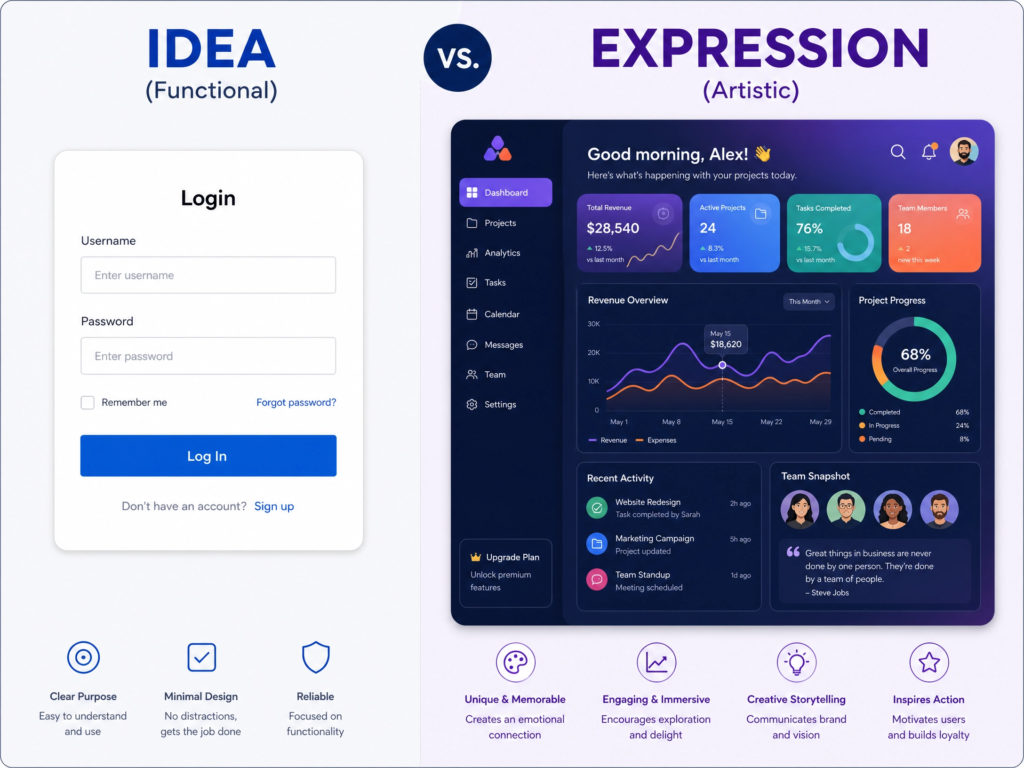
Let’s wipe the slate clean. Forget whatever nonsense you read on Twitter about design rights.
What is a copyright, really ?
Copyright law protects the expression of an idea, not the idea itself. This is a vital distinction in the legal world.
If you design a basic login screen with a username field and a password field, you cannot copyright that.
The law considers that purely functional. The US Copyright Office explicitly states that you cannot protect standard layouts or familiar symbols.
This is known in legal terms as the “idea-expression dichotomy,” outlined in Title 17 U.S. Code § 102.
But UI/UX is rarely just a basic login screen.
When you create a unique user journey, a specific arrangement of data cards, and a proprietary navigational flow, you cross a line.
You move from a bare “idea” into an “expressive layout.”
The US Supreme Court ruled in Feist Publications, Inc. v. Rural Telephone Service Co. that a work must possess a “minimal degree of creativity” to be protected.
A standard wireframe might fail this test. A highly detailed, custom user interface passes it easily.
If your unpaid wireframes were highly detailed, custom-tailored, and visually structured, you own a copyrightable asset.
You aren’t just protecting a “wireframe.” You are protecting a “compilation of creative elements.”
If you were hired through a middleman and they stole your expressive layout, you might even be able as a subcontractor to sue the end-client directly.
When Ownership Transfers (The Payment Condition)

One of the biggest misunderstandings clients have is this : Clients think that because they hired you, they own the work immediately.
That is not how ownership typically works in most cases.
In almost every jurisdiction, the creator of a work owns the copyright the second it is fixed in a tangible medium. Yes, saving a Figma file counts as a tangible medium.
The only way the client owns your UI is if you signed a “Work Made for Hire” agreement.
Even if you did sign one, those contracts almost always contain a payment condition.
The legal transfer of intellectual property is contingent upon the exchange of money. No money? No transfer.
Sometimes clients argue they have an “implied license” to use your layout because you delivered it to them.
An implied license does exist in law. But guess what? In many cases, courts treat non-payment as grounds to revoke an implied license, especially when payment was a core condition of use.
In practice, I’ve seen multiple freelancers recover payments by asserting IP ownership at the right stage.
To avoid this in the future, you need to learn how to watermark your UI/UX deliverables before handing them over.
But for now, understand this: They may be using the design without a valid license, which can amount to copyright infringement. They are infringing on your rights.
You don’t always need a lawyer immediately. You can actually take steps to recover an unpaid invoice yourself by using their fear of IP infringement against them.
How to Prove UI/UX Copyright Infringement

Okay, so you own the layout. How do you legally prove their internal dev team copied it?
Judges and lawyers are not designers. You cannot just say, “It looks the same.”
This is where most freelancers misunderstand how these cases actually work. You have to prove two specific legal elements: “Access” and “Substantial Similarity.”
Access : You must prove the client had access to your files. Did you send them a Figma link? Did you email them a PDF?
Save those access logs. Take screenshots of the email timestamps.
Substantial Similarity : You must prove that an average, ordinary person would look at both the wireframe and the final product and conclude they are the same.
In many cases, internal teams tend to reuse existing layouts rather than rebuild from scratch. They rarely rebuild from scratch. They usually trace your grid exactly.
Look for the “smoking gun.” Did they copy a specific typo you made? Did they use your exact placeholder text?
Did they replicate an unusual spacing quirk you left in the design?
Document all of this. This is the exact kind of proof you need before you write a clean cease-and-desist letter.
You also have to be careful about how much extra work you did. Often, clients steal work after pushing you too far.
If this started because you refused to do extra revisions, you should read up on how to stop working for free and prevent scope creep.
Filing the Federal / National Claim

I didn’t escalate immediately either — and that delay can cost you leverage. If they ignore your warnings, you have to escalate.
You need to know exactly when it is officially time to take legal action.
If you are in the United States, you cannot actually file an infringement lawsuit until your work is formally registered with the US Copyright Office.
Yes, you own the copyright automatically. But to sue in federal court, you need that official registration certificate.
Registration costs around $65. It is the best investment you can make right now.
Once registered, you can sue for “Statutory Damages.” This is terrifying for clients.
Instead of proving exactly how much money you lost, statutory damages allow a judge to fine the client up to $150,000 per willful infringement.
This is the ultimate leverage. When their lawyer sees you have registered the copyright, their tone will change instantly.
They will suddenly want to settle the invoice.
US vs Global Comparison : Copyright Law for Freelancers
If you work with US clients, the rules of the game are brutally specific. I see this all the time.
You need to know how to protect yourself when dealing with American corporate entities versus international clients.
Let’s look at how copyright claims for UI/UX actually work, starting with the heaviest hitter.
Of course, outcomes can vary depending on jurisdiction and the exact terms of your agreement.
The United States:
Here is the thing: You own the IP the second you create it. That is baked right into Title 17 of the U.S. Code.
But ownership and enforcement are two very different animals in America.
You are completely barred from filing a federal lawsuit until you formally register the work with the U.S. Copyright Office.
Without that certificate, federal judges will not even look at your case.
The US system heavily rewards early registration. If you register before the infringement happens, you unlock statutory damages under 17 U.S.C. § 504.
This means you don’t have to prove exactly how many dollars you lost. A judge can just hit the client with up to $150,000 per willful infringement.
That threat alone is usually what gets your invoice paid.
If federal court sounds too expensive, the US recently launched the Copyright Claims Board (CCB).
It is a small-claims system inside the Copyright Office that handles disputes up to $30,000. It is completely remote, much cheaper, and designed specifically for creators like us.
And according to Cornell Law School’s Legal Information Institute, maintaining that formal federal registration is still your absolute strongest legal shield.
The United Kingdom:
Unlike the US, the UK does not force you to jump through registration hoops.
Under the UK Copyright, Designs and Patents Act 1988 (CDPA), your UI is protected and enforceable automatically.
There is no formal government registry. You can take a client straight to the Intellectual Property Enterprise Court (IPEC) using your timestamped Figma files as proof.
India:
Under the Indian Copyright Act, 1957, protection is also automatic. You do not strictly need to register to file a suit.
However, local courts strongly prefer it. A formal registration certificate serves as prima facie evidence, making it much harder for the client to delay the legal process.
Evidence Checklist : Build Your Case
Before you make a single threat, gather your ammunition. If you miss one piece of evidence, a smart corporate lawyer will destroy your claim.
- The Contract/Agreement : Save the PDF, the Upwork terms, or screenshot the entire WhatsApp conversation.
- Timestamped Deliverables : Export your Figma version history. Prove exactly when you created the layout.
- Delivery Proof : Find the exact email or Slack message where you handed over the files.
- The Payment Default : Save the unpaid invoice and any messages where they make excuses for not paying.
- The Infringement Proof : Take high-resolution screenshots of their live website. Use the Wayback Machine to archive their site instantly.
- The “Smoking Gun” : Highlight overlapping oddities, identical grid structures, or copied placeholder data.
Freelancer IP Risk Matrix
Use this matrix to understand exactly where you stand right now.
| Risk Level | Scenario | Your Legal Leverage | Next Step |
| Low Risk | You retained native files. They only have low-res JPEGs. They haven’t built anything yet. | High. They can’t easily build it without your files. | Withhold all source files until the invoice is paid in full. |
| Medium Risk | You handed over Figma access. They stopped paying, but the product isn’t live yet. | Moderate. The implied license is revoked, but damages are unproven. | Send a Cease & Desist warning them against using the assets. |
| High Risk | Product is live. Internal devs built your exact layout. You have no formal contract. | Strong, but complex. You must rely on implied copyright law. | Register copyright immediately. Prepare for a formal legal claim. |
Quick Decision Section : What to do in the next 24 hours
Look, you don’t have time to hesitate. Every day their site is live, they are making money off your brain.
Step 1 : Revoke all access. Kick them out of Figma, disable any staging links, and pull down any testing servers.
Step 2 : Archive everything. Take screenshots of the live site. Do not tell them you are doing this.
Step 3 : Send the Final Notice. Be cold. Be professional. State clearly that the license to use the design is revoked due to non-payment.
Step 4 : File a DMCA Takedown. If their hosting provider (like AWS or GoDaddy) receives a valid copyright claim, they might pull the site offline.
Free Tool : UI Infringement Notice Generator
I built this simple HTML framework. If you are a designer, copy this text, fill in the brackets, and send it directly to their legal or billing department. Do not use emotion. Just facts.
Subject: NOTICE OF COPYRIGHT INFRINGEMENT AND REVOCATION OF LICENSE – [Invoice #]
To [Client Name/Company],
This is a formal notice that your company is currently utilizing copyrighted UI/UX architecture and layouts created by me, without authorization or active licensing.
Under our agreement, the transfer of intellectual property rights is strictly contingent upon full payment of Invoice [Invoice Number]. Because this invoice remains unpaid as of [Date], all implied or explicit licenses to use these designs are immediately revoked.
Your internal development team has deployed these proprietary layouts on [Website URL]. This constitutes direct copyright infringement under applicable intellectual property laws.
If the outstanding balance of [Amount] is not settled within 72 hours, I will be forced to escalate this matter. This may include filing formal infringement claims, issuing DMCA takedown notices to your hosting provider, and seeking statutory damages.
Please confirm receipt of this notice and remit payment immediately.
Regards,
[Your Name]
Frequently Asked Questions
Can you file a DMCA takedown for UI/UX design or wireframes ?
Yes. While DMCA is usually used for copied code or stolen photos, an expressive, highly detailed UI layout is protected material. You can submit a takedown notice to their server host. The host will often force the client to respond to avoid liability.
Is it still copyright infringement if UI colors or fonts are changed ?
Changing surface-level aesthetics does not negate copyright infringement if the underlying structural layout and unique user flow are substantially identical. Courts look at the “total concept and feel” of the design.
Do I need a registered company to file a claim ?
No. As a freelance individual, you possess the intellectual property rights automatically. You do not need an LLC or a corporation to enforce your copyright as an independent creator.
Can you claim copyright without a written contract ?
Without a written contract, the default law applies: The creator (you) owns the work. The lack of a contract actually hurts the client more than it hurts you, because they cannot prove you signed away your rights.
Is it worth suing if the invoice was only for $2,000 ?
Filing a federal lawsuit for $2,000 is usually not financially viable due to legal fees. However, the threat of a lawsuit, backed by a formal Copyright Registration, is usually enough to terrify a company into paying the $2,000 immediately to make you go away.
The Final Takeaway
Listen to me carefully. Your ideas have value. Your execution has value.
Do not let a corporate team bully you into thinking you are just a replaceable vendor.
When you create a structural user flow, you are engineering a digital asset.
If they do not pay for it, they do not get to keep it.
Stand your ground. Gather your evidence. Register your work if you are in the US.
Send that cold, calculated legal notice.
Many companies rely on freelancers avoiding legal escalation. They rely on freelancers being too scared to fight back.
If your case is strong, you are in a position to enforce your rights. Protect your cash flow.
Disclaimer: This guide is intended for educational purposes and risk management analysis. It does not replace formal legal counsel. For specific cross-jurisdictional contract disputes, always consult a certified attorney or local legal advocate.
Author Box
Adv. Sagar Haribhau Shirsat is an active legal professional specializing in commercial transaction architectures, cross-border corporate compliance, and digital debt recovery systems. He designs strategic asset-protection and recovery frameworks that help freelancers, independent contractors, and global agencies defend their cash flow and enforce their billing rights.
Connect via his Official Professional LinkedIn Profile or About Us page.