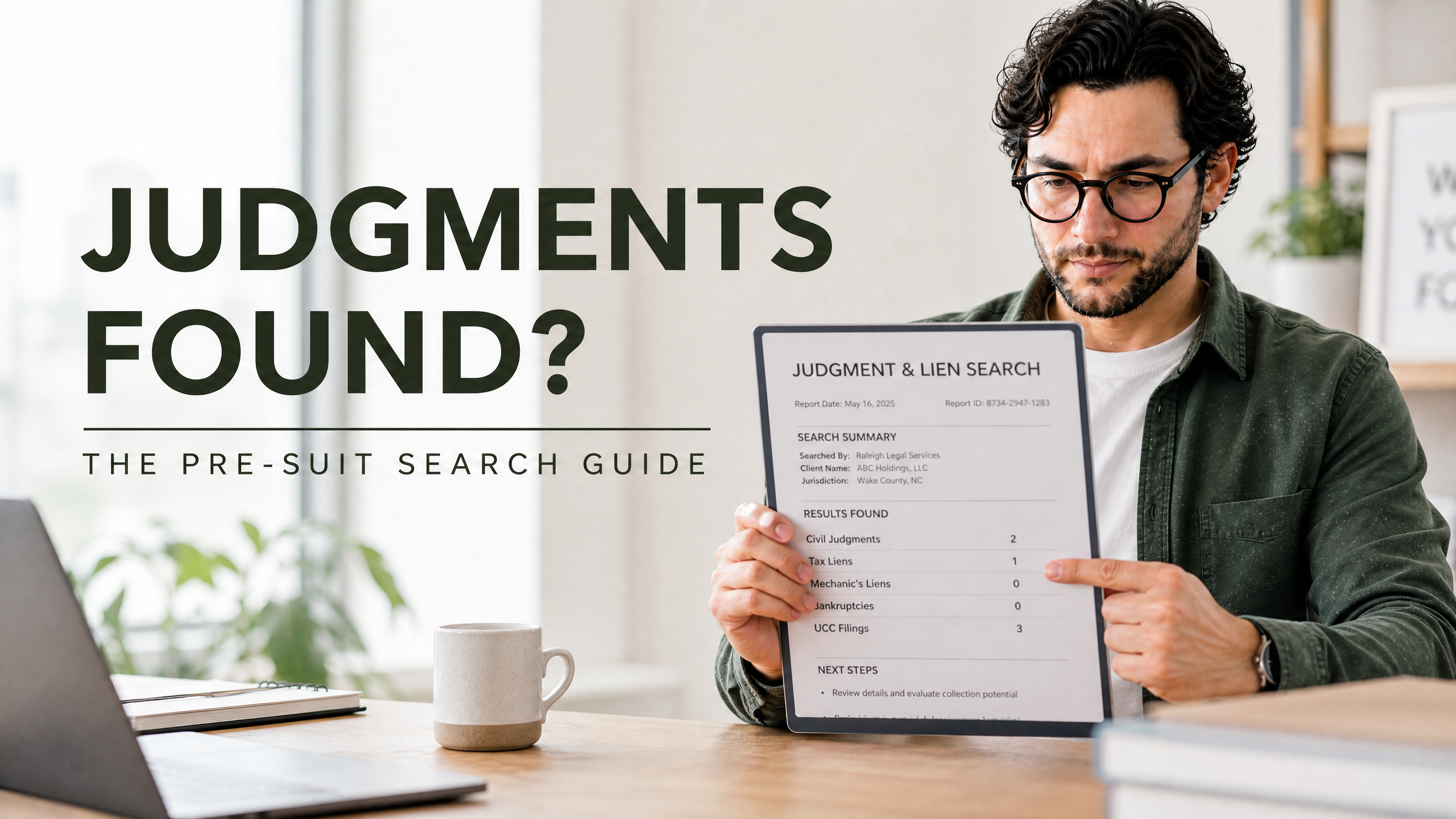
Let me tell you about a web developer named Marcus.
Marcus built a custom booking system for a mid-sized event agency. His final invoice was $15,000.
The agency launched the site, started taking bookings, and then stopped answering his emails.
Marcus was furious.
He wanted justice.
So he hired a local business lawyer, paid a $4,000 retainer, spent months dealing with the litigation process, and eventually won a judgment for the amount he was owed, plus whatever costs and interest the court awarded.
Marcus thought the hard part was over.
It wasn’t.
When he started trying to collect, he discovered that the company already had substantial debts. Other creditors had sued it. Lenders had filed financing statements against company assets. There were serious tax issues. The company’s financial position was far weaker than its website, office and equipment had suggested.
Marcus had won the lawsuit.
But winning and collecting are two different problems.
That distinction is one of the most expensive lessons a freelancer can learn.
A judgment can establish that a debtor owes you money. It does not automatically put money into your bank account. Collection may require additional legal procedures, and the amount you ultimately recover can depend on the debtor’s assets, existing liens, creditor priority, exemptions, bankruptcy proceedings and the law of the relevant jurisdiction.
That is why I like to think about a lawsuit as an investment decision.
Before spending $3,000, $5,000 or $10,000 trying to recover a $15,000 invoice, you should ask a brutally practical question:
If I win, is there a realistic path to getting paid?
This guide shows you how to investigate that question before you spend serious money.
If you’re still deciding whether litigation is appropriate in the first place, start with The Freelancer’s Legal Guide to Recovering Unpaid Invoices (Without Expensive Lawsuits).
Important: This is a U.S.-focused educational guide, with a short international comparison. Court-record access, lien rules, judgment enforcement, creditor priority, bankruptcy procedures and collection remedies vary by state and country. A public-record search is a risk-assessment tool, not a guarantee that a debtor is solvent or collectible.
Table of Contents
1. Don’t Waste Money Suing a Client You Cannot Realistically Collect From
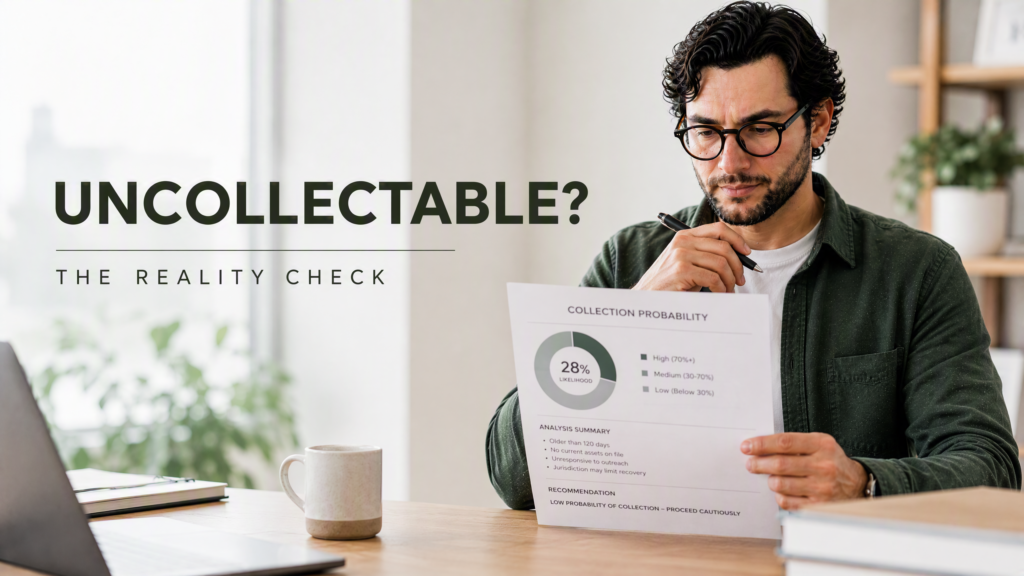
There is an old saying:
You can’t get blood from a turnip.
The wording is crude.
The business lesson is not.
A lawsuit can establish your legal claim. But if the debtor has little non-exempt property, substantial secured debt, serious creditor claims or an active insolvency proceeding, the practical value of winning may be much lower than the face value of your invoice.
This is why I don’t recommend looking at litigation as simply:
Invoice amount → lawyer → lawsuit → judgment → payment.
The real chain is:
Invoice → evidence → legal claim → judgment or settlement → enforcement → collectible assets → actual recovery.
Each step has a cost.
And each step has a failure point.
The common mistake
You are owed $12,000.
The client is ignoring you.
You become angry.
You think:
“They’re obviously wrong. I’ll sue them.”
That may be completely justified emotionally.
But before you spend money, investigate the economics.
Ask:
- Does the company still operate?
- Is it actively being sued?
- Does it appear to have substantial secured debt?
- Are there public tax-lien records?
- Has it filed bankruptcy?
- Does it have assets in the jurisdiction?
- Are there other judgment creditors?
- Is the company dissolved?
- Is there evidence of serious payment distress?
- Would collection cost another round of legal fees after you win?
This is also why I would not ignore earlier warning signs. If the client has been repeatedly delaying invoices, you may want to review What to Do When a Corporate Client Claims Your Invoice Was Lost in Accounting for the Third Time and Client Says Your Invoice Was Lost? How to Get Paid by Corporate Accounts Payable.
The goal isn’t to discourage legitimate lawsuits.
The goal is to stop you from spending litigation money blindly.
2. First, Confirm the Client’s Exact Legal Identity
Before searching for judgments or liens, get the client’s legal identity right.
This sounds boring.
It is not.
A search for:
“ABC Creative”
may produce very different results from:
“ABC Creative LLC”
or:
“ABC Creative Holdings, Inc.”
You need to identify, as accurately as possible:
- Full legal business name
- Entity type
- State or country of formation
- Registered address
- Principal business address
- Company registration number, if available
- Names of relevant subsidiaries or parent companies
- Any former names
- Any trade names or DBAs
If your contract names one company but the invoice was sent to another entity, stop and investigate that relationship before assuming you have sued the correct defendant.
The same problem occurs when freelancers contract with a brand name but the actual contracting party is a separate LLC or corporation.
Your evidence file should therefore include the contract, invoices, payment communications and the entity information you used when conducting your searches.
If there is no formal written contract, that doesn’t automatically mean you have no claim. See Can You Sue a Client Without a Contract? Real Legal Answer (2026) for that separate issue.
3. Search Local and State Court Records for Existing Lawsuits and Judgments
This is where your investigation begins.
If a company is already being sued by multiple creditors, that doesn’t automatically mean you should abandon your claim.
But it is a very important warning signal.
Search for the client’s exact legal name in:
- County civil court systems
- State court databases
- State judicial portals
- Local clerk-of-court systems
- Relevant appellate records
- Federal court records where appropriate
Google can help you locate the correct portal.
Try searches such as:
“[County] [State] civil court case search”
or:
“[State] business court records search”
Do not rely entirely on Google search results.
Go to the actual court or government database where possible.
What are you looking for?
You want to identify patterns.
For example:
One old contract dispute from five years ago
is very different from:
Six recent collection lawsuits filed by vendors in the last twelve months.
Look at:
- Case filing dates
- Plaintiff names
- Nature of claims
- Amounts involved
- Case status
- Whether a judgment was entered
- Whether the judgment was satisfied
- Whether the defendant appeared
- Whether the case was dismissed
- Whether the company is repeatedly being sued for nonpayment
A lawsuit by itself doesn’t prove insolvency.
But a pattern of recent creditor litigation can tell you something important about the company’s payment behavior.
Don’t make the “3 lawsuits = don’t sue” mistake
There is no universal legal rule saying that three lawsuits means you should walk away.
The better conclusion is:
Multiple recent creditor lawsuits are a reason to investigate further before committing significant litigation money.
That is much more useful—and much more accurate.
4. Search Federal Court and Bankruptcy Records Through PACER
If your client is a substantial U.S. business, don’t stop at county or state records.
Federal litigation and bankruptcy cases can matter enormously.
The official PACER system allows registered users to search federal court records, including district, appellate and bankruptcy cases. The PACER Case Locator can also be used for nationwide searches.
You can search federal cases through PACER when appropriate.
The federal judiciary explains that PACER can be searched by specific court or through its nationwide index.
Search for:
- Bankruptcy filings
- Breach-of-contract lawsuits
- Collection actions
- Major commercial disputes
- Receivership-related proceedings
- Repeated litigation involving the company
If you discover a bankruptcy filing, slow down immediately.
A bankruptcy petition generally triggers the automatic stay under 11 U.S.C. § 362, which can stop many lawsuits and collection actions against the debtor or property of the bankruptcy estate. The statute contains exceptions, and parties can seek relief from the stay in appropriate circumstances.
So don’t write:
“You can never sue a bankrupt company.”
That is too simplistic.
Instead:
A bankruptcy filing can substantially change the collection strategy. Before starting or continuing collection litigation, confirm the bankruptcy case status and determine whether the automatic stay applies to the action you are considering.
If you’re dealing with a corporate bankruptcy specifically, also read What Happens to Your Invoice If Your Corporate Client Goes Bankrupt?.
5. Understand the Difference Between a Judgment, a Judgment Lien and a UCC Financing Statement
This distinction is extremely important.
These three things are related to creditor rights, but they are not the same thing.
A judgment
A judgment is a court’s formal determination resolving a claim.
Depending on the jurisdiction and circumstances, the judgment may allow the creditor to pursue enforcement remedies.
A judgment lien
A judgment lien is a lien created or perfected under applicable law after a judgment.
The precise procedure and property affected vary by jurisdiction.
Federal regulations, for example, recognize that a judgment lien creditor must have a perfected lien on the relevant property, and perfection can depend on recording, docketing, levy or other requirements under applicable law.
Cornell Law School’s Legal Information Institute also describes a judgment lien as a claim against a debtor’s property arising from a judgment, subject to applicable priority rules.
A UCC financing statement
A UCC financing statement is different.
UCC Article 9 provides a legal framework for secured transactions involving personal property, and states maintain filing systems where financing statements can publicly disclose security interests.
A UCC-1 filing therefore does not simply mean:
“The bank owns everything.”
That’s not an accurate way to describe it.
It can indicate that a secured creditor claims a security interest in described collateral.
The collateral description, filing status, debtor name, secured party, amendments and other details matter.
This distinction is one of the most important upgrades to the original version of this article.
6. Search UCC Financing Statements
Now we get to one of the most useful pieces of your investigation.
If the client is a U.S. business, identify the state where the relevant UCC financing statement is likely to be filed and use the state’s official UCC search system.
For many business debtors, the Secretary of State or another designated state filing office provides access to UCC records.
The Uniform Law Commission explains that Article 9 governs secured transactions and that states maintain filing offices for financing statements that publicly disclose security interests in encumbered property.
You can also review the Uniform Law Commission’s UCC materials for background on Article 9.
What should you examine?
Don’t just count filings.
Look at:
- Debtor’s exact legal name
- Secured party
- Filing date
- Status
- Collateral description
- Amendments
- Continuations
- Terminations
- Whether the filing appears active
- Whether the collateral appears broad or narrowly defined
A terminated filing is not the same warning signal as a current financing statement.
Likewise, one equipment-financing filing is not necessarily evidence that the company is drowning in debt.
What a UCC search can tell you
It can provide evidence that secured financing exists.
What it cannot tell you by itself
It cannot reliably tell you:
- The company’s current cash balance
- Its total debt
- Its profitability
- Whether it will default
- Whether your eventual judgment will be collectible
- Whether a secured creditor has priority over your particular claim in every circumstance
This is why a UCC search should be treated as one piece of the solvency investigation, not a magic “collectible/not collectible” button.
If you’re considering stopping work because the client appears to be financially unstable, see How to Use the Notice of Suspension of Services Without Ruining the Client Relationship Permanently.
7. Search for Tax Liens—but Don’t Assume a Tax Lien Means You Get Nothing
This is another area where freelancers can easily misunderstand the law.
A federal tax lien is a serious warning signal.
The IRS explains that a federal tax lien is a legal claim against property to secure tax debt, while a levy is an actual seizure of property. The IRS also explains that a Notice of Federal Tax Lien is filed in public records to alert creditors to the government’s claim.
The important point is this:
A tax lien does not automatically mean every other creditor loses.
Priority can depend on federal law, timing, the type of competing interest and whether the IRS filed its notice.
The IRS’s own materials recognize circumstances in which certain competing creditors can prevail over a federal tax lien under 26 U.S.C. § 6323.
So if you discover a tax lien, don’t write:
“The IRS eats first. You get nothing.”
Instead write:
“A federal tax lien is a major collection-risk signal. Determine what property is affected, when the lien arose or was filed, what competing interests exist, and whether the lien has priority over the creditor’s potential remedies.”
That is the level of precision you want when discussing a YMYL legal topic.
If you discover a tax lien, your next move may be to obtain jurisdiction-specific advice rather than immediately abandoning the claim.
8. Look for Signs of Insolvency Beyond Liens
A public-record investigation is not the same thing as a forensic financial audit.
You are looking for signals.
Think of them as pieces of a puzzle.
Warning signals include:
- Multiple recent collection lawsuits
- Recent judgments
- Repeated vendor disputes
- Active bankruptcy proceedings
- Insolvency or liquidation proceedings
- Numerous active secured financing statements
- Public tax-lien information
- Repeated payment defaults
- Business closure or dissolution
- Sudden disappearance of the company’s normal operations
- Significant changes in ownership or management
- Long-running payment delays
None of these, by itself, proves that the company cannot pay you.
The power comes from the pattern.
A company with one UCC filing and a clean payment history is a completely different risk profile from a company with eight active financing statements, multiple recent creditor lawsuits, a tax lien and an insolvency proceeding.
9. Consider a Business Credit Report
Public court records are only part of the picture.
For larger claims, you may also consider a commercial credit report from a reputable provider.
Depending on the provider, a report may contain information about:
- Payment history
- Trade experiences
- Collection activity
- Public records
- Credit risk indicators
- Business identity
- Reported financial information
Some reports may include a PAYDEX score or another proprietary payment indicator.
Don’t treat any single score as a legal conclusion.
A credit score is a risk indicator, not a court finding.
The practical question is:
“Does the available information make it more or less likely that this business can satisfy a judgment?”
That is the question that matters.
And remember the economics.
Spending $100 on additional diligence before spending $5,000 on litigation may be rational.
Spending $5,000 investigating a $1,500 invoice probably requires a different analysis.
10. Don’t Confuse “No Record Found” With “No Debt Exists”
This is one of the most important lessons in the entire article.
You search the court database.
Nothing appears.
You search UCC records.
Nothing alarming appears.
You find no obvious public tax-lien record.
You conclude:
“The company is solvent.”
No.
You have established something much narrower:
“I did not find the particular public records I searched.”
Those are very different statements.
Public-record searches can be limited by:
- Jurisdiction
- Search-name variations
- Filing delays
- Data quality
- Database coverage
- Incorrect entity identification
- Sealed or restricted records
- Private debts
- Unrecorded interests
- Information not available through that particular database
That is why the audit should be described as a risk screen, not a guarantee.
11. The 5 Things I Search Before Spending Serious Litigation Money
If you want the simple version, this is my framework.
Search #1: Court cases
Look for:
- Recent creditor lawsuits
- Existing judgments
- Repeated breach-of-contract claims
- Collection cases
- Bankruptcy cases
Search #2: UCC records
Look for:
- Active financing statements
- Major secured lenders
- Broad collateral descriptions
- Recent financing activity
- Amendments and continuations
Search #3: Tax-lien information
Look for:
- Public federal tax-lien notices where available
- Relevant state tax records
- Other recorded liens available through applicable public systems
Search #4: Business information
Confirm:
- Exact entity name
- State of formation
- Registered status
- Current address
- Parent/subsidiary relationships
- Dissolution or liquidation information
Search #5: Commercial credit information
Look for:
- Payment history
- Collection activity
- Trade experiences
- Risk indicators
- Other publicly reported financial warning signs
Then combine the results.
Don’t let one clean search override four serious red flags.
12. My Pre-Lawsuit Solvency Audit
Here is the framework I would use before spending serious money.
Step 1 — Identify the debtor
Confirm the exact legal entity.
Step 2 — Search local and state court records
Look for recent creditor litigation and judgments.
Step 3 — Search federal records
Use PACER where federal litigation or bankruptcy may be relevant.
Step 4 — Search UCC records
Review active financing statements and collateral descriptions.
Step 5 — Investigate public lien information
Check relevant federal, state and local sources.
Step 6 — Review business status
Check whether the entity is active, dissolved, liquidating or otherwise undergoing a significant corporate change.
Step 7 — Consider commercial credit information
For larger claims, determine whether the additional information justifies its cost.
Step 8 — Estimate collection probability
Ask:
“If I obtain a judgment, what assets or cash-flow sources could realistically satisfy it?”
Step 9 — Calculate litigation economics
Include:
- Attorney fees
- Court fees
- Service costs
- Expert costs
- Travel
- Your time
- Enforcement costs
- Expected delays
Step 10 — Make the decision
Only now decide whether litigation makes economic sense.
13. The Pre-Suit Decision Matrix
Here’s a better way to think about the results.
| Evidence | Collection Risk | Sensible Next Step |
|---|---|---|
| Few adverse records, operating business, no obvious major liens, normal payment indicators | Lower | Investigate the legal claim and consider demand or litigation |
| Some creditor litigation or secured financing, but business appears operational | Moderate | Consider negotiation, payment plan, demand, or limited legal spend before full litigation |
| Numerous recent creditor suits, major payment problems, serious lien issues or insolvency indicators | High | Obtain jurisdiction-specific advice before committing substantial litigation funds |
| Active bankruptcy or liquidation proceeding | Special situation | Stop ordinary collection workflow and determine what the insolvency process requires |
| Dissolved or apparently inactive entity with little evidence of assets | Potentially very high | Investigate remaining assets, legal status and possible remedies before spending heavily |
Notice what I am not saying.
I’m not saying:
“Red means never sue.”
I’m saying:
Red means don’t spend blindly.
There are situations where even a difficult debtor is worth pursuing.
There are also situations where a smaller claim against a solvent company is far more attractive than a larger claim against an empty entity.
14. Don’t Forget Judgment Enforcement
This is where many freelancers stop thinking too early.
They investigate the debtor.
They file the lawsuit.
They win.
Then they ask:
“Okay. How do I actually get the money?”
That question should exist before you file.
Depending on the jurisdiction and circumstances, enforcement may involve remedies such as:
- Garnishment
- Levy
- Execution
- Judgment liens
- Post-judgment discovery
- Debtor examinations
- Seizure of certain non-exempt assets
- Other statutory collection remedies
The availability and procedure for these remedies vary significantly.
And the existence of a judgment does not automatically mean every asset can be seized.
This is why a pre-suit solvency investigation is valuable.
You aren’t trying to predict the future with certainty.
You’re trying to avoid walking into a collection problem you could have seen coming.
15. What About a Client Who Has Already Been Sued by Other Creditors?
This is where judgment searches become especially useful.
Suppose you search the company and discover:
- Four recent collection lawsuits
- Two judgments
- One active UCC filing
- A history of late vendor payments
That does not prove you will recover nothing.
But it changes the question.
You are no longer asking:
“Can I prove this invoice is owed?”
You are asking:
“What is my likely position among the company’s competing obligations, and what assets or collection mechanisms might actually be available?”
That is a much more sophisticated litigation decision.
16. What If the Client Is Still Operating Normally?
Don’t automatically assume that a busy company is financially healthy.
A company can have:
- A beautiful office
- Employees
- Expensive equipment
- Active advertising
- A large website
- Strong social media
- Major customers
and still have severe cash-flow problems.
Conversely, a company with a few UCC filings may be perfectly healthy.
That’s why visual impressions are weak evidence.
Public records, payment behavior, financial information and the actual legal structure tell you much more.
17. International Clients: The Investigation Changes
The U.S. system is decentralized.
You may need to examine:
- State corporate records
- County courts
- State courts
- UCC filing systems
- Federal PACER records
- Local recording offices
- Bankruptcy records
Other countries use different systems.
United Kingdom
Companies House provides public company information through its online service. The UK government says the service provides public company data for free, including company details and filing information.
You can search the Companies House register by company name, number or officer name.
You can also investigate whether a company is being wound up through the UK government’s insolvency-related services.
A UK creditor should also understand that winding-up proceedings are a specialized insolvency process. GOV.UK notes that a creditor may apply to wind up a company that cannot pay its debts, but there is no guarantee that the creditor will recover all or any of the money owed.
European Union
There is no single universal “EU debtor database” that replaces the individual systems of every member state.
Commercial registers and insolvency systems vary by country.
So if you’re dealing with a German, French, Dutch or other European company, identify the relevant national registry and insolvency system instead of assuming that a U.S.-style search will work.
For broader cross-border risk management, read How to Protect Yourself When Working With International Clients.
18. The Litigation ROI Calculation
Now let’s get to the part most people skip.
Suppose your unpaid invoice is:
$15,000
Your estimated legal costs are:
$4,000
Court and filing costs:
$600
Your estimated time cost:
$2,000
At first glance:
$15,000 – $4,000 – $600 – $2,000
= $8,400
That looks attractive.
But there is another variable.
Collection probability.
Suppose, after your investigation, you estimate that there is only a 50% chance of ultimately collecting the judgment.
Your rough expected recovery becomes:
$15,000 × 50%
= $7,500
Then subtract your estimated litigation and enforcement costs.
$7,500 – $6,600
= $900 expected economic value
That is a radically different decision.
This isn’t a substitute for legal advice or a formal financial model.
It is simply a way of forcing yourself to think beyond:
“I’m right, therefore I should sue.”
19. Pre-Suit ROI Calculator
Use the following calculator to estimate the economic value of pursuing an unpaid invoice.
Inputs:
- Unpaid invoice amount
- Estimated probability of collection
- Lawyer fees
- Court/filing costs
- Estimated enforcement costs
- Your estimated time cost
The basic formula is:
Expected Recovery = Invoice Amount × Estimated Collection Probability
Then:
Expected Net Value = Expected Recovery − Total Estimated Costs
This is more useful than simply subtracting legal fees from the invoice because it recognizes the central reality:
Winning the case and collecting the judgment are separate events.
For example:
$15,000 invoice × 70% collection probability = $10,500 expected recovery
If total expected costs are $5,000:
$10,500 − $5,000 = $5,500 estimated net value
Again, this is an estimate—not a prediction.
20. Your Pre-Suit Evidence File
If the numbers make litigation worth considering, build your evidence file before handing the matter to a lawyer.
Include:
- Signed contract
- Proposal or statement of work
- Amendments
- Invoices
- Proof of delivery
- Emails
- Slack communications
- Project-management records
- Git commits
- Approval messages
- Payment promises
- Partial payments
- Dispute communications
- Client complaints
- Evidence showing acceptance or use of your work
- Public-record search results
- UCC search results
- Relevant lien information
- Bankruptcy search results
- Business-status information
If your work has already been used without payment, preserve evidence before making emotional decisions. Depending on the work involved, you may also want to review Client Used Your Work Without Paying? Use This “Content Kill Clause” to Shut It Down.
For technical projects, evidence can become especially important. See The Client Has Your Code on AWS and Won’t Pay: The Code-Audit Breakdown for a related evidence problem.
For creative work, usage itself may also matter to your broader strategy. See Client Used My Video Without Paying? Here’s How to Recover Your Money Using a YouTube Copyright Strike and Client Published My Article But Didn’t Pay? Here’s Exactly How to Recover Your Money (Legally).
21. What If the Client Is Using Your Work but Still Refusing to Pay?
Don’t automatically assume the only remedy is a lawsuit.
Depending on the facts and the rights involved, your options may include:
- Formal demand
- Negotiation
- Payment plan
- Suspension of services
- Collection agency
- Arbitration
- Small claims court
- Civil litigation
- Contractual remedies
- Copyright-related remedies where legally applicable
- Other jurisdiction-specific remedies
For example, if the client has already used your creative work, the legal analysis may be different from a situation where the client never received or used the deliverables.
You can explore related situations in Client Used Your Work But Didn’t Pay? A Colorist and Sound Engineer’s Legal Guide.
The important point is:
Do not choose the most expensive remedy merely because it feels the most powerful.
Choose the remedy that gives you the best combination of legal leverage, expected recovery and manageable cost.
22. When a Collection Agency May Make More Sense
Sometimes the math tells you that a lawsuit is simply too expensive.
That does not necessarily mean the debt should be abandoned.
A collection agency may be worth considering when:
- The debt is documented
- The debtor appears operational
- Litigation economics are weak
- The claim is commercially collectible
- You would prefer contingency-based collection
- You don’t want to manage litigation personally
The agency’s fees, legal authority, licensing requirements and collection methods should be reviewed carefully.
See Should You Hire a Debt Collection Agency? (Real Cost, Risks & When It Actually Works) for the separate analysis.
23. What If the Client Offers You 10% to Walk Away?
This is where the solvency investigation becomes extremely valuable.
Suppose the client says:
“We’ll pay you $1,500 today. Take it or leave it.”
You might think:
“That’s insulting.”
Maybe.
But the real question is:
“What is my expected recovery if I reject it?”
If your investigation suggests the business is financially healthy and the legal claim is strong, the settlement may be unattractive.
If the investigation suggests the company is collapsing and several creditors are already pursuing it, $1,500 today may have a very different economic value.
Don’t accept or reject a settlement purely because of pride.
Understand what you’re trading.
For a deeper look at the legal and strategic risks around partial payments, see The Partial Payment Trap: Why Accepting 10% of a Late Invoice Can Sometimes Erase Your Legal Leverage.
Frequently Asked Questions
Can I search for a client’s existing judgments before suing?
Yes, where the relevant court records are publicly searchable. The exact database depends on the jurisdiction.
Search using the client’s exact legal entity name and reasonable name variations.
Remember that a search result—or lack of one—is not a complete financial investigation.
Can I search UCC filings myself?
In many U.S. jurisdictions, yes. State filing offices commonly provide UCC search systems.
The Uniform Law Commission explains that Article 9 deals with secured transactions involving personal property and that states maintain filing offices for financing statements.
But interpreting priority and collateral coverage can require legal analysis.
Does a UCC-1 mean the bank owns all the client’s assets?
No.
A financing statement generally gives public notice of a claimed security interest. The filing does not, by itself, mean that the secured party owns every asset of the debtor.
Read the collateral description and consider the applicable law.
Does a tax lien mean I will never get paid?
No.
A federal tax lien is a serious warning sign, but priority depends on applicable law and the competing interests involved. The IRS itself recognizes statutory exceptions affecting competing creditors.
Does a bankruptcy filing mean I can never sue?
No.
But the automatic stay can prevent many actions against the debtor or bankruptcy estate, and exceptions and stay-relief procedures exist. Confirm the bankruptcy status before proceeding.
If the company has several lawsuits against it, should I automatically walk away?
No.
Multiple lawsuits are a risk signal.
You need to examine their age, status, amounts, judgments, debtor assets and the broader financial picture.
If I find no liens, is the client solvent?
No.
It simply means your searches did not reveal the particular liens you were looking for.
Can I sue an LLC owner personally if the company doesn’t pay?
Not automatically.
An LLC’s separate legal status generally matters, and the circumstances under which an owner can become personally liable depend on applicable law and facts. A personal guarantee is one possible route, but it is not the only legal issue that can arise.
How long does a U.S. judgment last?
There is no single nationwide answer.
Judgment duration, renewal requirements, dormancy rules, interest and enforcement procedures vary by state and by the type of judgment.
Check the applicable jurisdiction rather than relying on a generic “10 to 20 years” rule.
Should I hire a private investigator to find hidden assets?
Possibly, but usually only when the amount at stake justifies the cost and the investigation can be conducted lawfully.
Asset investigation should not involve unauthorized access to bank accounts, protected databases or other unlawful methods.
25. The Hard Truth About Suing a Client
Here’s the lesson I want you to remember.
A lawsuit is not the finish line.
It is one step in a recovery process.
You can have:
- A perfect contract
- A perfect invoice
- Excellent evidence
- A strong legal claim
- A favorable judgment
and still face a difficult collection problem.
That doesn’t mean you should never sue.
It means you should make the decision with your eyes open.
Before spending serious litigation money, search the debtor.
Find the legal entity.
Check court records.
Check federal records where appropriate.
Search UCC filings.
Investigate relevant public lien information.
Check bankruptcy and insolvency records.
Consider commercial credit information.
Then estimate the probability that a judgment could actually be converted into money.
That’s the difference between:
“I want justice.”
and:
“I have a recovery strategy.”
And when a client is genuinely solvent but simply refusing to pay a valid debt, that’s a different situation.
You may have a very good reason to escalate.
But make the escalation deliberate.
Not emotional.
Not because you’re angry.
Not because you want to “teach them a lesson.”
Because the expected value of the recovery justifies the cost and risk.
That is how you protect your cash flow.
And that’s how you stop turning unpaid invoices into expensive victories.
Final Pre-Lawsuit Checklist
Before spending serious money on litigation, ask yourself:
- Have I confirmed the exact legal entity?
- Have I searched relevant state and local court records?
- Have I checked federal litigation and bankruptcy records where appropriate?
- Have I searched the relevant UCC filing system?
- Have I investigated relevant public lien records?
- Have I checked whether the business is active, dissolved or in an insolvency process?
- Have I reviewed available payment-history or commercial-credit information?
- Have I preserved the contract and evidence of performance?
- Have I calculated my expected legal and enforcement costs?
- Have I realistically considered the probability of collecting after judgment?
- Have I considered settlement or collection alternatives?
- Have I obtained jurisdiction-specific legal advice where necessary?
If you can answer those questions, you’re making a much more informed litigation decision.
And remember:
A judgment tells you that you won the legal dispute.
It does not necessarily tell you that you will collect the money.
That distinction can save a freelancer thousands of dollars.
Author
Adv. Sagar Haribhau Shirsat is an Indian advocate and legal content creator focused on commercial disputes, unpaid invoices, debt recovery and cross-border legal issues affecting freelancers, independent contractors and businesses.
Professional profile: Connect through the author’s official professional LinkedIn profile.
Disclaimer
This article is provided for educational and general risk-management purposes. It is not individualized legal advice and does not create an attorney-client relationship.
Court-record access, creditor priority, judgment liens, UCC filings, tax liens, bankruptcy procedures, enforcement remedies and collection laws vary by jurisdiction. A public-record search cannot guarantee that a debtor is solvent or that a judgment will be collectible.
Before filing a lawsuit or taking enforcement action, consult a qualified lawyer licensed in the relevant jurisdiction, particularly where bankruptcy, secured creditors, tax liens, cross-border assets or substantial amounts of money are involved.