It is a specific, sickening kind of gut punch.
You hustled for weeks. You meticulously crafted the perfect pitch. You finally secured that premium backlink or authored that killer guest post on a massive Tier-1 publication.
The middleman agency praised your work. The post went live. You saw your words on the screen.
Then, you sent the invoice.
And the agency completely, utterly vanished.
The first time this happened to me, I had just landed a massive feature on a premier marketing blog for a white-label broker.
Since that experience, I have studied numerous freelancer payment disputes involving agencies, subcontractors, and content creators.
Although every dispute is different, the commercial patterns are surprisingly consistent.
I bought a slightly too expensive coffee to celebrate. I felt like I was finally leveling up.
Then came day 30. Day 45. Day 60.
Nothing but automated out-of-office replies and vague promises from generic support emails.
It felt incredibly personal. I felt disrespected. But here is the hard truth I eventually learned: it is just business mechanics.
Broker agencies operate on razor-thin margins and chaotic, unpredictable cash flow. When things get tight on their end, they freeze out the bottom of the food chain.
You are the easiest person to ignore.
But you aren’t helpless. Not by a long shot.
Today, I am going to show you exactly how to bypass the ghosting agency and go straight to the top.
We are talking about going over the middleman’s head directly to the brand recipient.
Before You Begin
Every dispute is different.
The strategies discussed below are intended to help freelancers understand practical negotiation options and general legal principles.
Outcomes depend on the wording of your contract, local law, and the facts of your case.
If the amount involved is significant or the dispute crosses jurisdictions, obtain advice from a qualified lawyer licensed in the relevant jurisdiction.
Table of Contents
Stiffed by the Middleman Broker
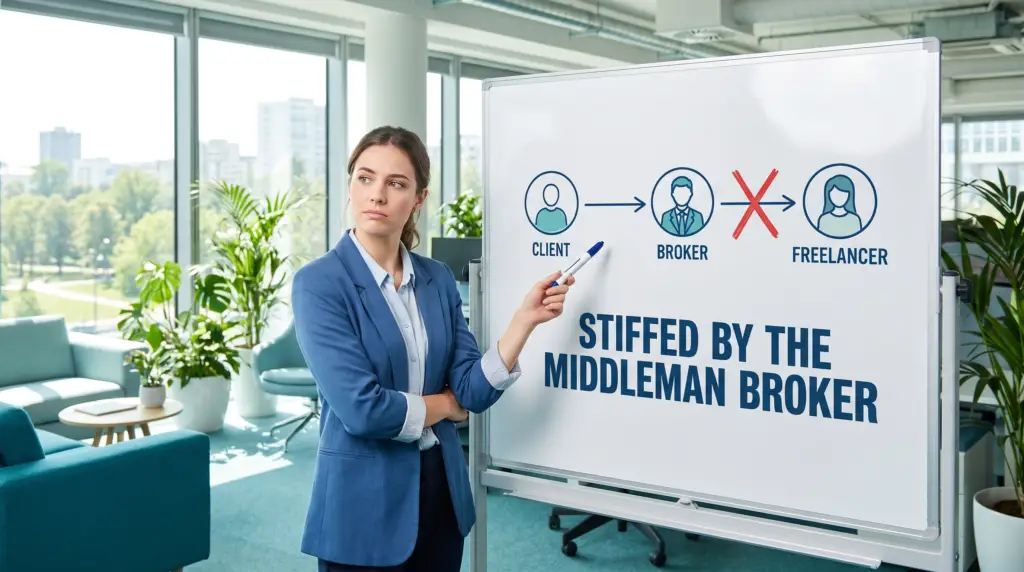
Let’s break down what is actually happening behind the scenes of your unpaid invoice.
Most middleman PR and SEO agencies act as protective buffers. They sell premium placements to SaaS companies or e-commerce brands at a massive markup.
Then, they hire you—the outreach specialist or ghostwriter—to do the actual heavy lifting.
When the piece gets published, the agency immediately invoices their end-client.
If that end-client pays late, the agency makes a quiet decision to make their problem your problem.
Suddenly, my client ghosted me after I sent the invoice becomes your daily reality.
Look, I get the intense frustration. You did the work. The article is live right now.
The end brand is getting SEO value, targeted traffic, and domain authority right now.
But you are sitting there holding a worthless PDF invoice and checking your bank app out of habit.
In practice, many freelancers report spending weeks sending follow-up emails before receiving either payment or a clear response.
They get trapped in a never-ending cycle of “checking with our finance team” or “waiting on the director.”
If you are stuck in an “accounting loop”, polite nudges will not save your cash flow.
You need real, undeniable leverage.
And your ultimate leverage isn’t the middleman agency that is ignoring you.
Your leverage is the brand that is currently enjoying the fruits of your unpaid labor.
They are holding the asset you created. That makes them vulnerable.
The Liability of the Beneficiary Brand
Now, let’s talk about the law. Don’t worry, I will keep this entirely practical and simple.
You might logically think you have no legal relationship with the end brand.
You didn’t sign a contract with them, right ? You only spoke to the broker.
Not necessarily. In many cases, the legal position is more favorable to freelancers than they initially assume. Intellectual property rights often exist independently of the commercial relationship between the freelancer and the intermediary, although contractual terms remain important.
For example, the U.S. Copyright Office explains that copyright protection exists automatically once an original work is fixed in a tangible medium, although ownership and licensing questions can still depend on contractual terms.
Unless your agreement validly assigned ownership or qualified as a work-made-for-hire arrangement under applicable law, you may retain significant copyright interests in the work.
Whether intellectual property rights transfer immediately or only after payment depends on the contract, governing law, and jurisdiction. However, in many freelance arrangements, payment plays a significant role in determining the scope of the license granted to the client.
Where the agreement makes payment a condition of the license—or where applicable law supports that interpretation—continued commercial use may expose the client to legal risk. It is truly that straightforward.
This means what to do when a client uses your work but refuses to pay you applies directly, and aggressively, to the end brand.
Depending on the contract and applicable law, the continued publication of the work could raise copyright licensing or contractual issues.
The legal term for them benefiting from your unpaid work without compensation is “unjust enrichment.”
I have seen freelancers panic because their deal with the agency was just a few casual text messages.
But can a WhatsApp chat count as a legally binding contract ? Often, yes.
The digital paper trail of you submitting the work, combined with it getting published, is all the proof you will ever need.
If a client published your article without paying (and gave someone else the byline), You may possess meaningful commercial leverage, particularly if you can clearly document authorship, delivery, and non-payment.
The Tier-1 publication site does not want a messy copyright dispute.
The end brand definitely does not want a DMCA takedown on a backlink they likely paid thousands of dollars for.
United States vs Global Comparison : Copyright & Subcontractor Rights
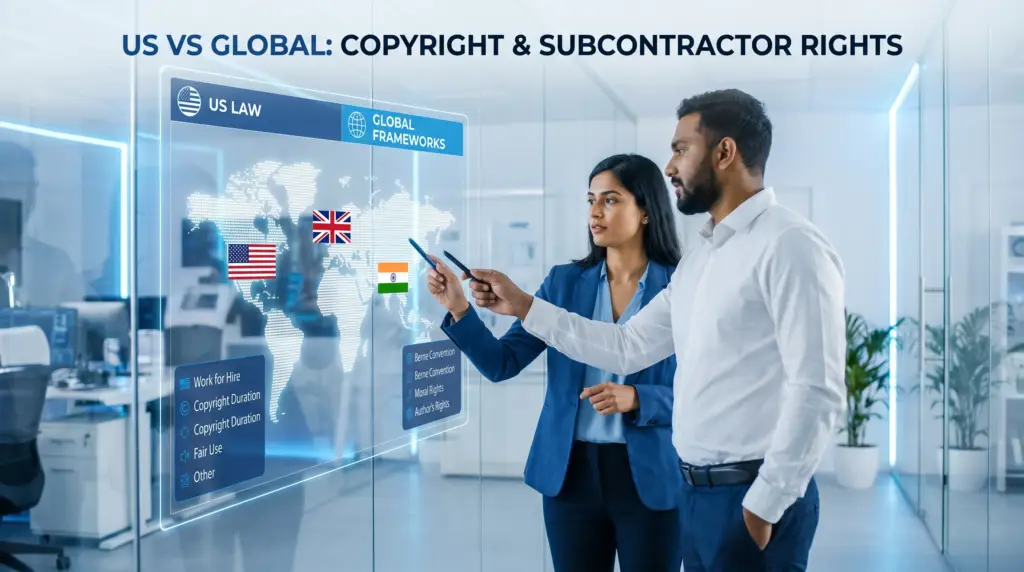
Look, I approach these payment disputes from a strategic, global perspective.
Jurisdictions handle unpaid freelance invoices slightly differently, but your core strategic leverage remains exactly the same everywhere.
The end brand desperately wants the content asset, and Depending on your agreement, you may retain significant legal leverage over the commercial use of the work.
Here is exactly how the law backs you up in the major markets.
United States : The Global Standard for IP Leverage
In the US, extremely strong copyright protections make the end-client strictly liable for publishing your work without a paid commercial license.
Under Title 17 of the U.S. Code, Section 106 (via Cornell Law School), you instantly hold the exclusive commercial rights to your work the exact second you create it.
If the middleman agency completely defaults on your invoice, the legal license to use or display that work simply rarely transfers to the end brand.
The end brand could potentially face copyright infringement allegations if the necessary rights were never validly obtained.
This makes a formal DMCA takedown highly effective, and it is precisely why understanding how to recover an unpaid invoice yourself (without hiring a lawyer) starts with weaponizing your basic IP rights.
United Kingdom: Statutory Penalty Power
If you are operating in the UK, the law actively punishes middlemen who string you along just to protect their own corporate cash flow.
The Late Payment of Commercial Debts (Interest) Act 1998 protects you fiercely, allowing you to legally penalize the defaulting middleman with statutory interest (8% over the Bank of England base rate) plus fixed debt recovery costs.
More importantly, the end brand can still be heavily pressured via direct Intellectual Property claims if their chosen agency fails to legally secure the commercial rights.
You can bypass the agency entirely and leverage the UK Intellectual Property Office’s (IPO) strict enforcement rules against unauthorized commercial use.
The Global Scenario & India : Unjust Enrichment
But what if you are working across borders, perhaps dealing with an Indian agency or a brand located halfway across the world?
In India, this exact scenario is heavily governed by the Indian Contract Act of 1872, specifically Section 70, which strictly prevents a concept called “unjust enrichment.”
It clearly states that if a person lawfully does anything for another, not intending to do it gratuitously, the beneficiary—meaning the end brand—must legally compensate them.
Indian commercial courts heavily enforce this, meaning the brand cannot just shrug their shoulders and blame their broker.
Regardless of where you happen to live, understanding how to protect yourself when working with international clients means recognizing that IP rights cross borders incredibly efficiently.
International copyright treaties provide meaningful protection across many jurisdictions.
Do not let a foreign agency intimidate you with complex legal jargon; your right to be paid for your delivered assets is widely recognized.
The Intermediary End-Around Framework
Here is the exact strategy I use. To my knowledge, this framework is an original strategic model developed from practical observations of freelance payment disputes rather than an established legal doctrine.
It is specifically designed to cleanly bypass the ghosting agency and force the actual beneficiary to act immediately.
We are not going to yell. We are not going to make emotional threats.
We are going to apply surgical, calculated corporate pressure.
Whenever I am acting as an unpaid subcontractor wondering when I can sue the end-client directly, I immediately stop acting like a victim.
I start acting like a forensic auditor.
You need to visually map out the supply chain of your work.
Diagram : The Supply Chain of a Tier-1 Guest Post
The Content Creator
Owns the original IP and copyright until final payment clears.
The Ghosting Broker
The white-label layer pocketing the margins while withholding your cash.
The Beneficiary Client
Enjoys the SEO juice and equity. Strictly liable for unlicensed asset usage.
Forbes, HubSpot, TechCrunch
The authority site hosting the text. Highly sensitive to copyright/DMCA risks.
The agency is heavily relying on you staying quietly at the top of that diagram.
They assume you are too scared, or too professional, to contact the End Brand or the Tier-1 Publication.
We’re about to challenge that assumption.
Here’s the thing: the end brand probably paid the agency a premium rate.
They genuinely think the agency handled everything cleanly and legally.
When they find out the agency left an unpaid, radioactive copyright risk sitting on their balance sheet, they will be furious.
But they won’t be furious at you. Many brands are likely to treat this as a serious vendor management issue at their agency.
Your communication should remain factual, professional, and focused on protecting your contractual and intellectual property interests.
You need to find the CMO, Marketing Director, or Head of SEO at the end brand.
Use LinkedIn. Dig deep. Find the person actually in charge of PR or Content.
Do not, under any circumstances, message their generic info@ or support@ email.
You want the specific decision-maker who likely signed the check to the middleman agency.
Once you find them, you prepare your strike.
Drafting the ‘Notice of Unpaid Supply Chain Layer’
You aren’t sending a traditional, aggressive cease and desist letter.
Those sound way too hostile and emotional for this early stage.
You are sending what I call a “Notice of Unpaid Supply Chain Layer.”
This deliberately sounds like a standard, boring compliance alert.
Corporate executives respond incredibly well to boring compliance alerts.
The tone should be calm, informative, and slightly bureaucratic.
You are simply informing the brand that the asset they are currently using lacks a valid commercial license.
Why? Because their chosen middleman defaulted on payment.
If you want to master how to recover an unpaid invoice yourself (without hiring a lawyer), Mastering this tone is extremely important.
You are a peer alerting them to a supply chain failure, not an angry freelancer begging for rent money.
I have built a specialized tool below to help you generate this exact notice.
Just fill in the blanks. It creates a highly professional, undeniable email template you can copy and paste.
Supply Chain Notice Generator
(You can save this code block as an HTML file to use locally on your machine)
Notice of Unpaid Supply Chain Layer — Generator
Generate a professional compliance notice to bypass the ghosting agency and secure direct settlement.
When the brand executive reads this, The notice is designed to encourage the recipient to review the issue internally through their legal, procurement, or marketing teams.
You aren’t threatening them directly; you are politely threatening the expensive asset they paid for.
You are also exposing their chosen agency as unreliable, broke, and highly risky.
Large organizations generally treat vendor compliance and intellectual property risks seriously because they can affect legal, financial, and reputational exposure.
Securing Direct Pay via End-Client Settlement
Once the brand receives this notice, One of several outcomes is common in situations like this.
Scenario A : The brand instantly emails the middleman agency and furiously demands they pay you immediately.
Suddenly, the agency that ghosted you for 60 days will magically “find” your invoice in their spam folder and wire the money.
Scenario B : The brand realizes the agency is broke, fraudulent, or incompetent.
Some brands may offer a direct commercial settlement to resolve the issue quickly. just to secure the IP rights and avoid a massive PR mess on the Tier-1 site.
Depending on the circumstances and local law, a direct settlement may be legally permissible. You are essentially executing a direct commercial settlement.
I always advise freelancers to be highly flexible here.
If the brand offers to pay the principal invoice directly, take it immediately.
If you are wondering, can you legally charge interest on late invoices, the answer is generally yes, but you must pick your battles carefully.
Your main goal right now is recovering the core principal amount, not fighting over a 3% late fee.
If the end brand completely ignores you (which is less common), you move to the final, nuclear strike.
You directly contact the managing editor at the Tier-1 publication.
You inform them that an unpaid, unlicensed piece of ghostwritten content was slipped past their editorial team.
Major publishers generally take copyright complaints and editorial integrity seriously because protecting their reputation and compliance processes is a core business priority.
Depending on their internal policies and the facts presented, the publisher may investigate the matter, temporarily remove the content, or request additional documentation, pull the article offline, or replace the byline within 48 hours.
The end brand loses everything they paid for. The middleman loses their major client.
This is the ultimate exercise in professional boundary setting.
You have to learn to stop working for free and prevent scope creep from continuously eating your profit margins.
Part of that survival is having very sharp teeth when people try to steal your margins.
Evidence Checklist for The End-Around Strategy
Before you send a single email to the end brand, Make sure your house is in perfect order.
Gather this specific proof. If the brand’s legal team pushes back, you need to be able to drop this digital PDF on their desk immediately.
- The Original Pitch/Brief : Screenshots of the middleman giving you the exact assignment and parameters.
- The Drafts : Google Doc history showing your live typing, edits, and timestamps prior to the publication date.
- The Delivery Proof : The exact email or Slack message where you submitted the final version to the agency.
- The Ghosting Trail : A complete log of at least three ignored invoice follow-ups sent to the agency over time.
- The Live Asset : Clear screenshots of the live article on the Tier-1 site, highlighting the end brand’s backlink.
Do not bluff. Never bluff. Have these five items saved in a single, neatly labeled Google Drive folder.
When a skeptical CMO asks, “How do I know you actually wrote this ?” you simply send the link to the folder.
At this point, you have substantially strengthened your negotiating position. In many cases, this significantly increases the likelihood of a commercial resolution.
Risk Matrix : Bypassing the Middleman
Let’s be brutally honest about the risks of executing this strategy. Nothing in business is completely risk-free.
| Action Taken | Risk to Your Cash Flow | Risk to Agency Relationship | Legal Risk to You | Recommended? |
| Doing Nothing (Waiting) | High (Payment becomes increasingly unlikely over time.) | Low (They already don’t respect you) | Low | Absolutely No. |
| Sending End-Brand Notice | Low (Forces an immediate resolution) | High (The agency may decide not to work with you again.) | Low (Truth is an important defense in many jurisdictions, although defamation laws vary. Sticking strictly to verifiable facts is generally the safest approach.) | Yes. |
| DMCA to Tier-1 Publisher | Medium (Destroys the asset, doesn’t guarantee cash) | Extreme (Agency loses their client) | Medium (Must ensure you own the IP) | Only as a final resort. |
They may choose not to hire you again.
But let me ask you a very serious, practical question:
Why would you desperately want to work for someone who actively steals from you?
Losing a relationship with a consistently non-paying client is often a commercially reasonable trade-off.
The Quick Decision Section
Feeling overwhelmed by the legal mechanics? Let’s cut right through the noise.
Here is exactly what you need to do, right now, based purely on how many days past due your invoice currently is.
If Invoice is 1-15 Days Late :
Do nothing drastic yet. Send standard, polite, automated reminders. Corporate accounting departments simply get backed up.
If Invoice is 16-30 Days Late :
Stop all new work immediately. Send a firm warning to the agency that IP rights are contingent on payment.
If Invoice is 31+ Days Late and Agency is Ghosting :
Deploy the Intermediary End-Around Framework. Map the supply chain. Find the end brand on LinkedIn. Use the HTML generator above. Send the notice.
If End Brand Ignores the Notice (After 7 Days) :
Contact the Tier-1 publication’s editorial team directly. Issue a formal, legally binding copyright takedown request.
FAQs on Middleman Invoice Recovery
u003cstrongu003eCan the middleman agency sue me for contacting their client ?u003c/strongu003e
It is highly, highly unlikely. First, they fundamentally breached the contract by failing to pay you. Second, the truth is an absolute legal defense against defamation or tortious interference claims. You are merely stating a factual commercial reality: the invoice remains unpaid.
u003cstrongu003eWhat if I signed an NDA with the middleman agency ?u003c/strongu003e
An NDA protects trade secrets and confidential data like client lists. It does not act as a magical shield for non-payment or copyright infringement. If they breached the core payment terms, the entire contract is fundamentally compromised. However, Generally consult a local attorney if your NDA has incredibly aggressive penalty clauses.
u003cstrongu003eDo I need to register my copyright before sending the notice to the brand ?u003c/strongu003e
In both the US and UK, copyright is automatic the very moment the work is fixed in a tangible medium (like writing it in a Google Doc). Registration gives you the right to sue for massive statutory damages later, but you absolutely do not need it just to send a commercial takedown notice.
u003cstrongu003eWill the Tier-1 site ban me from writing for them in the future if I complain ?u003c/strongu003e
Usually, no. Tier-1 editors deeply hate shady PR agencies more than you do. By alerting them to unlicensed, paid-link schemes, you are actually helping them maintain their vital editorial integrity. Just remain highly polite to the editors.
u003cstrongu003eThe agency says they haven’t paid me because the end brand hasn’t paid them. What now ?u003c/strongu003e
That is entirely not your problem. Unless you explicitly signed a u0022pay-when-paidu0022 clause, the agency assumed the financial risk of their client, not you. You are legally owed money for delivery, regardless of their own internal cash flow issues.
Conclusion
Your Guest Post Was Published on a Tier-1 Site, But the Middleman Agency Ghosted Your Invoice.
It is a terrible, frustrating feeling. But it only remains a permanent tragedy if you quietly accept it.
The creative and freelance business world runs on applied leverage, not just good intentions and polite emails.
When you finally realize that your writing, your outreach, and your link-building are tangible commercial assets, your entire mindset shifts.
You begin approaching unpaid invoices as commercial disputes that require documentation, strategy, and professional communication rather than emotional confrontation.
Use the framework. Map the supply chain. Alert the beneficiary brand.
Protect your cash flow fiercely. No one else is going to do it for you.
About the Author
Adv. Sagar Haribhau Shirsat is an active legal professional specializing in commercial transaction architectures, cross-border corporate compliance, and digital debt recovery systems. He designs strategic asset-protection and recovery frameworks that help freelancers, independent contractors, and global agencies defend their cash flow and enforce their billing rights.
Connect via his Official Professional LinkedIn Profile.
The author regularly researches commercial payment disputes, copyright licensing, and freelancer risk management. This article combines legal research with practical observations from real-world freelance payment scenarios.
Disclaimer : This guide is intended for educational purposes and risk management analysis. It does not replace formal legal counsel. For specific cross-jurisdictional contract disputes, Generally consult a certified attorney or local legal advocate.
Editorial Methodology
This article was prepared using publicly available legal sources, statutory materials, commercial practices, and practical observations from freelance payment disputes. It is reviewed periodically to improve accuracy. Because laws change and contractual wording differs, readers should verify current legislation before taking action.