
If a client used your work without paying, you are not just dealing with a late invoice—you are dealing with a legal leverage problem.
This is one of the most common (and frustrating) situations freelancers face. You deliver the work, the client launches it, and suddenly your invoice is ignored, delayed, or “processing.”
Meanwhile, they are actively making money from your work.
Here is the truth most people won’t tell you:
Once you deliver assets without controlling usage rights, you lose leverage.
But there is a precise way to fix this—without immediately hiring a lawyer or going to court.
It’s called a Content Kill Clause.
In this guide, I will show you exactly how to structure a Content Kill Clause, how to enforce it when a client is not paying, and how to legally shut down unauthorized use of your work.
Most freelancers try to recover payment after the damage is done.
This strategy does the opposite—it prevents clients from legally using your work in the first place.
First, here is the quick answer if you are in a panic right now :
What to Do If a Client Uses Your Work Without Paying
If a client used your work without paying, take these steps immediately:
- Send a formal payment reminder within agreed terms
- Restrict usage rights until payment is cleared
- Issue a written license revocation notice
- Assert your copyright ownership
- Initiate takedown procedures if the work remains live
These steps help you regain control and stop unauthorized use quickly..
Now let’s break down exactly how this works.
What Is a Content Kill Clause ?
A Content Kill Clause is a contract provision that allows a freelancer to revoke a client’s right to use delivered work if payment is not completed.
It ensures that ownership and usage rights transfer only after full payment is received, giving the creator legal leverage against non-paying clients.
The Default Delivery Trap
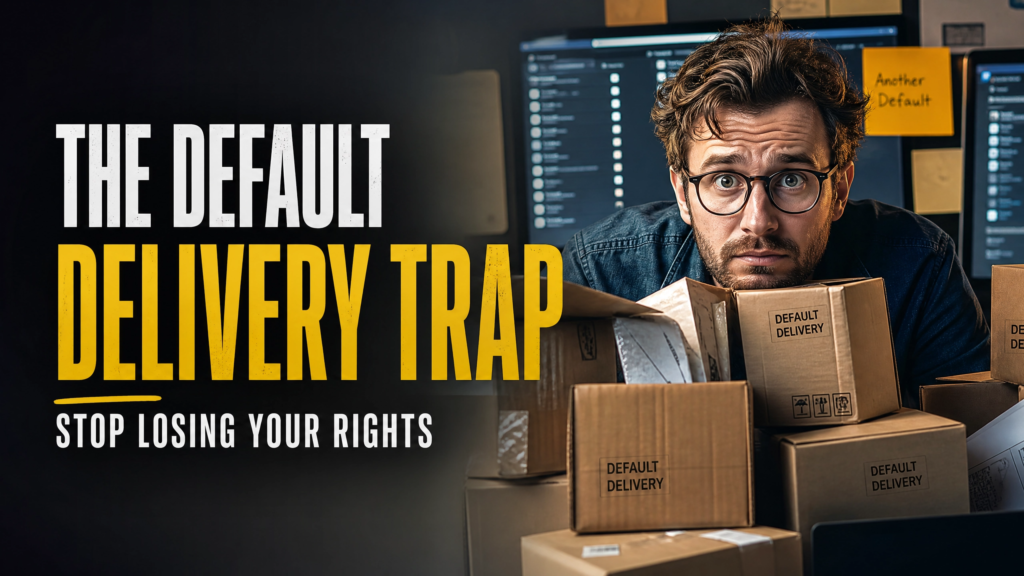
Most freelance copywriters and marketers operate on blind trust. They finish the work, hit send on the Google Doc or Figma file, and assume the money will follow.
This is a massive operational mistake.
When you hand over completed work without specific contractual boundaries, you are falling into the default delivery trap.
Let me share a slightly embarrassing story from my early agency days. I wrote a massive, high-converting email sequence for an e-commerce brand.
I sent the files over, eager to please. The client immediately plugged my copy into their CRM and hit send to 100,000 subscribers.
Then, the payment excuses started rolling in.
“Our accountant is out sick,” they said. “We are waiting on a funding round to clear.”
I realized I had given them the final product while holding absolutely nothing back. I was totally powerless.
If you have ever been in a situation where a client published your article without paying, you know exactly how maddening this is.
Or perhaps you are a visual creative, and a client used your design without paying. The feeling of helplessness is exactly the same.
Here is the thing: the client holds your money, and because you delivered the files cleanly, they also hold your work.
Under basic, poorly-drafted agreements, delivering the files implies you have granted them a license to use those files.
You must break this cycle. You have to separate the act of delivering the asset from the act of granting permission to use it.
At this point, the client has already used your work without paying, which puts you in a weak legal position unless your contract is structured correctly.
This is exactly how most cases of “client not paying freelancer after using work” begin.
The Psychological Angle of Non-Payment
Look, business owners are rarely sitting in a dark room plotting how to steal from freelancers. Most of them are just disorganized.
Sometimes they simply mismanage their cash flow.
But when payroll is due, they will always pay their full-time employees first. Freelancers naturally get pushed to the bottom of the priority pile.
Unless, of course, you make it incredibly dangerous for their business to ignore your invoice.
That is human nature. People respond to immediate risk. Your goal is to shift the risk of non-payment back onto their shoulders.
When you fail to tie asset usage rights to actual bank clearance, you lose your only real leverage.
If you are wondering what to do when a client uses your work without paying, everything comes down to how you define ownership and usage rights.
Anatomy of an Unconditional Content Kill Clause
So, how do we fix this ? We implement a Content Kill Clause.
A kill clause is essentially a conditional license. It tells the client: “You can review this work, but you absolutely do not own it yet.”
Ownership and usage rights only transfer when the final payment actually clears your bank account.
Not when the check is put in the mail. Not when the accounting software says “processed.” When the funds are cleared and accessible.
If a client decides to publish your marketing assets before that financial transaction is complete, they are no longer just a late payer.
They are actively committing copyright infringement.
Let’s break down the actual anatomy of how to structure a ‘Content Kill Clause’ inside marketing asset delivery agreements.
It consists of four distinct, undeniable parts.
Part A : The Conditional Grant
You must explicitly state that the license is conditional. You are granting them permission to use the work, but only on the condition of full payment.
If you are dealing with a situation where you are wondering what to do when a client uses your work but refuses to pay you, the absence of a conditional grant is usually why you feel stuck.
Part B : The Trigger Event
The contract must define exactly what triggers the transfer of rights. “Full and final payment” is the standard.
Be precise. If they owe you $5,000, and they pay $4,900, the trigger has not been met. They do not own the rights.
Part C : The Automatic Revocation
This is the “kill” part of the clause. You must state that if payment is delayed, disputed, or charged back, any implied license is automatically revoked.
No warnings necessary. It dies instantly.
Part D : The Enforcement Mechanism
You have to state what happens when the license is revoked. You reserve the right to issue takedown notices or demand immediate removal of the assets.
If they ask for raw files early, you point to this clause. It is the perfect shield when a client is asking for PSD files before payment.
The Legal Backbone
I rely on hard statutes to make these clauses bulletproof. In the United States, 17 U.S. Code § 204 clearly states that the transfer of copyright ownership requires a written instrument.
If your written instrument says “no transfer until payment,” the law backs you up.
For my friends across the pond, Section 90 of the UK Copyright, Designs and Patents Act 1988 functions very similarly regarding the assignment of rights.
It is not just freelancer folklore. It is codified intellectual property law.
Explicit License Revocation Mechanics

Having the clause in your contract is great. But knowing how to actually enforce it is what separates the professionals from the amateurs.
You cannot simply panic and start sending angry emails. You need a calm, systematic revocation process.
First, you need to understand your own payment terms. Did you establish clear boundaries?
If you aren’t sure how to set these, I highly recommend reviewing Net 15 vs. Net 30 vs. Net 45 payment terms to understand your cash flow cycles.
Step 1 : The Grace Period Warning
When an invoice goes past due, do not immediately threaten legal action.
Send a firm but polite reminder. Remind them that the usage license is tied to the invoice.
I call this the “Friendly IP Reminder.” It assumes they simply forgot.
Step 2 : The Revocation Notice
If they ignore the grace period, or if your client ghosted you after you sent the invoice, it is time to escalate.
You send an official Revocation Notice. This explicitly states that their temporary license to view the files is now terminated.
It is essentially the precursor to learning how to write a clean cease-and-desist letter.
Step 3 : The Takedown Action
If they still refuse to pay and continue using your marketing assets, you pull the trigger.
Under the Digital Millennium Copyright Act (DMCA) 17 U.S.C. § 512, you can contact their web host or social media platform directly.
Because you have the kill clause in your contract, you can legally swear under penalty of perjury that they do not have the rights to use the content.
This is incredibly powerful. You can literally have their ads pulled off Facebook or their landing page taken offline by their hosting provider.
This strategy is especially effective if you need to file a copyright infringement claim for unpaid UI wireframes or massive copy assets.
Visualizing the Revocation Flow
To make this crystal clear, here is how the enforcement mechanics actually flow in the real world:
Here is how the enforcement process works in practice :
The License Revocation & Enforcement Pipeline
When you follow this structure, you strip away their leverage. You dictate the terms of engagement.
Pre-built Snippets for Modern Marketing Contracts
I told you I was going to give you practical tools. I am not a fan of vague advice.
Here are the actual contract snippets you can copy, paste, and adapt for your own marketing asset delivery agreements.
Remember, These templates are based on practical contract enforcement strategies and should be adapted to your specific jurisdiction. Always adapt them to your specific local jurisdiction.
Snippet A : The Standard Agency Shield
Use this for standard clients where trust is decent, but you still need professional protection.
“Rights and Ownership: The Client understands that all deliverables, copy, and visual assets remain the exclusive intellectual property of the Freelancer until the final invoice is paid in full. Upon clearance of the final payment, a permanent, non-exclusive license for commercial use will automatically transfer to the Client. Any use, publication, or distribution of the assets prior to full payment is strictly prohibited and constitutes copyright infringement.”
Snippet B : The Ironclad Corporate Kill Clause
Use this for high-value projects, new clients, or clients with a history of dragging their feet.
“Conditional License and Revocation: Delivery of draft or final assets does not constitute a transfer of usage rights. The Client is granted a temporary, non-transferable license solely for the purpose of reviewing the work. This review license is automatically revoked if the final invoice is not paid within the specified [Net 14/30] terms. Should the Client publish or utilize the assets while in default, the Freelancer reserves the right to issue immediate DMCA takedown notices to relevant web hosts or platforms without further warning.”
This enforcement mechanism is particularly effective in the United States, where DMCA compliance by platforms and hosting providers is strictly enforced.
Snippet C : The Dispute Protector
This is vital for when a client tries to withhold payment over minor revisions.
“Severability of Payment and Revisions: The Client may not withhold final payment for completed project milestones due to minor bugs or subjective aesthetic revisions. Usage rights for all delivered assets remain suspended until the invoice is settled. Unauthorized commercial deployment of the assets prior to payment will result in an immediate revocation of all implied licenses.”
Having these clauses in place helps you stop working for free and prevents scope creep from eating your profits.
It sets a tone of absolute professional authority from day one.
Can You Take Legal Action If a Client Uses Your Work Without Paying ?
Yes. If your contract clearly states that ownership transfers only after full payment, the client does not have the legal right to use your work.
In such cases, you can:
- Treat the usage as copyright infringement
- Send a formal legal notice or cease-and-desist
- Initiate takedown procedures through hosting platforms
- Claim damages depending on jurisdiction
The strength of your action depends entirely on how your agreement is drafted.
The Content Kill Notice Generator (Interactive Tool)
When it is time to actually enforce the clause, you need to send a very specific, emotionless email.
Do not type while you are angry. Stick to the facts.
I have designed a simple HTML framework below. You can save this snippet, load it in your browser, and use it to generate a sterile, legally-sound revocation email.
Formal License Revocation Generator
Generate a sterile, contract-compliant notice to immediately suspend asset usage rights for overdue accounts.
Use this tool to keep your communications strictly business. Let the contract do the heavy lifting for you.
Risk Matrix : Delivering Without a Kill Clause
To put this into perspective, I want to show you exactly what kind of risk you are absorbing if you ignore this advice.
Here is a clear breakdown of the liabilities you face when you operate without a Content Kill Clause.
| Delivery Scenario | Risk Level | Probable Consequence | Freelancer Leverage |
| No Contract, Direct File Handoff | CRITICAL | Client uses work, delays payment indefinitely. You have no legal proof of a conditional license. | Zero. You are entirely at their mercy. |
| Basic Contract, No IP Transfer Clause | HIGH | Implied license granted. Client can claim they paid for the delivery, not the IP. | Low. You must prove intent in small claims court. |
| Standard IP Clause (Transfer upon payment) | MEDIUM | Protects copyright, but lacks immediate enforcement mechanisms or takedown threats. | Moderate. You can sue, but it takes time. |
| Unconditional Content Kill Clause | LOW | Client is legally barred from usage. DMCA takedowns are immediately actionable. | Maximum. You control the asset’s visibility. |
You should always aim to operate in the Low Risk, Maximum Leverage category.
It is the only way to scale a freelance business without losing sleep over receivables.
The Evidence Checklist: Before You Pull the Plug
Before you send a revocation notice or file a DMCA takedown, you must gather your ammunition.
Do not make empty threats. Have your paperwork in flawless order.
If you are wondering can you legally charge interest on late invoices, having this evidence organized is step one for that process too.
Here is the exact checklist I use:
- The Signed Agreement : Ensure you have a PDF copy of the contract containing the Kill Clause, signed by the client.
- Proof of Delivery : Screenshots or timestamped emails proving you delivered the finalized assets.
- The Unpaid Invoice : A clean PDF of the overdue invoice showing the exact date it became delinquent.
- Proof of Unauthorized Use : Take screenshots of their website, social media, or ads where your work is currently live.
- Communication Log : A unified PDF or folder of all your polite follow-up attempts demonstrating their failure to pay.
Once you have these five items compiled, you are bulletproof. You have the right to enforce your contract.
8. Global Perspectives: India vs. US/UK Frameworks
The United States and UK
I always remind my freelancers in the US and UK that copyright law is incredibly stringent regarding written transfers. This gives you a massive operational advantage when dealing with difficult accounts.
In the United States, the execution of ownership transfers is strictly governed by 17 U.S.C. § 204. This federal statute explicitly requires a written instrument to transfer any rights.
Because of this law, your Kill Clause actively prevents an implied license from ever forming. You legally own the work until the funds actually clear your bank account.
If a client decides to publish the assets unpaid, the Digital Millennium Copyright Act (17 U.S.C. § 512) provides immediate relief. It allows creators to bypass the client entirely.
You can enforce a kill clause by going directly to their internet service providers. Platforms like Google or Shopify will almost always side with the copyright holder to avoid safe harbor liability.
For British freelancers, I point directly to Section 90 of the Copyright, Designs and Patents Act 1988. It legally binds the assignment of your intellectual property to your exact contract terms.
The Indian Legal Context and Global Overlap
Contract law varies depending on where you live, but the core concept of conditional performance is almost universal. If you are a freelancer dealing with international clients, you need to understand how these jurisdictions overlap.
In India, the Indian Contract Act, 1872 governs the execution of conditional promises. Under Section 51, if a contract requires reciprocal promises to be performed simultaneously, the promisor (you) does not need to perform if the promisee (client) isn’t ready to pay.
Furthermore, the Copyright Act, 1957 dictates that assignment of copyright is only valid if it is in writing and specifies the exact terms.
If your contract explicitly states that assignment only happens upon payment, Indian courts will generally uphold that the client has no rights to the work.
While India doesn’t have a direct equivalent to the rapid DMCA takedown system, the contractual breach gives you massive leverage for a legal notice.
No matter where you are, clearly writing out the conditions of ownership protects you globally.
Frequently Asked Questions
Over the years, I have helped hundreds of freelancers implement these exact strategies.
Here are the most common questions that pop up regarding the Content Kill Clause.
Will a kill clause scare away good clients ?
No. Professional clients expect professional contracts. A legitimate business fully intends to pay you, so a clause stating they must pay to own the work will not bother them at all.
Can I use this for software and code, or just copy and design ?
Absolutely. For developers, this functions as a software license revocation. If they do not pay, they do not have the license to run your proprietary code on their servers.
What if the client already paid a 50% deposit ?
The clause still holds. A deposit pays for the labor of creation; the final payment buys the commercial rights to use the asset. Ensure your contract specifies “final payment in full.”
Do I need a lawyer to draft this for me ?
While consulting a local attorney is always best practice, you can legally write your own contract terms. Clear, plain English stating “You do not own this until you pay me” is legally binding in most jurisdictions.
What if the client modifies my work to avoid copyright ?
If they use your original work as a foundation, it is considered a derivative work. Without the original usage license clearing, their derivative work is still an infringement of your intellectual property.
Quick Decision Matrix
- If the invoice is 1–14 days late: Send a friendly reminder
- If the invoice is 15–30 days late: Issue a formal revocation notice
- If the client is actively using the work unpaid: Prepare takedown action
- If the client demands files before payment: Refuse and cite your contract
Most freelancers try to solve non-payment with reminders and follow-ups.
That approach rarely works.
The real solution is structural—you control leverage, not chase payment.
Author Box
Adv. Sagar Haribhau Shirsat is an active legal professional specializing in commercial transaction architectures, cross-border corporate compliance, and digital debt recovery systems. He designs strategic asset-protection and recovery frameworks that help freelancers, independent contractors, and global agencies defend their cash flow and enforce their billing rights.
This framework is based on real-world contract enforcement strategies used in freelance disputes involving unpaid work and unauthorized asset usage.
Connect via his Official Professional LinkedIn Profile and About Us page.
Disclaimer : This guide is intended for educational purposes and risk management analysis. It does not replace formal legal counsel. For specific cross-jurisdictional contract disputes, always consult a certified attorney or local legal advocate.