
It’s a Tuesday afternoon. Your rent is due in three days.
You’ve been staring at an unpaid invoice for $12,000. It’s been sitting there for 60 days. You’ve sent the polite emails. You’ve made the awkward phone calls.
Then, your inbox pings. It’s the client.
They apologize for the delay. They say cash flow is tight right now. But as a gesture of “good faith,” they are wiring you $1,500 immediately.
They ask you to accept this for now so they can close out out their monthly books.
You feel a wave of relief. Some money is better than no money, right?
You reply, “Thanks, received.” You pay your rent. You breathe.
A week later, you ask for the remaining $10,500.
The client replies with a strange, formal tone. “As discussed, we settled the outstanding balance with the $1,500 payment. The matter is closed.”
Your stomach drops. You call your lawyer.
The lawyer asks, “Did you accept the partial payment to settle the account?”
You say, “No, just for now!”
Your lawyer sighs. You just stepped into a very old, very dangerous legal snare.
Welcome to The ‘Partial Payment’ Trap: Why Accepting 10% of a Late Invoice Can Sometimes Erase Your Legal Leverage.
I’ve been in this game a long time. I’ve seen brilliant developers and world-class designers lose thousands because they didn’t understand the legal weight of a simple “thank you” email.
Look, I get it. When a client runs out of money mid-project, panic sets in. You want to salvage anything you can.
But taking a token payment without the right legal armor can legally wipe out the rest of the debt.
Let’s break down exactly how this happens, and more importantly, how you can take the cash without losing your rights.
Table of Contents
The Crumbs Strategy : Why Clients Offer Tokens
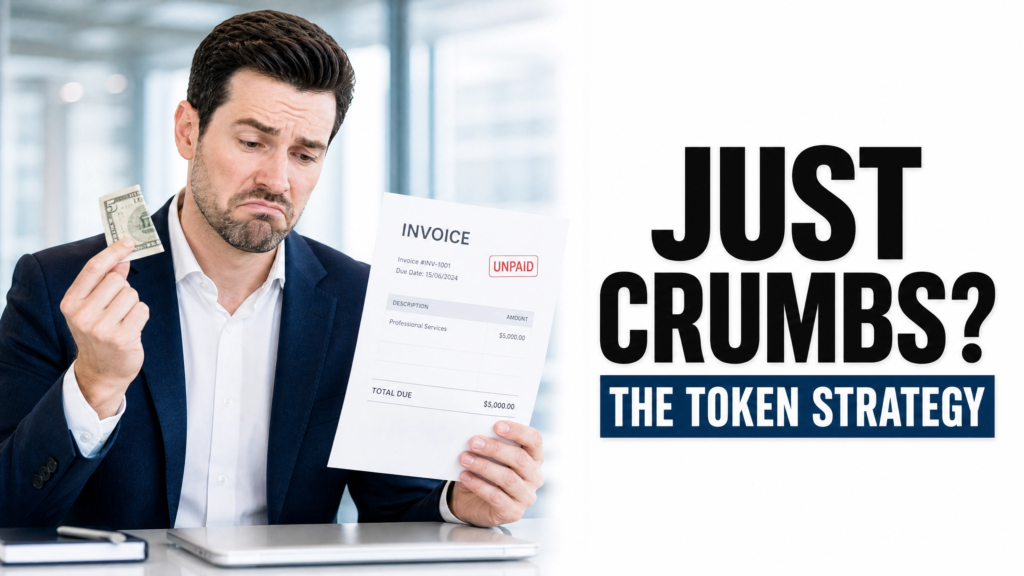
Let’s be brutally honest. Sometimes, a client is just genuinely struggling.
They want to pay you. They really do. They send a partial payment because they respect you.
But other times? It’s a calculated legal strategy.
Some organizations adopt structured settlement strategies designed to reduce outstanding liabilities during periods of financial pressure.
While many clients act in good faith, others may attempt to negotiate substantial discounts after work has already been completed.
If they are dealing with a cash crunch, they will deploy tactics to limit their liabilities.
They know that freelancers operate on tight margins. They know you are likely stressed.
So, they offer a crumb.
When you are stressed, your brain prioritizes immediate survival over long-term leverage. This is human nature.
They might frame it as a way to “close the current ticket.” Or they might complain about a minor bug and offer a reduced rate to just “move on.”
If you fall for it, you might find yourself frantically googling what to do when a client demands a full refund or suddenly altering your terms.
Whether intentional or not, these negotiations often occur when freelancers are under financial pressure, making it easier to accept unfavorable settlement terms without fully considering their legal consequences.
It’s not personal. It’s just a balance sheet maneuver.
The Accord & Satisfaction Legal Assessment
Here is where we get into the actual law. Don’t worry, I’ll keep it simple.
There is a legal doctrine called “Accord and Satisfaction.”
It sounds like a bad 1970s cologne, but it’s actually a contract law principle that dictates how debts are settled.
An Accord is a new agreement between you and the client. It replaces the old agreement (your original invoice).
The Satisfaction is the execution of that new agreement (you accepting the money).
If a client owes you $10,000, and they say, “I’ll give you $2,000 to settle this completely,” and you agree—that’s an accord and satisfaction.
If the legal requirements for an accord and satisfaction are satisfied, the original claim may be considered legally discharged, preventing further recovery of the remaining balance.
Successfully pursuing the remaining balance may become significantly more difficult because the client may argue that the dispute was fully settled through the accepted payment.
You might be thinking, “But I would never agree to that!”
Here’s the thing: you might agree to it entirely by accident.
The “Payment in Full” Check
Let’s say they mail you a physical check.
In the memo line, they write: “Payment in full for Invoice #104.”
You roll your eyes. You know it’s only 10% of the invoice. You cross out the words “Payment in full,” deposit the check, and plan to bill them for the rest.
Under the Uniform Commercial Code (UCC) § 3-311 in the United States, cashing that check can constitute an Accord and Satisfaction.
Depending on the circumstances and the requirements of UCC § 3-311, depositing a check marked “Payment in Full” may legally constitute acceptance of a settlement offer.
Courts generally examine factors such as whether the debt was genuinely disputed, whether the settlement language was conspicuous, and whether the payment was tendered in good faith before deciding whether the remaining balance has been discharged.
You can read the exact legal phrasing over at the Cornell Law School’s Legal Information Institute. It’s dry, but it’s the rulebook judges use.
The Digital Trap
Nobody sends checks anymore, right? We use Stripe, PayPal, or bank wires.
The trap still exists digitally. It usually happens over email or Slack.
The client messages you: “Hey, sending $1,000 to wrap up the project since there were some delays. Releasing the wire now.”
You reply: “Got the wire, thanks.”
That short reply may later be presented as evidence that you accepted the client’s proposed settlement. Whether it ultimately creates a binding accord and satisfaction depends on the surrounding facts, communications, and the law governing your contract.
If you try to chase them later, they will print out that email and show it to a judge.
This is why understanding if a WhatsApp conversation is a legally binding contract is so critical. Casual chats hold severe legal weight.
USA vs Global Law (The Jurisdictional Headache)

I deal with international contracts constantly. The laws on partial payment change depending on where you stand.
If you want to know how to protect yourself when working with international clients, pay close attention to this breakdown.
In the United States (UCC):
The US is very strict. If a debt is disputed, and the client offers a lesser amount in full satisfaction, and you accept it, the debt is discharged.
The key word is disputed. If they simply don’t want to pay, it’s different. But if they invent a complaint about your work to create a “dispute,” the trap is set.
In the United Kingdom (Common Law):
The UK follows a very old precedent from 1602 called Pinnel’s Case.
Generally, in the UK, payment of a lesser sum on the day it is due cannot legally satisfy the whole debt.
Why? Because there is no “consideration” (something of value) given for you forgiving the rest of the debt.
However, if they pay you early, or give you a physical item alongside the partial payment, it can legally clear the debt. It’s complex.
In India (Indian Contract Act, 1872):
India has a very unique stance under Section 63 of the Indian Contract Act.
A creditor can legally dispense with or remit the performance of a contract, wholly or in part.
You can accept any satisfaction you deem fit.
India approaches this issue differently under Section 63 of the Indian Contract Act, 1872.
The law allows a promisee to remit or accept a lesser performance in satisfaction of an obligation without requiring fresh consideration.
However, whether a particular partial payment actually settles the entire debt depends on the surrounding facts, the parties’ communications, and their intention.
Courts generally examine whether both parties objectively intended the payment to operate as a full and final settlement rather than assuming that every accepted partial payment automatically discharges the remaining balance.
You can read the specific statutes on the India Code government portal. It’s heavily favored toward settlement.
Case Study : The Exhausted Developer
The following example is fictional but reflects situations commonly encountered in commercial payment disputes.
Let me tell you about a developer I’ll call Mark.
Mark built a beautiful e-commerce platform for an agency. The agency owed him $25,000.
They kept dodging him. Mark was stuck in what I call the accounting loop. He desperately needed to know how to recover an unpaid invoice without a lawyer.
Finally, the agency owner emailed: “Mark, our end-client hasn’t paid us. I can give you $5,000 right now from my own pocket to settle our account, but that’s all I have.”
Mark was broke. He took the $5,000. He replied, “Okay, send it.”
A month later, Mark found out the agency did get paid by their end-client.
Mark demanded his remaining $20,000. The agency ignored him.
Mark wanted to know if he could use a stop working for free scope creep tactic or revoke access.
But it was too late. I had to look at Mark and tell him the truth.
By saying “Okay, send it” to an email that explicitly said “to settle our account,” Mark signed away his $20,000.
How to Safely Accept Partial Payments with Reservation of Rights

So, what do you do ? Do you reject the money ?
Hell no. You take the money. But you take it safely.
You need to create a legal firewall around that payment. You must explicitly state that accepting the cash does not waive your right to the rest.
We do this using specific legal terminology: “Under Protest” and “Without Prejudice.”
When you receive an offer for partial payment, you do not just say thanks.
You reply stating that the payment is accepted strictly as a partial credit against the total outstanding balance.
If you are dealing with a client who ghosted you after you sent the invoice and suddenly appears with a fraction of the cash, you must document your stance.
The Magic Words Explained
The phrase “Without Prejudice” is commonly used during settlement discussions in many common-law jurisdictions to encourage open negotiations without necessarily treating those communications as admissions.
Its legal effect varies by jurisdiction, and in some countries—including parts of the United States—it does not automatically create evidentiary protection.
Using the phrase “Under Protest” may help demonstrate that you accepted the payment without intending to waive your remaining contractual rights.
While it can strengthen your position, it is not a guaranteed legal safeguard in every jurisdiction.
You don’t need a law degree to use these. You just need discipline.
If you don’t use them, you lose your leverage. And leverage is everything. If they have your source code, you need to know what to do if a client used your work without paying.
Flow Explanation : The Payment Trap Matrix
Imagine a simple decision tree.
Scenario : Client offers 20% of the invoice.
- Path A : You reply, “Thanks, I appreciate it.”
- Result: High risk of Accord & Satisfaction. Debt likely discharged. You lose.
- Path B : You reply, “I accept this as full and final.”
- Result: 100% Accord & Satisfaction. Debt gone.
- Path C : You reply, “I am accepting this strictly as a partial payment. $X remains due.”
- Result: Rights preserved. You can sue for the balance.
It’s really that simple in practice. The problem is, freelancers get emotional and forget Path C.
The Anti-Waiver Document Template
The following sample is intended for educational purposes only.
Its suitability depends on your contract, governing law, and the facts of your dispute. Consider obtaining jurisdiction-specific legal advice before relying on standardized legal language.
I want to give you something practical. Not just theory.
If a client sends you a partial payment, or offers one, you need to reply immediately.
Do not wait. Do not let their narrative stand uncontested.
I use a specific template for this. It stops the accounting games dead in their tracks. It works perfectly when figuring out the exact follow-up timeline for late invoices.
Here is a tool you can use right now. Just copy and paste this into your email.
The Anti-Waiver Email Template
Subject: Without Prejudice: Partial Payment Receipt for Invoice #[Number]
Hi [Client Name],
I confirm receipt of your payment of $[Amount Received] on [Date].
Please note that I am accepting this sum strictly as a partial payment toward the total outstanding balance of Invoice #[Number].
This acceptance is made under protest and without prejudice to my right to claim the remaining balance of $[Remaining Balance].
This payment does not constitute an accord and satisfaction, nor does it waive any of my legal rights regarding the full amount owed.
The remaining balance is due by [Date]. Let me know when the final wire will be initiated.
Best regards,
[Your Name]
When they read that, two things happen.
First, they realize you aren’t an amateur.
If the dispute later reaches legal review, your written reservation of rights may make it substantially more difficult for the client to argue that you accepted the partial payment as a complete settlement.
If they try to ignore it and delay again, try using this psychological trick to get paid fast when stuck in an accounting loop. It pairs perfectly with strict legal boundaries.
Adding Interest to the Remaining Balance
Here is a fun fact. When they underpay you, the remaining balance is still late.
That means late fees apply.
Many freelancers are scared to tack on late fees when a client is already struggling. I think that’s a mistake.
You are not a bank. You do not offer free credit lines.
If you are unsure about the laws in your area, read up on whether you can legally charge interest on late invoices.
Send a revised invoice showing the partial payment subtracted, and the new late fee added to the remainder.
It shows you are tracking every single penny.
Risk Matrix : Accepting Partial Payments
Let’s look at the actual risk levels of taking partial cash.
| Action | Risk Level | Probable Outcome |
| Cashing a check marked “Payment in Full” | CRITICAL | Debt is legally erased in most US jurisdictions. |
| Replying “Thanks” to a settlement email | HIGH | Client holds written proof you agreed to close the matter. |
| Staying silent after receiving a partial wire | MEDIUM | Ambiguous. Courts might rule implied consent based on silence. |
| Replying with a “Without Prejudice” notice | LOW | Your rights to the remaining balance are fully protected. |
Never live in the Critical or High zones. It’s not worth the stress.
The Evidence Checklist
If this goes sideways, and you eventually have to figure out when it is officially time to take legal action, you will need evidence.
Judges deal in paper, not feelings. Here is what you must have saved locally:
- The Original Contract : The bedrock of your claim.
- The Invoice : Showing clear payment terms. Should you use Net 15 vs Net 30 vs Net 45? Your invoice must state it clearly.
- The Delivery Proof : Logs, emails, or sign-offs proving you did the work.
- The Client’s Offer : The email where they offered the partial payment.
- Your Anti-Waiver Notice : Proof you rejected their settlement terms.
If you don’t have these, your lawyer is going to have a very hard time helping you.
Prevention is always cheaper than litigation. The best way to prevent this is to learn how to structure a proposal so it functions like a real legal defense contract.
What if they are going bankrupt ?
This is the big fear.
Sometimes a client isn’t being sneaky; they are literally out of cash.
If you suspect a client is facing insolvency, the rules change entirely.
If you want to know what if a corporate client goes bankrupt, the short answer is: you become an unsecured creditor.
You will be at the very bottom of the food chain, behind the IRS and the banks.
In this specific scenario, a partial payment might be all you ever see.
But even then, do not sign a release. Take the cash, reserve your rights, and wait to see how the bankruptcy proceedings unfold.
You never know if they will restructure and suddenly have funds available later.
Quick Decision Section : Should You Take The Money ?
I get asked this daily. Let’s make it binary.
TAKE THE MONEY IF :
- You have sent the Anti-Waiver email template.
- The payment does not require you to sign a release document.
- The money is sent via wire or ACH (not a physical check with conditional language).
- You desperately need the cash to survive.
REJECT THE MONEY IF :
- They force you to sign a “Settlement and Release” agreement to get it.
- They send a physical check with “Payment in Full” on the back.
- The payment is tied to you handing over source files you haven’t delivered yet.
Never hand over leverage for a fraction of what you are owed.
If they want the final files, they pay the final bill.
If you are dealing with setting up your terms from the start, check out this freelancer payment terms guide to avoid Net 60. It will save you a lot of headaches.
The Real Cost of Being “Nice”
I see too many creatives trying to be the “nice guy.”
They don’t want to cause friction. They don’t want to sound like a lawyer in their emails.
Listen to me: Business is a framework of rules.
When a client uses a legal tactic like Accord and Satisfaction, they aren’t being nice. They are protecting their company.
You have to protect your company too.
Using phrases like “Without Prejudice” doesn’t make you aggressive. It makes you a professional who understands the rules of the game.
FAQs on Partial Payments
Can I just cross out “Payment in Full” on a physical check ?
In some states, yes. In many, no. Under UCC § 3-311, cashing it often constitutes acceptance regardless of your ink marks. It is safer to return the check and demand an unrestricted payment or a digital transfer.
What if they wire the money without warning me ?
This happens. If money just appears in your account, immediately send the Anti-Waiver email. State that the unsolicited funds have been applied to the balance, but the remainder is still due. Prompt written clarification generally provides stronger evidence that you did not intend the unsolicited payment to settle the entire dispute.
Does this apply to Upwork or Fiverr ?
Escrow platforms have their own binding arbitration rules. If you accept a partial milestone release and close the contract, the platform considers it settled. You cannot usually chase them outside the platform later.
Can I pause the project if they only pay partially ?
Absolutely. Unless your contract explicitly forces you to continue working while unpaid (which you should never sign), you have the right to suspend services. Deliverables stop when the money stops.
How long do I have to send the Anti-Waiver notice ?
Do it within 24 hours of receiving the payment or the offer. The longer you wait, the more a judge might view your delay as an implied acceptance of their terms. Speed is legal armor.
Key Takeaways
- Accepting a partial payment does not always waive your remaining rights, but it can create legal complications depending on the governing law and the facts.
- Avoid language that could reasonably be interpreted as accepting a “full and final settlement” unless that is your intention.
- Respond promptly in writing if you intend to treat the payment only as a credit toward the outstanding balance.
- Keep complete records of invoices, correspondence, and payment communications.
- When significant amounts are involved, obtain advice from a qualified lawyer in the relevant jurisdiction before making settlement decisions.
Your cash flow is the lifeblood of your freelance business.
Don’t let a panicked client, a sneaky accounting department, or your own exhaustion trick you into giving away your hard-earned money.
Take the partial payment if you must. But keep your leverage intact.
Stay sharp. Protect your work. And never sign away your rights for a crumb.
Author Box
Adv. Sagar Haribhau Shirsat is an advocate practicing in India with experience in commercial legal matters, contract-related disputes, and legal risk management. Through Freelancer Recovery, he publishes educational resources that help freelancers and independent professionals better understand payment disputes, contract enforcement, and practical business risk management.
The information provided is educational and should not be treated as individualized legal advice.
Connect via his Official Professional LinkedIn Profile.
Legal Sources Referenced
This guide discusses legal principles commonly encountered in commercial payment disputes, including:
• Uniform Commercial Code § 3-311 (United States)
• Pinnel’s Case (1602)
• Foakes v Beer (1884)
• Indian Contract Act, 1872 – Section 63
Because the application of these authorities varies according to jurisdiction and the specific facts of each dispute, freelancers should obtain advice from a qualified lawyer before making legal decisions based on any general guidance.
Disclaimer : This guide is intended for educational purposes and risk management analysis. It does not replace formal legal counsel. For specific cross-jurisdictional contract disputes, always consult a certified attorney or local legal advocate.