
You wake up, grab your coffee, and open your browser. There it is. Your custom code or your exact UI design is sitting on the client’s live production server.
The twist ? They haven’t paid you a single dime. They ghosted your last three emails.
Look, this is where freelancers quietly get harmed. They see their work live, feel a sense of urgency, and often start sending emotional messages. They feel completely powerless.
However, depending on the facts, you may have meaningful legal and practical options available to protect your work and enforce your rights
When a client displays unpaid assets live on production servers, they aren’t just being rude. This may constitute unauthorized use of intellectual property, depending on the contractual terms and applicable law. In many cases, unless otherwise agreed in writing, intellectual property rights remain with the creator until full payment is received. However, this depends on the terms of the contract and applicable law.
Today, I will show you how to flip the script. You will learn exactly how to write a clean cease-and-desist letter when a client steals your code or designs. No corporate jargon. Just practical, real-world steps to protect your business.
Table of Contents
The 5 Catastrophic Mistakes Freelancers Make First
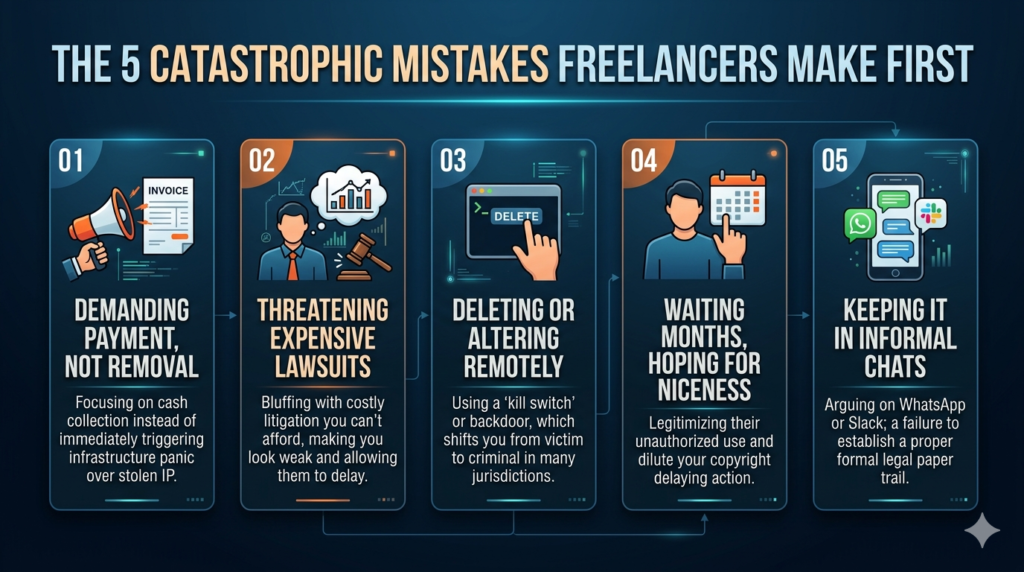
Before we talk about solutions, we need to talk about how independent creators accidentally ruin their own practical advantage. I have made these mistakes myself.
1. Demanding Money Instead of Asset Removal
When a client steals your code or designs, your instinct is to scream, “Pay me !”
This is often a strategic mistake in enforcement positioning.
If you demand money, you are arguing about a debt. Debt collection is slow, boring, and easy for them to ignore.
Instead, you must demand that they immediately take down the stolen intellectual property.
When you formally notify relevant infrastructure providers, it often creates urgency for compliance. Suddenly, their ongoing operations may be affected if the issue is not resolved. This typically increases the likelihood of a prompt response. In many cases, resolving the infringement issue also leads to payment discussions.
2. Threatening a Massive Lawsuit You Can’t Afford
We have all seen the angry email: “I will see you in court!”
The client knows you are bluffing. They know a tech lawyer charges $400 an hour. They know you probably don’t have a $10,000 legal retainer sitting in your mattress.
When you make wild, empty legal threats, you look weak. You lose your psychological edge.
Keep your tone calm, cold, and entirely realistic. Focus on immediate infrastructure takedowns, not hypothetical supreme court battles.
3. Deleting or Altering the Code Remotely (The Rogue Backdoor)
If you left a hidden “kill switch” or a backdoor in the code, do not pull it.
I know it feels incredibly satisfying to think about wiping their database with a single line of terminal code. Don’t do it.
The moment you unauthorizedly access a live production server to negatively affect data, you cross the line from a victim into a criminal. You open yourself up to computer fraud and abuse charges.
Let the law and the hosting providers do the heavy lifting for you. Keep your hands clean.
4. Waiting for Months Hoping They Will “Be Nice”
“Oh, they are just having a bad quarter.” “They promised they would pay next month.”
Stop making excuses for people who are actively using your stolen property to make money. The longer you wait, the more you legitimize their unauthorized use.
You need to act the moment your payment terms are breached. If you are debating your options, read up on when is it officially time for a freelancer to take legal action? to set a hard boundary.
5. Keeping All Communication in Informal Chats
You cannot build a legal case out of unorganized, emotional text threads.
If you are arguing on WhatsApp, Slack, or Discord, you are losing control of the narrative. You need a formal, written paper trail.
Can those text threads help you later? Yes, absolutely. In fact, you might surprise yourself by looking into can a WhatsApp chat count as a legally binding contract? to see how your chat history holds up. But for the actual dispute, you must pivot to formal notices.
The Solution : The Asset Control Framework
Here is the strategy. We do not beg for payment. We treat this as an unauthorized distribution of your private property.
The Asset Control Framework
Follow these strategic technical checkposts to seize leverage when a client uses unauthorized assets live.
Unpaid Live Assets
The client deploys your source code or high-fidelity designs onto production servers without paying the final invoice.
Gather Immutable Evidence
Secure source inspection traces, CSS styling path snapshots, and permanent third-party Archive.org URL timestamps.
Find the Infrastructure Bottleneck
Locate their specific web host provider, DNS registrar, content delivery network (CDN), or integrated core APIs.
Issue Clean Cease-and-Desist
Deliver a cold, objective formal legal warning containing absolute deadlines and explicit infrastructure escalation clauses.
File DMCA / Host Takedown Notices
Execute formal infringement complaints with the host to strip their safe harbor immunity and suspend their active operations.
When a client steals your code or designs, You do not approach the matter only through direct communication with the client. You may also address the issue through the infrastructure providers supporting their platform.
If their website goes down, their revenue stops. If their payment gateway gets paused because of an IP dispute, their business operations may be significantly disrupted.
By focusing on asset removal rather than just focusing only on payment reminders, you may improve your position in resolving the dispute more effectively. They will realize that paying you is much cheaper than rebuilds or total digital downtime.
Step-by-Step Writing Guide for Your Cease-and-Desist Notice

Your notice must look like it was written by a professional who does not have time to play games. It needs to be clean, specific, and completely devoid of emotion.
Here is what you must include to ensure it actually works:
1. Clear Identification of Ownership
You must state exactly what was created, when it was created, and under what conditions. Specify that ownership only transfers after full payment is received.
2. Precise Location of Infringement
Do not just say “my designs on your site.” Give exact URLs. List specific CSS file links, image paths, or GitHub repositories if applicable.
3. The Infrastructure Trigger Clause
This is a key provision in the process. You must include a clause that explicitly states your intent to notify their web hosting company, domain registrar, and third-party API providers if they fail to comply.
Hosting providers generally respond to properly submitted intellectual property complaints in order to maintain safe harbor protections under applicable laws. They do not want to be held liable for hosting stolen code.
4. A Strict, Reasonable Deadline
Give them a clear window. 48 to 72 hours is standard for digital asset removal. Do not give them two weeks to think about it.
Sample Document: The Clean Cease-and-Desist Statement
Here is a ready-to-use template. Replace the bracketed text with your specific details. Keep it exactly this clean.
Formal Notice Template: Cease & Desist
FORMAL NOTICE: CEASE AND DESIST
UNAUTHORIZED USE OF INTELLECTUAL PROPERTY

Date: June 3, 2026

To: [Client Company Name]
Attn: [Client Founder/CEO Name]
Address: [Client Business Address]

VIA ELECTRONIC MAIL: [Client Email Address]

Dear [Client Name],

I am writing to formally demand that you immediately cease and desist from all unauthorized use of my proprietary intellectual property, specifically consisting of [describe exactly: e.g., the custom React frontend source code and high-fidelity Figma UI design systems for the project known as "Project Name"].

As of the date of this notice, these creative assets are being displayed and utilized publicly on your production infrastructure at the following locations:
- [Insert Exact URL 1, e.g., https://www.clientwebsite.com]
- [Insert Exact URL 2, e.g., https://www.clientwebsite.com/assets/main.js]

Ownership and Copyright Status:
Pursuant to our original engagement terms, all intellectual property rights, source code ownership, and design copyrights remain exclusively with me until full and final payment for services rendered has been received and cleared. To date, invoice number [Invoice #] totaling [Amount] remains unpaid and past due.

Consequently, your current live deployment of this code and these designs may constitute intellectual property infringement under applicable laws under applicable copyright laws.

Required Action:
You are hereby given forty-eight (48) hours from the transmission of this notice to completely remove all of my code, designs, and derivative assets from your live servers, staging environments, and public-facing digital properties.

Non-Compliance and Escalation:
If the infringing material is not completely removed by [Insert Time, e.g., 5:00 PM EST on June 5, 2026], I will immediately proceed with the following actions without further warning:

1. File formal Digital Millennium Copyright Act (DMCA) takedown notices directly with your web hosting provider ([Insert Host Name, e.g., AWS / DigitalOcean]) and your domain registrar to request an immediate suspension of your hosting account and digital infrastructure.
2. Notify your integrated third-party service providers and payment processors regarding the utilization of stolen application architecture.

This notice is sent without prejudice to my rights, remedies, and claims, all of which are expressly reserved.

Sincerely,

[Your Name]
[Your Freelance Studio/Business Name]
Contact: [Your Email] / [Your Phone Number]
Very Important Citations :
In the United States Section ( Federal Statutory Protection )
When a client deploys your unpaid development work or design assets onto a live environment, this may amount to copyright infringement under applicable laws, subject to legal interpretation and the specific facts. Under the provisions of the Digital Millennium Copyright Act (DMCA), codified under 17 U.S. Code § 512, online service providers and hosting networks are granted a safe harbor from copyright liability only if they act expeditiously to remove or disable access to material upon receiving a proper notification of claimed infringement.
Furthermore, according to structural research by the Cornell Law School Legal Information Institute, in general, creators receive copyright protection from the moment of creation, subject to contractual arrangements, work-for-hire provisions, and jurisdiction-specific rules under federal law.
When you send your cease-and-desist, you are setting up the foundation required to bypass the client entirely and go straight to their infrastructure providers with a formal statutory takedown request.
In the United Kingdom Section ( Intermediary Liability Protocols )
In the UK, the legal framework operates on a matching mechanism regarding intellectual property enforcement on digital infrastructure. Intermediary liabilities and the structural rules for hosting providers are governed under the Electronic Commerce (EC Directive) Regulations 2002 provided via the official UK Legislation registries.
Under these regulations, cloud servers and domain entities are protected from hosting illegal content only as long as they do not have “actual knowledge” of the copyright infringement.
The moment you deliver a clean cease-and-desist or an official structural notice to a UK-hosted entity, the host gains actual knowledge of the unauthorized deployment.
To insulate themselves from direct economic liability, they may be required under UK law to review and potentially remove infringing content once they obtain actual knowledge of a violation. if the user fails to provide valid authorization or proof of payment.
The Pre-Action Evidence Checklist
Before you hit send on that notice, you must lock down your proof. If you don’t secure the evidence now, the client might quickly pull down the site, modify a few lines, hide the code, and claim they never used your work.
Run through this checklist immediately :
- [ ] Full Source Code Snapshots : Download the complete codebase with timestamps showing exactly when you wrote it.
- [ ] Public Source Inspection : Right-click on their live site, open the developer tools, and take screenshots of your unique CSS classes, unique functions, or comments left in the production build.
- [ ] Wayback Machine / Archive.org : Submit their live URLs to an independent web archiver to create a permanent, unalterable record of the infringement online.
- [ ] Full-Page Video Walkthroughs : Record your screen while navigating their live platform, showing the exact design elements alongside your local design files (like Figma or Sketch).
- [ ] Unanswered Invoice Logs : Export your clean invoice trail showing exactly when it was viewed and ignored. If you need help structuring this timeline, refer to the exact follow-up timeline for late freelance invoices (that actually works).
Pre-Action Evidence Tracker & Settlement Predictor
Check off the evidence assets you have secured to compute your real-time infrastructure leverage score.
Indicative Evidence Strength (Illustrative Tool)
No Evidence Selected
Select the checkboxes on the left to measure how effectively your digital proof trail can force a hosting infrastructure takedown or rapid settlement.
Live Risk Matrix : Choosing Your Strategy
Not all asset thefts are the same. You need to assess how much leverage you actually have before deciding your next move. Use this risk matrix to guide your response strategy.
| Theft Scenario | Risk Level | Immediate Impact | Recommended Action Strategy |
|---|---|---|---|
| Designs used on public marketing landing page | Low | Brand dilution, low technical damage. | Issue the Cease-and-Desist template directly via email. Use a standard 72-hour deadline. |
| Full backend code running application core | Medium | Client business operations depend entirely on you. | Send formal notice. Prepare DMCA files for their specific server hosting provider simultaneously. |
| White-labeled code resold to another enterprise client | High | Legal liabilities compounding; massive financial damage. | Issue strict 24-hour notice. Prepare to contact their end-client directly to halt the unauthorized distribution. |
If you find yourself facing a high-risk situation where a subcontractor relationship went south, you might want to look into unpaid subcontractor? Here is when you can sue the end-client directly to explore deeper recovery channels.
How to Automate Your Late Fee Calculations
If your contract allows you to charge interest on late balances, you should include those calculations directly in your formal communication. It adds an extra layer of financial pressure.
Use this simple, interactive calculation logic to figure out your total outstanding claim amount before sending your final demand.
Financial Recovery Calculator
Late Fee & Financial Recovery Calculator
Calculate your legal interest penalties before finalizing your notice claims.
Formula Mechanics
Daily Interest = (Base × (Rate / 100)) / 365
Pro Tip: Include this line item breakout within your Notice under the "Ownership and Copyright Status" section to apply direct psychological pressure.
If you are unsure whether you can legally add these numbers to your notice, take a look at our comprehensive breakdown on can you legally charge interest on late invoices? (US, UK, & India rules) to stay on solid legal ground.
Real-World Case Study : The Broken SaaS Launch
Let’s look at a real scenario to see how this works out in practice.
The Background
A seasoned JavaScript developer named Sarah was hired to build a complex internal analytics dashboard for a growing logistics agency. The project took two months of intense work. Sarah delivered the final production code to a staging server managed by the client.
The Problem
The client claimed they were "unsatisfied with the loading speed" of the charts. They refused to sign off on the final milestone invoice of $8,500. Then, they abruptly cut off Sarah's access to the staging server.
Two weeks later, Sarah discovered that the client had migrated her entire frontend dashboard directly onto their live main production domain. They were actively using it with their real operations team while ignoring her emails. They fell right into the classic trap detailed in what to do when a client uses your work but refuses to pay you.
The Execution
Sarah didn't argue. She didn't call the client names. She spent one hour gathering her evidence. She ran a full network trace to confirm the code was calling her specific open-source module configurations.
She then sent the exact Clean Cease-and-Desist Notice outlined above, straight to the CEO and their main operations email. She added a CC line pointing directly to the legal compliance address of their web host, DigitalOcean.
The Result
The client’s operations manager responded urgently when they realized that a formal DMCA filing with Digital-Ocean could take their entire logistics platform offline right before a busy weekend.
Instead of arguing about loading speeds, the client's internal accounting team reached out within six hours. They paid the $8,500 invoice via wire transfer in full, plus a small processing fee, just to get Sarah to sign an immediate copyright release waiver.
Global Comparison : Protecting Your IP Across Borders
The rules change depending on where you and your clients are physically located. If you are handling cross-border work, you must adjust your strategy accordingly.
United States (US) Jurisdiction
- Primary standing advantage Tool : Digital Millennium Copyright Act (DMCA) Section 512 provisions.
- How It Works : You can send a takedown notice directly to the host (AWS, Google Cloud, Heroku). The host may temporarily disable or restrict access to the content in order to maintain safe harbor protections, subject to their internal compliance procedures to protect themselves from liability. This may provide significant immediate practical leverage.
United Kingdom (UK) & European Union (EU) Jurisdiction
- Primary legal standing Tool : Intellectual Property Regulation frameworks and Copyright, Designs and Patents Act ( CDPA ) .
- How It Works: Hosting providers operate under "Notice and Takedown" procedures. While there is no explicit federal DMCA form, hosts must act swiftly once notified of clear copyright piracy or theft on their networks to maintain immunity.
India Jurisdiction
- Primary legal framework : Indian Copyright Act, 1957 read with the Information Technology (Intermediary Guidelines and Digital Media Ethics Code) Rules, 2021.
- How It Works : Intermediaries may be required to act upon receiving actual knowledge of infringement through a valid legal notice or court order, subject to procedural compliance. Enforcement typically depends on proper notice delivery and jurisdiction-specific compliance mechanisms.
No matter where your client sits, understanding your payment infrastructure beforehand is key. Make sure you read our guide on Net 15 vs. Net 30 vs. Net 45: which payment terms protect your cash flow? before kicking off your next international contract.
Quick Decision Matrix: Should You Send the Letter Now?
If you are still hesitating, stare at this flowchart for a moment. It will tell you exactly what your next step should be.
Instant Strategic Action Decision Tree
Click the options below based on your current scenario to find your exact next move.
Is your stolen code or design live on their production server?
Have you officially sent the final milestone invoice?
Has the formal payment deadline passed?
SEND THE CEASE-AND-DESIST NOW
You hold immediate infrastructure leverage. Copy the notice template above, collect your server trace evidence, and issue the notice immediately with a strict 48-hour deadline.
Wait For Deadline to Clear
You cannot claim structural default while the invoice is still legally within its active grace period. Prepare your evidence logs quietly, but wait until the exact hour the deadline expires before firing the notice.
Send the Invoice Immediately
You cannot claim asset theft if you haven't formally asked for the money. Generate a clean invoice right now, state explicit Net 15 or Net 30 terms, and state clearly that usage rights do not transfer until payment clears.
Keep Access Locked Tight
You are in a safe position. Do not hand over local repositories, design files, or access keys without an upfront cleared deposit. Maintain total control of your environment assets.
If you find yourself stuck at the invoice stage because your client has completely stopped replying, don't lose hope. Walk through our step-by-step strategy on my client ghosted me after I sent the invoice—what do I do now? to kickstart the conversation again.
Frequently Asked Questions (FAQs)
Can I send a cease-and-desist letter if we didn't sign a formal contract ?
Yes. Under international copyright law, you automatically own the copyright to the creative work (code, designs, or text) the exact moment you create it. A formal contract usually dictates how that copyright transfers to the client. If they haven’t paid you and there is no contract stating they own it unconditionally, you remain the legal owner of that intellectual property.
What happens if the web host ignores my DMCA takedown notice ?
Major cloud hosting companies (like AWS, DigitalOcean, Linode, or Cloudflare) almost never ignore proper takedown notices. Doing so strips away their safe harbor legal immunity, making them co-defendants in a copyright infringement case. If you provide clear proof, they will almost always forward the notice to the client or pause the hosting space until the dispute is settled.
Should I hire an expensive lawyer to sign my cease-and-desist letter ?
Not necessarily for the first step. Sending the notice yourself on your own business letterhead shows that you understand your rights and are prepared to defend them. It keeps costs low. However, if the client has an in-house legal team that tries to bully you with complicated jargon, that is when you should look into professional support. For a roadmap on self-recovery, read how to recover an unpaid invoice yourself (without hiring a lawyer).
Can the client sue me for lost business revenue if their site goes down ?
If they are using stolen material to run their business, their legal entitlement to such revenue may be disputed if it is derived from unauthorized use of protected work. Your notice simply demands the removal of your property. If their entire infrastructure breaks because they built their platform on stolen foundations, that is a business risk they consciously chose to take.
What if the client modifies 10% of my design or code and keeps it online ?
Creating a derivative work based on your original creations without your permission is still a copyright violation. If the core structural design, user journey, or logic modules are clearly copied from your files, they cannot escape liability simply by changing a few variable names or tweaking hex codes.
Final Thoughts : Protecting Your Agency Long-Term
Look, getting your creative assets or proprietary code stolen is a miserable experience. It makes you question whether running an independent business is even worth the stress.
But you have to treat this as a standard, unemotional business process.
Clients don't steal work because they dislike you. They do it because they assume enforcement is unlikely or delayed to stop them. The moment you drop a precise, cold, infrastructure-focused notice into their inbox, they realize they are more likely to recognize the seriousness of the situation.
If you want to avoid these battles altogether in the future, you need to change how you handle your billing process from day one. You can start by learning how to design an invoice that accounts payable teams can’t ignore to establish absolute authority before a single line of code is ever deployed.
Stay calm, lock down your evidence, and protect what you build.
Author Profile
Adv. Sagar Haribhau Shirsat (Enrollment number: MAH/8118/2020) is an active legal professional specializing in commercial transaction architectures, cross-border corporate compliance, and digital debt recovery systems. He designs strategic asset-protection and recovery frameworks that help freelancers, independent contractors, and global agencies defend their cash flow and enforce their billing rights.
Connect with him and follow strategic industry updates via his Official Professional LinkedIn Profile.
Disclaimer: This guide is intended strictly for educational purposes and risk management analysis. It does not constitute formal legal counsel. For specific cross-jurisdictional contract disputes, always consult a certified attorney or local legal advocate in your region.