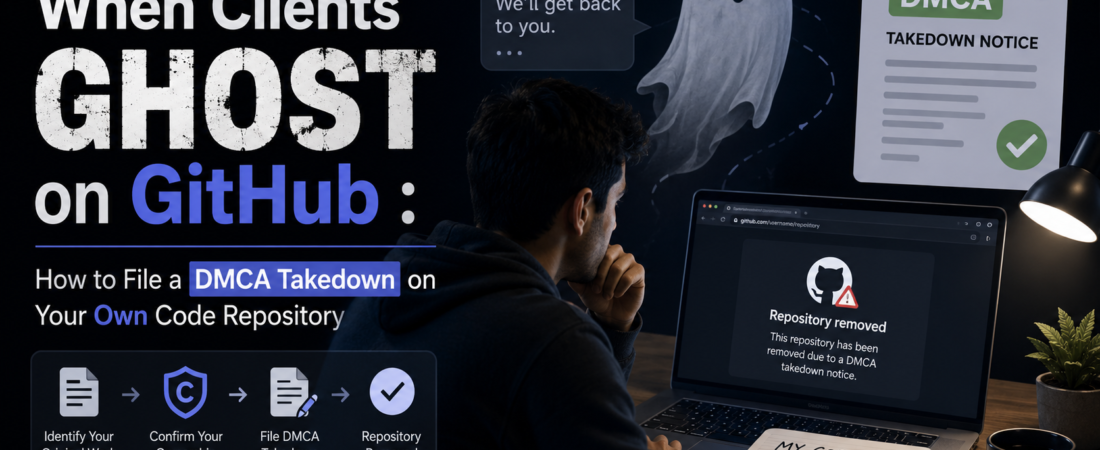
A DMCA takedown on GitHub is a formal legal request under the Digital Millennium Copyright Act (17 U.S.C. § 512) that allows a copyright owner to request removal of infringing code. If a freelancer’s work is used without payment and no valid ownership transfer exists, this mechanism may be used to restrict access to the repository until the dispute is resolved.
Major platforms such as GitHub maintain formal DMCA policies and are legally required to act on valid notices to preserve their statutory safe harbor protections.
You did the work. You committed the final lines. You pushed it to their repository.
The pull request was merged. The project went live.
Then you sent the final invoice. And suddenly, they stopped replying.
This is where freelancers quietly get destroyed.
You sit there, refreshing your email, wondering if they are just busy or if you have been completely scammed. It is a terrible, sinking feeling.
But here is the truth. You are not powerless.
If you are a developer whose client ghosted after you sent the invoice, you may still retain significant legal leverage, depending on your contract terms and payment status. You just need to know how to play it.
This is a structured, practical guide explaining how a DMCA notice process generally works in the context of unpaid freelance code disputes on your own code repository. so now How to File a DMCA Takedown on Your Own Code ?
Table of Contents
The Python Automation Nightmare : A Case Study
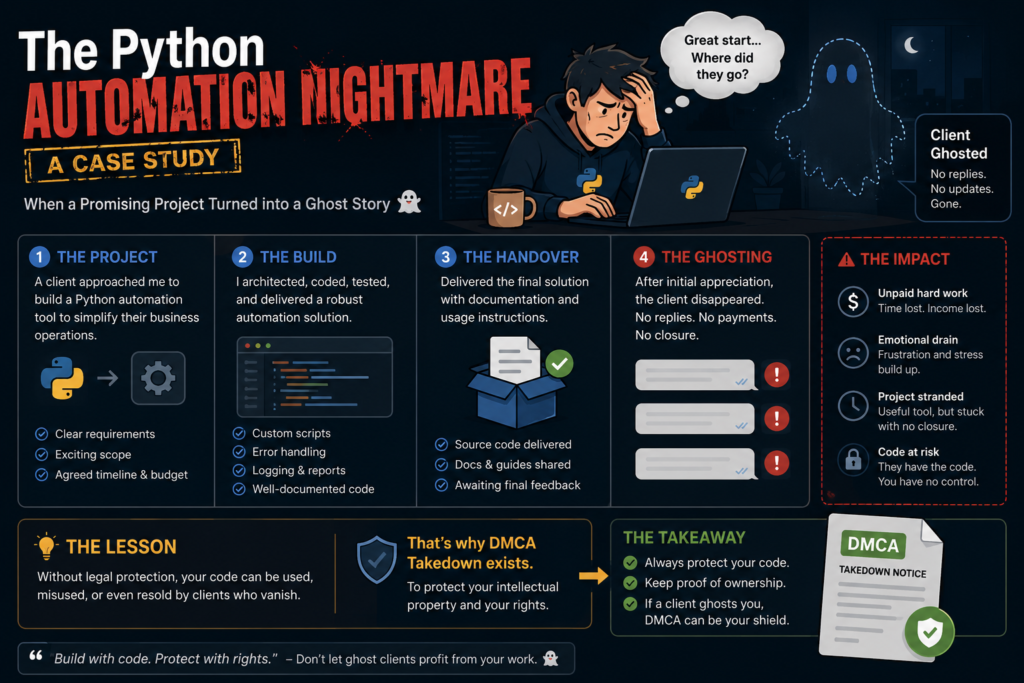
Let me tell you about a project from a while back. I was hired to build a complex Python backend system.
Specifically, I wrote a custom architecture utilizing MoviePy and Pillow to fully automate their video production pipeline for social media. I spent weeks getting the rendering logic and automated asset generation perfect.
I foolishly pushed the final update directly to their private GitHub repository before the final $4,000 milestone cleared.
They launched their automated channel, started posting daily, and entirely ghosted my emails.
When a client uses your work but refuses to pay you, it feels deeply personal. I felt stupid for trusting them. I felt out of control.
But I wasn’t. And neither are you.
I drafted a formal takedown notice. Within 48 hours, GitHub pulled their entire repository offline.
Their automated video pipeline broke instantly. The ghosting stopped immediately. I had my money wired by the end of the day.
The Psychological Angle : Taking Back Control
When a client stops responding, your mind spirals.
You think because the code is sitting on their server, or in their GitHub organization, they hold all the cards. This situation can create a perceived imbalance of control, particularly when access to the repository is restricted.
But let’s look at the actual reality of the situation.
You wrote that code. Under international copyright law, you own that code until a valid contract says otherwise.
If they have not paid you, the contract is likely breached. The transfer of intellectual property never legally occurred.
That means they are currently hosting stolen property. you may have enforceable leverage, subject to the terms of your agreement and applicable copyright law.
Flow : Mistake → Consequence → Law
Let’s break down exactly how you got here, and how the law gets you out.
The Mistake
We all do it. We want to be helpful. We want to prove the project is finished and functioning.
Instead of sticking to a strict follow-up timeline for late freelance invoices, we merge our branch into main. We do this before the final wire transfer hits our account, trusting professional courtesy.
The Consequence : The Open Repo Exploitation
This leads directly to what I call the “Open Repo Exploitation.”
They get the functional software. You get an empty bank account.
They might even revoke your access to the repository immediately after the merge. You are left wondering if you can freeze a live domain legally or if your code is gone forever.
The Law : Your Legal Remedy
This is where the law steps in to save you. Specifically, the Digital Millennium Copyright Act (DMCA) under United States Law ( 17 U.S.C. § 512 ).
Code is considered a literary work. It is protected by copyright the moment it is saved to a disk.
Unless you signed a specific “Work for Hire” agreement AND they actually paid you for it, that code belongs to you.
GitHub, GitLab, and Bitbucket are service providers. By law, they must respond to valid takedown requests to maintain their safe harbor status.
Important : This approach depends heavily on the terms of your contract. If you have signed a “work for hire” or intellectual property assignment agreement that transfers ownership upon creation (rather than upon payment), your ability to file a valid DMCA claim may be limited. Always review contractual clauses carefully before proceeding.
Deep Checklist System : Pre-Takedown Evidence Gathering
Before you file anything, you need an airtight case. Do not skip these steps. If you file a false DMCA claim, you can be held legally liable.
Use this checklist to secure your position:
- [ ] Export your local Git history : Run
git log --author="Your Name"and save the text output. This proves your timeline. - [ ] Screenshot the repository : If you still have access, take screenshots of the commit history, pull requests, and file structures.
- [ ] Gather communications : Save all emails, Slack messages, or upwork chats proving they accepted the work but failed to pay.
- [ ] Check the contract : Verify there is no clause stating ownership transfers before payment clears.
- [ ] Document the unpaid invoice : Save a PDF of the overdue invoice showing the exact amount and dates.
Evidence Integrity Checklist
Check off the evidence you have secured. Each item strengthens your legal position.
0% Evidence Secured
Why Git History is Absolute Evidence
Look, in the legal world, proving authorship can be incredibly difficult for writers or strategists.
But software engineers have a built-in advantage. We have version control.
Every single commit is a cryptographically hashed, timestamped digital signature of your work. Your local .git folder is an a highly reliable and timestamped record of authorship of creation.
Even if the client locked you out of GitHub, you likely have the local history on your machine.
In legal disputes, evidence is everything. Just like wondering if a WhatsApp chat count as a legally binding contract (it often does), your commit hashes serve as binding proof of authorship.
The Step-by-Step Visual Walkthrough
Filing a DMCA notice isn’t just sending an angry email to GitHub support.
It is a formal legal process. It requires specific language under penalty of perjury. If you get the wording wrong, the platform will simply reject it.
Here is the exact visual flow of how to execute this.
Identify URI
Locate the exact GitHub Repo URL hosting your code.
Draft the DMCA
Utilize a strict legal framework under penalty of perjury.
Submit to Host
File with the official GitHub/GitLab Copyright Agent.
Client Pays Invoice Fast
Funds are cleared and leverage is successfully executed.
Client Panics
Deployments fail and their automated pipeline breaks.
Repo is Hidden
GitHub enforces the takedown and access is blocked.
Draft a DMCA for Code ( The Exact Text )
You need to send a very specific document. Think of it as a highly specialized, legally aggressive version of a clean cease-and-desist letter.
It must contain specific elements mandated by 17 U.S.C. § 512(c)(3).
I have built a simple HTML tool below. You can save this code block as an .html file on your computer, open it in your browser, and generate your exact legal text.
DMCA Takedown Notice Generator
Draft a legally compliant 17 U.S.C. § 512(c)(3) takedown request.
Generated Legal Document
US vs Global Comparison : Jurisdictional Leverage
You might be wondering: ” I am based in India, but my client is in the US. Does the DMCA still work ? “
In many cases, yes—particularly where the hosting platform operates under United States jurisdiction.
When you protect yourself when working with international clients, you generally rely on the legal framework governing the service provider hosting the content.
GitHub is a US company. Therefore, GitHub complies with the US Digital Millennium Copyright Act, regardless of where you live.
However, your actual copyright ownership is protected locally. Under the Indian Copyright Act, 1957 ( Section 17 ), the author of a work is the first owner of the copyright.
Unless your freelance contract specifically transfers these rights under Indian law, you remain the owner. You leverage US law to take down the server, while holding local rights to the code itself.
The Aftermath : Forcing the Client’s Hand
So, you filed the notice via GitHub’s official copyright portal. What happens next ?
GitHub legal will review it. If it meets the requirements, they disable access to the repository. They replace it with a public “Repository unavailable due to copyright complaint ” notice.
Suddenly, their production deployments break. Their internal developers cannot pull code.
This is the exact moment the ghosting stops. Usually, you will receive a frantic, aggressive email from the client within a few hours.
They will demand you reverse it. They will threaten you.
Stay entirely calm. Do not apologize.
Simply state: “The repository was removed due to the unlicensed use of my copyrighted intellectual property. I will gladly retract the takedown notice immediately once invoice #104 is paid in full.”
Knowing when it is time for a freelancer to take legal action is half the battle. Executing it without blinking is the other half.
Risk Matrix : What Could Go Wrong?
Before pulling the trigger, you must understand the board. Here is how the risk breaks down.
| Scenario Level | Client Action | Your Risk | Recommended Response |
| Low Risk | Client panics, realizes they are caught, and pays the invoice immediately. | Minimal. You get your money and retract the claim. | Verify the funds are fully cleared in your bank, then email GitHub to retract. |
| Medium Risk | Client deletes your specific code, rewrites it, and ignores you. | Moderate. You lose the leverage of the active repo. | You still haven’t been paid, but their timeline was severely delayed. Consider small claims court. |
| High Risk | Client files a formal “Counter-Notice” claiming they own the code. | High. If they file a counter-notice, GitHub will restore the repo in 10-14 days. | You must file a formal lawsuit in federal court within 14 days to keep the repo down. Consult an attorney. |
Interactive Risk Assessment
Select a scenario to understand your exposure before filing a takedown.
When a DMCA Takedown May Not Work
There are situations where a DMCA notice may be ineffective or legally risky:
- If your contract explicitly transfers intellectual property ownership before payment
- If your contribution cannot be clearly identified within a larger codebase
- If the client can demonstrate independent creation of the disputed code
- If your claim contains factual inaccuracies, exposing you to liability under Section 512(f)
In such cases, alternative legal remedies such as contractual recovery or civil litigation may be more appropriate.
Quick Decision Section : Should You File ?
Are you debating whether to actually send the notice? Use this quick logical flow to decide right now.
Did you sign a contract that transfers IP “upon creation” rather than “upon payment” ?
- Yes: Stop. You likely do not own the code anymore. A DMCA could get you sued for perjury.
- No: Proceed to the next question.
Is the outstanding invoice amount worth burning the bridge with this client ?
- No: Send one final firm email and write it off as a lesson.
- Yes: The bridge is already burned by their theft. File the DMCA.
Frequently Asked Questions
Does GitHub charge a fee to process a DMCA takedown ?
No. Submitting a DMCA takedown notice is a completely free legal process mandated by federal law.
What if my code was merged into a massive codebase ? Will GitHub take down the whole thing ?
Often, yes. If the client cannot separate your infringing code from the rest of the repository quickly, GitHub will disable the entire repository to comply with the law.
Do I need to register my copyright before filing a DMCA ?
No. In both the US and under the Berne Convention, copyright automatically vests the moment your code is fixed in a tangible medium (saved to your hard drive).
What is a Counter-Notice ?
A counter-notice is a legal declaration by the client stating your claim is a mistake or misidentification. If they file one, you have 10-14 business days to seek a court order, or the repo goes back up.
Can they sue me for filing a DMCA ?
If you lie, yes. Under Section 512(f) of the DMCA, any person who knowingly materially misrepresents that material is infringing can be liable for damages. Only file if you genuinely own the code and haven’t been paid.
Final Thoughts
Here is the bottom line. No one wants to deal with legal threats.
We just want to write good code, deliver solid products, and get paid for our time.
But the freelance market is entirely unregulated. There is no HR department coming to save you when a client decides to keep their money and your source code.
You have to be your own advocate.
Document everything. Keep your Git history clean. And never be afraid to protect your intellectual property when someone tries to exploit your hard work.
About Author
Adv. Sagar Haribhau Shirsat is an active legal professional specializing in commercial transaction architectures, cross-border corporate compliance, and digital debt recovery systems. He designs strategic asset-protection and recovery frameworks that help freelancers, independent contractors, and global agencies defend their cash flow and enforce their billing rights.
Connect via his Official Professional LinkedIn Profile.
Disclaimer : This guide is intended for educational purposes and risk management analysis. It does not replace formal legal counsel. For specific cross-jurisdictional contract disputes, always consult a certified attorney or local legal advocate.