
The red recording light finally blinks off.
You survived a grueling three-day commercial shoot. The crew is exhausted, the lighting gear is packed, and you are sitting on four terabytes of beautiful, high-res raw footage.
It feels great. You’ve done your job perfectly.
You back up the drives in three different locations. You open your laptop, send the invoice for the post-production deposit, and you wait.
A day passes. Then three.
Finally, you get that dreaded email from the client’s project manager.
“Hey, we hit a bit of a budget snag. Can we pause editing for now? Also, can you just send over the raw files so we have them?”
Look, I have been there. My stomach dropped the first time I read an email like that.
You’ve already paid your gaffer, your sound mixer, and the grip truck rental. You are out of pocket, and now the client wants the gold without paying the toll.
Here is the thing: you are not helpless. In fact, if you still have the footage, you are holding all the leverage.
This guide is exactly what to do when a video production client runs out of money before post-production ends. We are going to walk through the problem, the law, and the exact solution you need to get paid.
Table of Contents
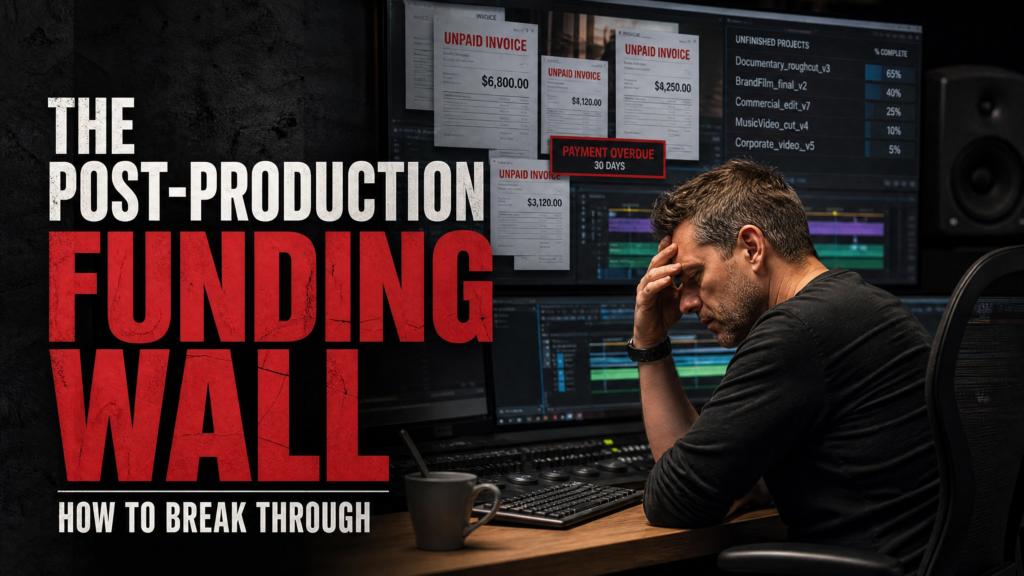
The Post-Production Funding Wall
Why does this happen ?
Usually, it is not malice. It is terrible planning.
Industry surveys consistently report that payment delays and cash-flow problems remain among the most common operational challenges faced by freelancers, particularly on large creative projects involving multiple vendors.
They blow their budget on locations, on-screen talent, or last-minute script changes during production.
By the time the project reaches the edit bay, the well is completely dry.
The problem is, they still want their video. Or worse, they want to take your raw footage to a cheaper, entry-level editor to save money.
This is a classic scenario where a client runs out of money mid-project.
If you just hand over the drives, you lose your only bargaining chip.
I learned early on that handing over raw assets without full payment is a rookie mistake. It is the easiest way to ensure you never see your final invoice paid.
You have to change your mindset. You are not just a creative professional right now.
You are holding an important commercial asset that may provide contractual and practical negotiating leverage.
You need to establish boundaries immediately to stop working for free and protect the time you’ve already invested.
Physical and Digital Liens on Media Assets
Let’s talk about the law, simply and clearly.
When a client refuses to pay, but demands the deliverables, they are testing your knowledge of intellectual property and contract law.
In many freelance productions, copyright initially remains with the creator unless a written contract transfers ownership earlier or classifies the work as “work made for hire.”
If your agreement conditions ownership or usage rights on payment, withholding unreleased footage until contractual obligations are met may be an important source of commercial leverage.
Always review your contract and applicable local law before refusing delivery.
Under the US Copyright Act (17 U.S.C. § 201), the creator of a work holds the copyright the moment it is fixed in a tangible medium.
Unless you signed a specific “Work for Hire” agreement that legally transferred those rights prior to payment, you hold the cards.
(Source: U.S. Copyright Office).
In the physical world, if you take your car to a mechanic and refuse to pay for the repairs, they keep your car. This is called a mechanic’s lien.
Think of this as a practical commercial strategy that is analogous to a possessory lien—not a separate legal doctrine.
Your continued control over unreleased footage can provide valuable negotiating leverage where your contract and the law allow.
You are going to use your possession of the raw files as structural leverage to secure your historical debts.
If you suspect they might try to rip a low-res proxy and use it anyway, you need to be prepared. Knowing what to do if a client used your video without paying is crucial for independent cinematographers.
Even if they only post a rough cut on social media, you can strike it down. The same rules apply when a client uses your work but refuses to pay you.
The Footage Lien Playbook (Diagram)
Here is how you structure your defense mathematically and logically.
Do not send proxies.
Restructuring into a Multi-Phase Release Schedule
So, they don’t have the $10,000 to finish the project. But maybe they have $3,000.
You need to stop thinking about a single final invoice and start thinking like a bank.
You can restructure their debt. This keeps the project alive but heavily protects your downside.
If they are dragging their feet, you might need a psychological trick to get paid fast. Usually, the trick is realizing you control the release valve.
Offer to release the project in phases.
If it was supposed to be four promotional videos, offer to finish and release one video for a prorated payment.
You hold the master files for the remaining three videos until their budget refreshes next quarter.
You must outline this clearly in an addendum. A proper freelancer payment terms guide will tell you to avoid Net 60 or Net 90 terms for distressed clients.
Demand payment upon delivery for each micro-phase.
If they refuse and demand everything upfront on credit, you kindly decline.
You can even point out that standard commercial practice allows you to legally charge interest on late invoices while they delay.
Tool : Restructuring Payment Release Calculator
I use a simple formula to determine how to break up deliverables. You can use this HTML tool below for your own projects.
Save this code as an .html file and open it in your browser to calculate phased release payments.
Deliverable Release Calculator
Expert Tip
Never confuse physical possession of files with ownership of intellectual property. In many jurisdictions, these are separate legal concepts governed by different rules and by the specific terms of your contract.
Liquidating Raw Footage to Recover Overhead Costs
But what if the client doesn’t just have a temporary cash flow problem ?
What if they are completely broke ?
If a corporate client goes bankrupt, you are suddenly an unsecured creditor.
You are standing at the back of a very long line of people waiting to get paid. You will likely never see that money.
So, how do you recover your hard costs ?
If the project has completely collapsed, consider whether any portions of the footage can be commercially licensed—but only if doing so is legally permissible.
Before licensing any material, confirm that your contract, confidentiality obligations, model releases, location permissions, trademark issues, and applicable law allow such use.
Many commercial productions cannot legally be relicensed, while generic B-roll or independently owned footage sometimes can.
When in doubt, obtain legal advice before attempting to monetize unused footage.
If you shot generic lifestyle footage, cityscapes, drone flyovers, or nature B-roll, that footage has value.
You can strip the raw files of any specific branding related to the client. Color grade it, chop it up, and upload it to premium stock footage sites like Filmsupply, Pond5, or Getty.
I have actually recovered lost project fees over a period of two years just from residual stock footage sales.
This is why you must know how to structure a proposal so it functions like a real legal defense contract.
Your contract must explicitly state that if the client defaults on payment for more than 60 days, you retain full rights to license, sell, or distribute any non-confidential raw footage shot during production.
If you don’t have that clause yet, add it today.
Real-World Case Study : The Agency Pivot
Let’s look at how this plays out in reality.
Last year, a freelance DP friend of mine was hired by a mid-sized marketing agency. They were shooting a high-end commercial for a fitness brand.
My friend completed the shoot and invoiced for $8,000 to cover production and the upcoming edit.
The agency ghosted him for two weeks.
He was panicked. He didn’t know what to do when his client ghosted after the invoice.
Eventually, the agency admitted the fitness brand had pulled their funding. The agency had no money to pay my friend.
They aggressively demanded the raw files, claiming it was their “agency property.”
Because my friend was a seasoned pro, he refused. He kept the drives locked.
He sent a formal notice stating that no files would be transferred until the day rate for production was paid in full. He gave them a strict follow-up timeline.
Two months later, the fitness brand got new funding. Because the agency couldn’t access the footage without my friend, they were forced to come back to the table, pay the original invoice, plus a late fee.
Carefully exercised contractual leverage often produces better commercial outcomes than emotional confrontation or immediate litigation.
But only if you hold the line.
Evidence Checklist : What You Need to Win
If this situation escalates, you need to prove your case.
Don’t rely on memory. Gather these items immediately when a project stalls:
- The Original Signed Contract : Proving the scope of work and payment schedule.
- Proof of Production Execution : Call sheets, behind-the-scenes photos, and expense receipts.
- The “Pause” Email : The written communication where the client admits they lack funding.
- Time Logs : Exact hours spent prepping, shooting, and backing up data.
- Drive Logs : Screenshots of the file directory proving the footage exists and is secured.
Organize this into a single PDF. If you have to recover an unpaid invoice yourself, having an organized evidence packet is your strongest weapon.
Risk Matrix : Evaluating Your Next Move
Before you act, weigh your options. Not all clients are the same, and your approach should match the risk level.
| Action Taken | Client Reaction | Risk Level | Your Strategic Move |
| Withhold all raw files | Client threatens legal action | Low to Medium | Hold firm. Remind them of copyright ownership until payment clears. |
| Release watermarked proxies | Client tries to edit proxies | Medium | Monitor social media. Issue DMCA takedowns if they post unpaid work. |
| Offer phased payment plan | Client agrees but pays slowly | Low | Secure. Release only one final asset per cleared payment. |
| Send raw files on good faith | Client ghosts completely | Extremely High | Never do this. You lose all leverage and usually the money. |
Global Freelancer Leverage: US, UK, and Australia :
If you are a global freelancer, you need to understand how borders affect your leverage—particularly when protecting yourself while working with international clients.
United States
In the US, copyright law heavily favors the creative freelancer from the moment of creation. Under 17 U.S. Code § 201(a), initial copyright ownership automatically vests in the author of the work.
Unless you explicitly sign a written agreement designating your output as a “Work Made For Hire” or execute a formal transfer of rights, you remain the legal owner.
This grants you significant leverage to withhold usage rights if a client fails to pay, as unauthorized commercial use of your unreleased assets constitutes federal infringement under the U.S. Copyright Act.
United Kingdom
In the UK, independent creators retain automatic copyright ownership by default, but your sharpest weapon against non-payment is statutory debt recovery.
Under the Late Payment of Commercial Debts (Interest) Act 1998, independent contractors are statutorily entitled to claim compounding interest (set at 8% above the Bank of England base rate) plus fixed compensation for debt recovery costs the moment a business commercial invoice becomes overdue.
Australia
Australia mirrors this strong default protection for independent operators. Under the Copyright Act 1968, as outlined by IP Australia, intellectual property created by an independent contractor or freelancer remains the exclusive property of the contractor unless a signed written contract specifically states otherwise.
Furthermore, Australia recognizes robust “Moral Rights” under the Attorney-General’s framework, protecting your right to attribution and the integrity of your work, meaning clients cannot legally alter or display your work without proper clearance.
India vs. Global : Jurisdictional Legal Nuances
When contrasting Western frameworks with the domestic landscape in India, the core legal mechanisms of leverage shift from strict intellectual property statutory penalties to general contract and bailment laws.
While the US, UK, and Australia rely on codified copyright default protections and specialized commercial debt acts to penalize non-payment, the Indian legal framework handles these disputes under the Indian Contract Act, 1872.
Specifically, Indian freelancers rely heavily on Section 170’s “Bailee’s particular lien,” which allows a service provider who has expended physical or intellectual labor upon bailed property to legally retain possession of those goods until proper remuneration is received.
In India, disputes involving unpaid creative work are generally resolved through contract principles, copyright law where applicable, and the specific terms agreed between the parties.
Depending on the facts, service providers may also consider principles such as the bailee’s particular lien under Section 170 of the Indian Contract Act, 1872, although its application to purely digital deliverables remains fact-dependent and may depend on contractual language and judicial interpretation.
Because the legal position can vary considerably, well-drafted ownership, payment, and delivery clauses are often more valuable than relying on default legal rules alone.
Quick Decision Section : Your Next 24 Hours
You are sitting at your desk right now. The client just paused the project.
What exactly do you do in the next 24 hours ?
- Stop all work immediately. Do not render a single timeline.
- Back up the footage securely. Unplug the external drive and put it in a drawer.
- Send the “Stop Work” Notice.
Do not write an emotional essay. Keep it clinical, cold, and professional.
Tool : The Stop-Work Notice Generator
If you don’t know what to say, use this tool to generate a professional, legally-sound email to your client.
Formal Stop-Work Notice Generator
Send that email. Then step away from your computer.
The ball is in their court.
Key Takeaways
- Stop work immediately.
- Preserve all raw assets securely.
- Review your contract before releasing deliverables.
- Communicate professionally in writing.
- Consider phased delivery where appropriate.
- Obtain legal advice before relying on copyright or lien arguments across jurisdictions.
FAQs : Answering the Hard Questions
When clients run out of money, freelancers tend to panic and second-guess themselves. Here are the most common questions I get asked.
Can the client sue me for holding the raw footage ?
Anyone can initiate legal proceedings. Whether they succeed depends on the governing contract, applicable law, ownership provisions, and the facts of the dispute. Before withholding deliverables, ensure your legal position is supported by your agreement and local law.
What if they ask for proxies so they can log the footage themselves ?
Do not send proxies.
Clients often take watermarked proxies, drop them into Premiere, and use AI tools to upscale or remove the watermark. If they want to log footage, they can pay the current invoice first.
Should I offer them a discount to just get some money ?
No. Never discount work you have already completed.
You can offer a payment plan, but discounting completed production work signals desperation. It also trains the client that your boundaries are weak.
What if the production was technically “Work for Hire” ?
If you signed a strict Work for Hire agreement, the client technically owns the copyright from the moment of creation.
However, in many jurisdictions, a material breach of contract (like total non-payment) can void those transfer clauses.
This is a complex area, often relying on doctrines like Quantum Meruit (getting paid for the value of services rendered). If this happens, you should speak to a local attorney.
How long should I keep the footage on my drives ?
State in your contract that you only archive unpaid footage for 60 or 90 days.
After that, you are not responsible for data loss. Drives cost money. You are not a free cloud storage service for clients who default on their bills.
Common Mistakes That Cost Freelancers Money
- Sending raw footage before payment clears.
- Continuing to edit after work has been paused.
- Negotiating only by phone instead of email.
- Assuming copyright automatically solves every payment dispute.
- Forgetting confidentiality obligations when considering relicensing footage.
- Failing to document production costs and communications.
The Bottom Line
When a video production client runs out of money before post-production ends, it feels like a disaster.
But it is actually just a business negotiation.
You hold the physical drives.
In many freelance engagements, you may retain copyright or other contractual rights until ownership transfers under the agreement.
You have the leverage.
Do not let a panicked client bully you into handing over your hard work for free. Restructure the deal if you can, hold the line on your assets, and if all else fails, know your rights to liquidate and recover your costs.
Stay calm. Protect your drives. Get paid.
About Author
Adv. Sagar Haribhau Shirsat is an Indian advocate who writes about commercial contracting, digital asset protection, cross-border freelancer disputes, payment recovery strategy, and legal risk management for independent professionals and creative businesses.
Connect via his Official Professional LinkedIn Profile.
Disclaimer : This article provides general educational information and risk-management guidance. It is not legal advice and should not be relied upon as a substitute for advice from a qualified lawyer familiar with your jurisdiction, contract, and specific facts. Laws vary significantly between countries and may change over time.