
You are staring at the email draft. Your finger is hovering over the send button.
You have typed the magic words:
“If this invoice isn’t paid by Friday, you will hear from my lawyer.”
Don’t send it. Not yet.
I know you are furious. You did the work. The client is delaying payment, ignoring your reminders, or giving you one excuse after another.
But before you send a legal threat, stop for a moment.
A pre-litigation checklist can help you determine whether your documentation, contract, evidence, and proposed escalation strategy are actually ready.
Because there is a major difference between sounding serious and being prepared to follow through.
A legal demand letter is most effective when it is supported by a clean factual record. If the client responds by challenging your performance, disputing the contract, questioning the legal entity, or raising a counterclaim, you want to know those issues before—not after—you escalate.
Think of this as a defensive safety audit.
You want to make sure your own position is as organized as possible before you begin an unpaid invoice dispute or other formal debt-recovery process.
Table of Contents
Here is the pre-litigation checklist for freelancers : 7 things to secure before telling a client “You’ll hear from my lawyer.”
Important jurisdiction note: Contract formation, notice requirements, cure periods, attorney-fee rules, intellectual-property rights, small-claims procedures, limitation periods, arbitration requirements, and enforcement procedures vary by jurisdiction. This pre-litigation checklist is a general risk-management framework, not a statement that the same legal rules apply everywhere.
Consider a hypothetical example that illustrates why immediate legal threats can sometimes backfire.
Meet Sarah. She is a senior brand strategist.
She landed a $15,000 rebranding project for a mid-sized technology startup. She delivered the final brand guidelines, logo assets, and pitch-deck templates.
The client liked the work and began using the new branding on its website.
Then the final $7,500 invoice went unpaid.
Week one passed.
The client said it was waiting on funding.
Week three passed.
Then communication became increasingly difficult.
Sarah got frustrated. She sent an email terminating the relationship and ended with:
“My legal counsel will be in touch tomorrow.”
What Sarah Had Not Checked
Before sending that email, Sarah had not completed even a basic pre-litigation preparation review.
First, she did not actually have a lawyer engaged to contact the client.
Second, the client immediately forwarded the email to its corporate counsel.
The client’s lawyer reviewed the original contract and noticed that Sarah had delivered one milestone four days later than the date stated in the agreement.
The client responded by disputing the invoice and asserting that the delay had caused additional business losses.
Whether that counterclaim would ultimately succeed is a separate legal question. But Sarah had created a more complicated dispute than she originally had.
Instead of beginning with a relatively straightforward unpaid-invoice claim, she now had to consider:
- the contract’s delivery requirements;
- whether the deadline was actually strict;
- whether the client had accepted the late delivery;
- whether the client had waived or modified the deadline;
- whether the delay caused any legally recoverable loss;
- and what evidence existed about the client’s approval of the work.
The Pre-Litigation Lesson

The lesson is not that freelancers should never threaten legal action.
The lesson is that pre-litigation preparation matters.
Before sending a demand letter before lawsuit proceedings, you want to understand both the strengths and weaknesses of your position.
The legal question is not simply:
“Did the client fail to pay me?”
It may also involve:
“What does the contract say, what happened during performance, what evidence exists, and what remedies are actually available in the relevant jurisdiction?”
If you are dealing with an unpaid invoice, especially one involving a significant amount of money, that distinction matters.
Here is the 7-step pre-litigation checklist for freelancers I would use before escalating.
Pre-Litigation Checklist Step One: Do You Actually Have Counsel ?
Here is the first question:
If you tell the client that a lawyer will contact them, is a lawyer actually prepared to do so?
There is nothing inherently wrong with telling a client that you intend to pursue legal remedies.
The problem is making a specific representation about counsel or an imminent legal action that you are not actually prepared to follow through on.
A corporate client may respond:
“Please provide your attorney’s contact information so our counsel can communicate directly.”
You should not make a statement that creates a factual problem for you.
What to Do Instead
If you do not currently have counsel, use accurate language.
For example:
“If the outstanding balance is not resolved, I will consider pursuing the formal legal and debt-recovery remedies available to me.”
That does not pretend that a lawyer has already been retained.
Depending on the circumstances, those remedies might include:
- a formal demand letter;
- mediation;
- arbitration;
- a small-claims action where available;
- a civil lawsuit;
- or another lawful debt-recovery process.
The correct option depends on the contract, amount in dispute, jurisdiction, and applicable procedural rules.
The Rule for Your Pre-Litigation Checklist
Do not represent that counsel has been retained if counsel has not been retained.
And do not threaten a specific legal procedure unless you have at least checked whether that procedure is actually available to you.
Pre-Litigation Contract Review : Did You Actually Comply With the Deal ?
Before accusing the client of breaching the contract, audit your own performance.
Ask:
Did I perform the agreement substantially as required?
Go back to your Statement of Work (SOW), Master Services Agreement, proposal, purchase order, or other governing documents. If you want to strengthen this protection before a dispute ever begins, see How to Structure a Proposal So It Functions Like a Real Legal Defense Contract.
Review:
- the scope of work;
- milestone dates;
- payment deadlines;
- revision limits;
- acceptance provisions;
- delivery requirements;
- termination clauses;
- dispute-resolution clauses;
- governing-law provisions;
- arbitration clauses;
- attorney-fee provisions;
- intellectual-property provisions;
- and any notice or cure requirements.
The Freelancer Contract Review
Ask yourself:
- Did I deliver what I promised?
- Did I miss a material deadline?
- Did I provide the required file formats?
- Did I complete the agreed number of revisions?
- Did the client request additional work? If the scope changed during the project, review Client Asked for “One Quick Fix”? Here’s How to Charge for Scope Creep Without Losing Client before treating the dispute as a straightforward non-payment case.
- If the client substantially changed the project after the original agreement, Client Changed the Entire Project and Won’t Pay? Here’s 2 Ways to Kill Fee Strategy That Works may also be relevant.
- Did the client approve the work?
- Did the client continue using the work after delivery?
Do not assume that a minor mistake automatically eliminates your right to payment.
Likewise, do not assume that the client’s failure to pay automatically eliminates every defense it might have.
The purpose of this part of the pre-litigation checklist is to identify potential disputes before they become surprises.
The Counterclaim Risk
A client defending an unpaid invoice may argue that:
- work was late;
- deliverables were incomplete;
- specifications were not followed;
- revisions were outstanding;
- or the freelancer breached another contractual obligation.
Whether such a defense or counterclaim has legal merit depends on the agreement and applicable law.
That is why you should gather evidence before escalating.
If a client previously approved the work, for example, preserve that approval.
If the parties agreed by email to extend a deadline, preserve that email.
If additional revisions were requested after the original scope was completed, preserve those communications.
Your objective is not to make your record look perfect. Your objective is to understand the actual record.
Pre-Litigation Entity Verification : Are You Pursuing the Correct Legal Party ?

This is one of the most important steps in an unpaid invoice legal action.
You cannot sue a logo, a website, or a brand name.
You need to identify the person or legal entity that is actually responsible for the contractual obligation.
You might know the customer as:
Rocket Marketing
But the contracting party could be:
- Rocket Marketing LLC;
- Rocket Marketing Inc.;
- Rocket Marketing Ltd.;
- a sole proprietor operating under a trade name;
- or an individual doing business under a DBA.
Check the Contract First
Look at:
- the signed agreement;
- proposal;
- invoice;
- purchase order;
- email signature;
- payment records;
- business website;
- and relevant business-registration records.
In the United States, the appropriate state business registry may help confirm an entity’s legal name and status.
Do not assume that the name printed on an invoice is automatically the complete legal identity of the contracting party.
Why Entity Verification Matters
Correct identification can affect:
- the demand letter;
- service of legal proceedings;
- jurisdiction;
- enforcement;
- collection;
- and the accuracy of court documents.
If you discover that your invoice uses a trade name rather than the underlying legal entity, do not panic.
That does not automatically mean that your underlying claim disappears.
The contract, communications, payment history, business records, and other evidence may still help establish who entered the agreement.
The goal of this step is simply to make your identification as accurate as possible before sending a legal demand letter.
Pre-Litigation Notice and Cure Check: Do You Have to Give Notice First?
This is one area where freelancers should be especially careful.
There is no universal rule saying that every unpaid invoice requires the same number of days of notice before legal action.
Instead, check three separate things.
1. What Does the Contract Say?
Your agreement may contain:
- a notice provision;
- a default provision;
- a cure period;
- a demand requirement;
- or a dispute-resolution procedure.
If the contract says a party must receive written notice and a specified period to cure a particular breach, that provision may matter.
2. Does Applicable Law Impose a Requirement?
Some legal claims or procedures have statutory notice requirements.
Those requirements vary by jurisdiction and by type of dispute.
Do not assume that a rule applicable to one kind of claim automatically applies to a freelance services contract.
3. What Does the Payment Term Say?
If the contract states:
Net 30
that establishes an agreed payment term.
It does not automatically answer every separate legal question about default, notice, interest, remedies, or litigation.
Notice Before Legal Action
Before sending a final demand letter, review the agreement for language such as:
“written notice”
“notice of default”
“opportunity to cure”
“dispute resolution”
“mediation”
“arbitration”
“notice of claim”
“venue”
“governing law”
If the contract requires a particular notice procedure, follow it carefully.
Do not invent a universal 15-day, 30-day, 45-day, or 60-day legal rule.
The correct timeline depends on the contract, jurisdiction, claim, and procedural requirements.
Intellectual Property and Access: Secure Your Position Without Interfering With Client Systems
This part of the pre-litigation checklist requires particular caution.
If you have created:
- designs;
- source code;
- graphics;
- website content;
- photographs;
- video;
- templates;
- databases;
- or other intellectual property,
review the contract to determine what rights were granted, transferred, licensed, or conditioned on payment.
Do not assume that non-payment automatically gives you unrestricted rights to revoke access or take down work.
Copyright ownership and transfer rules can be complicated. In the United States, for example, copyright initially generally vests in the author, subject to doctrines and contractual transfers such as assignments and qualifying works made for hire. (copyright.gov)
That is very different from saying:
“The client has not paid, so I can take their website offline.”
You should not interfere with systems, accounts, servers, repositories, or production environments that you are not authorized to access or control.
What You Can Do
Before escalating, review whether your contract permits you to:
- withhold unfinished deliverables;
- delay delivery of additional work;
- suspend future services;
- withhold transfer of specified rights until payment;
- or revoke access to a workspace that you lawfully administer.
The exact answer depends on the agreement and applicable law.
If your contract permits suspension of services, see How to Use the Notice of Suspension of Services Without Ruining the Client Relationship Permanently before taking that step.
What You Should Not Do
Do not:
- damage a client’s website;
- delete production files;
- change passwords without authorization;
- disable business-critical systems;
- access an account after your authorization has ended;
- deploy malicious code;
- or interfere with a client’s infrastructure to force payment.
If the unpaid work involves AWS, GitHub, hosting, databases, production servers, or other operational infrastructure, get jurisdiction-specific legal advice before taking any action that could affect the client’s systems.
The Better Pre-Litigation Strategy
Preserve your contractual and legal rights. Do not create a separate computer-access, property, or business-interruption dispute while trying to collect an invoice.
Pre-Litigation Evidence Checklist: Archive the Entire Communication Trail
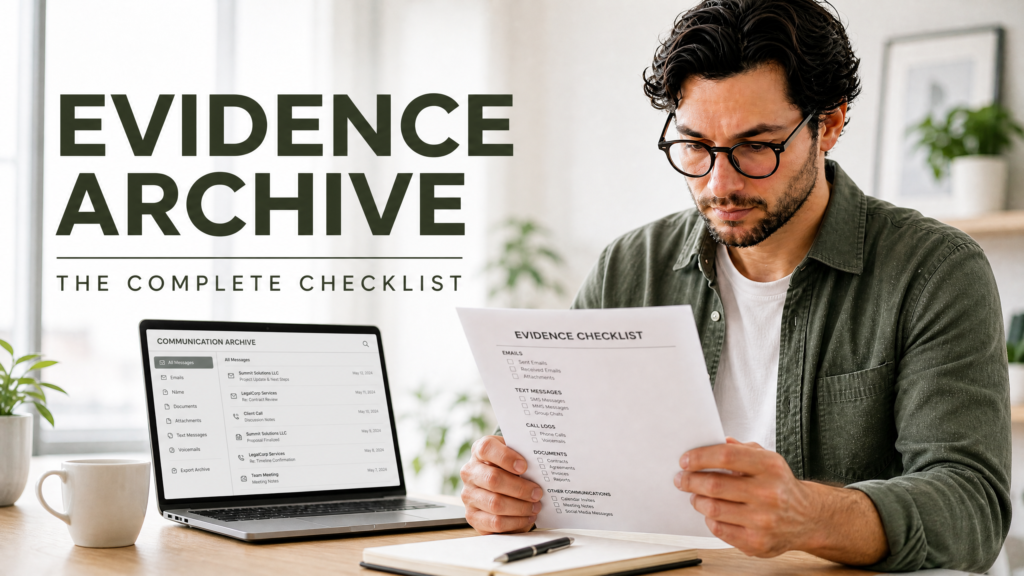
This may be the most valuable part of your pre-litigation preparation.
Do not wait until after sending a demand letter to start gathering evidence.
Preserve the record now.
Ask:
- Did the client approve the final deliverables?
- Did they acknowledge the invoice?
- Did they promise a payment date?
- Did they request additional work?
- Did they complain about quality?
- Did they accept delivery?
- Did they continue using the work?
- Did they dispute the invoice before it became overdue?
Build Your Evidence Timeline
Export or preserve, where you are lawfully entitled to do so:
- email chains;
- invoices;
- contracts;
- Slack messages;
- relevant WhatsApp messages;
- project-management records;
- approval messages;
- delivery confirmations;
- GitHub records;
- file-transfer records;
- payment records;
- and other relevant project documentation.
Do not secretly access systems or accounts after your authorization has ended simply to obtain evidence.
Preserve what you already lawfully possess or can lawfully obtain.
Your Pre-Litigation Evidence File
Create a chronological record:
1. Contract formed
↓
2. Work commenced
↓
3. Scope changed, if applicable
↓
4. Deliverables completed
↓
5. Client approved or accepted work
↓
6. Invoice issued
↓
7. Payment became due
↓
8. Payment reminders sent
↓
9. Client responses received
↓
10. Final demand or notice sent
This timeline can save substantial time when you consult a lawyer.
And if the client later says:
“We never approved that work.”
you have contemporaneous evidence to examine.
A paper trail for unpaid invoices is often far more useful than an emotional explanation of what happened.
Pre-Litigation Financial Check: Is the Client Actually Collectible?
Here is an uncomfortable reality of debt recovery:
Winning a claim and collecting money are not necessarily the same thing.
Before spending substantial money on litigation, consider collectability.
Ask:
- Is the company still operating?
- Is the business active?
- Is there evidence of insolvency?
- Has the company stopped paying other suppliers?
- Is there a bankruptcy or insolvency proceeding?
- Does the contracting entity still have assets?
- Is the person or entity you intend to pursue actually responsible for the debt?
Be careful, however, about drawing conclusions from social-media activity.
A company running advertisements or announcing a new executive does not necessarily prove that it has sufficient cash to satisfy your invoice.
Likewise, rumors of financial difficulty do not automatically prove insolvency.
The Insolvency Question
If a company is genuinely insolvent or already subject to a formal insolvency proceeding, ordinary litigation may not be the only or best route.
Depending on the jurisdiction, you may need to understand:
- creditor priorities;
- insolvency proceedings;
- proof-of-claim procedures;
- stays or restrictions on litigation;
- and available recovery mechanisms.
If collectability appears doubtful, a negotiated payment plan or settlement may sometimes make more commercial sense than an expensive dispute.
That is not “giving up.”
It is evaluating the economics of recovery.
Pre-Litigation Readiness Calculator for Freelancers
Before sending a legal demand letter, use this simple documentation-readiness tool.
It is designed to help you identify missing pieces in your file.
Important: This is not a legal-risk calculator and it cannot determine whether you have a valid claim, whether you will win, or whether you should file a lawsuit. It only measures whether several basic documentation elements appear to be in place.
(For web developers, the following HTML/JS block can be embedded directly into your site to create an interactive tool.)
The Pre-Litigation Readiness Calculator
Check the boxes that apply to your current dispute:
The calculator should be treated as a pre-litigation documentation checklist, not as a substitute for legal analysis.
The Mandatory Pre-Litigation Evidence Checklist
Before you send a final demand or begin an unpaid invoice legal action, organize the following into one secure folder.
The Origin Documents
- Signed Statement of Work;
- Master Services Agreement;
- proposal;
- purchase order;
- accepted quotation;
- or relevant emails establishing the agreement.
The Entity Proof
- legal business name;
- company registration information where available;
- business address;
- contracting-party information;
- and other records identifying the responsible party.
The Approval Trail
Preserve timestamps showing:
- approval;
- acceptance;
- positive feedback;
- requests for final delivery;
- publication;
- use of the work;
- or other evidence relevant to performance.
The Asset and Delivery Log
Examples may include:
- file-transfer receipts;
- delivery emails;
- GitHub commit records;
- project-management records;
- Google Drive records;
- or other lawful records showing when work was delivered.
The Financial Log
Keep:
- original invoice;
- payment terms;
- payment reminders;
- client responses;
- payment promises;
- partial-payment records;
- and bank records relevant to the transaction.
If major pieces of this file are missing, a lawyer may need additional time to reconstruct what happened.
That does not necessarily mean your claim is weak.
It means your pre-litigation evidence file needs work.
Legal Risk Matrix : Evaluate Your Unpaid Invoice Dispute Before Escalating
Use this framework to think about the factual posture of your dispute.
| Client Action / Scenario | Potential Leverage | Potential Dispute Risk | Next Best Step |
|---|---|---|---|
| Client accepted the work and stopped responding | Potentially strong | Lower if documentation is clear | Organize evidence and review notice requirements |
| Client claims the work is “subpar” after delivery | Depends on contract and evidence | Medium | Compile specifications, revisions, approvals, and delivery records |
| You missed a material deadline | Potentially weaker | Higher | Review whether the deadline was extended, waived, or accepted |
| Client demands additional work outside the agreed scope | Depends on contract | Medium | Preserve scope-change communications and review payment terms |
| Client has not paid but continues using the work | Potentially useful evidence | Depends on contract and IP terms | Preserve evidence of use and review contractual rights |
| Client appears insolvent | Recovery may be difficult | High collectability risk | Investigate the applicable insolvency process before spending heavily |
This table is a risk-management framework, not a prediction of how a court will decide a particular dispute.
Global Pre-Litigation Checklist : USA vs UK and International Disputes
Freelancing is a global business.
Your pre-litigation checklist therefore needs to account for the location of the parties, the contract, the governing law, and the agreed dispute forum.
A demand letter that makes sense in one jurisdiction may be poorly designed for another.
Always start by reviewing the contract’s:
- governing-law clause;
- jurisdiction or venue clause;
- arbitration clause;
- dispute-resolution procedure;
- notice provision;
- payment terms;
- and attorney-fee provisions.
The United States Setup
In the United States, civil procedure and small-claims rules vary by state.
Small-claims jurisdiction, monetary limits, filing procedures, service requirements, available remedies, and attorney participation can differ significantly.
The general American Rule also means that, as a starting principle, each side ordinarily bears its own attorney fees unless a statute, contract, court rule, or recognized exception provides otherwise.
That makes the economics of an unpaid invoice dispute important.
For example, a $3,000 claim might be commercially attractive in one situation and irrational in another depending on:
- attorney fees;
- filing fees;
- travel;
- arbitration requirements;
- evidence;
- collectability;
- and the likelihood of settlement.
Do not assume that the amount of the invoice alone determines whether litigation makes economic sense.
The UK and Commercial Late-Payment Rules
The UK has statutory protections for qualifying late commercial payments.
Under the Late Payment of Commercial Debts (Interest) Act 1998, qualifying business-to-business debts can generally attract statutory interest at 8% above the Bank of England base rate, subject to the statutory rules and contractual circumstances. GOV.UK also explains that statutory interest may not be available where the contract provides a different qualifying remedy for late payment. (gov.uk)
There can also be a fixed compensation amount for qualifying late commercial payments. (smallbusinesscommissioner.gov.uk)
Do not simply copy the UK statutory-interest formula into a dispute involving another country.
The applicable law may depend on:
- the parties;
- type of transaction;
- contract;
- governing law;
- place of performance;
- and applicable legislation.
The UK government has also been developing further commercial late-payment reforms, so readers should check current official guidance when dealing with a live dispute. (gov.uk)
Quick Pre-Litigation Decision Framework: Threaten Legal Action or Prepare Further?
If you are trying to determine whether the dispute has reached the point where escalation makes sense, see When is it Officially Time for a Freelancer to Take Legal Action?.
Still unsure ?
Use this framework rather than relying on an arbitrary invoice amount.
If the debt is relatively small
Do not automatically assume that hiring a lawyer is irrational.
Instead, compare:
Potential recovery
against
legal costs + filing costs + time + enforcement risk + collectability risk.
For a small claim, a well-drafted demand, negotiation, mediation, or small-claims procedure may sometimes be more proportionate than full-service litigation.
The appropriate option depends on your jurisdiction and circumstances.
If the debt is substantial and your documentation is strong
Consider moving toward a formal demand.
Before sending it, verify:
- the correct contracting party;
- the amount claimed;
- payment history;
- contractual interest provisions;
- applicable statutory interest;
- notice requirements;
- dispute-resolution provisions;
- governing law;
- venue;
- and available remedies.
If the amount is significant or the client has indicated that it intends to defend the claim, obtaining advice from a lawyer in the relevant jurisdiction can be particularly valuable.
When you are ready to make a formal demand, Final Notice Before Legal Action: Copy-Paste Script That Forces Payment can serve as a practical starting point.
If you missed deadlines or delivered disputed work
Do not automatically abandon the claim.
Instead:
- determine exactly what happened;
- review the contract;
- identify any extensions or waivers;
- gather evidence of acceptance;
- assess the actual financial dispute;
- consider negotiation or settlement;
- obtain legal advice if the potential exposure is significant.
A settlement can sometimes be commercially sensible.
But the correct settlement percentage cannot be determined by a universal rule such as “always accept 70%.”
It depends on the evidence, defenses, amount involved, collectability, costs, and litigation risk.
Frequently Asked Questions About Pre-Litigation Preparation
Can I copy and paste a legal demand letter from the internet ?
You can use publicly available templates as a starting point, but a generic template may not address your contract, jurisdiction, payment terms, notice requirements, or actual dispute.
A stronger legal demand letter is usually one that accurately identifies:
the agreement;
the amount due;
the relevant performance;
the payment history;
the requested resolution;
and the next step if the matter remains unresolved.
Do not add legal citations or threats simply to make the letter sound more intimidating.
Accuracy is more valuable than theatrics.
What if I don’t have a signed contract?
A missing signature does not necessarily mean that no enforceable agreement exists. For a deeper analysis of this issue, see Can You Sue a Client Without a Contract? Real Legal Answer (2026).
Depending on the jurisdiction and circumstances, contracts may sometimes be established through:
written communications;
accepted proposals;
invoices;
payment;
conduct;
delivery and acceptance;
or other evidence showing agreement.
But contract-formation rules vary.
If there is no signed agreement, preserve all communications concerning:
price;
scope;
deadlines;
deliverables;
revisions;
acceptance;
and payment.
That evidence may become particularly important in an unpaid invoice dispute.
That can include electronic communications such as messaging platforms; see Can a WhatsApp Chat Count as a Legally Binding Contract? (US & UK Law) for a deeper discussion.
Is it legal to take down a client’s website if they don’t pay?
Do not assume that non-payment gives you permission to access, disable, damage, alter, or interfere with a client’s website or production infrastructure.
If the website runs on the client’s hosting account or systems, unauthorized interference can create serious legal and technical problems.
The analysis can be different where you are lawfully controlling your own workspace or have an express contractual right to suspend your own services or withhold unfinished deliverables.
Review the contract before taking action.
When production systems, AWS accounts, GitHub repositories, domains, databases, or other critical infrastructure are involved, obtain appropriate legal advice before changing access.
Will threatening a lawsuit ruin my professional reputation?
A professional, truthful statement that you are considering lawful remedies does not automatically create a reputation problem.
The greater risk is unprofessional conduct.
Avoid:
harassment;
repeated threats;
public accusations;
doxxing;
publishing private communications;
defamatory statements;
or attempts to pressure the client through unrelated third parties.
Keep the dispute professional and focused on the contract and payment.
How long should I wait before sending a legal demand?
There is no universal “day 45” or “day 60” rule for every freelancer and every jurisdiction.
The appropriate timing depends on:
the contractual payment deadline;
any contractual notice or cure period;
applicable law;
dispute-resolution requirements;
the amount in dispute;
whether the client has raised a genuine dispute;
and whether limitation periods or other deadlines are approaching.
What to Put in Your Pre-Litigation File Before Sending a Demand Letter
Before you tell a client:
“You’ll hear from my lawyer,”
try to have these questions answered.
Contract
What agreement created the payment obligation?
Performance
What exactly did I deliver, and when?
Acceptance
What evidence shows that the client accepted, approved, used, or received the work?
Invoice
How much is actually outstanding, and when did payment become due?
Entity
Who is legally responsible for the payment obligation?
Notice
Does the contract or applicable law require a particular notice or cure process?
Dispute Resolution
Does the contract require negotiation, mediation, arbitration, or a particular court?
Intellectual Property
What does the contract say about ownership, licensing, transfer, and payment?
Evidence
Can I produce the relevant communications and documents chronologically?
Collectability
If I obtain a judgment or award, is there a realistic path to recovery?
If you cannot answer these questions, that does not necessarily mean you have no claim.
It means your pre-litigation checklist is not finished.
Final Thoughts : Complete Your Pre-Litigation Checklist Before You Escalate
The purpose of a pre-litigation checklist for freelancers is not to make you afraid of enforcing your rights.
It is to make you more deliberate.
An unpaid invoice can create enormous frustration. But frustration should not decide your litigation strategy.
Before sending a legal demand letter, take a step back.
Review the contract.
Identify the correct party.
Preserve the evidence.
Check the notice requirements.
Understand your intellectual-property position.
Consider the client’s ability to pay.
And make sure that the legal remedy you are threatening is one you are actually prepared and legally entitled to pursue.
The strongest position is not necessarily the loudest one.
It is the position supported by a clear contract, reliable evidence, accurate legal analysis, and a realistic recovery strategy.
So before you hit Send, complete the audit.
Secure the evidence.
Review the contract.
Verify the party.
Check the procedure.
And if the client still refuses to pay after you have done the groundwork, then you can make your next move based on evidence rather than emotion.
Stay sharp. Stay protected.
About the Author
Adv. Sagar Haribhau Shirsat is an active legal professional writing about commercial contracts, cross-border business disputes, digital transactions, and debt-recovery issues affecting freelancers, independent contractors, and global agencies.
His work focuses on practical legal risk-management frameworks designed to help independent professionals understand contracts, preserve evidence, evaluate unpaid invoices, and approach commercial disputes more systematically.
Connect via his Official Professional LinkedIn Profile.
Disclaimer: This guide is intended for educational and general risk-management purposes. It does not create an attorney-client relationship and does not replace advice from a qualified lawyer in the jurisdiction governing your dispute. Contract, notice, limitation, intellectual-property, arbitration, court, interest, insolvency, and enforcement rules can vary substantially between jurisdictions. For a specific cross-jurisdictional contract dispute or significant unpaid invoice claim, obtain advice from a qualified legal professional familiar with the applicable law.