
When a Client Changed the Entire Project and Won’t Pay, you are not dealing with feedback.
You are dealing with a commercial reset of the original agreement.
This is the exact point where most freelancers lose money—not because the client is smarter, but because they continue working while the contract has already collapsed.
If the scope has fundamentally changed, the original project is legally finished.
Your job is not to adapt. Your job is to close the old contract, secure payment for completed work, and only then negotiate the new scope.
Your Legal Position (In 30 Seconds)
- A major redesign = termination of original scope
- You are entitled to:
- Kill fee (if contract exists) OR
- Pro-rata payment (quantum meruit basis)
- You retain intellectual property rights until full payment
- Continuing work without settlement = waiver of leverage
If you remember nothing else : Stop work before you negotiate.
Table of Contents
Mid-Project Whiplash : The Real-World Reality

A SaaS team approves your dashboard. Two weeks later, a new decision-maker enters and scraps everything.
They say: “We’re not cancelling—we’re just changing direction.”
That sentence is the most expensive sentence in freelance work.
The client signed off on everything. Then, the client’s new VP of Marketing stepped in.
Overnight, the dashboard was scrapped. The client wanted a completely different architecture. But they refused to pay the agency’s 50% kill fee.
Their logic? “We aren’t canceling the project! We still want to work with you. We’re just changing the deliverables.”
This is one of the most common contractual misrepresentations in freelance work.
A total redesign is not a revision. It is a cancellation of the original agreement and the initiation of a new one.
When a client pulls this, they are trying to roll the budget of the old, dead project into the new one.
If you agree, you essentially just did 150 hours of work for zero dollars. It’s the ultimate form of scope creep.
You need to know how to stop working for free and prevent scope creep from eating your profits.
The moment the core brief changes fundamentally, the original project is dead. The kill fee is activated.
Anatomy of a Perfect ‘Kill Fee’ Clause
A kill fee isn’t a punishment. Legally speaking, it is a mechanism to cover your reserved time and lost opportunity costs.
In US contract law, a well-written kill fee acts as a “liquidated damages” clause.
According to the Uniform Commercial Code (UCC), these clauses are highly enforceable if they represent a reasonable estimate of your actual potential loss.
If you just slap “100% cancellation fee” on a contract, a judge might view it as a penalty, which is often unenforceable.
But a staggered kill fee ? That works beautifully.
For example: “Cancellation prior to phase two incurs a 50% fee. Cancellation after phase two incurs an 80% fee.”
What if you didn’t sign a formal PDF contract ?
Don’t panic. A written agreement over chat can absolutely save you. You should check if a WhatsApp conversation is a legally binding contract in your jurisdiction. Usually, it is.
If they agreed to a fee structure in an email thread, and then pivot the project, you have grounds to enforce your baseline rates.
Quantifying Pro-Rata Creative Labor
When a client refuses the kill fee because “the project isn’t technically cancelled,” you have to shift tactics.
You pivot to “Pro-Rata Billing.”
Pro-rata simply means billing proportionally for the exact amount of work done before the pivot happened.
You aren’t charging them a cancellation fee; you are charging them for the labor they consumed up to Tuesday at 2:00 PM.
If your client refuses to pay the final amount because the project didn’t launch, you remind them that you sell labor, not just final products.
Interactive Tool : Pro-Rata & Kill Fee Calculator
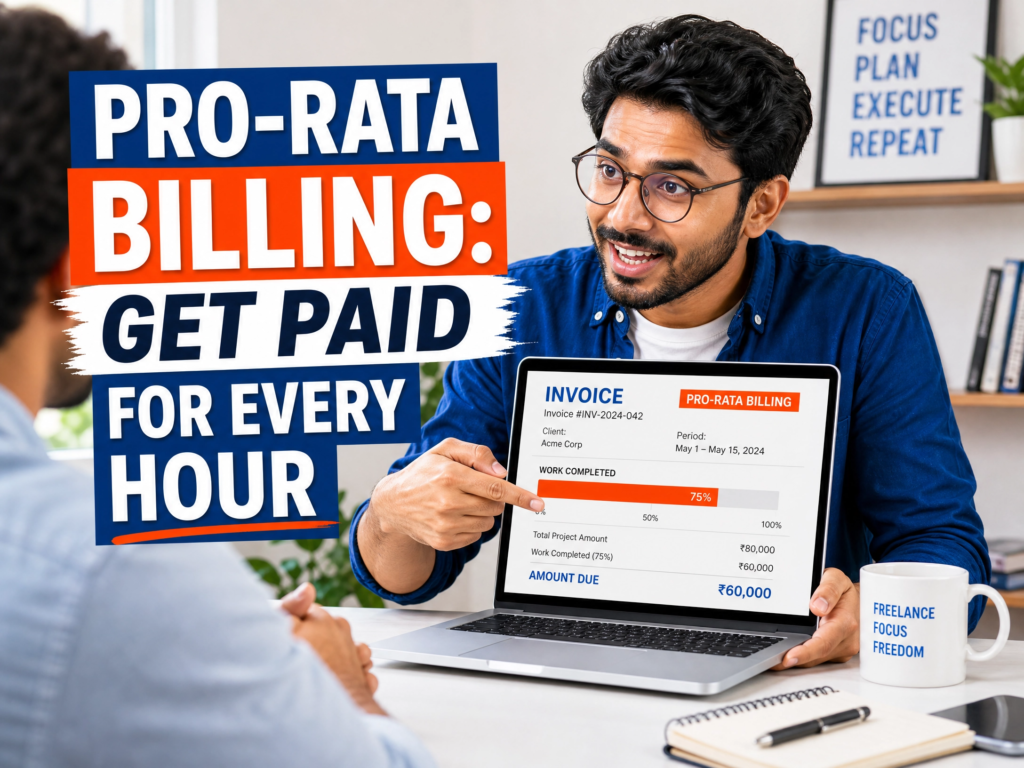
Use this tool to calculate exactly what to put on your leverage invoice today.
Percentage of Work Completed Before Pivot (%):
Upfront Deposit Already Paid ($):
Calculate Outstanding Balance
If the pro-rata amount is higher than what they’ve paid, that is your immediate invoice.
If they refuse to pay this, you do not proceed to the new design phase.
Pro-Rata & Kill Fee Calculator
Calculate the exact outstanding liability before generating your pivot invoice.
Financial Breakdown
The ‘Stop-Work and Settle’ Directive when Client Changed the Entire Project and Won’t Pay
Here is where freelancers mess up. They keep working while arguing over the money.
Never do this. It weakens your negotiating position entirely.
You must execute a clean, professional “Stop-Work” directive.
This means you halt all production. You do not deliver any further assets.
If you are a designer, you need to know how to revoke access to Figma files after non-payment safely and legally.
You own the intellectual property until the final invoice is paid.
The US Copyright Office is very clear: independent contractors own the copyright to their work unless a specific “work made for hire” agreement is signed AND paid for.
If they steal your half-finished wireframes or code to give to a cheaper freelancer, you have massive leverage.
At that point, you immediately look into how to write a clean cease-and-desist letter if a client steals your code or designs.
Interactive Tool : The “Stop-Work” Email Generator
Use this exact script to formally pause the project without sounding hostile.
Project Name:
Generate Script
Send this. Do not apologize. Do not over-explain.
Stop-Work Email Generator
Generate a transactional, legally defensive pause notice.
US vs Global Comparison : Enforcing the Rules
If you are operating out of the US, enforcing a kill fee comes down to state-level contract law. There is no magic federal agency that forces a client to pay a freelancer.
Your Master Services Agreement (MSA) is your entire defense.
For physical goods, the Uniform Commercial Code (UCC) provides some structure. But for creative and digital services, you rely entirely on common law.
If your contract is vague, you are leaving your cash flow up to a local judge’s interpretation.
Courts generally enforce such clauses when they represent a genuine pre-estimate of loss rather than a penalty.
You also need to understand your legal standing. The U.S. Small Business Administration (SBA) strictly defines independent contractors versus employees.
Look, as a contractor, you do not get federal wage theft protections. The labor board is not coming to save you. Your contract is your only shield.
But what if you are working across borders ? The rules of the game change entirely.
In the UK, the Late Payment of Commercial Debts Act actually gives you statutory power to charge interest on ignored invoices automatically.
If you are dealing with this, you should check out when you can legally charge interest on late invoices.
Other countries handle disputes differently, and India is a prime example. The Indian legal framework is heavily guided by Section 73 of their Contract Act.
Their courts strongly recognize quantum meruit—which literally translates to “as much as he has deserved.”
This means if an Indian or overseas client cancels halfway, they are legally bound to pay for the work actually completed, even if your kill fee clause was poorly drafted.
If you are a US freelancer exporting services globally, jurisdiction clauses will dictate your entire strategy.
You absolutely must know how to protect yourself when working with international clients to ensure you aren’t left stranded without legal recourse.
Evidence Checklist & Risk Matrix
Before you demand a kill fee or a pro-rata payment, you need ammo.
Do not go into this fight based on “vibes” or a sense of fairness. Business does not care about fair.
Gather your documentation quietly before sending the stop-work email.
The Evidence Checklist
- Original Scope Document : Signed or acknowledged via email.
- Milestone Approvals : Any message saying “Looks great!” on the early work.
- The Pivot Request : The email where they asked for the massive redesign.
- Time Logs : Your Toggl or Harvest reports showing hours spent.
- IP Lockout : Confirmation that you still hold the native files/source code.
If you have these five things, you are in a highly defensible position.
If they ignore you after you present this, you might need to read up on how to recover an unpaid invoice yourself without a lawyer.
The Dispute Risk Matrix
How hard should you fight ? It depends on the money and your leverage.
| Scenario | Financial Value | Client Leverage | Your Recommended Action |
| Low Risk | Under $1,000 | Client has all source files | Negotiate a small exit fee or walk away. Don’t burn legal fees. |
| Medium Risk | $1,000 – $5,000 | You hold native files | Enforce stop-work. Withhold IP. Send formal demand letter. |
| High Risk | Over $5,000 | Client needs IP immediately | Hard stop. Escalate to debt recovery or legal notice. |
If you fall into the medium or high-risk category, do not let them string you along.
If they just go silent, you have a different problem. You need to know what to do if a client ghosted me after I sent the invoice.
The Quick Decision Framework
You are sitting at your desk right now, reading their slack message about “changing directions.”
Your heart is probably sinking.
Take a breath. Here is your operational flow.
Step 1 : Is the change minor or structural ?
If it takes less than 2 hours to fix, just do it. Preserve the relationship. If it takes 20 hours, it’s a structural pivot.
Step 2 : Have they paid a deposit ?
If yes, does the deposit cover the hours already worked ? If so, you are safe. Just require a new deposit for the new direction.
Step 3 : If the deposit doesn’t cover it ?
You must issue the pro-rata invoice immediately.
Step 4 : Do they refuse to pay ?
You lock the files down. You stop answering creative questions.
You transition entirely to a collections mindset.
If weeks pass, you have to ask yourself when is it officially time for a freelancer to take legal action ?.
Do not let months go by. Debt gets cold very fast.
When It’s Smarter to Walk Away
- Amount is too small (< $500–$1,000)
- Client already has all usable assets
- Enforcement cost > recovery value
Not every dispute is worth winning. Some are only worth ending fast.
Frequently Asked Questions
Can a client refuse a kill fee if I didn’t explicitly call it a ‘kill fee’ in the contract ?
Yes, if the wording is vague. However, you can still demand “pro-rata payment” for hours worked under general contract law.
What if they claim my initial work was poor quality, justifying the redesign ?
This is a classic defensive tactic. This is why you must save their intermediate approval messages. If they said “looks good” last week, they can’t claim it’s garbage today.
Do I have to give them the half-finished files if they pay the kill fee ?
It depends on your contract. Generally, yes. If they buy out the contract via the kill fee, they are entitled to the work-in-progress assets up to that point.
What if there is no written contract at all ?
You rely on written correspondence. Emails, Slack messages, and project briefs establish the existence of an implied contract.
How do I prevent this from happening next time ?
You structure your payments differently. Stop doing 50% upfront, 50% on completion. Move to weekly billing or tight milestone payments so you are never exposed for more than a few days of work.
Final Thoughts
Look, nobody likes dealing with this. It feels awkward and adversarial.
But you are running a business, not a charity.
When a client redesigns your work halfway through, they are asking you to absorb the financial impact of their mistakes.
You must say no. You must enforce the boundary.
Draft that stop-work email. Send the pro-rata invoice. Protect your time.
If you don’t respect your own boundaries, no client ever will.
Author Box
Adv. Sagar Haribhau Shirsat is an active legal professional specializing in commercial transaction architectures, cross-border corporate compliance, and digital debt recovery systems. He designs strategic asset-protection and recovery frameworks that help freelancers, independent contractors, and global agencies defend their cash flow and enforce their billing rights.
Connect via his Official Professional LinkedIn Profile and About Us page.
Disclaimer : This guide is intended for educational purposes and risk management analysis. It does not replace formal legal counsel. For specific cross-jurisdictional contract disputes, always consult a certified attorney or local legal advocate.