
Recovering payment from a client in another country often feels impossible.
When the client is based in the United Kingdom and you are working from the United States, the distance alone can make an unpaid invoice seem beyond practical recovery.
In reality, many cross-border payment disputes are resolved without international litigation.
The key is understanding the legal and commercial pressure points available within the client’s own jurisdiction before considering court proceedings.
Look, I get it. When a client is sitting 4,000 miles away, you feel completely powerless.
You send emails. They bounce back or get ignored. You leave voicemails. Nothing.
You start wondering how to write off the loss because hiring a lawyer in London sounds like financial suicide.
If you are a US Freelancer Stiffed by a UK Ltd Company: Your Step-by-Step Transatlantic Recovery Roadmap starts right here.
I’m going to show you how to pull the exact levers that make international corporate ghosting stop. We aren’t going to threaten anyone.
We are going to use legitimate legal and commercial processes available under UK law to encourage prompt resolution of the unpaid debt.
Here is the thing: dealing with international clients isn’t about aggression. It’s about forensic, calm, step-by-step leverage.
Table of Contents
The Distance Illusion after UK Company Won’t Pay a US Freelancer
We need to address the psychological angle first. Distance makes you skeptical about recovery.
You think, “They are in the UK, I am in the US. My local laws don’t apply, so I have zero power.”
That is exactly what a shady client wants you to think. It is a complete illusion.
A UK limited company is a separate legal entity, but its publicly available corporate information can give a creditor useful information when assessing the company and planning a recovery strategy.
If you want to protect yourself when working with international clients, you have to understand their local vulnerabilities.
If you want to protect yourself when working with international clients, you should understand what information is publicly available about the company, who controls it, and where formal notices can be directed.
Case Study : The Silent Launch

Hypothetical Example: The Silent Launch
Consider a US-based motion graphics designer who completes a promotional video for a UK fintech company. The freelancer delivers the final files, the company launches the campaign, and the invoice remains unpaid for 45 days.
Instead of immediately filing a lawsuit, the freelancer could first verify the company’s registered information through Companies House, preserve evidence of delivery and use, and send a carefully prepared formal payment notice.
Auditing the UK Companies House Registry
Your very first step isn’t sending another angry email. It is gathering intelligence.
The UK government runs a public database called Companies House. It is a goldmine for unpaid freelancers.
You can literally look up any registered business for free.
Go to the UK Government Companies House search portal. Type in your client’s company name.
Here is what you are looking for.
Wherever possible, verify procedural requirements using official UK Government resources before taking formal legal action, as insolvency procedures and court rules can change over time.
Check Their Status
An “Active” status indicates that the company remains registered on the Companies House register. It does not, by itself, confirm that the company is currently trading, solvent, or financially able to pay your invoice.
If the company has an active proposal to strike off, treat it as a reason to investigate promptly. A proposed strike-off can affect how and when you pursue an unpaid debt, so check the company’s filing history and the relevant Companies House information before taking action.
If they are trying to close down, you need to know what happens to your invoice if your corporate client goes bankrupt.
Find the Director Details
Click on the “People” tab. This lists every active director.
The public register generally shows the director’s name, nationality, month and year of birth, and service address.
Sometimes, this is a generic accountant’s office.
Companies House generally displays a director’s public service address rather than their protected residential address.
Check the Filing History
Look at the “Filing History” tab. Pull up their most recent “Micro-entity accounts” or “Full accounts.”
You don’t need to be an accountant to read this. Just look at “Cash at bank and in hand.”
Recent financial statements can provide useful context about the company’s reported financial position. However, published accounts may be historical and should never be treated as conclusive evidence of the company’s current cash flow or ability to pay.
When a client ignores your Slack messages but posts on LinkedIn, having this financial data gives you extreme confidence.
Building Your Evidence Package
Before you strike, you need your paperwork perfectly aligned.
Written communications can be important evidence of what the parties agreed, particularly where there is no single signed contract.
Emails, Slack messages, proposals, invoices, payment records, and delivered work may help establish the scope of the agreement and the parties’ conduct.
Whether that evidence is sufficient depends on the facts and the applicable law.
Even casual chats matter. If you are wondering if a WhatsApp chat can count as a legally binding contract in US and UK law, the answer is yes.
Same goes for Slack. If a client ghosted the final invoice but you only agreed via Slack, you still have standing.
The Evidence Checklist
Collect these items and save them in one secure folder:
- The original proposal or quote.
- Every email approving the scope of work.
- The final delivered assets.
- Proof they are using the assets (screenshots, links).
- Your original invoice.
- Your entire unpaid invoice follow-up email template history.
If they are actively using your work while ignoring the bill, document it.
If it is a design asset, read up on what to do if a client used your design without paying.
Once your evidence is locked down, it’s time to communicate.
The Psychological Trap of the “Accounting Loop”
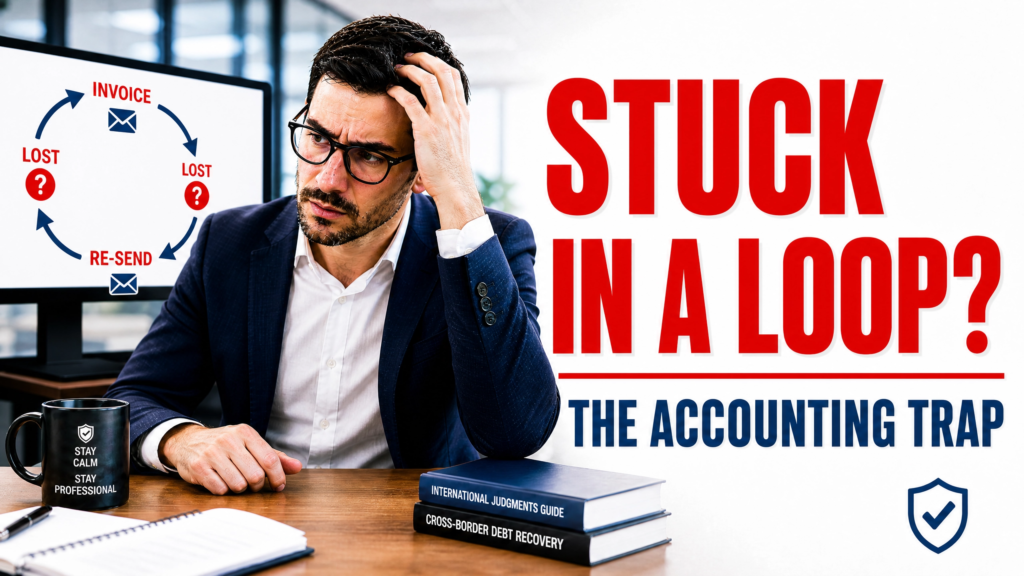
Often, they aren’t totally ignoring you. They are playing a stalling game.
They will claim the invoice is stuck in processing. Or they lost it.
If a corporate client repeatedly claims that an invoice has been lost or cannot be located, treat the pattern as a reason to move from informal reminders to a more structured payment request.
You need to know how to navigate this without losing your temper.
Learn how to get paid by corporate accounts payable when they claim an invoice is lost.
If you are stuck in this loop, change the conversation from a general payment reminder to a specific request for the reason the payment remains blocked.
Shift the conversation. Stop asking “when will I be paid?” and start asking “is there a specific compliance issue preventing the release of these funds?”
It forces them to give a real reasonThis can help identify whether the delay is caused by a genuine administrative issue, an approval problem, or a substantive dispute about the invoice.
or admit fault.
Next time, make sure you design an invoice that accounts payable teams can’t ignore.
Utilizing Statutory Demands in UK Jurisdictions
If the polite follow-ups fail, we escalate.
You are going to leverage a UK legal mechanism called a Statutory Demand.
A Statutory Demand is a formal written warning. It states that if a debt is not paid within 21 days, you will apply to the court to wind up (liquidate) their company.
You can read the official government guidance on making a statutory demand.
Why a Statutory Demand Can Encourage Serious Engagement
UK insolvency procedures create significant commercial consequences for companies facing undisputed debts, making formal insolvency processes an important consideration for many businesses.
If a UK director allows their company to trade while insolvent, they can be held personally liable. They can be banned from being a director for up to 15 years.
A statutory demand can create significant commercial pressure because, if the debt remains unpaid and the legal requirements are satisfied, a creditor may have grounds to pursue further insolvency proceedings.
A creditor can prepare a statutory demand without legal representation. However, where the debt is disputed or the matter involves cross-border service, obtaining advice from a qualified UK legal professional is often prudent.
You can recover an unpaid invoice yourself without hiring a lawyer.
How to Serve It
You download the standard SD1 form. You fill in the debt amount. You sign it.
The demand must be served in accordance with the applicable statutory requirements. For a UK company, the registered office may be one relevant service location, but the precise method and requirements matter. Because you are a US creditor dealing with a UK company, do not assume that simply mailing or emailing a document will constitute valid service. Check the current UK Government requirements and obtain UK legal advice where necessary before relying on a statutory demand.
A US creditor may choose to instruct a UK-based professional process server where appropriate. Fees vary depending on location, urgency, and the method of service, so obtain a current quotation before proceeding.
Before arranging formal service, many creditors choose to email a copy of the proposed demand as a final opportunity for voluntary payment. Formal service of a statutory demand should comply with the applicable legal requirements.
Attach a final notice before legal action script. Keep the tone completely flat and factual.
Tell them the physical copy is on its way.
Many commercial disputes are resolved after a formal legal notice is served, although outcomes vary depending on the circumstances of each case.
Adding Late Fees and Interest
When you send that demand, you shouldn’t just ask for the original amount.
You have suffered a loss. You spent time chasing this.
Before adding interest or recovery costs to your demand, determine which legal regime governs the transaction and what your contract permits.
Under UK law (The Late Payment of Commercial Debts Act), even if your contract doesn’t mention it, you have a statutory right to charge interest.
In qualifying commercial transactions, UK legislation may allow statutory interest and fixed compensation where the legal requirements are satisfied. Whether those provisions apply to a particular cross-border contract depends on the agreement and the applicable law.
If the applicable legal regime permits statutory interest or recovery costs, calculate the amount using the applicable statutory rate and relevant dates, and identify the legal basis for each amount in your demand.
Cost-Effective Cross-Border Collection Intermediaries

Let’s say the 21 days pass. The Statutory Demand is ignored.
Do you hire a London litigation attorney? Absolutely not. That will drain your bank account.
Instead, you escalate to a UK-based commercial debt collection agency.
But wait, should you hire a debt collection agency for your unpaid invoices?
Yes, if they operate on a “no-win, no-fee” basis.
There are specific B2B debt collectors in the UK that specialize in cross-border disputes. Because you already served the Statutory Demand, you have done half their work.
Fees charged by commercial debt collection agencies vary according to the agency, debt amount, jurisdiction, complexity, and recovery model. Some agencies offer contingency-based arrangements, while others may charge fixed or upfront fees.
Compare the terms carefully before instructing an agency, including whether legal action is included and what happens if the debt is disputed.
There is no universal “60-day” rule for deciding when to escalate.
A more useful trigger is whether the invoice is overdue, the debtor has stopped providing a credible payment explanation, the debt is adequately documented, and further informal collection efforts are unlikely to produce payment.
Quick Decision Flowchart
Not sure what step to take today? Follow this logic path.
Plaintext
Are you past the agreed payment date?
├── NO: Send a polite reminder.
└── YES: Are they responding to emails?
    ├── YES, but making excuses: Ask for a specific payment date. Use the Accounting Loop trick.
    └── NO, total ghosting: Proceed to Companies House Audit.
        └── Is the company Active?
            ├── NO: Check insolvency status. Contact the liquidator.
            └── YES: Prepare Evidence Package.
                └── Send Final Notice & Draft Statutory Demand.
The Global Enforcement Reality : USA vs UK vs India
Dealing with international debt requires understanding how different regions treat corporate liability.
You can’t treat a London agency the same way you treat an LLC in Texas or a Pvt Ltd in Mumbai.
Cross-border enforcement can depend on the contract’s governing-law and jurisdiction clauses, where the parties are located, where contractual obligations were performed, and the rules of the court or jurisdiction in which enforcement is sought.
United States (USA)
The US heavily protects the corporate veil. Piercing an LLC to go after a founder’s personal assets is difficult and expensive.
Privacy laws in states like Delaware mean you might not even know who owns the company you are billing.
United Kingdom (UK)
As we established, the UK leans toward transparency.
Directors have strict fiduciary duties.
Where a company owes an undisputed debt and the applicable requirements are satisfied, a creditor may in appropriate circumstances pursue insolvency proceedings, including a winding-up petition. Such proceedings can have serious consequences for the company, so they should not be treated as an ordinary debt-collection tactic.
Risk Matrix : Transatlantic Debt Recovery
When deciding how hard to push, measure your risk accurately.
| Action | Cost | Relationship Impact | Primary Purpose |
|---|---|---|---|
| Reminder Emails | Low | Low | Encourage voluntary payment |
| Companies House Review | Low | None | Verify company information |
| Formal Legal Notice | Low-Medium | Moderate | Escalate the dispute professionally |
| Commercial Debt Collection | Medium | High | Outsource recovery efforts |
| Court Proceedings | High | High | Obtain an enforceable legal remedy |
Preventative Measures for Next Time
The best cross-border debt-recovery strategy is to reduce the likelihood of the dispute occurring in the first place.
You have to secure your boundaries before the project starts.
First, stop working for free and prevent scope creep from eating your profits.
If you are a media buyer, you need to know if you can sue a media buyer not paying ad copy fees. Structure your contracts to protect your specific deliverables.
If they disappear right after you send the bill, follow the exact follow-up timeline for late freelance invoices.
Never let them think that distance equates to safety.
Interactive Tool : The 21-Day Statutory Demand Calculator
If you are issuing a UK Statutory Demand, timing is critical. Use this HTML tool below to calculate your exact legal deadlines based on the date of service.
UK Statutory Demand Calculator
Use the date on which the statutory demand was formally served in accordance with the applicable service requirements. This calculator only estimates the relevant 21-day period; it does not determine whether service was legally valid. For cross-border service, consider obtaining professional advice before relying on the calculation.
Common Situations Where This Strategy May Not Apply
This approach is not appropriate for every cross-border payment dispute. Consider obtaining professional advice before escalating if:
Then bullets:
- The debt is genuinely disputed.
- The company is already subject to formal insolvency proceedings.
- Your contract contains an arbitration clause.
- The debtor is not actually a UK registered company.
- The transaction was handled through a marketplace with its own dispute-resolution process.
- The contract contains an exclusive jurisdiction clause.
- You are unsure which country’s law governs the dispute.
- The amount claimed includes disputed interest, damages, or other sums beyond the original invoice.
Frequently Asked Questions
Does my US contract hold up in the UK ?
It depends. The governing-law clause, jurisdiction clause, nature of the dispute, and applicable conflict-of-laws principles can all affect how a contract may be enforced. A contract governed by US law does not automatically become unenforceable simply because the client is based in the UK. If the debt is disputed or formal proceedings are being considered, obtain advice on the applicable law and jurisdiction before taking action.
What if my client is a sole trader in the UK, not a Ltd company ?
Companies House only lists Limited companies. If they are a sole trader, they are personally liable for the debt. You can still issue a Statutory Demand against them as an individual.
Will serving a Statutory Demand ruin my relationship with the client ?
Yes. But let’s be entirely honest: a client who ghosts you for three months over a five-figure invoice has already destroyed the relationship. You are just cleaning up the mess.
Can I really charge UK statutory late interest as a US citizen ?
Whether you can claim UK statutory late-payment interest depends on whether the transaction falls within the applicable commercial-debt regime, the contract terms, and the law governing the transaction. Being a US freelancer does not automatically prevent a qualifying creditor from relying on UK statutory rights, but cross-border contracts should be assessed on their specific facts before interest or compensation is added to a demand.
How much does a UK debt collection agency charge?
Reputable B2B agencies work on a contingency basis. They typically charge between 10% to 15% of the recovered funds. You pay nothing upfront.
Final Thoughts
We have covered a lot of ground. You now have a functional understanding of cross-border leverage.
The next time you get stiffed by an international client, don’t let the distance paralyze you.
Do the research. Audit their public filings. Build your evidence. Escalate cleanly and unemotionally.
Distance does not eliminate your options. A well-documented contract, clear payment terms, preserved evidence, and a measured escalation strategy can make cross-border invoice recovery far more manageable.
Author Box
Adv. Sagar Haribhau Shirsat is an Indian advocate who writes extensively about freelancer contracts, unpaid invoices, commercial dispute resolution, and practical legal risk management for independent professionals working with domestic and international clients.
Connect via his Official Professional LinkedIn Profile.
Disclaimer: This article is provided for educational and informational purposes only and is intended to help freelancers understand general commercial debt recovery procedures. It does not constitute legal advice and should not be relied upon as a substitute for advice from a qualified attorney or solicitor. Cross-border disputes often involve complex jurisdictional and procedural issues that require professional legal assessment.