Most people tell you to immediately hire a lawyer when a client refuses to pay. I think that is terrible advice.
Lawyers are expensive. They take months to get results. And frankly, a formal lawsuit often burns bridges you could have repaired with a simple conversation.
I prefer leverage. Real, practical leverage that gets cash into your bank account without dragging you into a courtroom.
Look, if you are reading this, you are probably asking one specific question : Can You Sue a Media Buyer Client for Not Paying Your Ad Copy Fees After Running the Ads ?
The short answer is yes. You absolutely can.
If you are dealing with a media buyer not paying ad copy fees, you are not alone. This situation is extremely common in performance marketing, where agencies continue running ads using your work while delaying or ignoring payment.
But suing should be your absolute last resort. There is a much faster, much quieter way to handle a rogue media buying agency.
Let me walk you through the reality of the creative business world.
Can you sue a media buyer for not paying ad copy fees ?
Yes. You can file a legal claim for breach of contract or copyright infringement. However, in most cases, using platform enforcement tools like DMCA takedowns is faster and more effective than going to court.
Table of Contents
The Case Study : Ryan’s $10,000-a-Day Problem
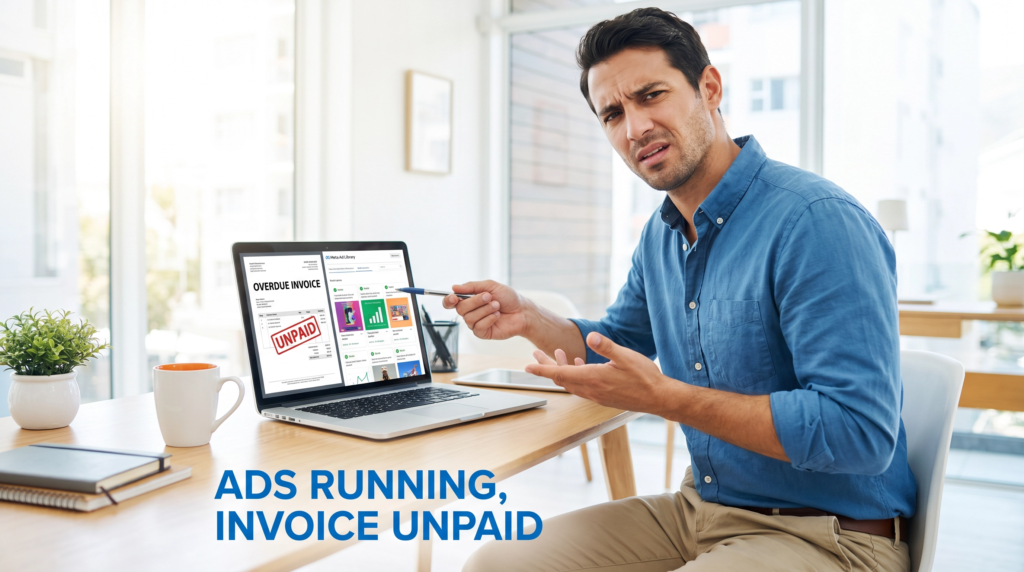
Let me tell you about a copywriter named Ryan. He is a real freelancer I helped last year.
Ryan wrote 40 high-converting ad copy variants for a media buyer. This agency managed ads for e-commerce brands.
The agency loaded Ryan’s text into a Meta ad account. Within days, they were spending $10,000 a day on his exact words.
The ads were crushing it. The return on ad spend (ROAS) was massive.
But when Ryan sent his $2,000 invoice for the copy, the agency went silent.
He waited two weeks. He sent polite reminders. Nothing.
When a what to do when a client stops responding after invoice ? scenario happens to you, it feels incredibly personal.
Ryan felt betrayed. He thought his only option was to spend $500 filing a small claims lawsuit.
I told him to put his wallet away. We were going to use a different strategy. We used what I call the High-Spend Account Intervention.
Why Media Buyers Delay Paying Ad Copy Fees (The Ad Spend Disconnect)
Here is the thing about media buyers. They operate in a world of massive cash flow, but very tight margins.
An agency might spend $50,000 a month on Meta ads, but they only keep a 10% to 15% management fee.
Because their cash is tied up in ad platform billing cycles, they often treat freelancers like free credit cards.
They delay your payment to float their own operational costs.
It is incredibly frustrating. You are watching them burn thousands of dollars a day on ads using your words, while they ignore your emails.
A lot of freelancers assume the client is broke. But usually, that is not the case.
When a Client runs out of money Mid-Project ? Legal & Smart Recovery Guide for Developers and writers, they pause the ads.
If the ads are still running, they have the money. They are just choosing not to pay you.
This is the Ad Spend Disconnect. They value the ad platform’s billing system more than they value your invoice.
We need to escalate the issue through the ad platform’s enforcement systems.
Legal Rights When a Media Buyer Is Not Paying Ad Copy Fees
To fix this, we need to talk about intellectual property.
Many freelancers don’t realize how copyright law actually works.
Unless you signed a contract explicitly stating otherwise, you own the copyright to your work until the invoice is paid in full.
Payment is the trigger for the copyright transfer. No money ? No transfer.
This means if an agency runs your copy without paying you, they are technically committing copyright infringement.
If you are wondering What to Do When a Client Uses Your Work But Refuses to Pay You, you need to look at platform policies.
Meta, Google, and TikTok do not mess around with stolen intellectual property.
Under the US Copyright Office guidelines, digital platforms have “Safe Harbor” protection.
This means platforms cannot be sued for user-uploaded stolen content, as long as they remove the content when the original creator complains.
Because platforms want to keep their Safe Harbor status, their safety teams are ruthless.
If you file a valid copyright strike against an ad, Meta will pull the ad down.
More importantly, repeated strikes can permanently ban the agency’s entire business manager account.
To a media buyer, an ad account ban is a critical business risk. It is their worst nightmare.
How to Handle a Media Buyer Not Paying Ad Copy Fees Using DMCA
This brings us to the High-Spend Account Intervention.
We do not threaten the agency. We do not yell. We simply report the stolen property to the platform hosting it.
Here is exactly how you execute this maneuver calmly and professionally.
1.Document the Active Ads : Gather undeniable proof.
Before you say a word to anyone, go to the Meta Ad Library or Google Transparency Center. Search for the brand’s active ads. Take clear screenshots showing your exact copy running live. Save the URLs.
2. Verify Your Paper Trail : Secure your timeline.
You need proof that you wrote the copy first. A Google Doc with timestamps is perfect. If you used messaging apps, that works too. Look into whether a whether a WhatsApp chat is legally binding ? (US & UK Law) applies to your situation.
3. Send the Final Warning : The 48-hour notice.
Send one last email. Do not threaten a lawsuit. Instead, state: “Since Invoice #123 remains unpaid, copyright has not transferred. If payment is not received within 48 hours, I will file a DMCA takedown notice with Meta regarding the unauthorized use of my intellectual property.”
4. File the Strike : Execute if ignored.
If they ignore the warning, go to the Facebook or Google Copyright Report form. Fill it out honestly. Provide your original timestamped doc and the screenshots of their active ads. Submit the form.
Before you send that final warning, make sure you have followed a reasonable escalation path.
You should always review The Exact Follow-Up Timeline for Late Freelance Invoices (That Actually Works) to ensure you are acting professionally.
When Ryan sent his 48-hour DMCA warning, the agency owner called him within 15 minutes.
The invoice was paid via wire transfer an hour later.
Why ? Because the agency could not risk their client’s ad account getting shut down. We found their leverage point.
What to Do If the Media Buyer Still Does Not Pay Your Ad Copy Fees
Sometimes, the media buyer is just an employee who quit, or the agency itself is completely incompetent.
If the agency ignores your DMCA warning, you have another highly effective option.
You bypass the agency entirely and go straight to the end-client.
The end-client is the brand whose product is actually being sold.
Often, the brand has already paid the agency for your work. They have no idea the agency is stiffing the freelancer.
When you reach out to the brand’s founder or marketing director, keep it calm and factual.
Let them know you are the original author of the current ad campaigns, but the agency has defaulted on payment.
State that you want to avoid filing a platform copyright strike that might disrupt their ad account.
This usually creates a massive internal panic. The brand will immediately demand answers from the agency.
If you find yourself in this situation, you need to know your rights.
Read up on being an legal rights of unpaid subcontractors ? Here is When You Can Sue the End-Client Directly to understand how to navigate this without violating non-disclosure agreements.
How Much You Can Claim When a Media Buyer Does Not Pay Ad Copy Fees
While you wait for payment, you might be wondering about late fees.
You are losing money due to inflation and lost opportunity cost.
Before you escalate, you should calculate exactly what you are owed.
I always tell freelancers to check if they Can You Legally Charge Interest on Late Invoices ? (US,UK, & India Rules) before sending a final demand.
Use this interactive tool to figure out your financial leverage.
Having the exact math ready shows the client you treat your freelance practice like a real business.
It strips the emotion out of the conversation and replaces it with cold, hard numbers.
The Evidence Checklist
If you do end up needing to file a platform strike or take formal legal action, your evidence is everything.
Judges and platform safety teams do not care about your feelings. They care about paper trails.
Before making any moves, gather these items:
- The Original Agreement : A signed PDF, an Upwork contract, or clear email acceptance.
- Timestamped Creation : Google Docs version history showing you typing the copy.
- Delivery Proof : The email or Slack message where you handed over the final assets.
- Infringement Proof : Screenshots of the Meta Ad Library showing the ads running.
- The Unpaid Invoice : The original PDF invoice showing the due date has passed.
If you are missing half of these, you need to tighten up your operations.
In the future, make sure you know How to Recover an Unpaid Invoice Yourself (Without Hiring a Lawyer) by building a flawless paper trail from day one.
Global Legal Options for Media Buyer Non-Payment of Ad Copy Fees
Because ad buying is a borderless industry, you will often find yourself dealing with clients across the world.
Look, international contract disputes can feel incredibly overwhelming when you are sitting at home trying to get a simple invoice paid.
Thankfully, digital intellectual property law is surprisingly unified due to long-standing global treaties, though actual enforcement models differ drastically.
Here is how this breakdown looks when you are forced to cross jurisdictional lines.
Under the Digital Millennium Copyright Act, platforms are required to remove infringing content once notified by the original creator.
Similarly, under Section 73 of the Indian Contract Act, 1872, you are entitled to compensation for losses caused by breach of contract.
The United States (DMCA & Contracts)
In the US, the Digital Millennium Copyright Act (DMCA) acts as your primary practical enforcement tool.
It legally forces American tech platforms like Meta and Google to act quickly on verified copyright infringement claims.
According to statutory guidelines outlined by Georgetown University, platforms must remove access to infringing materials to maintain their safe harbor immunity.
Furthermore, US contract law strongly protects original creators when explicit payment terms are breached.
If your contract states that rights only transfer upon final settlement, you legally retain ownership until that cash lands in your bank.
United Kingdom (IPO & Late Fees)
The UK takes an equally strict approach to protecting independent creative professionals.
The UK Intellectual Property Office ensures that unregistered copyright automatically protects your written text from the exact moment of creation.
While British regulations do not use the specific American term “DMCA,” UK platforms follow structurally identical web-based takedown procedures.
Here is my favorite part about dealing with British media buyers: the UK features strict statutory late payment laws.
You can legally charge specific compensation fees and interest on late commercial debts without even needing it in your contract.
India (Copyright Act, 1957)
In India, statutory copyright protection is also granted automatically the very moment your copy is fixed into writing.
Under Section 73 of the Indian Contract Act, you hold a clear right to claim financial compensation for losses caused by broken business agreements.
But I have to be completely raw with you here: Indian civil courts move at a notoriously slow pace.
A formal contract lawsuit in India can drag on for several years before reaching a final resolution.
This reality makes the Meta or Google ad account strike strategy absolutely vital for local creators.
By targeting the live ad campaigns directly, you bypass the sluggish court systems entirely and force an immediate settlement.
The Global Cross-Border Reality
Here is the ultimate truth about running a cross-border freelance business: you are protected worldwide by international IP frameworks.
Under global cooperation treaties, over 180 countries are legally bound to respect your creative copyright just as they would respect a local citizen’s work.
But actually filing a formal lawsuit against a client located in another country is rarely worth your time, energy, or money.
That is why I always lean on platform ecosystem pressure rather than international litigation to collect what is owed.
When you threaten an ad account’s life support system, borders instantly disappear, and the agency finds a way to pay.
The Risk Matrix for Ad Copywriters
Here is a practical comparison of strategies if you are dealing with a media buyer not paying ad copy fees :
Every action you take has consequences.
Before you pull the trigger on any strategy, you need to weigh the risks.
| Tactic | Relationship Risk | Success Probability | Time to Execute |
| Polite Follow-ups | Low | Low (if already ghosted) | 1-2 Weeks |
| End-Client Outreach | Medium | High | 2-3 Days |
| Platform DMCA Strike | High (Burns Bridge) | Very High | 24-48 Hours |
| Small Claims Court | High | Medium (Hard to collect) | 3-6 Months |
Look at that table closely.
If an agency is already using your work without authorization, the relationship is already dead.
Do not worry about burning a bridge with a non-paying client.
Focus on the tactics that have a high probability of success and a short execution time.
What to Do Right Now If a Media Buyer Is Not Paying Ad Copy Fees
If you are sitting there paralyzed, wondering what your very next step should be, use this simple logic flow:
- If the invoice is 1-14 days late : Send a friendly reminder. Do not panic yet.
- If the invoice is 15-30 days late : Send a firm warning about late fees and halt all current work. Learn to Stop Working for Free : How to Prevent Scope Creep From Eating Your Profits.
- If the invoice is 30+ days late and ads are running : Gather screenshots and prepare the DMCA warning.
- If they ignore the DMCA warning : File the strike directly with Meta or Google.
If you are still confused about timelines, you need to understand When is it Officially Time for a Freelancer to Take Legal Action?.
Do not let them string you along for months. Set your boundaries and enforce them.
Frequently Asked Questions (FAQs)
Does a DMCA takedown help when a media buyer is not paying ad copy fees ?
No. Filing a copyright notice through Meta, Google, or TikTok’s official safety channels is completely free. You do not need to hire a lawyer to submit the web form.
What if the agency claims they rejected my copy ?
If they rejected it in writing but are still running it in their ad account, their claim is inconsistent with the evidence. Your screenshots from the Meta Ad Library will prove they are actively using the material.
Can the agency counter-sue me for taking their ads down ?
They can file a counter-notice to restore the ads. However, suing you for damages is highly unlikely if they legitimately haven’t paid you. They would have to prove in court that they owned the rights without paying, which is incredibly difficult.
Should I threaten them on social media ?
Absolutely not. Public shaming can trigger defamation claims and makes you look unprofessional. Keep the dispute private, documented, and strictly business.
What if the media buyer not paying ad copy fees is in another country ?
Cross-border lawsuits are a nightmare. This is exactly why the platform strike is so powerful. Meta enforces its IP rules globally. It doesn’t matter if you are in India and the buyer is in Canada; Meta will still pull the ad down.
The Bottom Line
You are a business owner.
When a media buyer takes your ad copy, runs it to generate revenue, and refuses to pay you, they are treating you like an unsecured lender.
You do not have to accept that.
Before you waste money on legal fees, look at the tools you already have. Use the platform rules to your advantage.
Keep your tone calm, keep your records flawless, and protect your cash flow.
This strategy is based on established copyright enforcement frameworks used across major advertising platforms.
If you are currently dealing with a media buyer not paying ad copy fees, focus on enforceable leverage—not emotional reactions.
Author Box
Adv. Sagar Haribhau Shirsat is an active legal professional specializing in commercial transaction architectures, cross-border corporate compliance, and digital debt recovery systems. He designs strategic asset-protection and recovery frameworks that help freelancers, independent contractors, and global agencies defend their cash flow and enforce their billing rights.
Connect via his Official Professional LinkedIn Profile About Us.
Disclaimer : This guide is intended for educational purposes and risk management analysis. It does not replace formal legal counsel. For specific cross-jurisdictional contract disputes, always consult a certified attorney or local legal advocate.