It’s 2 AM. You just hit “send” on the final project files to a client in London, or maybe Singapore. You breathe a sigh of relief, fire off the invoice, and go to sleep expecting your money to hit your bank account by Friday.
Friday comes. Nothing.
You send a polite email. Crickets.
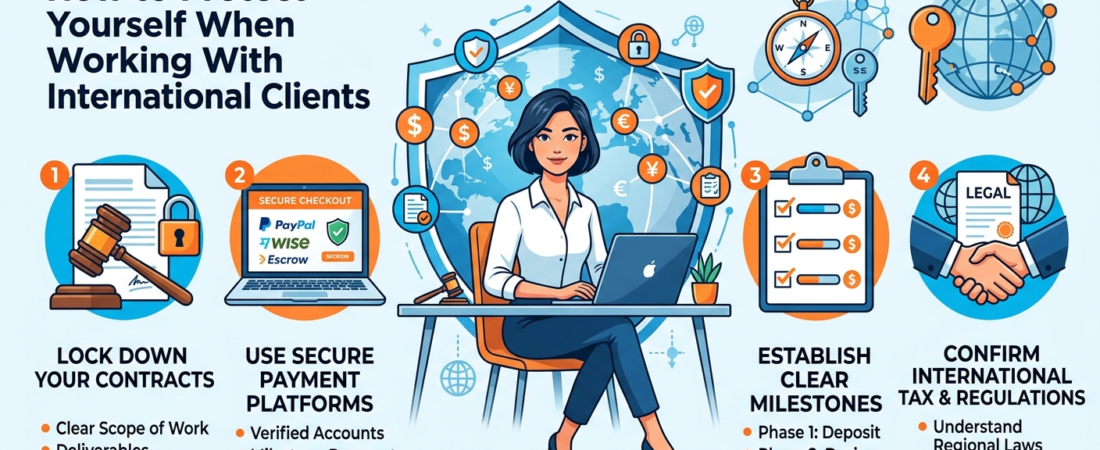
Suddenly, the reality sets in: your client is 4,000 miles away, operating in a totally different time zone, governed by laws you don’t understand, and your local small claims court can’t do a damn thing to help you. If you want to Protect Yourself When Working With International Clients, you have to stop acting like a local employee and start operating like a global business.
I’m not a boardroom lawyer who charges $800 an hour to quote Latin. I’m the person freelancers come to when they are bleeding cash and out of options. I’ve seen brilliant tech developers and top-tier graphic designers get completely taken advantage of because they relied on “trust” instead of systems.
We are going to fix that right now.
Table of Contents
The Ugly Behind-the-Scenes Reality of Global Payments
Clients don’t just delay payments because they are evil. They delay payments because it benefits their cash flow, and because you made it easy for them to do so.
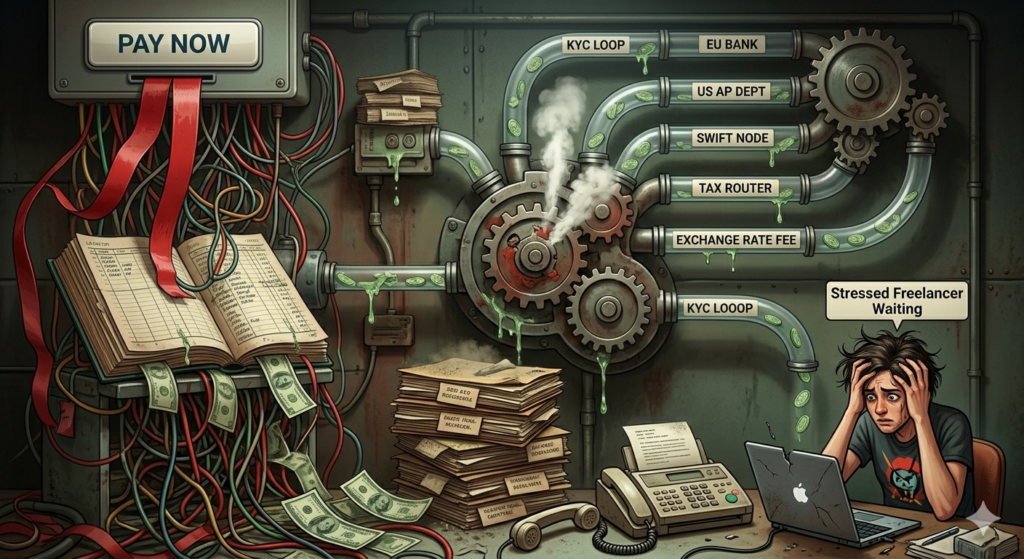
When you send an invoice to a mid-to-large agency overseas, it doesn’t go straight to the CEO’s desk. It goes into the inbox of a project manager who is currently juggling 40 other fires. If they remember, they forward it to Accounts Payable (AP). The AP department’s entire job is to keep money inside the company for as long as legally possible.
They will blame currency exchange rates. They will blame international bank holidays. They will tell you their payment portal is “undergoing maintenance.”
The truth ? You are an unsecured, remote vendor. If they have to choose between making local payroll or paying a foreign freelancer, you get pushed to next month. They prioritize the squeaky wheel.
If you want to bypass the corporate runaround, you need to set terms that force them to pay. If you want to know which payment terms actually give you leverage, you should understand Net 15 vs Net 30 vs Net 45 and which gets you paid faster.
The Cross-Border Compliance Guide : Your Global Shield
This is the meat of it. 80% of protecting yourself globally comes down to understanding the invisible lines drawn on the map. You aren’t an advocate, so I won’t bore you with heavy legal jargon. But you must understand how to lock down your money before you write a single line of code or design a single logo.
When a US freelancer works with a client in Europe or Asia, the biggest threat is jurisdictional ambiguity. If things go wrong, whose rules are we playing by ? Where do we fight ?
If you don’t decide this in advance, the default answer is “nowhere,” and your client gets free work.
1. Jurisdictional Selection Clauses ( Whose turf are we on ? )
A jurisdictional clause is simply a sentence in your contract that says: “If we argue, we argue in my hometown using my local rules.”
If you are based in Texas, and your client is in Germany, your contract must state that any dispute will be handled under Texas law. Why ? Because you cannot afford to hire a lawyer in Berlin to chase a $5,000 invoice.
Always claim home-field advantage. If a massive international client refuses and insists on their jurisdiction, you need to demand an upfront deposit to cover the risk.
2. Specialized Escrow Platform Integrations
Never rely on “net-30” promises for first-time international clients. You don’t know them, and they don’t know you.
The fix is Escrow. Escrow means a neutral third party holds the money before you start working. You know the client has the cash (because they deposited it), and the client knows you won’t run away (because you don’t get the cash until you deliver).
- Upwork/Fiverr : Built-in escrow, but they take a massive 10-20% cut. Good for starting, terrible for scaling.
- Escrow.com : The gold standard for independent international freelance work. You link it, they fund it, you build the website, they release the funds.
- Payoneer/Deel : Great for setting up milestone-based payments that lock in funds across borders.
3. International Arbitration Parameters
Suing someone in another country is a nightmare. Enter International Arbitration.
Instead of going to a foreign court, you and the client agree to hire a neutral expert (an arbitrator) to look at the emails, look at the work, and make a final decision. Under an international treaty called the New York Convention, arbitration decisions are legally enforceable in over 160 countries.
Keep it simple. Add a line to your contract: “Any disputes will be resolved through binding online arbitration.”
Target Geographical Zones : The Rules of the Game
You need to know how different regions operate. Here is your cheat sheet.
- United States (US Clients)
- W-8BEN Forms : If you are outside the US billing a US client, they will ask for this. It proves you aren’t a US taxpayer so they don’t have to withhold 30% of your money. Have it filled out and ready.
- Independent Contractor Laws : US companies are terrified of misclassifying freelancers as employees. Keep your communication strictly business-to-business.
- ACH vs Wire : Push for ACH transfers via Wise or Payoneer. Direct international wire transfers will eat $30-$50 in hidden banking fees.
- United Kingdom (UK Clients)
- The Late Payment Directive : The UK actually has great laws protecting vendors. You have a statutory right to charge interest on late payments at 8% plus the Bank of England base rate. Tell them you enforce this.
- Clear Scope : UK agencies are strict on scope creep. If they ask for extra revisions, get the price increase in writing immediately. Want to know if a quick chat counts as approval ? Read up on whether a WhatsApp conversation is a legally binding contract.
- European Union (EU Clients)
- GDPR Compliance : If you are handling any data for an EU client (even just an email list), your contract needs a line stating you comply with data protection rules. EU clients will use “compliance issues” as an excuse to delay payment.
- VAT (Value Added Tax) : If you are outside the EU, you generally don’t charge VAT, but your invoices need to explicitly state why (e.g., “Reverse charge applies”).
- SEPA Transfers : EU businesses love SEPA (Single Euro Payments Area). Get a virtual Euro bank account via Wise to accept these instantly.
- India (Indian Clients or Indian Freelancers)
- FEMA Regulations : If you are in India receiving foreign funds, the Foreign Exchange Management Act requires specific documentation (FIRC) from your bank to prove the money came from exporting services.
- GST LUT : Indian freelancers exporting services must file a Letter of Undertaking (LUT) to avoid paying an 18% tax out of their own pocket.
- MSMED Act : If you are an Indian freelancer dealing with an Indian client, register as an MSME. The government mandates that MSME invoices must be paid within 45 days, or the client pays compound interest.
Tool : Cross-Border Escrow Pitch Generator
Use this to casually but firmly introduce Escrow to a new international client.
Escrow Pitch Generator
Step-by-Step Execution Timeline: The Payment Enforcement Protocol
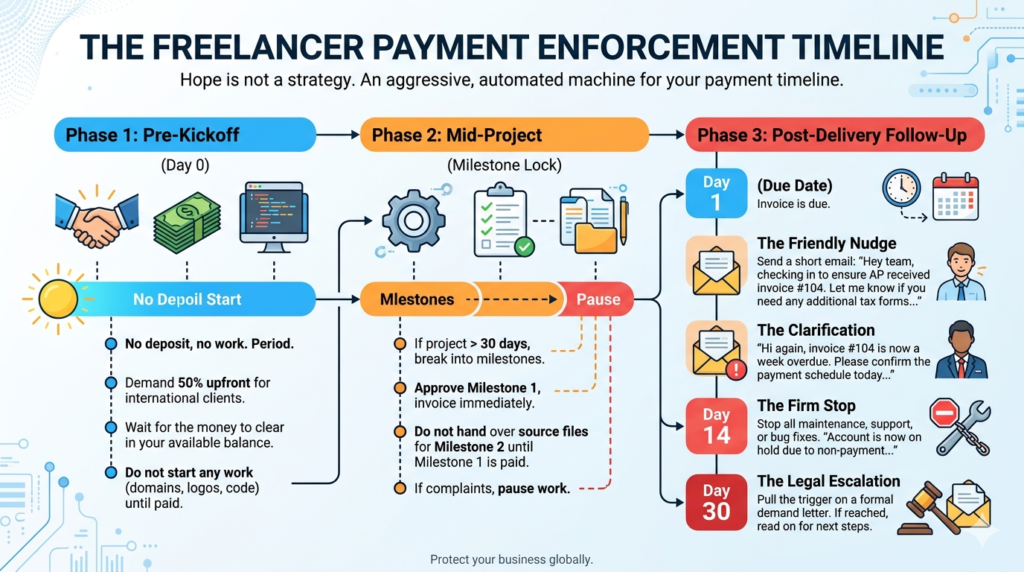
Hope is not a strategy. When working with international clients, your payment timeline needs to be an aggressive, automated machine. You need to know how to write an invoice that gets paid faster right out of the gate.
Here is the exact schedule you follow.
Phase 1 : Pre-Kickoff (Day 0)
No deposit, no work. Period.
For international clients, demand 50% upfront. Do not buy domains, do not sketch logos, do not write code until the wire clears. Bank receipts mean nothing; they can be faked or reversed. Wait for the money to hit your available balance.
Phase 2 : Mid-Project (Milestone Lock)
If the project takes longer than 30 days, break it into milestones.
If they approve Milestone 1, invoice for it immediately. Do not hand over the source files for Milestone 2 until Milestone 1 is paid. If they complain, pause work.
Phase 3 : Post-Delivery Follow-Up
You delivered the final files. The invoice was sent. Now the clock starts.
- Day 1 (Due Date) : The invoice is due.
- Day 3 (The Friendly Nudge) : Send a short email. “Hey team, checking in to ensure AP received invoice #104. Let me know if you need any additional tax forms from my end to process.”
- Day 7 (The Clarification) : “Hi again, invoice #104 is now a week overdue. Please confirm the payment schedule today so I can update my ledger.”
- Day 14 (The Firm Stop) : Stop all maintenance, support, or bug fixes. You tell them outright: “Account is now on hold due to non-payment. All ongoing support is paused until the balance is cleared.”
- Day 30 (The Legal Escalation) : This is where you pull the trigger on a formal demand letter. If you have hit this stage, read exactly what to do when a client ghosted after an invoice.
Utility Tool : The Late Payment Burden Calculator
Every day your money sits in a client’s bank account instead of yours, you are losing money to inflation, lost interest, and opportunity cost. Stop looking at a $5,000 unpaid invoice as just $5,000.
Here is the mathematical reality of what their delay is costing you.
We calculate the Late Payment Burden ($L$) using this formula:
$$ L = P \times \left( \frac{r}{365} \right) \times d $$
Where $P$ is the principal invoice amount, $r$ is the annual interest rate or inflation rate (e.g., 0.08 for 8%), and $d$ is the number of days late. Plus, add in a flat rate for your wasted administrative time.
Calculate exactly how much cash you are bleeding right now.
The Hidden Cost of Delay
Real-World Case Study : The “Corporate Realignment” Trap
Let me tell you about a textbook international payment dispute.
A freelance 3D animator based in Canada delivered a massive commercial package to a mid-sized marketing agency in Dubai. The files were delivered via Dropbox. The agency launched the commercial. It was a massive hit.
Then, the $12,000 invoice went unpaid.
When the freelancer followed up, the Dubai agency claimed they were undergoing “internal corporate structural realignments” and all vendor payments were frozen indefinitely. This is a classic stall tactic. They had the money; they just didn’t want to wire it to Canada when they could use it to fund their next local project.
Here is how the situation was dismantled systematically:
- The Takedown Notice Threat : The freelancer retained the IP rights until final payment. Because the agency was already airing the commercial, the freelancer informed them that a DMCA takedown notice would be issued to the hosting platforms (YouTube, Vimeo) and the agency’s end-client.
- The Paper Trail Push : The freelancer attached the signed contract highlighting the “jurisdiction in Ontario” clause, proving they were ready to file a local small claims suit which would create a public default judgment against the agency.
- The Result : The “frozen” AP department miraculously unfroze within 48 hours, and a wire transfer was initiated.
If your client takes your files and runs, you have leverage. You need to read the exact playbook on what to do when a client used my work without paying.
The Evidence Trail : Build an Iron Clad Case
If you ever need to legally force a payment, your word means absolutely nothing. Judges and arbitrators only care about the paper trail.
Here is exactly what you need to back up for every international project:
- The Original Agreement : A signed PDF. Under the US E-SIGN Act (15 U.S.C. § 7001) and the UK Electronic Communications Act 2000, digital signatures are 100% legally binding. Keep a copy in the cloud. Check the official US code here for proof that digital agreements hold up.
- Scope Change Approvals : When they asked for “one more quick thing” over Slack, did you screenshot their “yes” to the extra fee ? Save it.
- Delivery Logs : You need hard proof they received the files. Use trackable links ( like Dropbox with download notifications or DocSend ) so you have a timestamped log of their IP address downloading the work.
Chances of Winning : The Risk Assessment Matrix
Not every invoice is recoverable. You need to know when to fight and when to cut your losses. Here is the reality check.
| Documentation Level | Jurisdiction Setup | Communication | Recovery Likelihood |
| Signed contract + Upfront deposit | Your home state/country specified | Email approvals, tracked downloads | HIGH |
| Email agreement + No deposit | No jurisdiction specified | Unorganized Slack messages | MEDIUM |
| Verbal agreement + No contract | Client’s foreign country | Ghosted on WhatsApp | LOW |
Regulatory Nuances : India vs. Global Regions
Payment recovery heavily depends on where you live.
If you are an Indian freelancer, the MSMED Act is a massive weapon. If registered, your clients are legally required to pay you within 45 days. If they don’t, they are hit with compound interest at three times the bank rate, and the MSME Samadhaan portal allows you to file complaints directly online without a lawyer.
Globally, things are different. The US relies heavily on state-level Small Claims Courts ( which are difficult to enforce internationally ) or the Prompt Payment Act (which mostly applies to federal contracts). The UK utilizes Statutory Demands under the Insolvency Act, which can freeze a company’s assets for unpaid debts. Know your local weapons.
Real-World Insightful FAQ
Can I charge late fees on invoices ?
Only if they are explicitly stated in your signed contract before the project begins. You cannot randomly slap a 10% late fee on an invoice at day 45 because you are angry. Put it in your initial terms: “Invoices overdue by 15 days will incur a 5% monthly late fee.”
What if a client completely ignores my invoice ?
You stop acting like an employee asking for permission and start acting like a creditor. You send a formal Demand Letter. It is a legal document stating they have X days to pay before further action is taken.
How do I handle common payment excuses like ‘accounting loops’ ?
You cut through the middleman. If the project manager says AP is holding it up, ask for the AP department’s direct email and phone number. Tell them, “I will reach out to them directly to clear up any administrative blocks.” 90% of the time, the project manager just forgot to submit it, and your threat of going to AP fixes the problem instantly.
Tool : Formal Notice of Action Generator (PDF Exportable)
When emails stop working, generate a formal notice.
Formal Notice Generator
The Mindset Shift
Getting paid on time is not about chasing people down or begging for what you are owed. It is about establishing an iron-clad operational environment from day one. You need to make delaying your money incredibly inconvenient, uncomfortable, and risky for them.
You set the rules. You dictate the jurisdiction. You hold the files until the wire clears.
When you operate with this level of commercial boundary, the bad clients disappear, and the good international clients respect you immediately. Stop hoping your clients will do the right thing, and start building contracts that force them to.
About the Author
I’m Advocate Sagar Haribhau Shirsat . the strategist who steps in when the polite emails stop working. With a deep focus on international commercial dispute resolution, I help independent creatives and tech agencies build bulletproof payment infrastructures and recover lost revenue across borders. I don’t care about corporate PR; I care about getting you paid.
Connect with his professional network on LinkedIn for ongoing insights into corporate asset protection.
Disclaimer : This guide is intended for educational purposes and risk management analysis. It does not replace formal legal counsel. For specific cross-jurisdictional contract disputes, always consult a certified attorney or local legal advocate.