Look. If you are reading this, you are likely managing client domains, running website migrations, or handling hosting accounts.
You might even be staring down a client who locked you out right after a migration, leaving your final invoice sitting unpaid.
I have seen this exact scenario play out hundreds of times.
Freelancers often assume they are immune to hosting legalities. They think a domain fight is just between the client and the registrar.
This is not really about GoDaddy. This is about what happens to freelancers when client control + domain ownership + unpaid invoices collide.
Here is the thing : that assumption is completely false.
Can You Be Sued for a Client’s GoDaddy Account Dispute ?
Yes. Absolutely.
In most cases, the dispute is not about money—it becomes about access, ownership, and authorization, which is where legal risk begins.
The good news is this: most freelancers get into trouble not because they are wrong—but because they react emotionally.
If you understand where the legal boundaries are, you are actually in a stronger position than the client. The system favors documented work, clear communication, and intellectual property rights.
And it happens a lot faster than you might think. Let me explain exactly how this works, why you are at risk, and how to protect your money.
Yes, a freelancer can be sued in a client domain or hosting dispute if they access accounts without authorization, restrict access, or interfere with domain ownership. Legal risk depends on account control, contract terms, and applicable cyber laws.
Table of Contents
The Core Problem : GoDaddy’s Legal Landscape

Right now, GoDaddy Inc. and similar registrars face constant litigations, lawsuits, and court rulings regarding account management and domain ownership.
Registrars are legally protective of their own liability. When a dispute arises, they lock everything down.
As a freelancer or web developer managing these client assets, these legal liabilities directly affect your business.
If a client accuses you of holding their domain hostage, the registrar will not defend you. They will protect themselves.
This leaves you entirely exposed to the legal fallout.
The “Business Customer” Trap
This is the biggest mistake I see independent developers make.
The Mistake : You log into a client’s GoDaddy account to configure their DNS or transfer a domain. Or, you buy the domain on their behalf using your own account.
The Consequence : The client disputes your final invoice. They contact GoDaddy support, claiming you are an unauthorized third party hijacking their digital property. GoDaddy freezes the account.
The Law : GoDaddy’s updated terms mean freelancers are treated strictly as commercial entities. Their terms of service protect the platform.
If a client disputes a website migration or domain transfer, the liability shifts entirely to you. You are suddenly acting as an unauthorized broker in the eyes of their compliance team.
If you are dealing with a situation where a client simply vanished, you need to understand what to do when a client uses your work but refuses to pay you.
Do not try to take the domain back by force. It will backfire.
Domain Ownership & Settlements : The Legal Reality
Let’s look at the hard facts of domain ownership. Who legally owns a domain when a client refuses to pay the final invoice after a migration?
It comes down to whose name is on the registration data (WHOIS).
If the client’s name is on it, it is their property. Period.
Even if they owe you thousands of dollars, holding their domain hostage violates the Anticybersquatting Consumer Protection Act (ACPA), 15 U.S.C. § 1125(d).
In major court cases, like Petroliam Nasional Berhad v. GoDaddy.com, Inc. (9th Cir. 2013), courts ruled that registrars are largely shielded from liability in domain disputes.
The courts essentially stated that if there is a fight over a domain, the fighting parties bear the legal burden. Not GoDaddy.
If you want to know if you can simply pull the plug on their site, I highly recommend read the legal guide on shutting down a client’s server for non-payment .
Spoiler : Doing it wrong can result in serious legal consequences.
Case Study : The Migration Trap

Let me share a real-world scenario I analyzed recently.
A freelance developer in Chicago agreed to migrate a massive e-commerce site for a new client.
The developer handled the GoDaddy migration, updated the nameservers, and launched the site perfectly.
The client immediately changed all the GoDaddy passwords. Then, they ignored the final $4,500 invoice.
The developer panicked. He used a backdoor FTP account he had left open to take the website offline until he got paid.
The client didn’t just refuse to pay. They hired a lawyer.
The lawyer cited the UK Gov Computer Misuse Act 1990 (the client was UK-based) and local US cyber laws, claiming unauthorized access and business sabotage.
The developer lost his $4,500 and had to pay $2,000 in legal settlement fees just to make the lawsuit disappear.
If you find yourself stuck in a similar post-migration nightmare, you need to read the specific legal steps for developers regarding clients not paying after website migration.
Actionable Recovery Plan
If you are stuck in a website migration payment dispute on GoDaddy or any other host, here is how to legally draft a notice and recover your unpaid fees without violating hosting terms.
First, stop logging into their accounts immediately.
Every login is logged by the host’s IP tracking. It can be used as evidence of unauthorized access if the relationship has broken down.
Second, gather your communications. Did they approve the launch in a chat?
You might be surprised to learn how a WhatsApp chat can count as a legally binding contract. Export those chats immediately.
Next, you need to issue a formal demand.
- State the exact amount owed.
- State the exact date the work was delivered.
- Inform them that using the code without payment constitutes copyright infringement.
If they stole your custom code, you need to know how to write a clean cease-and-desist letter.
This changes the dispute from “I want my money” to “You are violating federal copyright law.”
The “No Hostage” Rule
Never hold the domain hostage.
Instead, use the ICANN Uniform Domain-Name Dispute-Resolution Policy (UDRP) as leverage, but only if you genuinely have a trademark claim.
If you are just owed money for a service, UDRP will not help you. You need a standard debt recovery process.
If you want to handle this without spending thousands on retainers, I wrote a detailed breakdown on Step-by-step legal process to recover unpaid freelance invoices yourself without hiring a lawyer.
It is simpler than you think if you follow the right sequence.
Sometimes the client hasn’t even stolen the site. They just complain about a minor issue to avoid paying the final bill.
If they are doing this, read my analysis on when a client refuses to pay the final amount because of a third-party API failure. You are not responsible for software you don’t control.
Evidence Checklist
Before you send any legal notice or demand letter, you must compile an airtight evidence file.
If GoDaddy legal or a courtroom gets involved, feelings don’t matter. Documentation is everything.
- Original Contract : Signed, dated, and clearly outlining payment milestones.
- Approval Records : Emails or texts where the client approved the final migration or site launch.
- WHOIS Records : Screenshots of the domain registration showing who officially owns it.
- Access Logs : Proof of when you were given access to the GoDaddy account and when your access was revoked.
- Invoice Delivery : Read receipts or software logs proving they viewed the final invoice.
If you don’t have a solid contract, you are relying on implied agreements.
It is always better to freeze their usage legally. Learn how to freeze a live domain legally if they cancel your subscription after launch.
Risk Matrix : Account Access
Let me break down the actual threat levels you face depending on how you interact with client accounts.
Understand this matrix before you touch another client domain.
| Action Taken | Legal Risk Level | Potential Consequence |
| Changing GoDaddy password without permission | High | Violation of CFAA / ACPA lawsuits. |
| Deleting site files after non-payment | High | serious legal consequences, business sabotage claims. |
| Refusing to transfer domain back to client | High | ICANN dispute, statutory damages. |
| Withholding custom source code until paid | Low | Standard contract dispute. Very safe. |
| Sending formal Cease & Desist for unpaid code | Low | Legally protected copyright enforcement. |
Notice how the high-risk actions all involve messing with their account or their servers.
The safe actions involve protecting your intellectual property. That is the critical difference.
Notice something important here.
The highest-risk actions come from trying to “force” payment through control.
The safest actions come from enforcing your legal rights through documentation.
That shift—from control to leverage—is what protects you.
United States vs Global Comparison
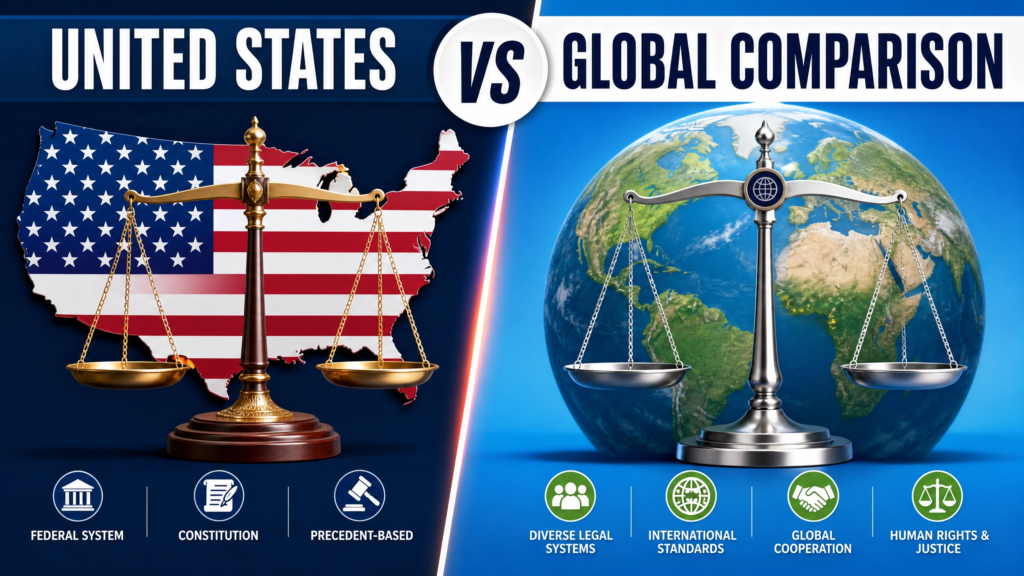
Jurisdiction changes everything in domain disputes. If your client is in the US, you are dealing with ICANN and federal anti-cybersquatting laws.
The United States heavily protects the entity officially named on the domain registration.
When I consult with developers, I constantly remind them about the Anticybersquatting Consumer Protection Act (ACPA). This federal law strictly penalizes anyone holding a domain hostage with bad-faith intent to profit.
If you touch a US client’s server unlawfully to force a payment, you trigger the Computer Fraud and Abuse Act (CFAA), 18 U.S.C. § 1030. It is a potential violation of federal law.
Under the CFAA, intentionally accessing a protected computer without authorization to alter or deny access to information leads to severe penalties. It is not just a billing dispute anymore; it is unauthorized interference with systems.
Courts also consistently shield registrars from these fights. In Rigsby v. GoDaddy Inc. (9th Cir. 2023), the court reaffirmed that registrars are immune from secondary liability regarding domain registration acts. You are left holding the legal bag.
For a deeper understanding of how these laws protect commercial property, the Berkeley Technology Law Journal at UC Berkeley provides excellent academic research on trademark infringement and internet policies.
In the UK, the Computer Misuse Act of 1990 is just as aggressive regarding unauthorized modifications to computer material.
If your client is international, the waters get very muddy. Recovering funds across borders is incredibly tough when local enforcement mechanisms clash with United States federal law.
If you frequently do this, you absolutely must learn how to protect yourself when working with international clients.
When expanding your business globally to countries like India, the legal framework shifts to local statutes like the Information Technology Act, 2000.
Under Section 43 and Section 66 of the IT Act, unauthorized access or altering of client server data is heavily penalized. It closely mirrors strict US cyber laws.
Recovering cross-border debt requires navigating complex international jurisdictions where foreign court orders may not be easily enforceable.
You must always establish specific dispute resolution jurisdiction in your contract before you ever touch their domain.
Quick Decision Section : What to do right now
If you are currently locked out and owed money, make a decision right now based on this simple flow.
Is the domain registered in your name ?
If yes: You legally control it. Offer to sell the digital asset to them for the price of the unpaid invoice.
If no: Do not touch the domain. It is not yours.
Did you write custom code or design the UI ?
If yes: You hold the copyright until you are paid. Send a DMCA takedown to GoDaddy to get the site removed legally.
If no: You only provided a service (like migration). You must pursue standard small claims or debt collection.
The Cease & Desist HTML Generator
I built a simple HTML tool you can use on your own machine.
Save the code below as an .html file and open it in your browser. It generates a legally sound warning email to clients who stole your work and locked you out of GoDaddy.
If you are dealing with a client who used your work but refused to pay, you need a structured legal communication—not emotional messages.
The simple HTML tool below helps you generate a clear, legally grounded demand notice that avoids common mistakes like threatening domain control or unauthorized access.
You can run it locally in your browser. Just fill in the details, generate the notice, and use it as a base for your formal communication.
Unpaid Work Notice Generator
This approach keeps the dispute focused on payment and intellectual property—not on account access or domain control, which is where most freelancers make costly mistakes.
Use this template. It is firm, it states the facts, and it completely avoids the “domain hostage” legal trap.
Frequently Asked Questions
Can GoDaddy legally lock my pro account if a client complains ?
Yes. Their Terms of Service give them broad discretion to suspend any account that poses a legal or security risk to their platform.
Should I keep the domain in my name until the client pays ?
It is highly risky. If you act as a proxy buyer, you take on liability. It is better to have them buy it and simply withhold the website files until final payment is cleared.
The client deleted my admin access. Is this a crime ?
No. If they own the account, they can revoke access at any time. Your issue is a breach of contract regarding the unpaid invoice, not a cybercrime.
Can I issue a DMCA takedown to GoDaddy ?
Yes, but only for assets you created from scratch (custom graphics, proprietary code). You cannot DMCA an open-source WordPress installation.
Will GoDaddy mediate our payment dispute ?
Never. They will explicitly tell you that they do not get involved in third-party billing disputes. You are entirely on your own.
Final Thoughts
Freelancers lose these disputes for one simple reason—they try to control what they don’t legally own.
Domains, hosting accounts, and access credentials feel like leverage. In reality, they are legal traps.
The moment you touch them without clear authorization, you stop being a service provider and start looking like a liability.
The freelancers who win don’t fight for control. They build leverage—through contracts, documentation, and intellectual property rights.
Remember this rule:
If you control the account, you take the risk.
If you control the law, you control the outcome.
About Author
Adv. Sagar Haribhau Shirsat is an active legal professional specializing in commercial transaction architectures, cross-border corporate compliance, and digital debt recovery systems. He designs strategic asset-protection and recovery frameworks that help freelancers, independent contractors, and global agencies defend their cash flow and enforce their billing rights.
Connect via his Official Professional LinkedIn Profile or About Us page .
Disclaimer : This guide is intended for educational purposes and risk management analysis. It does not replace formal legal counsel. For specific cross-jurisdictional contract disputes, always consult a certified attorney or local legal advocate.