Most freelancers think they get paid for writing clean code. They don’t. You get paid for managing client anxiety.
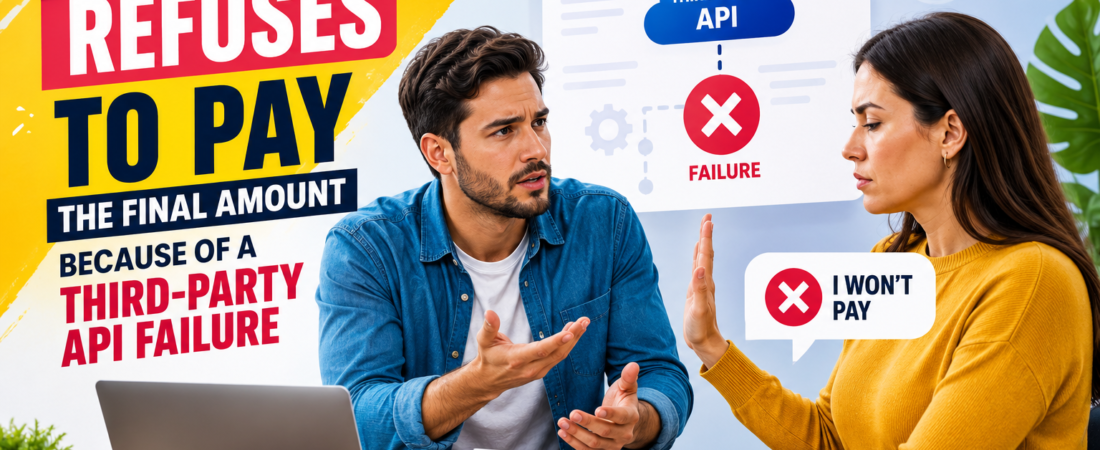
When a third-party API breaks right before handover, client anxiety spikes. They immediately withhold your final milestone payment. They blame you.
Here is the contrarian truth. You actually want the API to break early.
Why ? Because it tests the boundaries of your liability before you fully hand over the keys.
I used to panic when an external integration failed. I would work weekends for free, trying to patch a server issue that wasn’t mine.
Now, I just pull server logs, send a single, boring email, and I get paid. Every time.
If your client is holding your invoice hostage because Stripe, Twilio, or Shopify changed an endpoint, you are not alone.
Here is exactly how to deconstruct liability boundaries, prove the integration is sound, and force the final payment when Client Refuses to Pay the Final Amount.
The Dependency Post-Mortem : A Case Study
Let me tell you about a $15,000 project that almost ended in a lawsuit.
I was hired to build a custom booking engine for a logistics client. The system relied heavily on a third-party mapping API to calculate delivery distances and costs.
Everything worked perfectly on the staging server. The client approved it. We pushed it to production on a Tuesday.
On Thursday, the mapping API provider pushed an unannounced security update.
They changed their authentication payload requirements. Suddenly, my clean code was getting HTTP 401 Unauthorized errors.
The Breakdown
The client’s booking engine went down. Customers couldn’t get quotes.
The client immediately sent an angry email. They refused to pay the $5,000 final milestone. They claimed the system I built was “defective.”
Look, this is a classic scenario. To a non-technical client, the screen is broken. Therefore, the developer is broken.
They don’t see the invisible wires connecting their website to a server in Virginia. They just see a loss of revenue.
This often leads straight into the unfinished feature trap, where a client demands a full refund over one external dependency issue.
The Takeaway
I didn’t argue. I didn’t get defensive. I got objective.
I pulled the API logs. I took a screenshot of the successful 200 OK responses from Tuesday.
Then, I took a screenshot of the 401 Unauthorized responses from Thursday. I linked to the API provider’s changelog, which was published on Wednesday.
I showed them that my code hadn’t changed. The rules of the highway changed.
The client paid the final milestone the next morning. They even hired me on a retainer to monitor the API going forward.
The API Blame Game
Clients don’t understand microservices. They buy a car, and they expect it to drive.
If the local gas station suddenly changes the shape of their fuel pumps, the client blames the car manufacturer.
Your job is to calmly explain the difference between the vehicle you built and the fuel they chose to use.
When an API fails, the client’s first instinct is self-preservation. They hold your money to maintain leverage.
They are terrified that if they pay you, you will disappear, leaving them with a broken system.
You have to decouple your labor from the third-party platform’s uptime.
If you don’t, you become an unpaid server admin for the rest of your life.
You need to establish early on that you are the architect, not the utility company.
If the water gets shut off at the main valve, the plumber doesn’t issue a refund.
Defining Liability for Third-Party Downtime
Liability in software development usually comes down to “who controls the environment?”
You control your code. You do not control a massive tech company’s deployment schedule.
If you built the connection exactly to the API documentation provided at the time of development, your liability ends there.
According to the U.S. Uniform Commercial Code (UCC) principles, there is an implied warranty that a product works.
However, custom software development is generally treated as a service, governed by common law. You promise a standard of care, not absolute perfection against external forces.
If the client is still using the rest of the application while complaining about the API, you have leverage.
You need to know exactly what to do when a client uses your work but refuses to pay you.
Acceptance of the core system usually triggers payment obligations, regardless of peripheral API issues.
The Standard of Care Test
Did you use standard industry practices to implement the API?
Did you include basic error handling? If the API fails, does your site gracefully show an error message, or does it crash the whole database?
If you handled the error gracefully, you did your job. The code is performing as designed under adverse conditions.
United States vs. Global Comparison : Digital Liability
If you are a freelancer working across borders, you need to understand how different countries view third-party liability. Here is how it breaks down.
United States (Primary Market)
In the US, contract language is everything. You are operating in a legal system that leans heavily on the exact written word.
If your contract doesn’t explicitly exclude third-party downtime, a client might successfully argue “breach of contract” under common law or the Uniform Commercial Code (UCC).
Look, American courts expect you to define the boundaries of your service. If you fail to do so, they might assume you guaranteed the whole system. Protect yourself in writing.
United Kingdom (Secondary Market)
The UK Consumer Rights Act 2015 has specific provisions for digital content. If you supply digital content to a consumer, it must be fit for purpose.
However, B2B contracts are more flexible. You can explicitly limit liability for external software failures in a UK B2B contract. Just ensure your limitation of liability clause is clear and reasonable.
The European Union
The EU is strict. The GDPR makes you think about data passing through APIs. If an API fails because of a non-compliant data transfer, the liability gets muddy.
Here’s the thing: you need to keep your API logs clean. Strictly document why the failure occurred to prove it wasn’t your data handling that broke the chain.
India
Under the Information Technology Act, 2000 ( specifically Section 79 principles ), there is a concept of “safe harbor” for intermediaries.
While you aren’t an ISP, Indian commercial law heavily recognizes dependency on external service providers. If a third-party gateway fails, Indian courts generally do not hold the integrating developer liable, provided there is no gross negligence.
The SLA Escape Clause
The best way to handle an API dispute is to prevent it before you write the first line of code.
You need a Service Level Agreement (SLA) Escape Clause in your master services agreement.
This clause explicitly states that your milestone approvals are not contingent on third-party uptime.
Here is the thing: most freelancers just copy and paste generic contracts.
They forget to protect themselves against the SaaS platforms they integrate with.
A good SLA Escape Clause says: “Developer is not liable for project delays or system failures caused by changes, deprecations, or downtime of third-party APIs.”
If you had that clause, this current dispute wouldn’t be happening.
But since you are already in the dispute, you can still use the concept of the SLA to defend yourself.
Even without a formal contract, you can rely on written communication. Did they approve the milestone in a chat?
You might be surprised to learn if a WhatsApp conversation is a legally binding contract. Often, written approval there is enough to demand payment.
Tool : The Liability Boundary Notice Generator
I built a simple HTML/JS tool for you. You can save this code as an .html file on your computer and open it in Chrome.
It generates a clean, professional email notice to your client explaining the API failure without sounding emotional.
Formal Liability Boundary Notice
Construct a structured notification to isolate third-party service failures from contractual obligations.
This tool removes the emotion from your response. It makes you sound like a server admin diagnosing a weather event.
Evidence Checklist : What You Need Before Demanding Payment
Before you send that final demand for payment, you need to build an unassailable wall of proof.
Do not just say, “It’s not my fault.” Prove it.
Gathering evidence turns a subjective argument into an objective engineering fact.
- 1. Staging Server Logs : Find the exact logs from when the client approved the project. Show the API returning a clean 200 OK status.
- 2. Production Server Logs : Export the logs from the moment the system failed. Highlight the specific error code returned by the third party.
- 3. API Provider Status Page : Take a screenshot of the third-party status page. If they had an outage, this is your golden ticket.
- 4. Developer Changelogs : Check the API provider’s release notes. Did they deprecate a feature this week ? Save that web page as a PDF.
- 5. The Original Scope of Work : Highlight the section of your contract that outlines exactly what you were hired to build.
- 6. The Approval Message : Screenshot the email, Slack, or WhatsApp message where the client originally said, “Looks great, let’s launch.”
Once you have this evidence, organize it into a single PDF.
Make it impossible for their accounting team to dispute the facts.
How to Structure the Settlement Demand Letter
If the client still refuses to pay after you show them the logs, it is time to escalate.
You need to write a settlement demand letter.
This is not a lawsuit. It is a formal request for payment that signals you know your rights.
It tells them you are done doing free tech support for an API you don’t own.
You need to know the exact follow-up timeline for late freelance invoices. Do not send this letter on day one. Send it on day seven.
The Three-Part Demand Structure
First, state the facts clearly. “On Tuesday, the milestone was completed and approved. On Thursday, the third-party API failed.”
Second, establish the boundary. “My scope of work covers the creation of the integration, not the perpetual uptime of the API provider.”
Third, offer a path forward. “Once the final milestone is paid, I will gladly consult with you on an hourly basis to help resolve the external API issue.”
Applying Financial Pressure
If they ignore the letter, they are playing a waiting game.
You need to understand how to recover an unpaid invoice yourself before hiring expensive legal help.
Look at your initial contract. Did you specify payment terms?
Understanding the difference between Net 15 vs. Net 30 vs. Net 45 dictates exactly when you can start applying late fees.
If they are past the terms, you must add pressure. You can often legally charge interest on late invoices, which usually gets the attention of their accounting department fast.
What if they just stop replying ? It happens.
If your client ghosted after the invoice, you transition from negotiation to strict debt recovery protocols.
Risk Matrix : Will You Actually Get Paid ?
Not every API dispute is created equal. You need to assess your actual risk of non-payment.
I use this mental matrix to decide how hard to push.
Low Risk (You Will Get Paid Quickly)
- Scenario: The API status page shows a global outage.
- Client Mood: Frustrated, but understands what an outage is.
- Your Action: Send the status page link. Wait 24 hours. The client will realize it’s out of your hands and process the invoice.
Medium Risk (Requires Negotiation)
- Scenario: The API provider changed their documentation without warning. Your code is now technically “broken,” but it wasn’t your fault.
- Client Mood: Suspicious. Thinks you wrote fragile code.
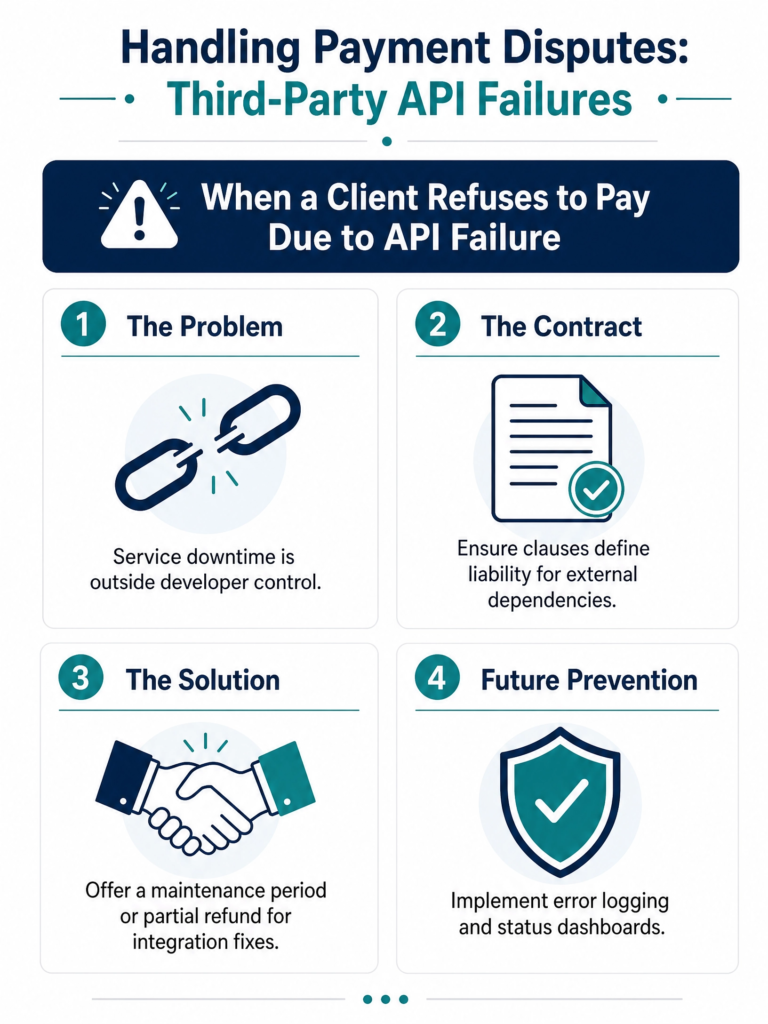
- Your Action: Provide the changelog. Offer a paid hourly fix. Hold firm on the original invoice being separate from the new fix.
High Risk (Potential Legal Escalation)
- Scenario: The API failed due to a rate limit because the client suddenly uploaded 100,000 users at once.
- Client Mood: Angry. Demands a refund for a “system that can’t scale.”
- Your Action: Pull the original scope of work. Prove you built to the agreed-upon specifications. Prepare for a fight over scope creep and scalability limits.
Dependency Settlement Strategy
Evaluate your specific integration scenario to identify the most effective recovery and settlement protocol.
Quick Decision Flowchart
Are you staring at an angry client email right now? Follow this path:
- Did the code work when handed over?
- Yes: Move to step 2.
- No: Fix your code. You aren’t owed the milestone yet.
- Can you prove the error originates from the third-party server?
- Yes: Move to step 3.
- No: Dig into your logs until you can. Do not guess.
- Did the client explicitly approve the staging environment?
- Yes: Send the Liability Boundary Email. Demand payment.
- No: Remind them of the implicit approval when they chose to push to production. Send the invoice.
Do not let them loop you into endless troubleshooting calls.
Your invoice is for development, not ongoing infrastructure therapy.
Frequently Asked Questions
Can a client legally withhold payment for a broken API ?
Legally? Usually no, assuming your code meets the agreed specifications and the failure is entirely on the third-party side. However, clients do it practically all the time because they control the bank account. You have to use evidence to force their hand.
Should I fix the API issue for free just to get the final payment ?
No. Never work for free to unlock money you already earned. It sets a dangerous precedent. It tells the client that your final milestone is actually a perpetual warranty. Offer to fix it after the milestone is paid, under a new hourly contract.
What if the client claims I picked a “bad” API ?
If you recommended the API, you carry slightly more reputational risk. However, unless you guaranteed the API’s uptime in writing, you are still just an integrator. Point out that all software services experience downtime.
Can I take down the site if they refuse to pay ?
Be extremely careful here. Depending on your jurisdiction and contract, taking down a live site could expose you to damages for lost business. It is usually safer to leave the site up and pursue the debt through formal legal channels or collections.
How do I prevent this in my next project ?
Add three clauses to your next contract: an SLA Escape Clause, a clear Definition of Done, and a specific Hourly Maintenance Rate for third-party changes post-launch. Make them sign it.
Final Thoughts
A broken API is an engineering reality. It is not a moral failing on your part.
Stop apologizing for servers you don’t own. Stop working weekends to patch undocumented changes from multi-billion dollar SaaS companies.
Draw a hard line around your liability. Provide objective proof. Send the invoice.
The moment you stop acting like a guilty employee, the client will start treating you like a vendor who deserves to be paid.
Author Box
Adv. Sagar Haribhau Shirsat is an active legal professional specializing in commercial transaction architectures, cross-border corporate compliance, and digital debt recovery systems. He designs strategic asset-protection and recovery frameworks that help freelancers, independent contractors, and global agencies defend their cash flow and enforce their billing rights.
Connect via his Official Professional LinkedIn Profile .
Disclaimer : This guide is intended for educational purposes and risk management analysis. It does not replace formal legal counsel. For specific cross-jurisdictional contract disputes, always consult a certified attorney or local legal advocate.