
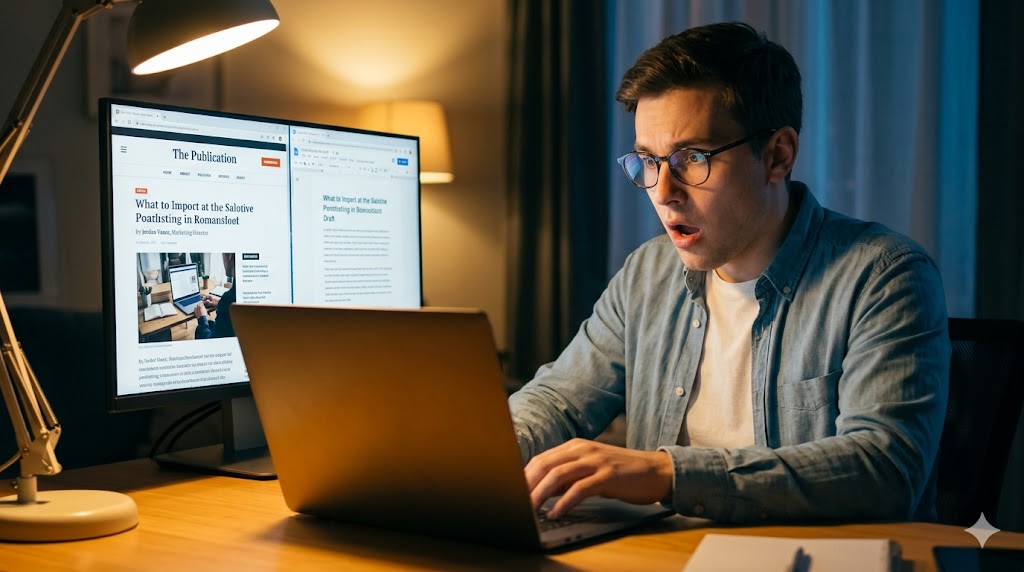
It was 11:14 PM when my phone buzzed with a tracking alert. An article I had just delivered wasn’t sitting in a draft folder anymore—it was live on a major publication.
The title was exactly the same, and every single sentence matched my original copy word-for-word. Yet, my name was nowhere to be found on the page. Instead, the piece carried the byline of an in-house marketing director I had never even interacted with.
To make matters worse, my payment application for that exact milestone was still sitting in their system, marked as a pending draft. The client had gone completely silent, ignoring every follow-up for nearly two weeks.
Look, if you stay in the writing or journalism game long enough, this exact scenario will eventually play out on your screen. You find yourself staring at your own hard work, published under a stranger’s name, while your invoice gathers digital dust.
When a client publishes your draft articles with a different byline and hasn’t paid the invoice, it feels incredibly personal, but treating it like an emotional crisis is a losing strategy. You have to treat it like a cold, operational systems failure.
Here is a proven step-by-step strategy you can use to handle that specific breach, resolve the outstanding payment, and reclaim structural control over your creative work.
Table of Contents
The Anatomy of an Intellectual Property Breach
Many writers mistakenly assume that once they hit “send” on a draft, the client owns the text. Under standard global copyright frameworks, including Section 201 of the U.S. Copyright Act and the UK Copyright, Designs and Patents Act 1988, copyright does not transfer automatically in most freelance arrangements. Unless there is a clear written assignment or a valid work-for-hire agreement, ownership remains with the author. While payment is commonly used as the trigger in practice, the actual transfer depends on the contract terms.
When a company publishes your uncompensated work under a completely different name, they are committing two distinct infractions: simple copyright infringement and moral rights violations regarding attribution. They are actively using your unlicensed intellectual property to build their own commercial authority.
This usually happens because a middle-manager or a content coordinator assumes that an external freelancer lacks the tools, time, or energy to look into where their copy went. They think you will just chalk it up to a bad business experience and walk away.
That is exactly the assumption this strategy is designed to counter. By remaining completely calm and executing an organized protocol, you shift the dynamic from a messy email argument to a formal compliance issue that their legal or finance department will want to settle quickly.
The Ghostwriting Theft vs. Copyright Infringement
There is a massive legal and structural difference between legitimate ghostwriting and outright content theft. Understanding this distinction is what prevents you from making weak, emotional demands that the client can easily dismiss.
- Legitimate Ghostwriting: You sign a clear contract agreeing to transfer your copyright and waive your attribution rights in exchange for a specific, agreed-upon fee. The key factor here is that you are paid for that anonymity.
- Copyright Infringement: The client takes your draft, fails to pay the invoice, and slaps someone else’s name on it anyway. Because no compensation occurred, the transfer of intellectual property was never completed.
Here’s the thing: you cannot accidentally sign away your rights via a casual conversation, though clear written agreements do hold weight. If you are wondering about the legal boundaries of digital discussions, it is worth looking into whether a WhatsApp chat counts as a legally binding contract.
If you never signed a formal work-for-hire agreement that explicitly transfers ownership prior to payment, you still control the legal use of that article. The live link on their website isn’t an operational misunderstanding; it is a live piece of evidence proving they are using unlicensed creative property.
Proving Original Authorship via Google Docs History
Before you send a single email or mention the word “invoice,” you must secure your structural evidence. The moment a dishonest client realizes you are tracking them, their first instinct is often to lock you out of the shared document or alter the file.
Your primary tool for establishing authorship is the immutable version history built into modern cloud-based word processors. This data acts as a digital fingerprint that cannot be easily faked or altered by an outside party.
The Metadata Preservation Checklist
- Export a Full Version History Log : Open your primary Google Doc, navigate to File > Version History, and take full-screen screenshots showing your email address attached to the creation timestamps.
- Download Offline Backups : Immediately download the document as a
.docxfile and a.pdffile to preserve the underlying creation metadata within the file properties. - Capture Live Proof of Infringement : Take archive screenshots of the live published article using services like the Wayback Machine or Archive.today to create a permanent, public record of the plagiarism.
- Document the Complete Communication Record : PDF every single email, Slack message, or project management ticket where the client requested the article, accepted the topic, or acknowledged receipt of the draft.
- Screen capture structural edits
- Document associated user accounts
- Save immediately as .docx & .pdf
- Retain original metadata tags
Once you have this evidence secured in a local folder on your computer, you have shifted the balance of power. You are no longer just an upset freelancer arguing over a missing payment; you are an asset owner with clear documentation proving your ownership.
If the client has completely stopped responding to your standard messages, you will need to change your approach. You can read through this guide on what to do when a client ghosts you after you send an invoice to learn how to re-engage them cleanly.
The Bylines Deconstruction Protocol
When standard payment reminders fail, you need to transition to a structured enforcement framework. I call this approach The Bylines Deconstruction Protocol. It focuses entirely on systemic escalation, bypassing the lower-level point of contact who caused the issue and moving directly to the decision-makers who manage the company’s financial and legal risks.
- Stop sending basic invoice reminders
- Compile your entire technical evidence folder
- Locate the publication’s Managing Editor or CFO
- Match the live published text layout directly to your source metadata
- Send the official fact-based transactional notification
- Present the clear parameters of the Content Takedown Matrix
This protocol works in most cases because it stops treating the outstanding payment as an isolated billing problem and starts treating the published article as an unapproved corporate liability. You are calmly showing them that leaving the invoice unresolved exposes them to a clear, documentable compliance risk that is far more expensive to manage than simply closing the payment.
Phase 1 : Internal Separation
Stop wasting your energy sending casual follow-up notes to an inbox that is clearly ignoring you. Every friendly reminder you send makes you look like you are willing to wait indefinitely. Cut off standard communications entirely while you assemble your documentation.
Phase 2 : Structural Audit
Find out who actually runs the publication’s operational strategy. Look for the Managing Editor, the Chief Financial Officer, or the Director of Compliance on LinkedIn. These professionals understand that publishing unlicensed content under an inaccurate byline leaves the company vulnerable to digital compliance complaints and platform penalties.
Phase 3 : Targeted Escalation
Reach out to these decision-makers directly with a factual, neutral summary of the situation. Avoid using angry or accusing language. Lay out the exact timestamps of your creation process alongside the live link where the content is currently being used without a license.
Contacting the Managing Editor Directly
When you contact leadership, your message needs to sound like an objective notice from an outside operations auditor. The goal is to make the managing editor or operations director look at the situation and quickly realize that their internal team made an embarrassing error that needs immediate fixing.
Here is a balanced, clear communication template you can customize for this situation:
Subject: Unauthorized Publication / Unpaid Invoice: [Article Title]

Dear [Editor Name],

I am contacting you regarding a compliance issue involving the article titled "[Insert Live Article Title]," which went live on your site on [Date] under the byline of [In-House Name].

This text is a word-for-word match of an original draft I produced and delivered to [Contact Name] on [Delivery Date] under project reference [Invoice Number]. To date, the corresponding payment application remains unpaid, meaning the copyright for this material has not transferred to your organization.

I have attached the original version history logs and metadata archives confirming my authorship of this work.

To resolve this matter without initiating formal enforcement steps, please confirm one of the following actions:
1. Invoice [Number] ($[Amount]) is cleared for immediate payment within 48 hours to complete the legal transfer of rights, or
2. The article is fully removed from your domain immediately.

You can review the outstanding payment details and process the payment securely here: [Link to Secure Invoice Payment]

Thank you for your prompt attention to this operational matter.

Best regards,

[Your Name]
[Your Contact Information]
Notice that this note avoids threats or emotional venting. It simply lays out two clear operational options: pay the pending invoice to formalize the text license, or take the content down.
If you are dealing with an agency that is trying to strip your credit from an entire portfolio of work while withholding payment, the situation requires a slightly adjusted strategy. Take a look at this breakdown on what to do if an agency strips your name from a case study and refuses your payout.
The Content Takedown Matrix
If the managing editor ignores your direct note or tries to deflect responsibility, it is time to look at external enforcement options. The Content Takedown Matrix helps you assess the risks and determine the most effective next step based on how the client responds.
Risk and Enforcement Assessment Matrix
| Scenario / Client Response | Risk Level | Primary Operational Impact | Recommended Action |
| Client claims the text was an internal “work-for-hire” draft despite having no signed contract. | Low Risk | Weak legal standing; clear absence of copyright assignment documentation. | Send a formal notice presenting your cloud version history and copy-paste records. |
| The client remains entirely silent but leaves your article live under an incorrect byline. | Medium Risk | Continued unauthorized commercial use of your intellectual property. | Issue a formal DMCA Takedown Notice directly to their web hosting provider. |
| The client refuses payment, claiming the work was unsatisfactory, yet keeps it live. | High Risk | Clear commercial exploitation of your property without compensation. | Escalate to their ad networks, programmatic partners, and corporate leadership. |
If you reach the point where a DMCA notice is necessary, you need to know exactly how to structure it so the hosting platform takes it seriously. For creative professionals dealing with stolen intellectual assets, this practical guide on how to write a clean cease-and-desist letter if a client steals your work walks through the exact mechanics.
Weaponizing DMCA Takedown Notices (Step-by-Step)
A Digital Millennium Copyright Act (DMCA) notice is an incredibly effective tool for freelancers. You don’t need a lawyer to file one, it costs nothing, and web hosts are legally required to act on them quickly to protect themselves from liability.
Hosts often act within 24–72 hours, though timelines can vary depending on the provider and the completeness of your notice. Seeing their live page replaced by a copyright warning notice usually brings a non-paying client back to the negotiating table quickly.
Step 1 : Locate the Web Host
Go to a free lookup site like whoishostingthis.com or run a standard WHOIS query on your computer’s terminal to find out who hosts the client’s website (e.g., DigitalOcean, AWS, Hostinger). Look for their designated abuse or legal contact email address.
Step 2 : Use the Automated Takedown Notice Tool
To make this process as simple as possible, I have built an interactive tool below. You can input your specific project details to generate a clean, compliance-ready DMCA Takedown Notice that you can copy and send directly to their web host.
Step 3 : Monitor and Follow Up
Once you submit the notice to the host, send a quick update to the client’s finance department letting them know that a formal copyright complaint has been lodged against their site. Give them one last chance to settle the invoice before the host takes the page down.
If you are a developer or technical writer dealing with a client who launched an entire site using your uncompensated work, the process has a few extra steps. You can check out this guide on handling a client who isn’t paying after a website migration for specific technical recovery methods.
International Jurisdictional Realities (US, UK, and Global Frameworks)
When your client is based in a different country, enforcing an pending payment obligation can feel like navigating a complex maze. However, cross-border creative work is heavily protected by foundational global treaties.
Thanks to the Berne Convention for the Protection of Literary and Artistic Works, an international treaty signed by more than 180 countries, your copyright is automatically recognized globally the moment your pen hits the paper or your fingers hit the keyboard. You do not need a formal international registration to maintain core ownership of an unpaid draft.
The US and UK Enforcement Landscapes
If you are dealing with a non-paying entity based in the United States or the United Kingdom, both jurisdictions provide highly structured, affordable, and accessible administrative pathways to challenge copyright infringement without stepping into a traditional federal courtroom:
- United States Jurisdiction : Beyond standard DMCA takedown pipelines, the US framework features a dedicated administrative venue designed specifically for independent creators: the Copyright Claims Board (CCB). Established under the Copyright Alternative in Small-Claims Enforcement (CASE) Act, the CCB operates as a voluntary, low-cost tribunal within the U.S. Copyright Office. It allows freelancers worldwide to resolve copyright disputes and seek damages up to $30,000 without the crushing expenses of a US federal district court. You can review the official filing procedures and dispute structures directly on the U.S. Copyright Claims Board Official Portal.
- United Kingdom Jurisdiction : In the UK, intellectual property enforcement is governed strictly under the Copyright, Designs and Patents Act 1988. If an international client uses your work without completing payment, you can access the specialized small claims track of the Intellectual Property Enterprise Court (IPEC). This specific legal pathway is designed to handle lower-value copyright disputes efficiently, capping recoverable legal costs to keep the process accessible for individual contractors and small agencies. Detailed jurisdictional rules on managing these intellectual property disputes are outlined on the UK Government Intellectual Property Enterprise Court Guide.
The Global and Indian Perspective
For freelancers navigating broader global markets, including India, intellectual property enforcement relies heavily on statutory frameworks that protect creative integrity alongside financial value. In India, copyright disputes are anchored by the Indian Copyright Act of 1957.
A critical advantage of the Indian framework is Section 57, which explicitly protects an author’s Moral Rights (also known as special rights). This unique statute grants you the legal authority to object to any unauthorized modifications, distortions, or incorrect attributions of your work, completely independent of economic ownership.
Even if commercial rights are assigned, Section 57 of the Indian Copyright Act preserves the author’s moral rights, including the right to claim authorship and object to false attribution.
For a deeper analysis of how global copyright principles interact with contract enforcement and digital asset protection across developing markets, you can explore the academic compliance resources provided by the Stanford Law School Center for Internet and Society.
Take a look at these tips on how to protect yourself when working with international clients to keep your future projects secure.
Preventive Contracting and Alternative Strategies
The best way to deal with content theft is to make your business systems too difficult and time-consuming for dishonest clients to target in the first place. You can easily achieve this by making small adjustments to how you manage and share your drafts.
1. Structure Your Milestones Around Payment Terms
Never deliver a full batch of articles all at once on a long payment delay. Break your projects down into smaller milestones using modern billing terms. If you want to optimize your incoming revenue, read through this comparison of Net 15 vs. Net 30 vs. Net 45 payment terms.
2. Share Work Securely
Don’t give clients full edit or download permissions on your Google Docs before they pay. Share your drafts as Viewer Only files, or use secure document review platforms that let you track engagement and turn off access if a client goes dark.
3. Use Clear Payment Frameworks
Make sure your invoices are clearly organized so they don’t get stuck in corporate review loops. You can implement these design rules on how to build invoices that accounts payable teams pay quickly to speed up your incoming payments.
If you find yourself constantly dealing with clients who try to add extra tasks to your projects without paying for them, you need to tighten up your boundaries. Learn how to prevent scope creep from eating your freelance profits to keep your business running smoothly.
Summary Strategy Guide
If you just discovered that a client published your draft under a different name without paying you, here is your quick operational plan :
- Take screenshots of the live, unauthorized page
- Save your complete Google Doc version history
- Skip your usual primary point of contact
- Send a clean, factual notice directly to the editor
- Submit a standard, compliance-ready DMCA notice
- Request immediate removal of the unlicensed text
Most writers assume they have no leverage once an invoice is ignored. In reality, your copyright is an enforceable asset—and when you treat misuse as a compliance issue, not a personal dispute, the leverage shifts back to you.
Frequently Asked Questions
Can a client claim they own my draft because they gave me the outline?
No. Outlines, content briefs, and general concepts are ideas, and you cannot copyright an idea. Copyright protects the specific expression of an idea—the actual written text—not the underlying concept or brief. Because you wrote the text, you own the copyright until they clear the invoice and complete the transfer of ownership.
What should I do if the client removes the article but still refuses to pay my invoice ?
If they take the content down, they have stopped the ongoing copyright infringement, but they still owe you for the production work. You can use standard debt recovery methods to handle the balance. Take a look at this guide on how to recover an unpaid invoice yourself without a lawyer.
How long should I wait before sending a formal DMCA notice to their web host ?
If you have sent a direct notice to the managing editor or operations director and received no response or payment within 48 to 72 hours, you have given them ample opportunity to resolve the issue. Go ahead and submit the takedown request to their web host.
Does a DMCA notice affect the client’s Google Search rankings ?
Yes. Websites that receive valid DMCA takedown notices can see their search visibility drop, and individual infringing links are completely removed from search results. This search engine impact is why major publications take copyright notices very seriously.
Can I legally charge extra fees on an invoice that a client is delaying ?
Yes, provided your contract terms outline late fees, or you fall under regional protections like the UK’s Late Payment of Commercial Debts Act. To see what options apply to your situation, look into whether you can legally charge interest on late freelance invoices.
Author Profile
Adv. Sagar Haribhau Shirsat is an active legal professional specializing in commercial transaction architectures, cross-border corporate compliance, and digital debt recovery systems. He designs strategic asset-protection and recovery frameworks that help freelancers, independent contractors, and global agencies defend their cash flow and enforce their billing rights.
Connect via his Official Professional LinkedIn Profile.
Disclaimer : This guide is intended for educational purposes and risk management analysis. It does not replace formal legal counsel. For specific cross-jurisdictional contract disputes, always consult a certified attorney or local legal advocate.