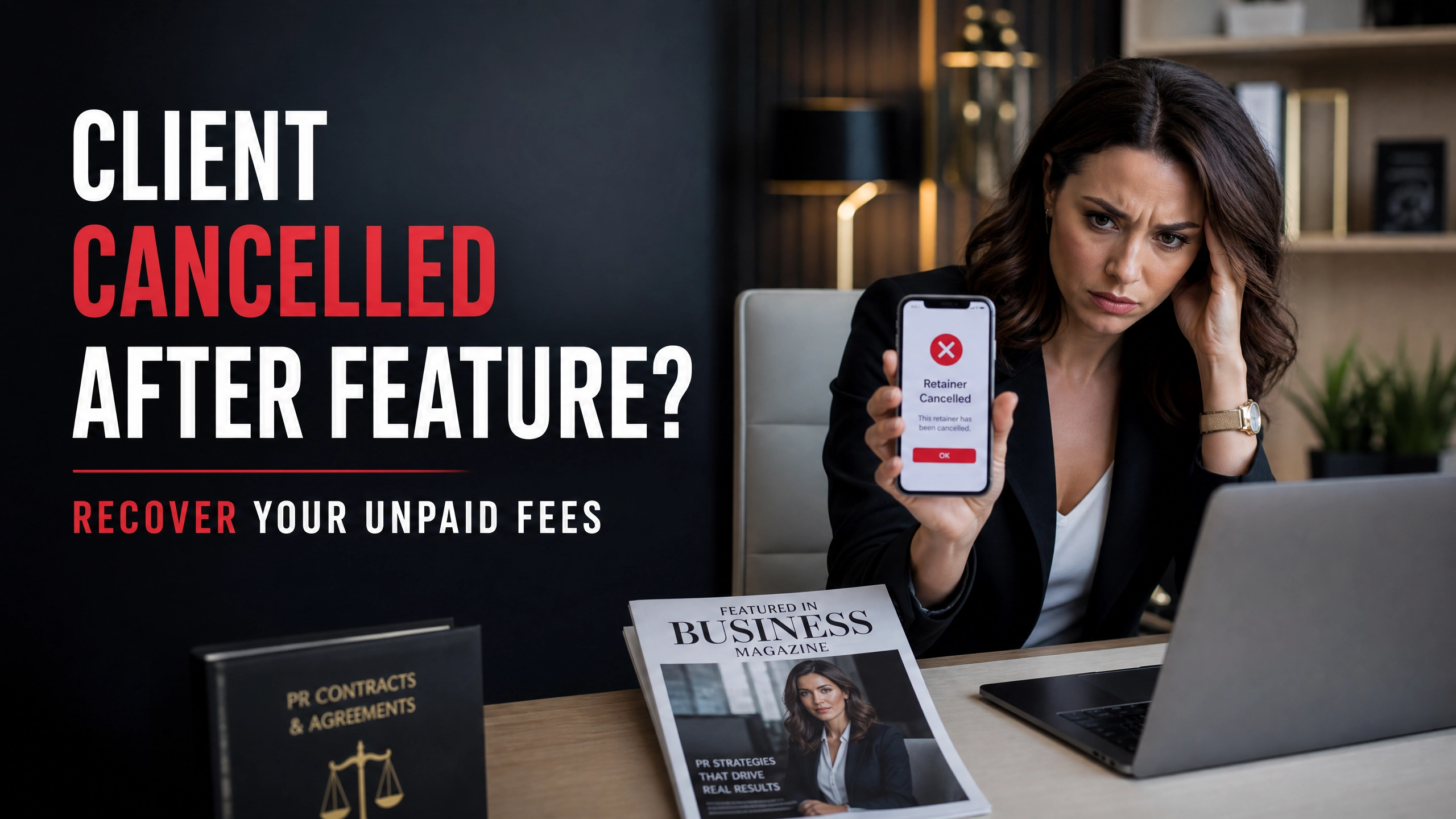
You hit send on the final pitch. A week later, the magic happens.
Your client gets featured in Forbes, TechCrunch, or a top-tier trade magazine. They are thrilled. They pop champagne on LinkedIn.
Then, your phone buzzes.
It’s an email from their CFO. They are “restructuring.” They are pausing all external marketing. They want to cancel your retainer, effectively immediately.
Oh, and they want you to void the invoice you sent this morning.
It feels like a punch to the gut. You just handed them a massive win, and they locked you out of the building.
Sometimes it is a deliberate cost-cutting decision. Other times it results from internal restructuring or budget changes. Regardless of the reason, the legal question is usually the same: must the client still pay for work already performed ?
If you just accept it and walk away, you lose more than a month’s pay. You subsidize their growth with your free labor.
Every single day you wait, your leverage evaporates. In 48 hours, the news cycle moves on. If you do not act today, that money is gone forever.
Here is exactly how you handle this, legally and professionally, without burning your media contacts.
Every payment dispute depends on its facts, governing law, written agreement, and jurisdiction. The strategies below are intended to help you preserve evidence, improve negotiation leverage, and understand the legal issues commonly involved.
Table of Contents
The Case Study : “The Media Hit and Run”

The following example is a composite based on recurring freelancer PR disputes I have seen over the years. Identifying details have been changed, but the legal and commercial issues are representative of real-world situations.
I was working with a mid-sized B2B SaaS company. Let’s call them “Acme Tech.”
They hired me on a $4,000 monthly retainer. The explicit goal? Get their CEO on a major business podcast and secure one tier-1 editorial feature.
It took me six weeks of grinding. I leveraged every contact I had. Finally, I secured both.
The podcast went live on a Tuesday. The editorial dropped on a Thursday.
Friday morning, I sent my retainer invoice for the upcoming month. Two hours later, Acme Tech replied.
They said the feature gave them all the inbound leads they needed for the quarter. Therefore, my services were no longer required. They refused to pay the new invoice.
I was furious. I felt used. I wanted to call the journalist and scream.
But here is the thing: anger doesn’t pay the bills. Strategy does.
We need to break down exactly why this happens and how to reverse it.
The Media Hit and Run
Let’s be brutally honest. Some clients view PR freelancers as disposable tools.
PR work is heavily front-loaded. You do 90% of the heavy lifting behind the scenes. You build the narrative. You write the pitches. You nurture the journalist.
Once the article is published, the client thinks the hard part is over.
They see the result and immediately try to cut the cost. This is what I call the “Hit and Run.”
They assume you are too small to fight back. They think you won’t hire a lawyer over a few thousand dollars.
Most freelancers just vent on Twitter and move on. This is exactly what the client is counting on.
But if you negotiated the deal via text message, you actually hold cards. Depending on the governing law and surrounding evidence, email or WhatsApp conversations may help establish the existence and terms of a binding agreement.
You do not have to accept their cancellation terms if they violate your agreement.
Editorial Discretion and Disputed Source Material
Your first instinct might be to threaten the client. You might want to tell them you will pull the article.
Don’t do that. It’s a bluff, and it’s a bad one.
You do not own the publication. The journalist has editorial discretion. They care about the story, not your unpaid invoice.
If you email a Forbes editor asking them to delete a live article because your client is cheap, you will just look unprofessional.
You will burn that media relationship forever.
Instead, you use the concept of “Disputed Source Material.”
If the client has not paid for the campaign that generated the press kit, quotes, or corporate data, depending on your agreement, questions may arise regarding copyright ownership, licensing scope, and the client’s continued right to commercially exploit unpaid deliverables.
You aren’t asking the journalist to take down the piece. You are notifying the client that their media rights are compromised.
If they reproduce that unpaid copy on their own website, you can hit them hard. You can use a content kill clause to shut it down.
If they posted an article you drafted under someone else’s name, that is even worse. Here is what to do if a client published your article without paying.
It is all about creating corporate risk. CFOs hate risk.
Retainer Vesting Rules on Performance
Clients love to treat retainers like Netflix subscriptions. They think they can just click “cancel” on the 1st of the month and owe nothing.
That is not how commercial law works.
A retainer is a commitment of availability and ongoing strategy. When you secure a major media placement, that is the culmination of weeks of retained effort.
In legal terms, we look at Quantum Meruit—a Latin phrase meaning “as much as he has deserved.”
If you performed the agreed work during the billing cycle, then, depending on the agreement and the work already completed, you may have a strong claim that payment accrued before termination.
In many jurisdictions, contract law recognizes duties of good faith in contractual performance. Where a client terminates an engagement solely to avoid paying for work already earned, those facts may become relevant in evaluating the dispute.
If they try to drag it out, don’t let them. Stick to an exact follow-up timeline for late freelance invoices.
If they go completely silent, you need to know what to do when a client ghosted you after the invoice.
Forcing Settlement via Press Relations Leverage
So, how do we actually get the money ? We use leverage.
We are not going to war. We are going to calmly corner them.
This is the exact playbook to use when figuring out what to do if a PR client gets the feature but cancels the freelancer’s retainer invoiced today.
Step 1 : The Tactical Pause
When you get that cancellation email, do not reply immediately.
Wait 24 hours. Let their adrenaline drop. Let them think they won.
Step 2 : The Compliance Notification
Send a calm, slightly formal email. Do not sound angry. Sound like an auditor.
State that the retainer cancellation is noted, but the current invoice covers the intellectual property and media relations that secured the recent feature.
Tell them that until the invoice is cleared, the source material rights remain in dispute.
To break their accounting loop, you can try a specific psychological trick to get paid fast.
Step 3 : The PR Risk Escalation
If they push back, remind them of the reality.
PR is about reputation. Brands pay us to make them look trustworthy.
A brand that refuses to pay the publicist who got them on television is a brand with a massive reputation liability.
You might be wondering when it is officially time to take legal action. Usually, it’s after step three fails.
Don’t forget to remind them that you can legally charge interest on late invoices while they stall.
The “Hit & Run” Email Generator (HTML Tool)
I built a simple tool for you. If you don’t know what to write, use this.
Save this HTML code to your desktop as a .html file and open it in your browser. It will generate a professional, professionally structured settlement demand.
The Compliance Notice
Draft a calm, high-leverage email to stop a “Hit and Run” cancellation.
This script writes the email for you. It is calm. It is polite. But it implies a massive problem if they don’t pay.
US vs. UK Legal Frameworks
How I enforce a retainer depends heavily on where my client is located.
When you work across borders, the rules shift drastically. I always make sure I know how to protect myself when working with international clients.
United States : Good Faith Performance and Course of Dealing
In the US, the Uniform Commercial Code (UCC) § 1-304 imposes an obligation of good faith.
A client cannot suddenly terminate a contract in bad faith precisely to dodge a success fee.
If they try, I remind them about “course of dealing.” Courts look at our working history.
If they refuse to settle, I can sue in small claims court. The limit is usually $5,000 to $10,000, depending on the state.
United Kingdom : Statutory Late Fees
The UK is brilliant for freelancer protection. The Late Payment of Commercial Debts (Interest) Act 1998 gives you automatic statutory rights.
You don’t even need a late fee clause in your contract.
You can legally add 8% plus the Bank of England base rate to your unpaid invoice.
Plus, you can charge a fixed debt recovery sum. It creates instant financial pressure.
The Global and India-Specific Scenario
For global disputes, especially in India, the Indian Contract Act (Section 70) protects non-gratuitous acts. If a client enjoys your PR work, they must pay.
In India, Section 70 of the Indian Contract Act may protect certain non-gratuitous acts where one party has accepted and benefited from services. In practice, however, many commercial disputes are first resolved through legal notices, structured negotiation, mediation, or settlement discussions before formal litigation becomes commercially worthwhile.
Client Risk Matrix
Use this matrix to understand what the client actually fears. This is how you find your leverage.
| Action Taken by Freelancer | Risk Level for Client | Probable Client Reaction |
| Angry Twitter thread | Low | They ignore it or call you unprofessional. |
| Sending an emotional email | Low | They forward it to HR and block you. |
| Sending the Compliance Email | Medium | The CFO pauses. They realize IP rights are murky. |
| Formal Legal Demand Letter | High | Legal team steps in. It costs more to fight than to pay. |
| Notice of Disputed Media Rights | Very High | The marketing team panics. They pay the invoice to secure the asset. |
Stop relying on emotional appeals. Use the matrix. Target their corporate risk.
Why Documentation Wins Most Payment Disputes
In my experience, payment disputes are rarely won through emotional arguments. They are won through documentation. Courts, arbitrators, and even corporate legal departments usually focus on timelines, written communications, invoices, approvals, and objective evidence rather than opinions about fairness.
The Evidence Checklist
Before you send any demands, you need to lock down your proof.
Do not assume you will always have access to shared drives. Clients can cut your access in three seconds.
Grab these items right now:
- The Original Agreement : Even if it is just a Slack thread or an email confirming the retainer amount.
- Pitch Drafts : Save PDFs of the pitches you wrote and sent to the journalist.
- Timestamped Emails : Export the email thread where the journalist confirmed they would run the piece.
- The Client’s Reaction : Screenshot the message where the client praised the feature before cancelling the retainer.
- The Publication : Save a PDF offline copy of the live article.
If you do this right, you stop working for free and prevent scope creep from ever ruining your month again.
Frequently Asked Questions (FAQs)
Can I ask the journalist to take the article down ?
No. The journalist works for the publication, not for you. Asking them to delete a news story over a billing dispute will ruin your media reputation.
What if we never signed a formal PR contract ?
You don’t always need a formal PDF. Email threads, text messages, and a history of paid invoices establish a course of dealing. You still have rights under implied contract laws.
The client says the retainer was “at-will.” Does that matter ?
“At-will” means they can fire you going forward. It does not mean they can refuse to pay for work you have already performed, especially if that work resulted in a tangible asset like a media feature.
Should I publicly name and shame the client ?
Almost never. It makes you look like a liability to future clients. Keep the dispute professional, private, and financially focused. Put the pressure on their accounts payable department, not their social media manager.
Quick Decision Section : What to Do in the Next 10 Minutes
Take a deep breath. Drink some coffee. Let’s get to work.
Here is your immediate action plan:
- Do not send an angry email. If you already drafted one, delete it.
- Backup everything. Screenshot the client’s praise for the article. Export your pitch emails. Download the live article.
- Generate the email. Use the HTML generator above to create a calm, risk-focused compliance email.
- Send it to the CFO. Do not send it to your marketing contact. Send it to the person who holds the purse strings.
You are a professional. You delivered a massive win. You deserve to be paid for it.
Hold the line. Don’t blink. Many commercial payment disputes settle once the discussion shifts from emotion to documented contractual obligations and business risk.
Author Box
Adv. Sagar Haribhau Shirsat is an Indian advocate focusing on commercial contract disputes, freelancer payment recovery, cross-border service agreements, and digital business risk management. His work emphasizes practical legal strategy, evidence preservation, negotiation, and commercial dispute resolution for freelancers, agencies, and independent professionals.
Connect via his Official Professional LinkedIn Profile.
Disclaimer : This guide is intended for educational purposes and risk management analysis. It does not replace formal legal counsel. For specific cross-jurisdictional contract disputes, always consult a certified attorney or local legal advocate.