
One of the most frustrating payment disputes for creative professionals happens when a client suddenly rejects completed work using vague feedback such as “the vibe changed” or “it doesn’t feel right anymore.” Unlike objective technical issues, these disputes are difficult to measure and often occur after weeks of approved collaboration.
This payment disputes typically manifests at the final sign-off stage.
Look, I have sat through dozens of these exact corporate alignment calls.
An client reviews a comprehensive brand system, nods along during the project review, and then holds back a multi-thousand-dollar asset fee because “the energy feels different now.”
Here’s the thing: they aren’t actually confused about the art direction.
Sometimes, vague feedback becomes a way to delay or avoid paying the agreed project fee.
I recently watched a brilliant design conceptualist lose a major payout because of a single, unmapped milestone.
The client quietly launched the entire brand identity three months later.
This guide breaks down how to handle this exact situation.
Table of Contents
The Anatomy of an Aesthetic Dispute : A Case Study
Let us analyze a real-world scenario that happens every day in the agency ecosystem.
Marcus, an independent creative director, was hired by a growing fintech company to design their primary brand assets.
The project proposal contained a distinct clause outlining a $15,000 “Asset Fee” due upon the delivery of the core brand identity package.
Client Claims “The Vibe Changed”
Halting Production
Validates unquantifiable, subjective ambiguity, compromises agency momentum, and initiates unpaid scope creep iterations.
Enforce UCC / Contract
Isolate subjective shifts from structured deliverables, protect design equity, and assert commercial milestone compliance boundaries.
During Phase 1 and Phase 2, the client’s executive team provided written sign-offs on the conceptual frameworks.
However, upon delivery of the final final design files in Phase 3, the client suddenly changed direction.
The Chief Marketing Officer stated via text that market dynamics had shifted, meaning “the vibe changed,” and refused to clear the final milestone invoice.
Marcus was left with spent hours and zero compensation for his strategic intellectual property.
When “The Vibe Changed” Really Means “We Don’t Want to Pay”
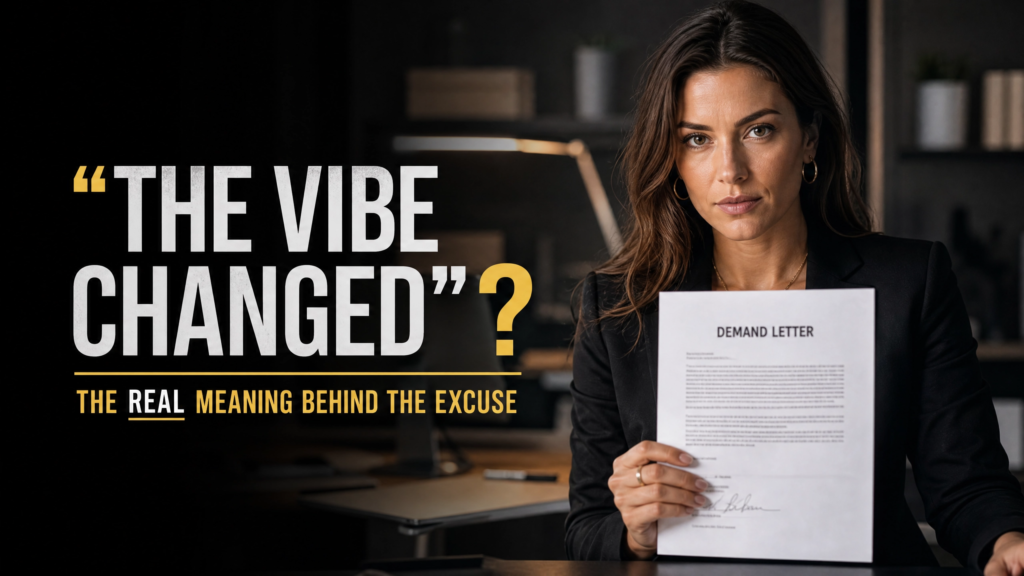
Clients frequently mask financial preservation strategies as artistic critique.
When a client uses abstract terminology like “the vibe changed” or “it doesn’t click anymore,” they are establishing an impossible-to-satisfy standard to delay their obligations.
The Mistake
Many creative directors respond to subjective rejections by instantly re-opening the design file and offering free revisions.
The Consequence
This response confirms to the client that your original delivery was flawed, reduces your profit on the project, and causes extreme scope creep. You are essentially teaching them how to exploit your boundaries.
The Legal Reality
Under established contract law, subjective satisfaction clauses must be exercised in good faith.
If you want to protect your agency from this exact scenario, you must learn how to structure a proposal so it functions like a real legal defense contract.
In commercial transactions, courts look at whether the work met the agreed contractual requirements rather than personal emotional whims.
If the delivered creative assets match the explicit structural parameters defined in your initial scope, the client’s the client may still be legally required to pay.
Milestone Alignment to Creative Brief Sign-Offs
To convert subjective aesthetic feedback into objective contract milestones, you must build an explicit operational pipeline.
| Contractual Vector | Objective Metric |
|---|---|
| Color Palette | Verified Hex / Pantone Values |
| Typography Hierarchy | Licensed Font Families Specified |
| Structural Deliverables | Exact Dimension Vectors Delivered |
The Mistake
The most common structural failure is treating a creative brief as an informal mood board rather than a binding compliance instrument.
The Consequence
Without objective benchmarks, the client can continually claim your assets do not meet their expectations, and you will have no contract mechanism to prove otherwise.
The Law
In contract enforcement, a “condition precedent” must be clearly defined to be enforceable.
By structuring your contract so that each phase requires a signed creative brief confirmation, you transform subjective design work into a series of binary, verifiable approvals.
Look, even informal approvals can carry legal weight. You might be wondering, can a whatsapp chat count as a legally binding contract? Under both US and UK law, written confirmation of a milestone in a chat application frequently satisfies the Statute of Frauds.
Written milestone approvals can become strong evidence that the work matched the agreed scope.
Although every dispute depends on its facts and local law, these approvals often make it much harder for a client to reject the same work later based only on subjective preferences.
- Step 1 : Issue a formal, itemized creative brief outlining technical parameters.
- Step 2 : Require an explicit written or digital sign-off before commencing asset production.
- Step 3 : Tie the final asset fee invoice directly to the delivery of these pre-approved parameters.
Quantifying Ideation Hours Legally
An asset fee is not merely a payment for your final file output; it is a specialized charge for your strategic intellectual property architecture.
The Mistake
Creative professionals frequently make the mistake of blending their strategic directional asset fee with operational production hours on their line-item invoices.
The Consequence
When an aesthetic deadlock occurs, the corporate client will claim they only owe you for the raw hours worked, entirely ignoring the intrinsic market value of the concepts you generated.
The Law
Under the principle of Quantum Meruit (as much as he has deserved), Depending on the jurisdiction and the facts of the dispute, courts may allow recovery of the reasonable value of services already performed under the legal doctrine known as Quantum Meruit.
Furthermore, until the asset fee is paid in full, Copyright ownership depends on your contract and local copyright law.
In many projects, ownership or licensing transfers only after payment, but you should always verify the wording of your agreement.
If you are dealing with a client trying to extract your raw source work before paying, read this specific guide on handling a client asking for psd files before payment.
If the client retains your concept files while withholding payment, they are engaging in keeping and using your creative work without authorization.
To prevent this from destroying your agency’s cash reserves, you must proactively manage your operational boundaries and learn how to prevent scope creep from eating your profits.
Resolving Subjective Deadlocks with Arbitrated Settlements
When a client holds a critical invoice because of a “vibe shift,” you must transition from creative partner to business owner protecting your work.
The Mistake
Entering emotional screaming matches or threatening immediate litigation without leverage.
The Consequence
The corporate entity will hand the issue over to their legal department, effectively burying your small agency under endless lengthy legal processes.
The Law
Most commercial contracts contain an implicit or explicit Alternative Dispute Resolution (ADR) framework.
Before rushing to court, look into your options. It is highly beneficial to study how to recover an unpaid invoice yourself without a lawyer using tactical professional payment escalation steps.
If the client claims the assets are unusable, you can propose a mutual termination agreement.
This agreement grants them a limited covenant not to sue, while you retain full ownership of the intellectual property.
If they subsequently deploy those concepts, you can pursue them for direct copyright infringement.
Here is the thing: if they use your work anyway, you need to understand what to do when a client uses your work but refuses to pay you to protect your creative work.
Interactive Asset Dispute Risk Mitigation Calculator
Use this calculator to evaluate your current contractual leverage and determine the best operational step to protect your pending asset fee.
Asset Fee Dispute Risk Evaluator
Select the conditions that apply to your current client deadlock to assess your recovery posture.
Commercial Dispute Evidence Checklist
Before issuing any formal notice to a corporate client who claims “the vibe changed,” ensure you have compiled these items into a single, secure digital folder:
- [ ] The Fully Executed Master Services Agreement (MSA) : Including all relevant addenda.
- [ ] The Signed Creative Brief : Or documented confirmation matching the asset parameters.
- [ ] Timestamped Communication Records : Exports of emails or messaging threads showing feedback history.
- [ ] Proof of Delivery : Read receipts or vector download logs proving asset delivery.
- [ ] The Unpaid Milestone Invoice : showing the unpaid balance.
To optimize your invoicing framework for corporate accounting portals, it helps to review how to design an invoice that accounts payable teams can’t ignore. This prevents administrative bottlenecks from slowing down your collections process.
Strategic Risk Mitigation Matrix
| Risk Level | Triggering Event | Main Risk | Immediate Strategy |
| Low | Client requests technical layout corrections matching the brief. | Minor operational delays. | Process updates inside agreed revisions. |
| Medium | Client claims “the aesthetic direction feels off” after brief approval. | Extended revision cycles and scope creep. | Restrict access to assets; point to brief sign-offs. |
| High | Client refuses asset payment but retains access to source files. | Asset theft and complete loss of revenue. | Issue an administrative notice and revoke asset access. |
Jurisdictional Analysis : Regional Commercial Enforcement
Managing an asset fee dispute requires recognizing the jurisdictional framework governing your Master Services Agreement.
United States Framework
- Look, across the Atlantic, In the United States, the legal rules that apply depend on the nature of your agreement. Projects involving the sale or licensing of creative deliverables may raise issues under the Uniform Commercial Code in some situations, while many disputes involving design or creative services are governed primarily by general contract law.
- This body of commercial law regulates corporate transactions involving specialized deliverables.
- According to the Cornell Law School UCC Locator, these state-enacted rules protect asset delivery.
- Here’s the thing: once a client accepts files, they cannot retract payment based on aesthetic whims.
- Under UCC Section 2-204, your collective conduct establishes a binding sales agreement.
- If a corporate partner ignores your follow-up emails, you need an administrative strategy.
- Review this guide on what to do if your client ghosted after sending an invoice to protect your billing.
United Kingdom Architecture
- In the UK, creative studios enforce statutory interest on late payouts.
- The Late Payment of Commercial Debts (Interest) Act 1998 establishes this right automatically.
- According to official guidelines on GOV.UK, you can levy statutory interest immediately.
- This base rate modifier helps creative small businesses maintain daily operational cash reserves.
- If you work via white-label terms, specialized collection mechanics apply to your case.
- Knowing when you can sue the end-client directly as an unpaid subcontractor gives you an additional recovery path.
Australian Corporate Protections
- In Australia, corporate entities cannot rely on unfair terms in standard contracts.
- The federal regulatory framework strictly bans unconscionable payment retention strategies.
- As detailed by business.gov.au, Australian Consumer Law guarantees basic protection mechanisms for independent operators.
- Depending on the facts and the applicable law, courts may refuse to enforce unfair contractual terms or conduct that is unconscionable.
- I have used these exact structural tools to break corporate payment deadlocks.
- If your Client. changes their perspective post-delivery, their retention acts as a structural breach.
Global and Indian Regulatory Compliance
For other commercial markets, including India’s protective MSMED Act, 2006 framework, debt recovery relies on verifying objective milestones. No matter your local territory, global corporate transactions require explicit contract documentation and systematic administrative boundary management to safely defend creative assets.
Comprehensive Aesthetic Rejection Dispute Notice
If your corporate client refuses to pay your asset fee based on a subjective vibe check, copy, customize, and issue this notice via email.
Dear [Client Name],
I am writing regarding the outstanding Asset Fee for the creative direction deliverables submitted on [Date of Delivery], under the terms of our Master Services Agreement dated [Contract Date].
On [Date of Brief Approval], your team provided explicit written authorization for the Creative Brief parameters, which defined the objective technical and structural goals for these assets. The delivered assets completely fulfill those structural specifications.
Under applicable commercial rules (including UCC Article 2 / Indian Contract Act), subjective adjustments outside the pre-approved brief do not void a client’s payment obligations.
Please choose one of the following paths by [Date – 5 Business Days]:
[Your Name]
[Your Agency Name]
Summary of Payment Framework Options
Before launching a creative project, it is essential to establish the payment terms that will govern your invoices. Choosing the right framework dictates your financial stability when dealing with complex corporate review cycles.
To pick the approach that best fits your agency’s cash flow needs, take a look at this guide evaluating net 15 vs. net 30 vs. net 45 payment terms. Setting these boundaries early prevents cash flow dry spells when a client stalls during final approvals.
Quick Decision-Making Guide for Creative Directors
File a formal claim immediately.
Escalate via standard timeline.
Freeze all source file access and secure current frameworks.
If you need to map out your communication strategy week-by-week, implement a proven follow-up timeline for late freelance invoices. This helps you escalate professionally without damaging client relationships prematurely.
Strategic FAQs for Creative Asset Disputes
Can a client legally withhold payment if the contract contains a ‘satisfaction clause’ ?
A satisfaction clause does not give a client permission to abandon a contract on a whim. Courts often interpret these clauses using an objective standard of commercial reasonableness. If a reasonable professional in your industry would judge the work as matching the approved brief, the client cannot legally withhold payment.
What should I do if the client launches the project using my ‘rejected’ concepts ?
If a client refuses to pay your asset fee but uses your concepts anyway, they are may be infringing your copyright or breaching the terms of your agreement, depending on the circumstances. You should document the usage immediately, issue an administrative cease-and-desist letter, and demand full payment for the unauthorized use of your intellectual property.
Am I required to hand over layered source files if the client rejects the vibe ?
Not necessarily. Unless your agreement explicitly states otherwise, layered source files (such as PSD, AI, or Figma links) remain the property of the creator. You should only deliver flattened preview files until the milestone invoice has cleared your bank account.
Can I charge interest on outstanding asset invoices due to aesthetic delays ?
Yes, provided your contract includes a late payment clause or you are protected by regional statutes like the UK Late Payment Act or the Indian MSMED Act. To learn more about how to set up these penalties correctly, review this guide on whether you can legally charge interest on late invoices.
How long should I negotiate before taking formal recovery action ?
Many freelancers choose to escalate after repeated unsuccessful attempts to resolve the dispute. The right timeline depends on your contract, payment terms, and jurisdiction. If the client refuses to align on How to Measure It within this window, it is time to escalate. For a clear breakdown of when to transition from reminders to formal collections, consult this guide on when is it officially time for a freelancer to take legal action.
Final Operational Checklist for Asset Protection
To ensure your agency is fully insulated against subjective aesthetic rejections, audit your current workflow against these operational principles:
- Decouple Ideation from Labor : Always list your conceptual asset fees separate from production hours on your scopes of work.
- Enforce Binary Sign-Offs : Never advance to production until the client provides written confirmation of the creative brief.
- Utilize measurable project requirements : Bind your client to measurable criteria (such as style guides and specific dimensions) rather than abstract mood boards.
- Retain Copyright Control : Ensure your contracts explicitly state that intellectual property ownership only transfers after final payment clears.
Author Box
Adv. Sagar Haribhau Shirsat is an active legal professional specializing in commercial transaction architectures, cross-border corporate compliance, and digital debt recovery systems. He designs strategic asset-protection and recovery frameworks that help freelancers, independent contractors, and global agencies defend their cash flow and enforce their billing rights.
Connect via his Official Professional LinkedIn Profile.
Disclaimer : This guide is intended for educational purposes and risk management analysis. It does not replace formal legal counsel. For specific cross-jurisdictional contract disputes, always consult a certified attorney or local legal advocate.