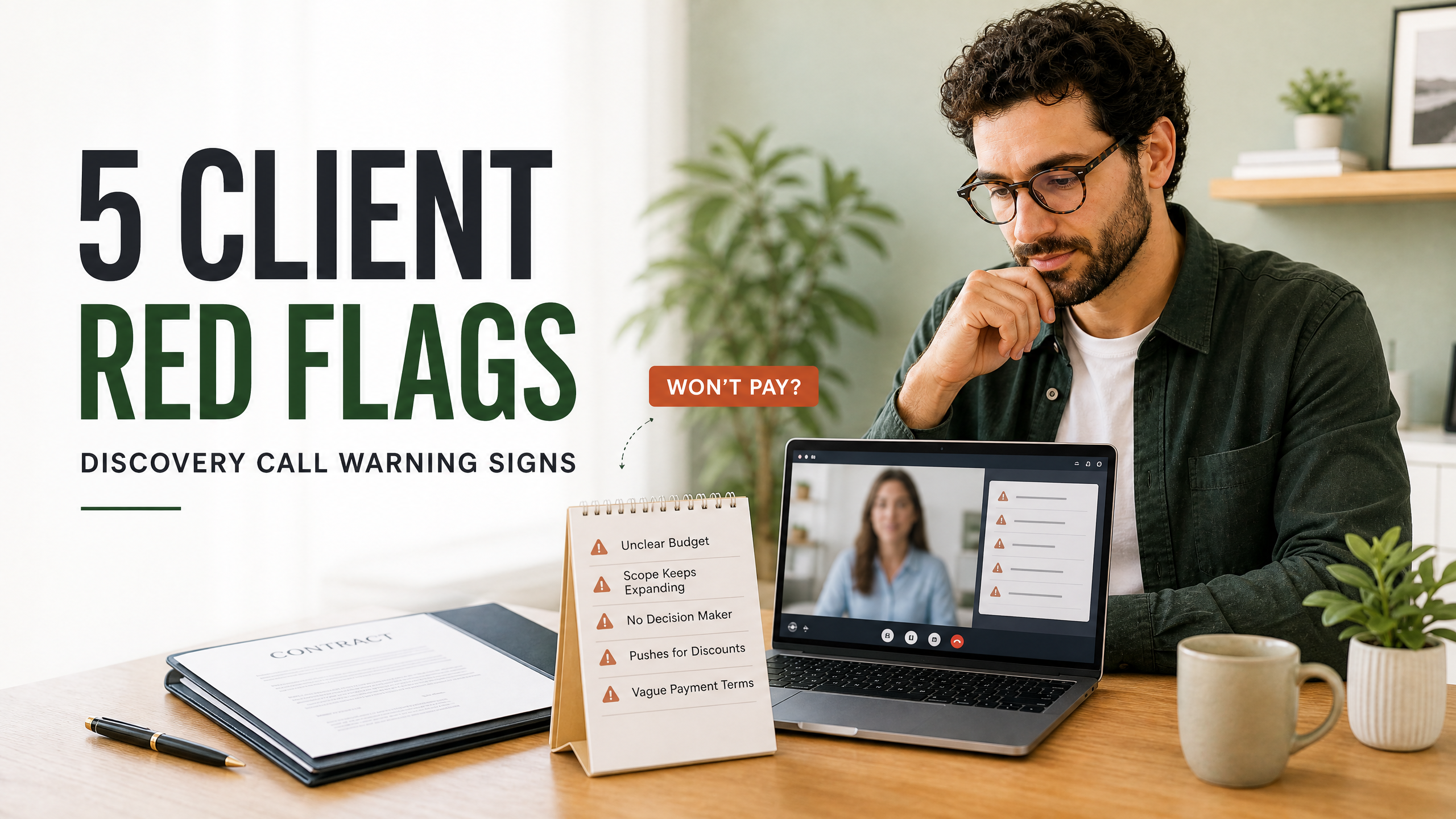
5 Warning Signs in the First Discovery :
I took a discovery call three years ago with a founder who swore he was going to “disrupt the logistics space.” He had venture backing, a slick presentation, and a very urgent problem. He needed a complete brand strategy and product overhaul in three weeks.
Then he dropped the phrase that should have made me bolt right out of the room:
“Our last three agencies just didn’t get it. They were lazy, slow, and tried to nickel-and-dime us on scope. We need a real partner, not someone who counts hours.”
I took the job anyway. I was confident. I thought I was different.
Six months later, I was holding a $14,000 unpaid invoice, staring at a wall of text from his CFO claiming that my deliverables were “incomplete” and that they were withholding payment until I fixed third-party software bugs I had nothing to do with. I spent two months writing follow-ups, stressing over cash flow, and learning the hard way that a client’s past behavior is an exact map of your future nightmare.
Here is the truth: non-paying clients don’t start ghosting you on day 60. They start telling you exactly how they plan to stiff you in the first fifteen minutes of your very first Zoom call. You just have to know how to listen.
If you want to protect your income, stop waiting for the invoice to bounce. You need to kill bad deals before the proposal even leaves your desk.
The Pre-Qualification Pricing Filter Technique
Before we look at the verbal red flags, here is the immediate operational fix. If a client makes it onto your calendar without passing through a financial friction point, you are begging for payment trouble.
Do not send a 10-page custom proposal to someone who hasn’t validated their budget. Use this quick pre-qualification flow on your intake form or within the first five minutes of conversation.
If a lead balks at paying a tiny deposit or a small fee for an initial strategy session, they will not pay your final $10,000 balance cleanly. End of story.
The Behavioral Screening Matrix
Clients drop subtle behavioral clues long before they sign a contract. I use this matrix during discovery calls to score prospective clients.
| Behavioral Indicator | Low Risk (Safe) | Medium Risk (Proceed with Caution) | High Risk (DO NOT SIGN) |
| Past Vendor Relations | Speaks respectfully of past partners; clear reasons for parting ways. | Neutral about past agencies; vague reasons for switching. | Blames past freelancers for “failing”; calls previous vendors incompetent or lazy. |
| Scope Definition | Clear business objectives, specific deliverables, realistic timeline. | Broad goals, flexible deliverables, but open to structured guidance. | Extreme urgency (“Need it yesterday”), highly vague scope, hates detailed contracts. |
| Pricing Pushback | Asks for trade-offs (“If we cut X feature, can we lower the price?”). | Asks for payment terms (“Can we do Net 15 instead of upfront?”). | Demands arbitrary discounts, demands free trial work, or calls rates “too high for basic work.” |
| Payment Process | Has a clear Accounts Payable contact and structured invoice processing. | Solopreneur/Founder managing payments directly via credit card. | Refuses upfront deposits, demands Net 60/90, or insists on retrospective NDAs. |
5 Warning Signs That Scream ‘This Client Won’t Pay’

Red Flag 1: Past Freelancer Disparagement
Look, if a prospect spends the first ten minutes of your call complaining about how their previous three contractors were “unprofessional,” “stole code,” or “did terrible work,” pay attention.
The common denominator in all those failed relationships isn’t the freelancers. It’s the client.
When a client trash-talks past talent, they are setting up the psychological groundwork to invalidate your work later. It is a defense mechanism designed to justify withholding cash when the final invoice arrives. They will happily let you build the asset, wait until you hand it over, and then suddenly discover that your work “didn’t meet their standards.”
If you run into a situation where a client tries to withhold your funds based on arbitrary subjective complaints, you have to fight back using your copyright rights. For example, if you build a custom interface and they refuse final payment, can you file a copyright infringement claim for unpaid UI wireframes? Absolutely. If they didn’t pay for the license, they don’t own the work.
Red Flag 2: Extreme Scope Ambiguity Combined with Urgency
“We need to launch this product next Friday, but we are still tweaking the features. Can you just start building and we’ll figure out the details as we go?”
Run. Run fast.
Urgency mixed with ambiguity is the number one environment for payment disputes. When the scope isn’t locked down, the client’s internal picture of what “done” looks like will shift every 48 hours. When you finally deliver what you thought was requested, they’ll look at you like you have two heads and say, “This isn’t what we talked about.”
This is how freelancers get stuck in perpetual scope creep, doing unpaid labor just to try and unlock their original fee. If you’re already in this trap, read our guide on how to stop working for free and prevent scope creep from eating your profits.
Red Flag 3: Aggressive Pushback on Standard Upfront Deposits
If a company has money, paying a 25% to 50% deposit for custom service work is a standard operational expense. If a prospect fights your deposit requirement, it usually means one of three things:
- They have severe cash flow issues (they are insolvent).
- They plan to use leverage to force extra work out of you later.
- They don’t respect independent contractors as real businesses.
Clients who refuse deposits will often hit you with excuses down the road, claiming their accounts payable team is slow or that the invoice was lost. If you ever hear that excuse, check out what to do when a corporate client claims your invoice was lost in accounting for the third time.
Here’s the thing: a client who won’t risk a $1,000 deposit on you expects you to risk $10,000 of your time on them. That isn’t a partnership. It’s an interest-free loan.
Red Flag 4: “This Will Lead to So Much Future Work” (The Equity/Exposure Trap)
When a client tries to negotiate your current rates down by promising a high volume of future work, equity, or “massive exposure,” they are telling you they don’t value what you do today.
Clients who have money pay for services. Clients who don’t have money pay with promises.
I have never once seen a client who demanded a discount on Project A actually follow through with a high-paying Project B. What usually happens is they try to claim ownership over your work without completing payments. If you write copy or design assets under these false promises, remember that using your assets without full payment is illegal. If they pull this on your written work, see our strategy on what to do when a client published your article but didn’t pay.
Red Flag 5: Refusal to Agree to Written Scope or Formal Milestone Terms
Some clients hate paper trails. They want to do everything over quick voice calls, WhatsApp messages, or loose Slack chats. When you send them a formal agreement detailing payment schedules, revision caps, and IP transfers, they say things like:
“We’re simple people, we don’t need all this legal mumbo-jumbo. Let’s just keep it friendly.”
That “friendly” attitude disappears the second a deadline slips or a budget caps out.
While written text conversations can hold weight legally (see our guide on whether a WhatsApp chat counts as a legally binding contract), relying on casual messaging for complex project terms is a recipe for disaster. If they refuse to sign a contract that includes clear billing milestones, they are protecting their ability to walk away without paying you.
Interactive Tool: Client Risk & Payment Vulnerability Calculator
Use this lightweight risk evaluation logic before sending your next proposal. Answer these quick scoring criteria to calculate your deal risk index.
Risk Scoring Logic
Score your prospective client on the following 5 factors (1 point for Low Risk, 2 points for Medium Risk, 3 points for High Risk):
- Past Vendor Talk:
- Respectful (1)
- Neutral (2)
- Blames past contractors (3)
- Deposit Acceptance:
- Agrees instantly (1)
- Asks for modified terms (2)
- Refuses upfront deposit completely (3)
- Scope Clarity:
- Written brief with goals (1)
- Loose idea, open to guidance (2)
- Urgent, chaotic, undefined (3)
- Contract Stance:
- Signs standard agreement willingly (1)
- Requests minor edits (2)
- Pushes back on formal terms/contracts (3)
- Payment Terms:
- Due on Receipt or Net 15 (1)
- Net 30 (2)
- Net 60+ or “When work is approved” (3)
Client Risk & Payment Vulnerability Calculator
Evaluate discovery call indicators to calculate your deal risk index before sending a proposal.
Score Interpretation
 TOTAL SCORE: 5 - 7
 [ RISK LEVEL: LOW ]
 Proceed with standard contract and normal deposit structure.

 TOTAL SCORE: 8 - 11
 [ RISK LEVEL: MEDIUM ]
 Caution. Require 50% upfront deposit. Do not transfer final deliverables or IP
 until funds clear. Read our guide on how to structure a proposal so it functions
 like a real legal defense contract:
 https://freelancerecovery.com/how-to-structure-a-legal-defense-contract/

 TOTAL SCORE: 12 - 15
 [ RISK LEVEL: HIGH ]
 DO NOT ENGAGE. High probability of payment default, excessive scope creep,
 or client ghosting.
What to Do When a Client Tries to Steal Work Mid-Project
Let’s say you missed these red flags, took the job, and now the client is refusing to pay the final invoice while actively using your work. You aren’t helpless. Depending on your industry, you have concrete levers to pull.
Creative and Code Recovery Options
- For Web Developers: If a client steals your code and hosts it on their servers, you don’t have to take it lying down. Learn how to handle it when a client has your code on AWS and won’t pay or explore how to handle an unpaid Shopify project by pausing access legally.
- For Designers & Product Teams: Revoke cloud assets immediately. Check our guide on how to revoke access to Figma files after non-payment. If they are printing physical collateral, read about how to stop the print job when a client uses your design without paying.
- For Video Creators & Editors: If a client uploads your edit to their video channels without clearing the balance, hit them with a takedown. Learn how to recover your money using a YouTube copyright strike for unpaid videos.
United States vs. Global Legal Mechanics for Non-Payment
If a client defaults on payment after ignoring your warning signs, your recovery options depend heavily on where you and your client are located.
United States Jurisdiction
- Small Claims Court: Quick, low-cost legal recourse for disputes typically under $5,000 to $10,000 (limits vary by state). No expensive lawyer required.
- Statutory Mechanics/Contractor Liens: If you provided tangible improvements or digital assets, some state laws allow contractors to file a lien against the client’s business assets. Read about how a digital contractor can file a lien for unpaid work.
- State Interest Regulations: You can legally charge interest on late balances if it is written into your contract terms. Read our guide on how to charge late fees legally in the US, UK, and India.
Global & Cross-Border Mechanics
- United Kingdom: The Late Payment of Commercial Debts (Interest) Act 1998 allows freelancers to automatically charge statutory interest (8% plus the Bank of England base rate) plus reasonable recovery costs on unpaid invoices.
- Cross-Border Enforcement: Suing an international client in small claims court is almost impossible. Your primary protection cross-border is holding IP transfer rights until payment clears, combined with explicit upfront milestones. Learn more in our full guide on how to protect yourself when working with international clients.
Statutory & Government Legal Sources
When drafting your client agreements, align your payment terms with established legal frameworks:
- United States Code (USC) Title 17 (Copyright Law): Under 17 U.S.C. § 204, a transfer of copyright ownership is not valid unless it is in writing and signed by the owner. If they don’t pay as agreed in the contract, the copyright transfer fails, making their use of your work an act of copyright infringement.
- UK Legislation (Late Payment Rules): Under the UK Late Payment Legislation, businesses are entitled to charge interest and compensation fees for late commercial payments automatically.
- US Small Business Administration (SBA): Provides regulatory guidance on standard commercial payment terms and contract compliance for independent businesses (SBA Contract Advice).
Case Study: The “We’ll Pay When the Investor Fund Clears” Trap
Scenario
A freelance UI/UX designer named Sarah agreed to design a web application for a mid-stage tech startup. During the discovery call, the founder mentioned that their previous agency was “way too rigid” and that their current funding round was closing in 30 days. Sarah skipped her standard 50% deposit requirement and began work under an informal email agreement.
The Issue
After delivering the complete Figma prototypes and component libraries, Sarah sent her final invoice for $8,500. The client immediately went quiet on Slack. Two weeks later, the founder responded stating that their funding round was delayed, and they couldn’t pay Sarah until the platform went live and generated revenue.
The Resolution
Because Sarah had retained ownership of the source files and had not signed a final IP transfer agreement, her legal counsel issued a formal Cease-and-Desist letter. The letter stated that using her UI components in their live production environment constituted immediate copyright infringement under 17 U.S.C. § 501.
Faced with a potential injunction right before pitching new investors, the startup cleared Sarah’s invoice in full within 48 hours, plus late payment fees. (If you ever need to issue a similar notice, check out our guide on how to write a clean cease-and-desist letter if a client steals your code or designs).
Practical Evidence Checklist for Discovery Calls
Do not end a discovery call without securing and documenting the following items:
- [ ] Legal Business Name & Entity Type: Verify their company via LinkedIn or state business registries (e.g., Secretary of State search).
- [ ] Specific Accounts Payable Contact: Get the direct email and phone number of the person cutting checks—not just the project manager.
- [ ] Written Scope of Work (SOW): Document explicit limits on deliverables, deadlines, and revision loops.
- [ ] Payment Terms Sign-Off: Confirm agreement on payment terms (e.g., Net 15, Net 30, or milestone-based). If you aren’t sure which terms to use, read our breakdown of Net 15 vs. Net 30 vs. Net 45 payment terms.
- [ ] Upfront Deposit Receipt: Ensure the initial deposit clears the bank before opening software or starting work.
Quick Decision Guide: Should You Take This Project?
Use this rapid decision tree when you finish a discovery call:
Frequently Asked Questions
1. What should I do if a prospect gets angry when I ask for an upfront deposit?
Stand your ground. A legitimate client understands that deposits secure their spot on your calendar and cover initial operating costs. If a client reacts aggressively to a standard deposit request, they are showing you how they will react when final invoices are due. Politely decline the project and move on.
2. Can I legally keep a client’s project assets if they haven’t paid their final invoice?
Yes, provided your contract clearly states that intellectual property (IP) and final deliverables are only transferred upon full payment of all invoices. Until that final balance clears, you own the underlying work product. If they take your preliminary work anyway, review your rights regarding clients who use your work without paying.
3. What is the safest payment term structure for freelance projects?
For projects under $10,000, the safest structure is 50% upfront and 50% prior to final asset delivery. For larger enterprise engagements, use milestone payments linked to objective deliverables (e.g., 25% kickoff, 25% wireframes, 25% beta build, 25% final launch). Never use “completion” as a milestone without defining exact acceptance criteria.
4. How long should I wait before taking legal action on a late invoice?
Do not wait longer than 30 to 45 days past the due date. The probability of recovering unpaid debt drops drastically every week that passes. Start with structured email follow-ups, escalate to a formal Notice of Suspension of Services, and then proceed to collections or legal action. Read our breakdown on when it is officially time for a freelancer to take legal action.
5. What if I already delivered the final assets and the client ghosted me?
If a client ghosted you after receiving final deliverables, send a firm final demand notice with a hard 7-day deadline before escalating. You can also use our tested copy-paste scripts from our Final Notice Before Legal Action template guide.
Author :
Adv. Sagar Haribhau Shirsat is an active legal professional specializing in commercial transaction architectures, cross-border corporate compliance, and digital debt recovery systems. He designs strategic asset-protection and recovery frameworks that help freelancers, independent contractors, and global agencies defend their cash flow and enforce their billing rights.
Connect via his Official Professional LinkedIn Profile.
Disclaimer : This guide is intended for educational purposes and risk management analysis. It does not replace formal legal counsel. For specific cross-jurisdictional contract disputes, always consult a certified attorney or local legal advocate.