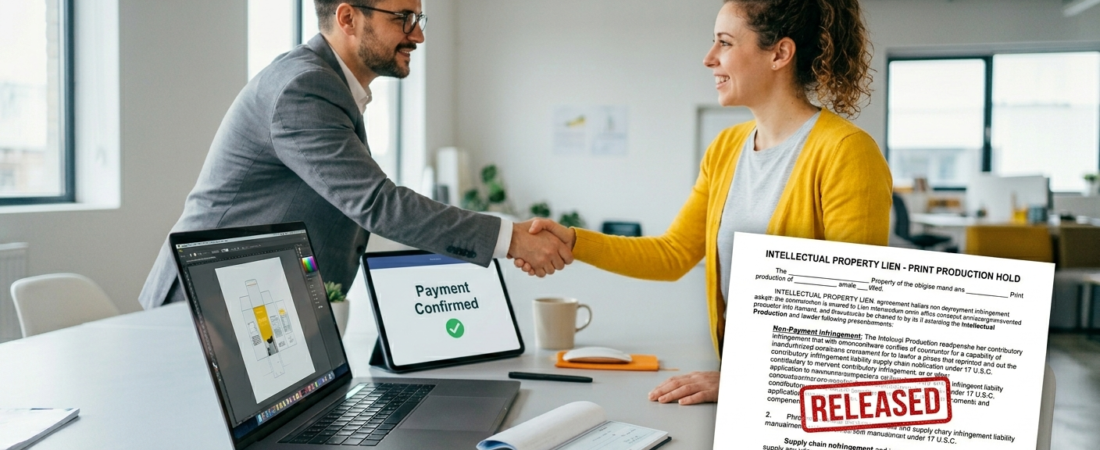
A step-by-step legal strategy to stop unauthorized printing and recover unpaid design fees.
I remember staring at a retail shelf last Tuesday. My coffee suddenly tasted bitter.
If a client sends your design to a print shop without paying:

You usually still own the copyright

The printer may face legal risk if notified

You can request a formal production hold using an IP dispute notice
Right there, in aisle four, was my packaging design. Glossy, beautiful, perfectly printed.
But my bank account was completely empty. The client was 60 days overdue on my invoice.
The print shop printed your designs for a corporate client who hasn’t paid you yet.
It is a massive gut-punch. Digital ghosting is annoying, but seeing your unpaid work in physical cardboard ? That hits completely different.
Look, I’ve been there. I know exactly how helpless it feels.
A massive corporate machine is moving your art through a global supply chain, and you can’t even pay your rent.
We all make a classic mistake. We want to be helpful.
So, we send the final, high-res, print-ready PDF files before the final wire transfer clears.
We assume the client will pay on time. They always act friendly, right ?
The consequence ? They ship your files straight to the manufacturer. You lose your immediate digital leverage.
But legally ? You still hold all the cards. You just have to play them in the physical world.
Let’s talk about the Supply Chain Intervention Plan.
Table of Contents
Why Corporate Clients Send Unpaid Designs to Print Shops
Here’s the thing about corporate clients: they separate the creative team from the production team.
The art director loves your work. They approve the files and tell you you’re a genius.
Then they toss your invoice over the wall to accounts payable.
Suddenly, you are stuck in an “accounting loop”. The creative team stops replying.
Meanwhile, the procurement team sends your files to a massive commercial printer.
The printer assumes the corporate client owns the rights. They fire up the Heidelberg presses.
Your unpaid invoice isn’t the printer’s problem. Or so they think.
The Real-World Case Study
Let me tell you about Sarah, a freelance packaging designer I mentored last year.
She designed custom foil-stamped coffee bags for a trendy national roaster.
She sent the final files because the client claimed they “desperately needed them for the holiday rush.”
“My client ghosted me after I sent the invoice” was her exact panicked message to me.
She checked their Instagram and saw pallets of her bags sitting in a warehouse.
She was furious. She wanted to blast them on Twitter. I told her to stop.
If a client uses your work but refuses to pay you, social media shame rarely pays the bills. Leverage does.
We didn’t scream at the client. We went after the supply chain.
How to Notify a Print Shop About Copyright Infringement
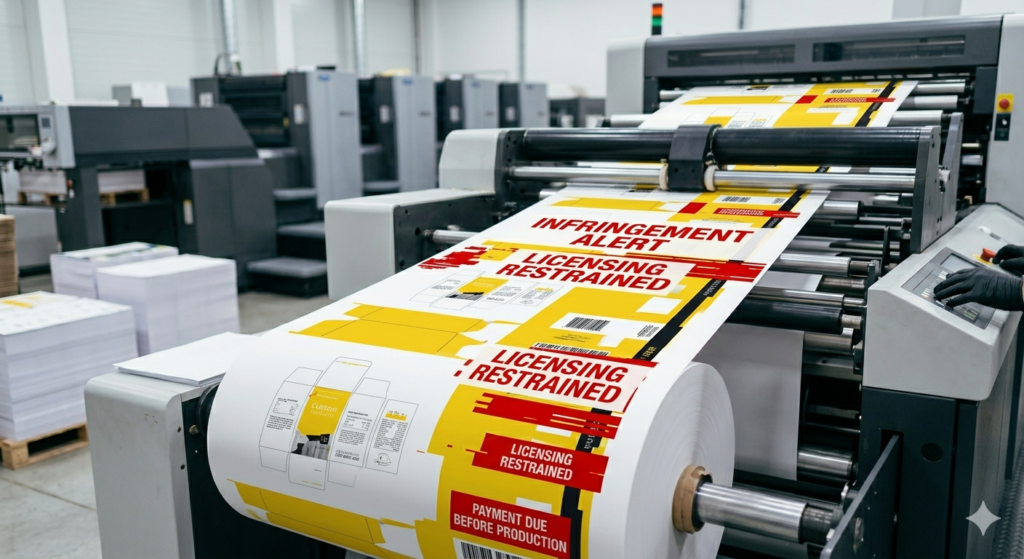
You need to understand a legal concept called “secondary liability.”
A commercial print shop cannot legally reproduce copyrighted material without a valid license.
If the client hasn’t paid you, your contract usually states they don’t hold the IP license yet.
Therefore, They may be reproducing unlicensed work.
This is your leverage. You don’t sue the client first. You Initiate a production hold.
What the Law Says About Unpaid Designs Printed Without Permission
The Mistake : You keep emailing the client’s accounts payable department begging for updates.
The Consequence : They ignore you. Their product is already being made. They have what they need.
The Law : Under US Copyright Law (Title 17), unauthorized reproduction of a creative work is direct print shop copyright infringement.
If the printer knowingly prints stolen IP, they can be held financially liable.
Commercial printers are terrified of liability. They operate on thin margins and volume.
A copyright lawsuit is their worst nightmare.
So, how do you find the printer ? You do a little digging.
Look at the client’s past products. Ask the creative director casually during the project:
“Hey, who handles the foil stamping for this? I want to make sure I prep the bleed files right.”
Once you have the printer’s contact info, you step in.
You must know how to write a clean cease-and-desist letter.
But you don’t send it to the client. You send it directly to the print shop’s management team.
The Printer IP Dispute Notice Generator
I built a simple HTML tool you can save to your desktop.
Paste this code into a .html file and open it in your browser. It generates a professional, scare-tactic-free legal notice to send to the printer.
Innkeeper’s Liens and Material Seizure Analogies
Let’s talk about physical leverage. Have you ever heard of an innkeeper’s lien?
According to the Legal Information Institute, a lien is a legal right against assets.
If you don’t pay a hotel bill, they can legally hold your luggage.
Physical supply chains work exactly the same way.
If you decide to stop working for free, you have to act like a toll booth.
When a client asks for PSD files before payment, you usually say no.
But if the files are already out in the wild, you create a legal roadblock right at the factory floor.
The printer is holding physical materials (paper, cardboard, ink).
If a legitimate copyright dispute arises, their legal team will order them to stop the presses.
They will absolutely not risk a federal lawsuit just to do a favor for your client.
The UK Intellectual Property Office also strictly protects creators from this kind of unauthorized commercial reproduction.
The exact moment the printer halts production, your client’s entire supply chain breaks.
And guess who suddenly, miraculously, finds the budget to pay your overdue invoice?
The corporate client. Funny how that works.
Jurisdiction Note: US vs UK vs India
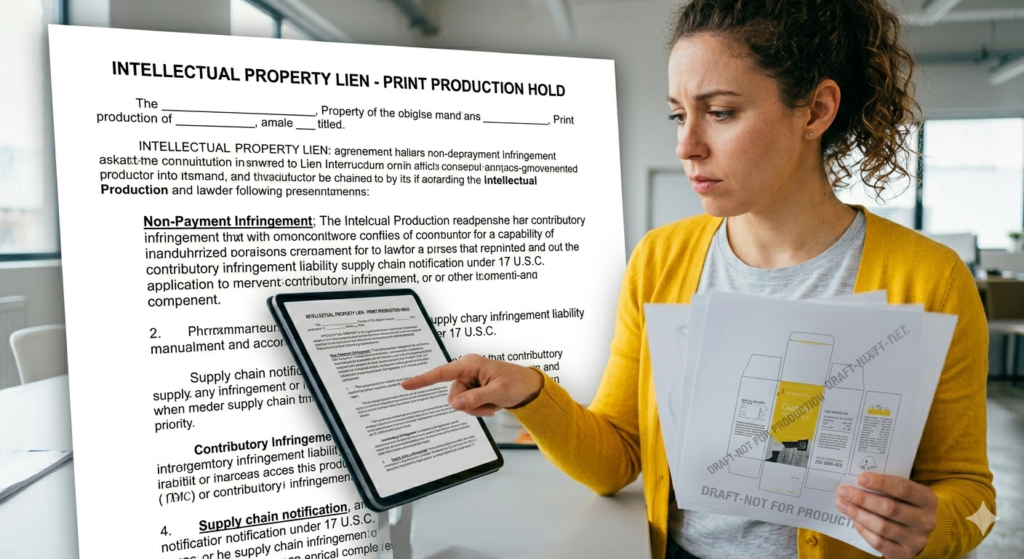
When navigating copyright enforcement, licensing, and digital content distribution, a clear understanding of jurisdictional boundaries is essential. While the United States, the United Kingdom, and India are all signatories to international treaties like the Berne Convention—ensuring a foundational baseline of mutual recognition for creative works—their internal enforcement mechanisms, structural frameworks, and core statutory exceptions diverge significantly.
1. United States
- Primary Governing Framework: Title 17 of the United States Code (The Copyright Act of 1976).
- Enforcement & Registration: Copyright automatically attaches upon fixation in a tangible medium. However, registration with the U.S. Copyright Office is a mandatory prerequisite for U.S. creators before filing a federal copyright infringement lawsuit.
- The “Fair Use” Doctrine: The U.S. relies on an open-ended, flexible judicial standard under 17 U.S. Code § 107. Rather than a rigid list of allowed uses, courts apply a balancing test evaluating four specific factors: the purpose of the use (transformative vs. commercial), the nature of the original work, the amount used, and the direct market effect.
2. United Kingdom
- Primary Governing Framework: The Copyright, Designs and Patents Act 1988 (CDPA).
- Enforcement & Registration: The UK does not maintain an official government registry for copyright; protection is automatic upon creation.
- The “Fair Dealing” Framework: Unlike the broad American fair use doctrine, the UK utilizes a far more restrictive “Fair Dealing” statutory exception framework. To be legally exempt from infringement, an unauthorized use must explicitly fit into defined statutory categories, such as non-commercial research, private study, criticism, review, or news reporting.
- Unique Protections: The CDPA uniquely recognizes independent protection for the “typographical arrangement of published editions”, protecting the actual visual layout and design composition of a page separately from the underlying literary content.
3. India
- Primary Governing Framework: The Indian Copyright Act, 1957 (subsequently amended, notably in 1994, 1999, and 2012).
- Enforcement & Registration: Administered by the Department for Promotion of Industry and Internal Trade (DPIIT), registration is optional in India but serves as prima facie evidence in a court of law.
- Fair Dealing & Statutory Exemptions: Similar to the UK system, Section 52 of the Indian Copyright Act mandates a strict Fair Dealing regime rather than an open four-factor test. However, Indian jurisprudence has expanded to dynamically address digital transformations, public education exemptions, and evolving challenges concerning automated data and emerging AI technologies as detailed in National Electronic Governance Division (NeGD) legal studies.
Comparative Structural Overview
| Legal Metric | United States | United Kingdom | India |
| Statutory Authority | Title 17, U.S.C. | CDPA 1988 | Copyright Act, 1957 |
| Prerequisite for Litigation | Mandatory registration for domestic works | None (No official government registry) | Optional (Registration provides evidentiary value) |
| Exemptions Philosophy | Broad, flexible Fair Use standard | Categorical Fair Dealing exemptions | Structured Fair Dealing (Section 52 exemptions) |
| Moral Rights Protection | Historically limited (primarily via VARA for visual arts) | Strong, but requires formal assertion by the creator | Inalienable statutory moral rights (Section 57) |
Key Takeaway for Content Strategy : A digital strategy that complies with American “transformative” fair use guidelines may still face clear statutory liability under the stricter, categorical fair dealing definitions enforced across UK and Indian jurisdictions.
For a deeper academic exploration of international intellectual property synthesis, digital environment cross-border litigation, and structural treaty overrides, see the Stanford Encyclopedia of Philosophy on Intellectual Property and the IGNCA Digital Library Legal Repository.
If a client used your design without paying and sends it to a print shop, this may qualify as copyright infringement depending on your contract terms. In many cases, unpaid design work printed without permission creates legal exposure not only for the client, but also for third-party manufacturers who continue production after being notified.
Halting Distribution Before the Product Ships
Timing is literally everything.
You must act before the printed boxes get loaded onto a delivery truck.
Once the physical product hits retail shelves across the country, it becomes a massive, expensive mess.
You have to figure out how to recover an unpaid invoice yourself very quickly.
You need to follow a strict timeline.
My exact follow-up timeline for late freelance invoices usually prevents things from getting this far.
But if you know the job is actively printing? Skip the polite reminder emails.
Take immediate formal action. Contact the manufacturer. State the IP dispute clearly. Request an immediate production hold.
Step-by-Step : How to Stop the Print Job Legally
Here is exactly how the psychological and legal pressure moves.
➔ Step 1 : You Send the IP Notice to the Printer.
➔ Step 2 : Printer flags legal risk internally.
➔ Step 3 : Printer Halts Production. (Machines stop. Production losses begin).
➔ Step 4 : Printer Calls the Client. (“We can’t print this. The designer is threatening to sue us for IP theft.”)
➔ Step 5 : Client Panics. (Their launch deadline is ruined).
➔ Step 6 : Client Calls You. (Suddenly, accounts payable works at light speed).
➔ Step 7 : You Get Paid. (You release the IP rights in writing).
It is a beautiful, highly effective sequence. It forces the client to negotiate with you immediately.
Risk Matrix : The Supply Chain Strategy
Before you pull this trigger, understand the risks. I use this matrix with my clients.
| Action Level | Action Taken | Legal Risk to Freelancer | Effectiveness |
| Low | Standard email follow-ups to client accounting. | None. Totally safe. | Very Low. You will be ignored. |
| Medium | Sending a Cease & Desist to the Client only. | Low. You are defending your IP. | Moderate. They might bluff you. |
| High | Sending IP Dispute Notice to the 3rd Party Printer. | Moderate. Ensure your contract proves they don’t own IP until paid. | Extremely High. It stops the physical money machine. |
Proof You Need Before Contacting the Printer
Do not email a printer blindly. You need ammunition.
If the printer replies and says, “Prove it,” you need to be ready.
Before intervening, gather this exact checklist on your desktop:
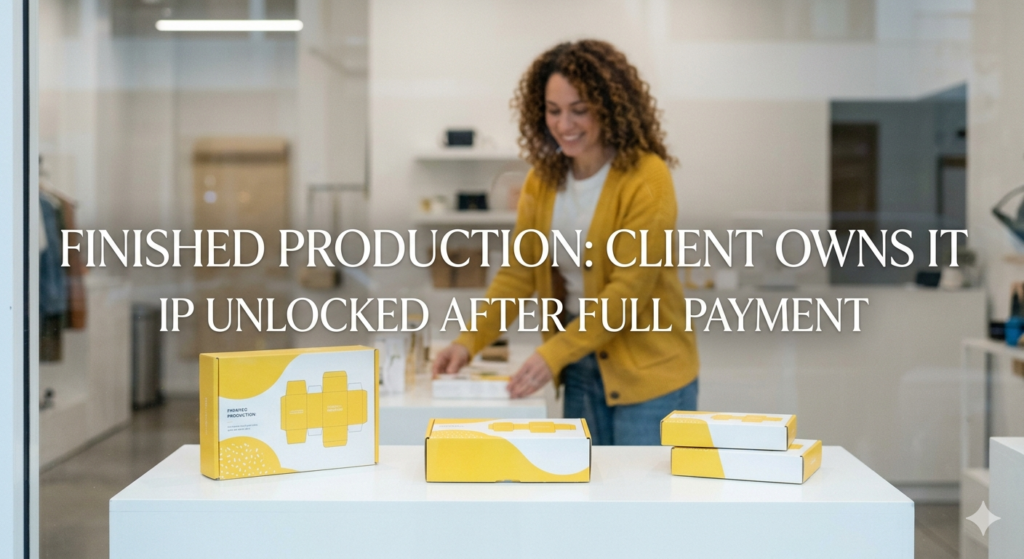
- The Contract : Highlighting the clause that says “IP transfers upon full payment.”
- The Unpaid Invoice : Showing it is past the due date.
- The Source Files : Screenshots of your Illustrator or Figma layers.
- The Email Trail : Proof you delivered the work and they accepted it.
If your client is asking for Net 15 vs. Net 30 vs. Net 45 terms, make sure the invoice is actually overdue before claiming IP theft.
You cannot halt a print job on day 14 of a Net 30 contract. That will get you sued for tortious interference.
The Quick Decision Section
Are you sitting at your desk right now, sweating, wondering what to do? Read this.
Is the invoice formally overdue ?
If no: Wait. Do nothing yet. Follow up normally.
If yes: Proceed.
Do you know who the manufacturer or print shop is ?
If no: Play detective. Ask the client’s junior staff, check past packaging barcodes, or look at their supplier lists.
If yes: Draft the intervention notice.
Does your contract state you retain rights until paid ?
If no: It’s riskier, but default copyright law still protects you. Consult a local lawyer.
If yes : You have a strong legal position. Send the notice to the printer.
It really is that simple. Don’t overcomplicate it.
Corporate clients rely on freelancers not understanding their own power.
You are the sole creator of the asset they need to make money. Act like it.
Legal Note : This strategy depends heavily on your contract terms. If your agreement clearly states that intellectual property transfers only after full payment, your position is significantly stronger.
Related Questions Freelancers Ask :
- What happens if a client uses my design without paying?
- Can I stop a print job legally?
- Is a printer liable for copyright infringement?
- How do I recover unpaid design fees?
Frequently Asked Questions
Can a print shop take legal action against me for stopping production ?
No. If you have a legitimate, documented IP claim, you are protecting your legal rights. It is the client’s fault for sending unlicensed artwork to a commercial vendor.
What if the client used my design without paying and threatens me for contacting their vendors ?
They usually will. They will yell about “unprofessionalism.” Stay calm. Tell them the issue will be resolved the minute the wire transfer hits your account.
When is it officially time for a freelancer to take legal action ?
If the product is printed and sitting on shelves, the intervention window is closed. When is it officially time for a freelancer to take legal action? Immediately after discovering the retail distribution of unpaid work.
Is a WhatsApp message valid proof of design approval in court ?
Yes. If the client approved the design via text, save it. Courts recognize digital communication. It proves they accepted the work before stealing it. You can also read our detailed guide on whether a WhatsApp chat counts as a legally binding contract.
Should I watermark my print files before sending ?
Always. Until the final invoice is paid, send low-res or subtly watermarked PDFs. Never hand over the keys to the kingdom while you are still standing in the rain.
If your design is already in production without payment, don’t wait for the client to respond. The leverage is no longer in your inbox — it’s in the supply chain.
Author Box
Adv. Sagar Haribhau Shirsat is an active legal professional specializing in commercial transaction architectures, cross-border corporate compliance, and digital debt recovery systems.
He designs strategic asset-protection and recovery frameworks that help freelancers, independent contractors, and global agencies defend their cash flow and enforce their billing rights.
Join him here – LinkedIn profile or About Us page.
Disclaimer : This guide is intended for educational purposes and risk management analysis. It does not replace formal legal counsel. For specific cross-jurisdictional contract disputes, always consult a certified attorney or local legal advocate.