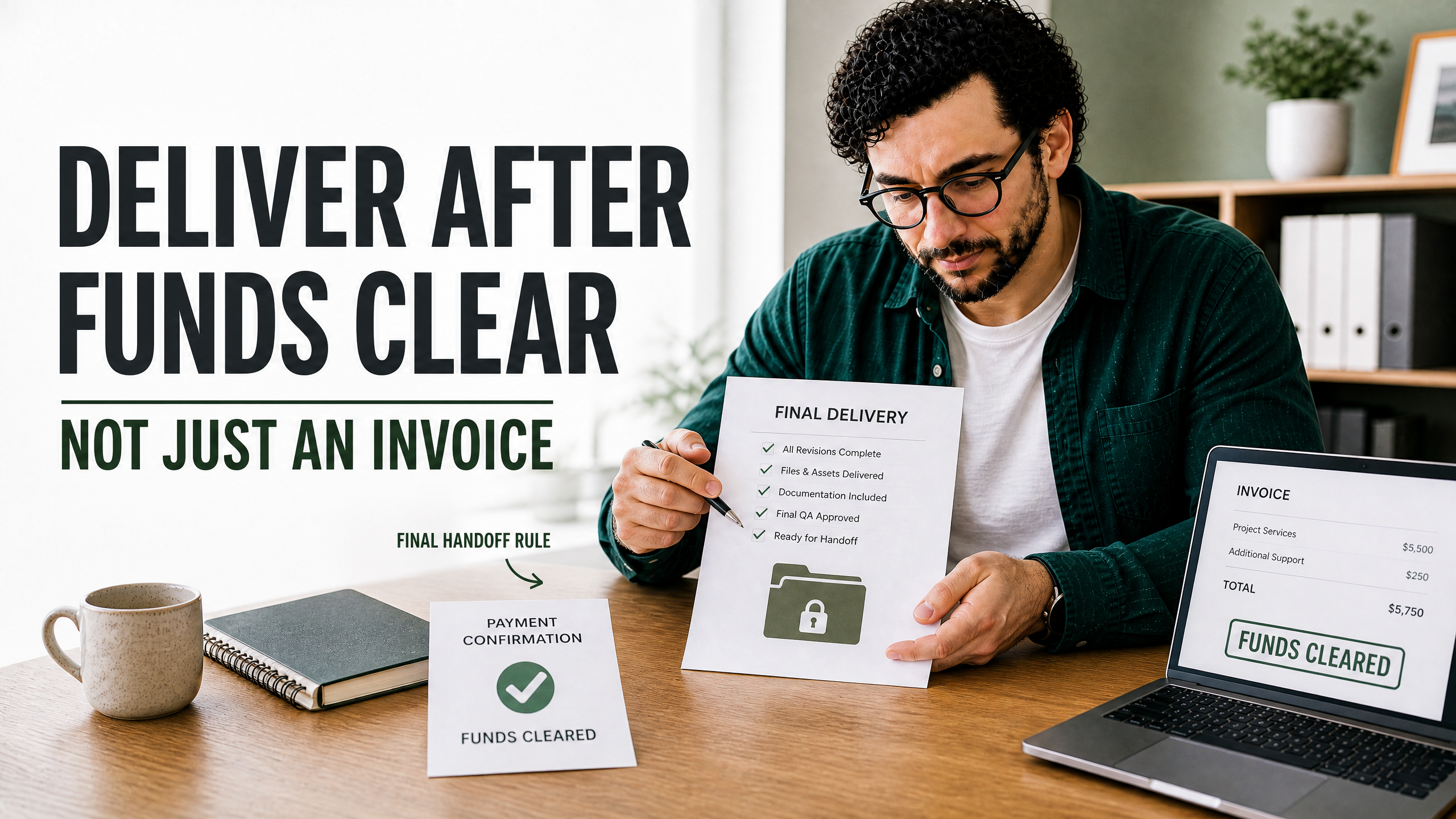
Imagine it is Friday afternoon.
You have finished the project. The client has approved the final version. Your final invoice has been outstanding for several weeks.
Then an email arrives:
“Hey, just processed the wire. We really need the final assets for Monday’s launch. Can you send the Dropbox link?”
Attached is a polished-looking payment receipt.
It contains a transaction number, the client’s company name, a payment amount, and what appears to be a bank confirmation.
The temptation is obvious: release the files and move on.
But there is an important distinction freelancers need to understand:
A payment instruction, payment receipt, or transaction screenshot is not necessarily the same thing as funds actually being received and available in your account. where you have to Link Final Project Delivery to the Clearance of Funds .
If your contract makes final delivery conditional on payment, releasing the final files merely because a client says “the money has been sent” can eliminate one of your strongest practical forms of leverage.
That does not mean every client who sends a payment screenshot is attempting fraud. Many legitimate corporate payments move through accounting departments, payment processors, correspondent banks, and clearing systems.
The problem is simpler:
You should not confuse evidence that a payment was initiated with evidence that your payment obligation has actually been satisfied.
This guide explains how freelancers can structure final delivery, contracts, payment verification, evidence preservation, and access controls around that distinction.
Important legal note: Payment systems, contract interpretation, copyright ownership, and remedies vary by jurisdiction and by payment method. This article provides a risk-management framework, not a universal legal rule. Your contract and the law governing it should determine what rights you have in a particular dispute.
Table of Contents
1. A Payment Screenshot Is Not the Same as Cleared Funds
A screenshot can show that a client initiated a transaction.
It does not necessarily establish that:
- the transaction has completed;
- your bank has credited your account;
- the funds are available for withdrawal;
- the payment cannot still be returned or disputed;
- the payment satisfies the payment condition in your contract; or
- the payment has become final under the applicable payment system.
That distinction matters because your commercial decision is not really:
“Did the client send me proof?”
It is:
“Has the payment condition required for final delivery actually been satisfied?”
For a new client, a screenshot should therefore be treated as payment evidence, not automatically as payment clearance.
The same principle applies when a client says:
“Accounting has approved it.”
or:
“The wire is in the queue.”
or:
“The transfer has been released.”
Those statements may be completely genuine.
They still do not necessarily mean your bank has received and made the funds available to you.
If you regularly encounter clients who want source files before payment, see our guide on Client Asking for PSD Files Before Payment or AI Files Before Payment.
And if a client wants access to unfinished or partially protected work before final payment, How to Watermark Your UI/UX Deliverables Without Ruining the Presentation explains one practical way to separate approval access from unrestricted production access.
2. Why the Payment Method Matters

There is no single universal “clearance period” that applies to every payment.
ACH, domestic wires, international transfers, cards, and payment platforms operate under different rules.
That means freelancers should avoid writing a contract that simply says:
“Files will be released after payment.”
A stronger contract defines what the parties mean by payment for the specific transaction.
For example:
“Final deliverables will be released after the applicable invoice amount has been received and credited to the Contractor’s designated account in accordance with the payment method specified in this Agreement. A payment instruction, payment receipt, screenshot, or transaction confirmation does not by itself constitute receipt of funds unless the parties expressly agree otherwise.”
That wording does not pretend that every banking system works identically.
It establishes a practical verification standard.
If you are still deciding whether your contract should use Net 15, Net 30, or Net 45, compare the alternatives in Net 15 vs. Net 30 vs. Net 45: Which Payment Terms Protect Your Cash Flow?.
You can also review the broader Freelancer Payment Terms Guide: Avoid Net 60 & Late Payments before finalizing your payment schedule.
3. ACH Payments: Initiated Does Not Necessarily Mean Final
ACH payments deserve particular care because an ACH transaction can involve initiation, processing, settlement, and possible return or reversal mechanisms.
A freelancer should therefore avoid making a blanket statement such as:
“ACH always clears in exactly three days.”
That is too simplistic.
The timing and outcome can depend on the transaction, financial institutions involved, applicable rules, and whether the transaction is returned or reversed.
The practical rule is much safer:
Do not release critical final deliverables merely because the client has shown you an ACH initiation confirmation. Verify the actual status of the funds with your financial institution.
This is also why your contract should avoid promising a fixed clearance period unless you actually control the payment process.
If an ACH transaction is returned, the freelancer may suddenly be in the same position as before: the client has the work, but the invoice remains unpaid.
That is exactly the situation your delivery workflow should prevent.
If the client repeatedly claims that the invoice is “somewhere in accounting,” use the documentation strategy in What to Do When a Corporate Client Claims Your Invoice Was Lost in Accounting for the Third Time.
For a broader accounts-payable strategy, see Client Says Your Invoice Was Lost? How to Get Paid by Corporate Accounts Payable.
4. Wire Transfers: Do Not Assume Every Wire Works the Same Way
Wire transfers are often treated as automatically final the moment a client sends a receipt.
That is also too broad.
The actual payment system matters.
For example, the Federal Reserve describes Fedwire as a real-time gross settlement system in which transfers become immediate, final, and irrevocable once processed through the system. The Federal Reserve also explains that Fedwire operates on defined business days and has specific operating deadlines.
That is very different from saying:
“Every wire sent at 4:30 PM on Friday can be cancelled all weekend.”
You should not make that claim.
Under UCC Article 4A, cancellation or amendment of a payment order depends in part on whether the receiving bank has accepted the order and whether the bank has a reasonable opportunity to act. After acceptance, cancellation generally requires the receiving bank’s agreement or an applicable funds-transfer rule.
For U.S. readers who want the underlying rule, see UCC § 4A-211 on cancellation and amendment of payment orders.
The important freelance-business lesson is simpler:
A client’s wire receipt tells you that a payment instruction exists. Your bank’s confirmation tells you much more about whether you actually received the money.
Do not turn a complicated banking question into a five-minute assumption.
5. What Should “Payment Clearance” Mean in Your Contract?
The phrase “payment” can create unnecessary uncertainty if your contract does not explain when payment is considered satisfied.
Consider the difference between these provisions:
“Final files will be delivered upon payment.”
and:
“Final files will be released after the applicable invoice amount has been received and credited to the Contractor’s designated account, subject to the terms of the applicable payment method.”
The second clause is more operational.
For some contracts, you may want even greater precision:
Final Deliverables Release: Final deliverables identified as “Release Materials” will be delivered after the applicable invoice has been paid in accordance with the payment terms of this Agreement. For purposes of release, the Contractor may require confirmation that the applicable funds have been credited and made available by the Contractor’s financial institution. A payment screenshot, transaction receipt, payment instruction, or notice of initiation does not by itself establish receipt of funds.
You should then define exactly what happens to:
- source files;
- editable documents;
- administrator credentials;
- production code;
- design-system files;
- uncompressed video;
- master audio;
- intellectual-property assignments;
- licenses;
- final deployment;
- account-transfer credentials.
Do not assume that all of these rights automatically rise and fall together.
If your proposal is doing most of the work of your contract, read How to Structure a Proposal So It Functions Like a Real Legal Defense Contract.
And if the parties never signed a formal contract, see Can You Sue a Client Without a Contract? Real Legal Answer (2026).
6. The Clearinghouse Security Rule
To make this process practical, Freelancer Recovery uses a three-phase framework called the Clearinghouse Security Rule.
This is an operational framework—not a banking regulation, statutory rule, or legal doctrine.
Its purpose is simple:
Separate client approval from unrestricted final delivery until the payment condition in your agreement has been satisfied.
Phase 1: The Verification Gap
This is the period between completing the work and receiving final payment.
Your objective is to let the client inspect and approve the work without unnecessarily giving them unrestricted production assets.
Examples:
- designer → watermarked or flattened preview;
- video editor → review copy rather than master;
- developer → staging environment rather than production credentials;
- copywriter → PDF preview rather than editable source;
- brand strategist → presentation rather than unrestricted editable assets.
If the client asks for “just one quick fix” during this stage, make sure the request does not quietly become additional unpaid work. See Client Asked for “One Quick Fix”? Here’s How to Charge for Scope Creep Without Losing the Client and Stop Working for Free: How to Prevent Scope Creep From Eating Your Profits.
Phase 2: The Leverage Hold
The final invoice is outstanding.
The client sends a screenshot.
You acknowledge it.
But you do not automatically release the final production assets.
You can say:
“Thank you for sending the transaction confirmation. I have recorded the payment reference and will complete the final handover once the funds are confirmed as received and available in accordance with our agreement.”
This is professional.
You are not accusing the client of fraud.
You are not threatening them.
You are simply following the agreed process.
If the client starts changing the commercial terms after the work is finished, see How to Handle a Client Who Retrospectively Demands an Uncontracted NDA Before Clearing an Invoice.
Phase 3: Controlled Release
Once your payment condition has been satisfied, release the final package according to the contract.
The important idea is controlled release, not indefinite withholding.
The freelancer should have a predictable process:
Approval → Invoice → Payment verification → Final release → Handover record
That process is much easier to defend than making an emotional decision every Friday afternoon.
7. How to Protect Final Deliverables Before Payment
The best payment protection is often not a legal threat.
It is a well-designed workflow.
Designers
Use review-quality exports, watermarks, flattened previews, or restricted access until the contractual release condition is satisfied.
For more detail, see Client Used Your Design Without Paying? Here’s How to Stop the Print Job and Client Used My Design Without Paying? What to Do (Legal Guide for Freelancers).
UI/UX designers
Use view-only or appropriately restricted collaboration permissions where practical.
If payment fails after access has been granted, review How to Revoke Access to Figma Files After Non-Payment (Safe & Legal Method).
Developers
Keep development and production environments appropriately separated.
Do not assume that because code is sitting in a client’s AWS account, you can simply delete it, shut down the server, or lock the client out.
Those actions can create contractual, technical, or legal problems.
If the client already has your code on AWS, see The Client Has Your Code on AWS and Won’t Pay: The Code-Audit Breakdown.
And before taking any action against a live server, read Can I Shut Down a Client’s Server for Non-Payment? (Legal + Safe Method for Freelancers).
Video editors
Provide review versions rather than unrestricted masters when your agreement permits it.
If a client uses the video before completing payment, see Client Used My Video Without Paying? Here’s How to Recover Your Money Using a YouTube Copyright Strike and Client Uploaded My Video Without Paying? How to File a YouTube Copyright Claim.
Copywriters
A review PDF can be appropriate where the contract does not require immediate editable-file delivery.
If the client publishes the material before paying, see Client Published My Article But Didn’t Pay? Here’s Exactly How to Recover Your Money (Legally).
8. Do Not Confuse Delivery of a File With Transfer of Copyright
This distinction is critical.
Giving someone a copy of a file does not automatically answer the separate question of who owns copyright or what license the client has.
The U.S. Copyright Office explains that copyright ownership and ownership of the physical or digital copy of a work are distinct concepts. Copyright ownership can also be transferred through agreements, subject to applicable law.
Stanford’s Copyright and Fair Use Center similarly explains that copyright ownership can depend on factors including authorship, employment status, work-made-for-hire rules, and written agreements.
That means you should not tell a client:
“I sent you the file, so now you own the copyright.”
Nor should you tell a freelancer:
“You still have the copyright simply because they haven’t paid.”
The answer may depend on the contract and applicable law.
Instead, your contract should clearly address:
- ownership;
- licensing;
- assignment;
- work-made-for-hire language where applicable;
- payment conditions;
- permitted pre-payment use;
- final transfer;
- source-file delivery;
- portfolio rights.
The U.S. Copyright Office provides further information on copyright ownership and transfers in its Copyright Basics materials.
If your specific problem is that a client is already using your work without paying, see What to Do When a Client Uses Your Work But Refuses to Pay You.
9. A Safer Final-Delivery Email
When a client sends a payment screenshot, you do not need to accuse them of attempting to deceive you.
Use neutral language.
Payment Screenshot Acknowledgment
Subject: Payment Confirmation Received — Final Deliverables
Hi [Client Name],
Thank you for sending the payment confirmation for the [Project Name] invoice.
I have recorded the transaction reference for our records. In accordance with our agreement, the final production files and remaining handover materials will be released once the applicable funds are confirmed as received and available in my account.
I will monitor the payment and complete the final handover as soon as the required payment condition has been satisfied.
Thank you,
[Name]
This is better than writing:
“I don’t trust your screenshot.”
You are enforcing a process, not accusing the client.
For broader written-payment documentation, see How to Turn an Email Trail into a Legally Defensible Invoice Statement.
10. What If the Client Says Accounting Needs the Files First?
This situation requires more nuance than simply calling the client a liar.
Sometimes a legitimate corporate procurement system may require a particular document before an invoice can be approved.
The correct response is to separate proof of completion from unrestricted delivery.
You might provide:
- a watermarked PDF;
- a review-only link;
- a low-resolution export;
- a staging demonstration;
- a completion report;
- a screenshot;
- a signed acceptance record.
But whether you are contractually required to provide these items depends on your agreement.
If the client is repeatedly claiming that accounts payable has lost your invoice, see Stuck in an “Accounting Loop”? Try This Psychological Trick to Get Paid Fast and How to Design an Invoice That Accounts Payable Teams Can’t Ignore.
If the client simply stops responding, see My Client Ghosted Me After I Sent the Invoice—What Do I Do Now?.
11. A Better Risk Matrix
There is no honest universal percentage for the probability that an invoice will be paid or a transaction will be reversed.
So instead of inventing percentages, use a relative-risk framework:
| Release point | Practical exposure |
|---|---|
| Final files released when invoice is merely issued | Very high |
| Final files released after payment screenshot | High |
| Final files released while transaction remains pending | Moderate to high |
| Final files released after your bank confirms receipt/availability | Lower |
| Final release under a clearly drafted contract after the required payment condition is satisfied | Lowest practical payment exposure |
These are risk-management categories, not statistical probabilities.
That distinction matters.
A payment can still be disputed or challenged even after it appears in an account, particularly where a payment platform or card network provides separate dispute mechanisms.
So never promise:
“Once the money appears, there is zero risk.”
There is no universal zero-risk payment method.
12. What If You Already Released the Files and the Payment Failed?
Do not immediately start deleting accounts, shutting down servers, or threatening copyright claims.
First preserve the evidence.
Create a folder containing:
- the signed contract;
- amendments;
- invoice;
- payment terms;
- payment screenshot;
- transaction/reference number;
- client emails;
- Slack or WhatsApp communications where relevant;
- proof of delivery;
- approval messages;
- bank records;
- notices you sent;
- evidence showing how the client used the work.
A contemporaneous written record is usually far more useful than relying solely on memory.
A phone conversation can potentially become evidence depending on the circumstances and applicable law, but important commercial communications should generally be confirmed in writing.
For communications conducted through messaging platforms, see Can a WhatsApp Chat Count as a Legally Binding Contract? (US & UK Law).
For Slack-based arrangements, see Client Ghosted Final Invoice But We Only Agreed Via Slack. Can I Sue?.
13. Do Not Automatically “Revoke” Copyright After Non-Payment
This is another area where freelancers need to resist oversimplification.
Suppose you sent the final files.
The client then fails to pay.
It may be tempting to send:
“Because you didn’t pay, all copyright rights are automatically revoked.”
That may be legally incorrect depending on your contract and jurisdiction.
Instead, review the actual agreement.
Ask:
- Did the contract condition a license or assignment on payment?
- Did ownership already transfer?
- Was the client given a license before final payment?
- Was there a work-made-for-hire provision?
- What law governs the agreement?
- Does the contract provide suspension or termination rights?
- What remedies are available for breach?
The U.S. Copyright Office confirms that copyright ownership can be transferred and that the precise ownership structure depends on the applicable agreement and statutory framework.
If the client has taken your code and refuses to pay, see Client Stole My Website Code: Legal Steps to Respond, Prove Ownership, and Recover Access.
If the dispute involves a repository, see When Clients Ghost on GitHub: How to File a DMCA Takedown on Your Own Code Repository.
And if you need a formal written demand, see How to Write a Clean Cease-and-Desist Letter If a Client Steals Your Code or Designs.
14. International Clients Require Even More Contractual Precision
A U.S. ACH transaction is not the same thing as a European SEPA payment.
A domestic wire is not the same thing as a SWIFT transaction.
A card payment is not the same thing as a bank transfer.
And a payment-platform balance is not necessarily equivalent to an irrevocably settled bank payment.
For international projects, your agreement should identify:
- payment currency;
- payment method;
- bank charges;
- intermediary-bank fees;
- exchange-rate responsibility;
- payment date;
- invoice currency;
- account details;
- what constitutes receipt;
- delivery condition;
- governing law;
- dispute forum;
- intellectual-property transfer;
- tax responsibilities where applicable.
If you routinely work with clients outside your home country, read How to Protect Yourself When Working With International Clients.
You should also review your approach to late fees and interest separately rather than assuming that a single rule applies worldwide. See How to Charge Late Fees Legally (US, UK & India Guide) and Can You Legally Charge Interest on Late Invoices? (US, UK & India Rules).
15. The Friday Afternoon Rule
Friday afternoon is not legally special.
But it can be operationally stressful.
A client may suddenly have:
- a launch deadline;
- an accounting cutoff;
- an executive demanding the files;
- a payment screenshot;
- a request for “just five minutes” of cooperation.
That pressure can cause freelancers to abandon their normal process.
Don’t.
If the contract says final assets are released after the applicable payment condition is satisfied, use the same process on Friday that you would use on Tuesday.
You do not need to accuse the client of fraud.
You simply say:
“I will release the final handover as soon as the payment is confirmed in accordance with our agreement.”
Consistency protects both sides.
16. The Quick Decision Checklist

If a client has just sent you a payment screenshot, ask these questions.
Has the client actually paid according to your contract?
If yes, follow the contract’s release mechanism.
If not, determine what the contract says about final delivery.
Is the transaction merely initiated?
If yes, do not automatically treat it as cleared funds.
Does your bank show the funds as received and available?
If yes, record the confirmation and proceed according to your agreement.
Is the transaction still pending?
If yes, ask your financial institution what the status means rather than relying on the client’s screenshot.
Is the client demanding immediate delivery because of an internal deadline?
Their deadline does not automatically rewrite your contract.
Is this a trusted long-term client?
You may choose to accept additional commercial risk, but understand that doing so is a business decision—not evidence that the payment has legally or technically cleared.
Are they threatening to cancel the project?
Stay professional.
Document the communication.
Do not respond emotionally.
If the client is attempting to change the commercial arrangement after the fact, review How to Use the Notice of Suspension of Services Without Ruining the Client Relationship Permanently.
17. What If the Client Offers a Partial Payment?
Be careful.
A client might say:
“I can send you 10% today. Just release everything and we’ll settle the rest next week.”
Whether accepting partial payment affects your legal position depends on the agreement and applicable law.
Do not assume that accepting a small amount automatically destroys your rights—but do not casually accept partial payment without documenting what it represents.
If the client proposes this arrangement, review The Partial Payment Trap: Why Accepting 10% of a Late Invoice Can Sometimes Erase Your Legal Leverage.
If the client has already run out of money during the project, see Client Runs Out of Money Mid-Project? Legal & Smart Recovery Guide for Developers and What to Do When a Video Production Client Runs Out of Money Before Post-Production Ends.
18. Prevention Is Better Than Chasing the Invoice
The strongest payment strategy begins before the final invoice.
Your contract should answer:
- What is the deposit?
- When are milestones invoiced?
- When is payment due?
- What happens if payment is late?
- When are final files released?
- When do licenses or assignments become effective?
- What happens if the client disputes part of the invoice?
- Can services be suspended?
- What happens to third-party expenses?
- What happens if the client becomes insolvent?
- What law governs the contract?
You can also use incentives rather than relying entirely on enforcement.
For example, Early Payment Discounts for Freelancers: How to Get Clients to Pay 5 Days Early explains how early-payment incentives can be structured as a positive alternative to constantly chasing overdue invoices.
And if a retainer is approaching exhaustion, The Retainer Exhaustion Warning: How to Auto-Notify Clients When Their Balance Hits $0 addresses the problem before it becomes a final-invoice dispute.
19. Build a Payment-to-Delivery Audit Trail
A strong workflow should produce a simple record:
1. Contract signed
↓
2. Milestone completed
↓
3. Client approval recorded
↓
4. Invoice issued
↓
5. Payment status recorded
↓
6. Payment confirmation received
↓
7. Funds verified according to the contract/payment method
↓
8. Final files released
↓
9. Handover confirmation sent
That record becomes extremely valuable if a dispute later develops.
It can show exactly:
- what was agreed;
- what was delivered;
- what was approved;
- what was invoiced;
- what the client claimed to have paid;
- what your bank actually received;
- when the final files were released.
If you need a more systematic approach to late invoices, see The Exact Follow-Up Timeline for Late Freelance Invoices (That Actually Works).
For a complete recovery framework, see The Freelancer’s Legal Guide to Recovering Unpaid Invoices (Without Expensive Lawsuits).
20. What If the Client Uses the Work Before Paying?
This is where the dispute can become more complicated.
The appropriate response depends on:
- your contract;
- the payment condition;
- the scope of any license;
- copyright ownership;
- jurisdiction;
- the nature of the work;
- whether the client has materially used the deliverable;
- whether the dispute is contractual, copyright-related, or both.
Do not immediately assume that every unpaid use is automatically copyright infringement.
Instead, identify the legal relationship first.
For example:
- Client Used My Video Script Without Permission? How to Protect Your Explainer Video Copyright
- Can You File a Copyright Infringement Claim for Unpaid UI Wireframes?
- Client Used Your Work Without Paying? Use This “Content Kill Clause” to Shut It Down
- Client Used Your Voiceover for a National TV Ad But Only Paid for a Local Radio Spot
These situations should be analyzed from the contract and applicable-law perspective rather than reduced to a single “unpaid = infringement” formula.
21. What to Do When the Client Stops Responding
If the client receives your invoice, sends a payment screenshot, fails to complete the transaction, and then disappears, resist the urge to send twenty angry messages.
Use a documented escalation process.
Step 1: Preserve the evidence
Save the contract, invoice, screenshot, communications, approvals, and bank information.
Step 2: Send a concise written follow-up
State:
- invoice number;
- amount;
- payment status;
- what the client represented;
- what remains outstanding;
- deadline for response.
Step 3: Avoid unnecessary accusations
You do not need to call the client a scammer.
Step 4: Escalate according to the contract
That may include:
- suspension;
- late fees where enforceable;
- formal demand;
- mediation;
- arbitration;
- collection;
- litigation.
For the next stage, see When Is It Officially Time for a Freelancer to Take Legal Action?.
If you want a formal final demand, see Final Notice Before Legal Action: Copy-Paste Script That Forces Payment.
22. A Simple Evidence Checklist
If a payment dispute develops, collect:
- Signed agreement — including payment and delivery clauses.
- Invoices — including dates, amounts, and payment instructions.
- Approval records — showing completion or acceptance.
- Payment screenshot — preserve the original file.
- Transaction/reference number — if supplied.
- Bank record — showing the actual status of the transaction.
- Email correspondence — particularly representations about payment.
- Project files — proving what was delivered.
- Access records — where technically available.
- Usage evidence — if the client used the work before payment.
- Written notices — keep copies of everything sent.
For freelancers who want to turn communications into a structured evidentiary record, How to Turn an Email Trail into a Legally Defensible Invoice Statement is a useful companion resource.
23. The Better Way to Think About Leverage
The goal is not to “trap” the client.
The goal is to avoid creating an unnecessary unsecured exposure.
Consider two workflows.
Workflow A
Client approves work → freelancer releases everything → client promises payment → invoice becomes overdue.
Now the freelancer has:
No files + no access control + unpaid invoice.
Workflow B
Client approves work → invoice issued → client provides payment confirmation → payment is verified → final assets released.
Now the freelancer has:
A documented approval + outstanding payment condition + controlled deliverable release.
The second workflow does not guarantee payment.
It simply avoids voluntarily giving away your strongest practical leverage before the agreed payment condition is satisfied.
24. Frequently Asked Questions
Can I refuse to release final files after a client sends a payment screenshot ?
If your contract makes final delivery conditional on payment or another clearly defined event, you may have a contractual basis for waiting until that condition is satisfied. The exact answer depends on the agreement and applicable law.
A screenshot alone should not automatically be treated as equivalent to receipt of funds unless the parties agreed that it would be.
Is a wire transfer receipt proof of payment ?
It can be evidence that a payment instruction was initiated, but it is not necessarily proof that your account has received and made the funds available to you.
For U.S. Fedwire transactions, the Federal Reserve describes processed Fedwire transfers as final and irrevocable once the relevant finality conditions are met.
Can a wire transfer be cancelled ?
Sometimes, depending on the payment system, processing stage, applicable rules, and governing law. Under UCC Article 4A, cancellation before acceptance can operate differently from cancellation after acceptance.
Should I wait exactly three business days for ACH ?
Not as a universal legal rule.
ACH transactions can involve different processing and return circumstances. The safer practice is to verify the actual status with your financial institution and follow the payment terms in your contract.
What if the client says accounting requires the final files before payment ?
Ask what documentation accounting actually needs.
If appropriate, provide a review copy, completion confirmation, or other evidence of performance while preserving the final production assets required by your contract.
Can I automatically revoke copyright when a client does not pay ?
Do not assume so.
Copyright ownership, assignments, licenses, work-made-for-hire arrangements, and contractual conditions can produce different results. The U.S. Copyright Office explains that copyright ownership and transfer depend on the applicable legal framework and agreements.
What if I already released the files and the client never paid ?
Preserve the contract, invoice, payment communications, delivery records, bank records, and evidence of use. Then review the contractual remedies and applicable law before taking technical or copyright-related action.
Should I shut down a client’s server because they did not pay ?
Do not assume that you can safely do so.
If the client controls the server or production environment, unilateral technical action can create additional contractual, security, or legal exposure. Review your agreement and the circumstances first.
See Can I Shut Down a Client’s Server for Non-Payment?.
25. The Bottom Line: Payment Proof Is Not the Same as Payment Clearance
The safest takeaway is not:
“Never trust a client.”
It is:
Do not confuse a client’s representation that payment has been initiated with the payment condition your contract requires for final delivery.
A professional freelancer should build a predictable sequence:
Contract → Approval → Invoice → Payment verification → Final release
The client can still send a screenshot.
They can still tell you accounting has approved the transaction.
They can still have a Monday launch deadline.
You can remain polite throughout the entire process.
The difference is that your decision is based on a defined workflow rather than Friday-afternoon pressure.
Your goal is not to make the client feel distrusted.
Your goal is to make final delivery predictable, documented, and commercially controlled.
And if an invoice does become unpaid despite your precautions, start with documentation and contractual remedies rather than immediately reaching for the most aggressive legal tool.
For a complete recovery path, start with How to Recover an Unpaid Invoice Yourself (Without Hiring a Lawyer).
Author
Adv. Sagar Haribhau Shirsat
Advocate and legal-content author focusing on freelancer payment disputes, contract risk, commercial recovery workflows, and digital-business legal issues.
For professional background and credentials, readers should consult the author’s official professional profile and author information page.
Disclaimer
This article is provided for general educational and risk-management purposes. It is not a substitute for legal advice concerning a specific contract, payment dispute, copyright issue, banking transaction, or cross-border transaction.
Payment-system rules, contract law, copyright law, remedies, and procedural requirements vary by jurisdiction. References to U.S. law, including UCC Article 4A and Federal Reserve payment systems, should not be treated as applicable to every transaction or jurisdiction.
Before withholding deliverables, suspending services, changing access permissions, making a copyright claim, sending a legal demand, or commencing proceedings, review the applicable contract and consult a qualified lawyer licensed in the relevant jurisdiction where appropriate.