A client launched your design using a premium font—but never paid your final invoice. Now your licensed typography is live on their website, and you are stuck wondering : Who Is Liable for Font License Violations ?
If you purchased the font license under your name, the situation is more serious than it looks. Font licenses are treated as software agreements, and unauthorized use can trigger legal liability.
This guide explains exactly who is liable when an unpaid client uses your typography, how font licenses actually work, and what steps you should take immediately to protect yourself.
If you are a designer, you have likely found yourself in this exact position, wondering about the legal fallout. You are stuck with one key question: who is actually responsible for this font usage ?
Let’s break down how font licenses actually work, who holds the legal risk, and how to protect your creative business without panicking.
Short answer: The person or entity that purchased the font license is usually responsible—unless your contract clearly shifts that liability to the client.
Table of Contents
The Font Licensing Trap
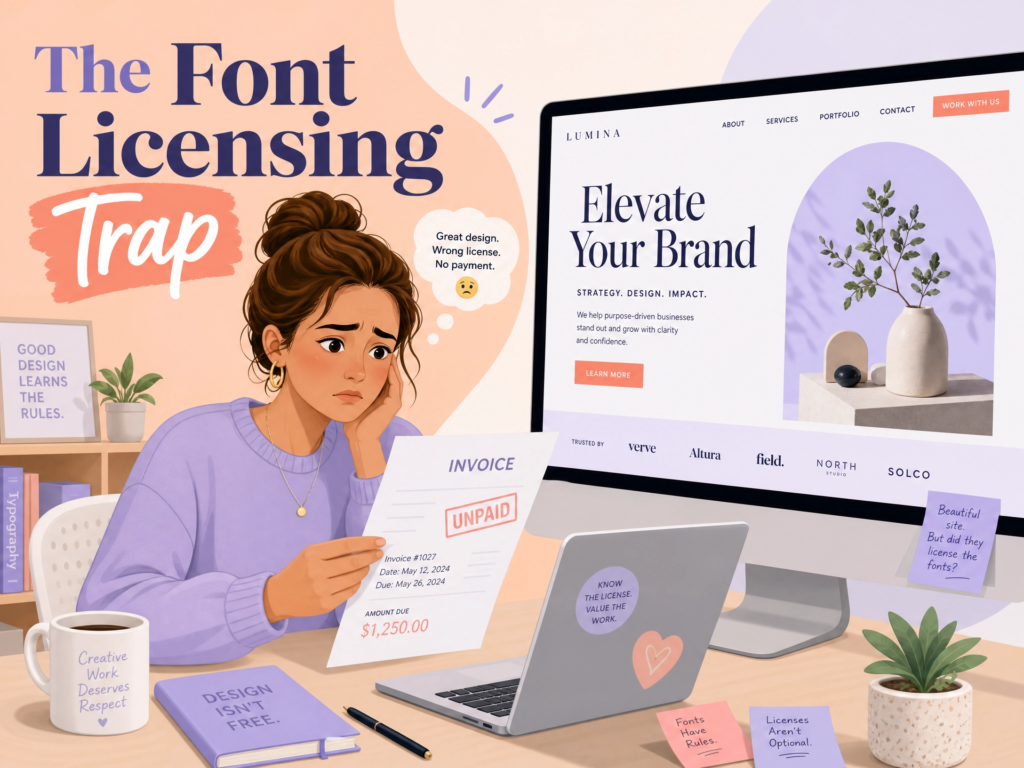
Most creative professionals treat fonts like images or color palettes, assuming that once you buy them, they belong to the project.The key point is: you are not buying a visual asset; you are purchasing a license to run proprietary software on a computer.
When a client refuses to settle your invoice, they are using your design deliverables without a valid transfer of intellectual property rights. If you want to understand your immediate options when this happens, you should read about what to do when a client uses your work but refuses to pay you.
Designer Buys Font License
Builds Creative Brand Assets
Client Uses Assets Without Paying
Who owns the software risk?
Because the design transfer is legally incomplete due to payment default, the way the font is being used can create real legal risk.
Font foundries do not care about your unpaid invoice drama; they only care about who clicked “Agree” on their terms. If you bought the desktop license under your own studio name, you are technically the licensee who is managing that specific deployment.
If your client copies those font files onto their own web servers or internal machines without paying for an independent license, an illegal deployment occurs. The primary issue is determining whether you left your own name on the hook for their digital copyright infringement.
What Font Licenses Actually Allow (EULA Explained Simply)

Every single font file comes bound to an End-User License Agreement, commonly known as a EULA, which dictates usage limitations. Most designers buy the standard commercial license using their own business credit card during the asset production phase of a creative project.
If you did not explicitly buy that license using the client’s legal corporate entity name, you could be the one legally responsible. The foundry views you as the primary party responsible for keeping those font files safe from unauthorized public distribution.
According to the United States Copyright Office guidelines under 17 U.S.C. § 106, font software receives distinct protection as computer programs. If an unauthorized party deploys that software, the foundry can initiate significant copyright infringement claims against the hosting infrastructure.
The Passing of the Liability Torch
You must review your initial communications to see if you accidentally formed a binding relationship regarding license procurement. If you coordinated the project details over messaging apps, you might wonder: can a WhatsApp chat count as a legally binding contract?
- The Purchaser Hook : The entity that buys the font is responsible for its initial installation boundaries.
- The Deployment Violation : The client infringes copyright when they run the font on un-licensed corporate web domains.
- The Contract Factor : Your master services agreement determines if the client owns anything before final payment clears.
If your contract states that rights only transfer upon final payment, the client possesses zero legal right to the typography. They are essentially running pirated software on a live commercial web server, which exposes their business to serious legal and financial consequences.
Transferring Liability to the Defaulting Client
To insulate your creative studio from downstream lawsuits, you must systematically document that you have not authorized this specific font deployment. If the invoice remains uncollected, you should immediately check the exact follow-up timeline for late freelance invoices to formalize your structural payment demands.
I always ensure my project contracts explicitly state that all font software licenses must be independently purchased by the end-client. If you bought it for them as a matter of convenience, it must be billed as a direct pass-through expense line item.
Is the invoice paid?
Intellectual property & typography rights transfer to the client smoothly.
Rights remain fully with the designer; ongoing client usage constitutes an active license software violation.
When a client defaults, you need to send a clear notice stating that their right to use the project typography is suspended. If you need a manual on how to structure this without paying thousands for a corporate retainer, read about how to recover an unpaid invoice yourself.
Building the Paper Trail
Do not let a ghosting client leave you holding a bill for massive font compliance penalties from an angry type foundry. If they stop responding completely, you can discover actionable strategies by reading about what to do when a client ghosts you after an invoice is sent.
- Send an explicit email stating that the font license keys have not been legally transferred to their company.
- Revoke any shared access to cloud folders containing the raw web font packages (.woff and .woff2 formats).
- Clearly inform their internal engineering team that using the fonts on production servers constitutes an active EULA breach.
Once you put these notices in writing, the legal liability shifts from an accidental issue to a clear and intentional violation. Willful infringement carries much harsher penalties under global intellectual property laws, making clients settle their balances much faster.
Alerting the Type Foundry as a Leverage Move
Here is a strategy that most corporate design agencies prefer to keep quiet : type foundries actively enforce their licensing terms. If an enterprise client uses a premium font without a valid corporate license, the foundry may take direct action to enforce compliance for compensation.
If you have reached your breaking point, you need to determine when it is officially time for a freelancer to take legal action. Sometimes, letting a third-party intellectual property owner do the heavy lifting is the smartest move you can make.
Designer Reports License Violation
Type Foundry Sends Audit Demand
Client Pays Original Invoice to Avoid Lawsuit
You can reach out to the font foundry’s compliance department and report that an unpaid client is using their software illegally. Provide the foundry with the domain name where the font is actively deployed and clarify that you did not purchase it for them.
The foundry’s legal team will typically send a formal audit letter to the client demanding proof of a valid enterprise license. Faced with an expensive software copyright audit, most corporate accounting departments will quickly pay your original creative invoice to make the issue vanish.
Typography Liability & Risk Assessment Tool
This interactive planner helps you evaluate your studio’s current legal exposure when an unpaid client uses your licensed fonts. Input your project parameters below to determine who is liable and generate an appropriate notification framework.
Legal Risk & Liability Matrix
| Font Purchase Scenario | Primary Liability Holder | Recommended Strategic Move | Risk Level |
| Purchased under your studio name, no contract signed | Designer (You) | Send immediate font revocation notice via email | High Risk |
| Purchased under your studio name, clear payment terms | Client (For Infringement) | Issue a formal debt collection notice with interest | Medium Risk |
| Client provided the font files to your studio | Client | Keep documentation proving they provided the files | Low Risk |
| Purchased under client’s corporate billing address | Client | Notify foundry compliance of un-authorized asset use | Low Risk |
United States Jurisdiction and Digital Realities

Where your business operates—and where your client’s target web servers are physically located—changes your entire legal recovery playbook. Intellectual property frameworks handle software licenses differently depending on geographic boundaries.
In the United States, fonts are licensed as software—not sold as design assets—and are strongly protected under federal copyright law. Foundries frequently employ automated web crawlers to scan code for unlicensed web font deployments, issuing automated settlement demands directly to enterprise hosting providers.
The U.S. Copyright Office treats font files as computer software, meaning unauthorized usage constitutes direct copyright infringement. This classification gives foundries immense leverage to issue quick takedown notices against non-compliant business domains.
Academic research shared by Wisconsin University shows that End-User License Agreements (EULAs) legally allocate clear liabilities between developers and end-users. If you bought the software but they are using it without paying you, the legal exposure shifts dramatically.
For example, if you purchase a font under your own name and use it to design a client’s website, that license typically allows usage only on your systems—not on the client’s live servers unless they obtain their own license.
According to the U.S. Copyright Office, software licenses grant limited usage rights—not ownership—meaning unauthorized use can qualify as copyright infringement.
If your American client is dodging payments, you can leverage specific interest clauses to increase the financial pressure. Review your local landscape by reading if you can legally charge interest on late invoices under US and UK rules.
The Global Landscape (Including India)
International markets vary; under India’s Copyright Act of 1957, software is protected, but civil enforcement moves slower than in the West. For cross-border defaults, master your billing mechanics by reading how to design an invoice that accounts payable teams cannot ignore.
Proof and Evidence Gathering Checklist

Before you make a formal allegation of font software copyright infringement, you must preserve undeniable digital proof. If a client realizes they are caught, they might quickly swap out the web fonts to destroy the active digital trail.
- [ ] Save a complete local copy of the live website HTML source code showing the font file calls.
- [ ] Take full-screen screenshots of the typography deployed across their active marketing collateral.
- [ ] Download the specific CSS stylesheets that reference your licensed font family names.
- [ ] Secure all email logs proving the client received your payment demands and project terms.
- [ ] Export your original font purchase invoices showing the exact licensee name and purchase timestamp.
If the client has integrated the typography into software or web infrastructure, you have significant technical options available to protect your work. If you are a developer or managing a web project, read our guide on client not paying after website migration for a full DMCA recovery guide.
Crucial Typography Licensing FAQs
Can I be liable if a client uses my font without paying ?
If you purchased the font license under your studio name and your contract doesn’t explicitly state that the client assumes deployment liability, the foundry can hold you responsible for mishandling their software. You must issue a formal notice to the client terminating their permission to use your licensed files to shield your studio from legal exposure.
What happens if I write a cease-and-desist letter to the client ?
A formal cease-and-desist letter informs the client that their ongoing deployment of your design assets and associated software is completely unauthorized. If you need a field-tested blueprint to write this document correctly, read about how to write a clean cease-and-desist letter if a client steals your designs.
Should I watermark my typography presentation layouts ?
Absolutely. You should never deliver clean, un-watermarked high-resolution design files or packaged font directories to a client before receiving a substantial project deposit. To preserve your display presentation quality while protecting your intellectual property assets, explore how to watermark your UI/UX deliverables without ruining the presentation.
Can a font license violation take down a website ?
Yes. Under international copyright regulations like the Digital Millennium Copyright Act (DMCA), a type foundry can issue a formal takedown notice directly to the client’s web host. Because hosting providers want to avoid secondary liability for hosting pirated software files, they will often suspend the client’s website until the licensing issue is resolved.
How can I avoid this font liability trap in future design contracts ?
The absolute best practice is to require your clients to create their own accounts with type foundries to purchase their own licenses directly. You can simply send them the exact links to the required font packages, ensuring your studio name never appears on the software registration documents.
If you are dealing with an unpaid client right now, start by checking whose name is on the font license. That single detail determines your next legal move.
Quick Decision Guide : Your Immediate Next Steps
If you are looking at an unpaid project invoice right now while your client proudly displays your licensed typography on their brand new homepage, do not sit around feeling helpless.
Assess Font License Licensee Name
Scenario A
The License is Under Your Studio Name
Scenario B
The License is Under the Client’s Corporate Name
Review your original font receipt immediately. If the license is under your name, notify the client in writing that their right to use the typography has not been transferred due to non-payment.
If the issue remains unresolved, you may consider escalating the matter by informing the font foundry or seeking legal guidance. Acting early helps protect both your work and your legal position.
Author Profile
Adv. Sagar Haribhau Shirsat is an active legal professional specializing in commercial transaction architectures, cross-border corporate compliance, and digital debt recovery systems. He designs strategic asset-protection and recovery frameworks that help freelancers, independent contractors, and global agencies defend their cash flow and enforce their billing rights.
Connect via his Official Professional LinkedIn Profile and About Us page .
Disclaimer : This guide is intended for educational purposes and risk management analysis. It does not replace formal legal counsel. For specific cross-jurisdictional contract disputes, always consult a certified attorney or local legal advocate.