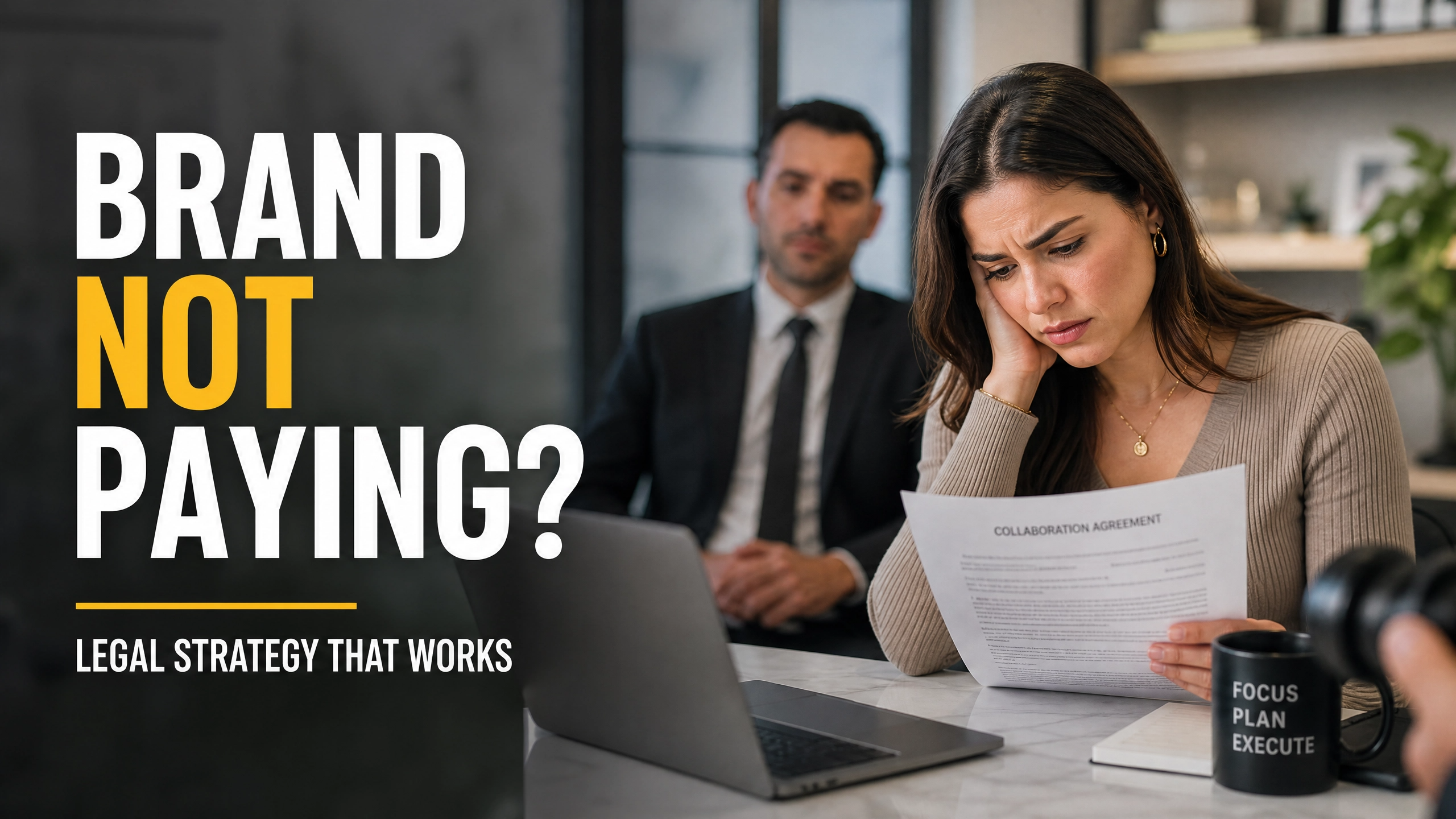
I remember sitting across a table from a lifestyle creator last year. She was staring at her phone, stirring a cold brew, looking absolutely exhausted.
Her recent video had just crossed 4 million views on TikTok.
It was a sponsored integration for a mid-tier skincare brand.
The brand’s website literally crashed from the incoming traffic. They sold out of two different product lines in 48 hours.
But when she sent her $4,500 invoice ?
Silence. Complete, deafening radio silence.
If you are dealing with a situation where a brand not paying influencer what to do becomes a real concern, you are not alone. Thousands of creators face delayed or unpaid brand deals every year, especially after viral campaigns. The key is not panic—but strategy.
What To Do If a Brand Is Not Paying an Influencer
If a brand is not paying an influencer, here is what to do :
- Check your contract and payment terms (Net 15, Net 30, etc.)
- Send a professional follow-up email with a deadline
- Escalate to senior management (CMO or finance team)
- Use copyright or IP leverage if content is live
- Send a legal notice if payment crosses 30 days
Most influencer payment disputes are resolved before court if escalation is done correctly.
Look, this isn’t a rare anomaly. It’s actually a built-in business model for some shady marketing agencies.
Table of Contents
Welcome to The Influencer Marketing Nightmare : Brand Refuses Payout After the Video Goes Viral.
If you are living this reality right now, take a deep breath. I’ve been navigating this space for a long time.
I know exactly how corporate marketing teams operate, how they think, and why they ignore you.
They aren’t ignoring you because they are broke.
They are ignoring you because, right now, ignoring you is completely free. You haven’t made it uncomfortable for them yet.
Let’s fix that. Today, I’m going to walk you through my Brand Safety Counter-Strategy.
We are going to use their own public relations fears against them, professionally and calmly.
Here is how the real creative business world works.
Brand Not Paying Influencer – What To Do Step-by-Step
The underlying problem is painfully simple. You delivered the digital asset. The asset is live.
The brand is currently extracting immense financial value from your face, your voice, and your audience.
Every single second that video plays, they are winning.
But your bank account is sitting at zero.
Usually, this nightmare starts with a seemingly innocent delay.
You get an excuse about “waiting for accounting to process the vendor forms.”
Then, the replies start getting slower. Eventually, they stop completely.
If they go completely dark, you might start wondering what to do when your client ghosts you after you send the invoice (a common issue in unpaid freelance work scenarios).
The psychological trap here is feeling entirely powerless.
This is exactly where most creators get stuck when facing a brand not paying influencer situation—they assume they have no leverage.
You sit there thinking, “They are a massive corporation with a legal team. I just have an iPhone and a ring light.”
That is exactly the narrative they want you to believe. It is a bluff.
If a client used your work but refuses to pay you, they are legally exposed.
In the world of creator marketing, this exposure is massive.
Why? Because digital intellectual property (IP) is a nightmare for brands to defend if they don’t hold a clean, paid-for license.
Let’s look at a real-world case study to see how this plays out.
Case Study : The VPN Ghosting
Meet David. He runs a tech-review channel on YouTube with about 150,000 subscribers.
A well-known VPN company hired him for a 60-second mid-roll integration.
They agreed to a $5,000 flat fee via a WhatsApp chat and a basic PDF terms sheet.
This is a textbook example of a brand not paying influencer scenario after performance has already been delivered.
By the way, if you are wondering if an informal chat holds up, yes. A WhatsApp chat can definitely count as a legally binding contract.
David’s review video exploded. The YouTube algorithm picked it up, and the VPN company got thousands of new sign-ups using his custom promo code.
But when invoice day arrived, the brand’s affiliate manager completely vanished.
Emails bounced back. LinkedIn messages were ignored. DMs were left on read.
David didn’t panic, and he didn’t immediately hire a lawyer to sue them.
Instead, we used a specific escalation sequence to apply corporate pressure.
Within four business days, the $5,000 was wired into his account. Here is the exact playbook we used.
The Direct PR Leverage Option
Here is the raw truth about modern corporate marketing.
Brands are absolutely terrified of “brand safety” risks.
They spend millions of dollars trying to look ethical, relatable, and creator-friendly.
A viral creator calmly explaining how they were exploited destroys that marketing ROI instantly.
But you do not start by publicly blasting them on social media.
That is a rookie mistake. It looks messy, desperate, and can trigger defensive legal letters.
Instead, you use the potential of bad PR privately. You weaponize their internal communication channels.
First, you need a tight follow-up timeline for late freelance invoices.
Stop emailing the 23-year-old junior marketing coordinator who ghosted you.
They do not control the budget. They are probably just as stressed out as you are.
Go to LinkedIn. Find the Chief Marketing Officer (CMO), the VP of Public Relations, or the Head of Influencer Partnerships.
Send them a highly professional, calm email. Do not sound angry. Sound concerned.
Say something like this: “Hi [Name], I am writing to resolve an overdue billing issue internally before my audience starts asking why my promo code for your brand was suddenly deactivated.”
This triggers a massive internal fire drill.
The CMO will immediately screenshot your email and send it to the marketing team on Slack.
They will demand to know why a viral creator is implicitly threatening a PR crisis over a delayed invoice.
Suddenly, you are no longer just an annoying unpaid invoice in a software system.
You are an active corporate risk that needs to be neutralized with a payment.
Platform Takedowns vs. Contract Breach
If the soft internal PR nudge fails to get a response, it is time to look at your intellectual property rights.
There is a massive legal difference between a simple contract breach and copyright infringement.
A contract breach just means they owe you money. Enforcing that takes time and civil courts.
Copyright infringement means they stole your digital property.
Under the US Digital Millennium Copyright Act (DMCA), platforms are legally obligated to remove content if the true copyright owner files a valid claim.
Until that invoice is paid, you own the rights to that video.
If the brand rips your video and posts it natively on their own corporate Instagram page?
That is a severe violation.
It is exactly like when a client publishes your article without paying. You have the absolute right to shut it down.
Even if they only sponsored the video on your own channel, they don’t own the commercial usage license until the money clears.
If they refuse to pay, you can legally edit out the sponsored segment, or private the entire video.
But the real leverage is targeting their paid ad campaigns.
Many brands run “Spark Ads” or whitelisted ads using your content through their own ad accounts.
Filing a takedown notice with TikTok or Meta’s ad library is devastatingly effective.
Taking down a brand’s active, money-making ad campaign gets the attention of their executives in about twenty minutes.
Just like a designer can file a copyright infringement claim for unpaid UI wireframes, you can enforce your rights over your video content.
To make this easier, I’ve built a simple HTML tool for you below. Use this to draft a professional warning before you file a strike.
Legal Rights When a Brand Does Not Pay an Influencer
When a brand does not pay an influencer, it is not just a delay—it can become a legal violation.
Depending on the agreement, this may qualify as:
- Breach of contract
- Copyright infringement (if content is used without payment)
- Unjust enrichment
This is why brands often resolve disputes quickly once escalation begins—they are legally exposed.
Quick Tool : IP Warning Email Generator
Generate Your IP Warning Notice
Collecting from Corporate Marketing Budget Pools
Sometimes, the actual brand isn’t the one trying to cheat you.
Often, the bottleneck is the third-party influencer marketing agency they hired to manage the campaign.
The brand pays the agency $20,000 for the campaign. The agency is supposed to pay you your $4,000 cut.
But the agency pockets the cash, blames “cash flow issues,” and ghosts you.
This is incredibly frustrating. But you are not out of options here.
If you act as an unpaid subcontractor, you can often go after the end-client directly.
You bypass the sketchy agency completely and email the main brand’s finance department.
Explain that their agency is defaulting on creator payments, which directly puts the brand’s IP licenses at legal risk.
Most large brands have a “vendor crisis” fund.
They also have holdbacks in their agency contracts specifically for situations exactly like this.
They will usually step in and force the agency to pay you immediately to avoid public embarrassment.
And speaking of finance departments, make sure you understand Net 15 vs. Net 30 vs. Net 45 payment terms before you sign your next brand deal.
Many creators panic on day 16, not realizing the contract clearly stated the brand had 30 days to pay.
If you are dealing with a massive global corporation, you might just be stuck in their outdated ERP software.
If that happens, you can use a specific psychological trick to escape the accounting loop. It works incredibly well on accounts payable teams.
But if the days turn into weeks, and the weeks turn into months, you must act.
You might need to recover the unpaid invoice yourself without a lawyer.
United States vs Global : The Enforcement Landscape
Let’s pause and talk about geography. The internet is completely borderless.
But the law governing your freelance contract ? That is strictly local. Where your client sits changes your entire strategy.
In the United States, you have fast, aggressive leverage. It is called the DMCA.
Under Section 512 of the U.S. Copyright Act, digital platforms are legally bound to remove stolen content. If a brand uses your work unpaid, you strike them.
But there is another hidden U.S. leverage point that corporate legal teams hate dealing with.
Under the FTC Endorsement Guides, influencer marketing requires crystal-clear disclosures.
If a brand steals your video, runs it as a whitelisted ad, and edits out the “#Ad” disclosure ? They are actively breaking federal trade laws.
Reminding an uncooperative U.S. brand of their FTC compliance risks is an incredibly sharp negotiation tactic. I use it all the time.
Now, let’s look at the United Kingdom. The UK does not just protect your IP ; it actively penalizes late payers.
Under the Late Payment of Commercial Debts (Interest) Act 1998, UK freelancers have a massive structural advantage.
You can automatically charge statutory interest on late invoices. That rate is the Bank of England base rate plus a massive 8%.
You do not even need this written in your contract. It is a strict statutory right.
According to official UK Government guidance on late commercial payments, you can also add fixed debt recovery costs—up to £100 per invoice. This makes ignoring you very expensive for British agencies.
For the rest of the global market, including India, recovery relies on corporate pressure rather than rapid takedowns. While the Indian Copyright Act protects creators, local courts require immense patience. Instead, polite public inquiries tagging a brand’s regional CEO on LinkedIn usually resolve payments faster than formal legal notices.
Evidence Checklist : Build Your Case
Before you make any aggressive move, you need to get your house in order.
Never start a corporate dispute without your ammunition neatly organized.
Here is your exact evidence checklist. Gather all of this today.
- The Contract : The signed agreement, or the email/WhatsApp thread where terms were agreed upon.
- The Metrics : Raw screenshots of the video analytics proving it went viral.
- Proof of Delivery : The timestamped email showing when you sent the final cut.
- The Invoice : The actual unpaid invoice, showing the overdue date clearly.
- Usage Proof : Screenshots or screen recordings of their promo code or affiliate link actively working.
- Approval Proof : All communication where their team explicitly approved the video for publishing.
If you do not have these items saved in a folder, stop typing angry emails.
Go take screenshots right now before they revoke your access or unsend messages.
Risk Matrix : Choosing Your Next Move
Let’s map out your strategic options based on the level of risk involved.
Low Risk : Emailing the CMO directly.
- Why : It bypasses the low-level bottleneck without making any public waves.
- Result : Usually gets your invoice bumped to the top of the accounts payable pile.
Medium Risk : Sending a formal IP takedown warning.
- Why : It directly threatens their active ad campaigns and IP usage.
- Result : Forces their internal legal team to calculate the cost of not paying you.
High Risk : Publicly calling them out on video.
- Why : It burns the corporate bridge forever and could trigger a defamation threat if you misspeak.
- Result : The nuclear option. Only use this if the money is effectively gone and you simply want justice.
Quick Decision Flowchart
Not sure what to do next ? Follow this simple logical sequence.
1. Are you past the agreed payment date by at least 15 days ?
- If NO : Wait. Send a polite, standard check-in email.
- If YES : Proceed to the next step.
2. Has your day-to-day contact ghosted you for over a week ?
- If NO : Keep pressing them directly. Ask for a specific wire transfer date.
- If YES : Escalate to the CMO or the Accounts Payable department immediately.
3. Is the brand currently running your video as a paid ad ?
- If YES : Send the copyright takedown warning email today.
- If NO : Stick to the internal PR leverage strategy first.
People Also Ask About Unpaid Influencer Deals
Why do brands delay influencer payments?
Brands delay payments due to internal approvals, cash flow control, or intentional avoidance after campaign success.
Can influencers take legal action for non-payment?
Yes. Influencers can enforce contracts, send legal notices, or use copyright/IP leverage depending on the agreement.
Is a WhatsApp or DM agreement legally valid?
Yes. Written communication showing offer and acceptance can form a legally binding contract.
How long should influencers wait before escalating?
Typically 15–30 days after the due date before applying escalation strategies.
Critical FAQs for Creators
Can I just delete the video if they refuse to pay ?
Yes, if your contract allows it. But I advise you to private the video instead of deleting it. Deleting it destroys your own channel analytics. Privating it hides their ad integration while keeping your data safe.
What if we only agreed on a price in Instagram DMs ?
Written communication is a valid contract. A clear offer and acceptance in DMs holds weight. Just make sure you screenshot the entire chat before the brand decides to unsend their messages.
Can I keep their physical product if they don’t pay my fee ?
If it is a physical product, keep it. Do not spend your own money shipping it back unless they prepay for the label. Sending a product does not cancel out the cash they owe for your labor.
Will complaining ruin my reputation with other agencies ?
No. Professional creators demand to be paid. Just keep your complaints highly professional. Do not act erratic online. Be firm, stay calm, and document every interaction.
How long should I wait before sending a formal legal notice ?
Usually, 30 days past the actual due date is the sweet spot. Before that, it is just an annoying delay. After 30 days, it is a clear, actionable breach of trust.
Final Thoughts on Enforcing Your Worth
If you are dealing with a brand not paying influencer situation, understand this clearly—this is not rare, and it is not the end of your leverage.
Every major creator I know has faced this exact scenario at least once in their career.
It hurts. It feels deeply personal and incredibly unfair.
But I need you to remember that it is just business. You must take the emotion out of it.
You provided a highly valuable marketing service. They consumed that service. Now, they must pay for that service.
Stop asking for permission to get paid. Start enforcing your professional boundaries.
Use the PR leverage. Escalate past the ghosting managers. Threaten the IP licenses if you have to.
Your creative work has massive, quantifiable value.
Do not let a disorganized corporate accounting department convince you otherwise.
Keep creating amazing content, but start protecting your cash flow like the serious business you are.
About Author
Adv. Sagar Haribhau Shirsat is an active legal professional specializing in commercial transaction architectures, cross-border corporate compliance, and digital debt recovery systems. He designs strategic asset-protection and recovery frameworks that help freelancers, independent contractors, and global agencies defend their cash flow and enforce their billing rights.
Connect via his Official Professional LinkedIn Profile or About Us page.
This article is based on real-world commercial dispute strategies used in influencer payment recovery cases.
Disclaimer : This guide is intended for educational purposes and risk management analysis. It does not replace formal legal counsel. For specific cross-jurisdictional contract disputes, always consult a certified attorney or local legal advocate.