
If an Agency Strips Your Name Off the Case Study and ghosts your final invoice, you probably feel a mix of panic and pure rage. I get it. I have been there.
You sit at your desk, staring at their shiny new portfolio piece. It is your design. Your code. Your late nights.
But your name is gone. And your bank account is empty.
Look, this is not a rare accident. It is a calculated business move.
If an agency removes your name from a case study and refuses payment, you are dealing with both attribution and payment enforcement issues.
Some agencies follow practices that can put freelancers at a disadvantage, especially near project completion. They wait until the project is 90% done. Then, communication slows down.
Suddenly, they claim the client was unhappy. Or they say the budget dried up.
Before you know it, the project is live. Your invoice is ignored.
We are going to fix this. Not with expensive lawsuits, but with leverage.
I am going to walk you through exactly how to handle this calmly and professionally.
Grab a coffee. Let’s dig into the real creative business world.
Table of Contents
The White-Label Erasure : The 90% Ghosting Trap
Here is the thing: white-labeling is a standard agency practice.
You build it. They sell it. They take the credit. That is fine, as long as you agreed to it.
And more importantly, as long as they pay you.
The problem starts when the agency uses white-labeling as an excuse for erasure and theft.
They strip your attribution rights to present the work as their in-house masterpiece.
Then, they freeze you out of the final payout.
If this happens, you need to understand what to do when a client uses your work but refuses to pay you.
This tactic relies purely on control.
They control the end-client relationship. They hold the final domain or launch keys.
They assume you are just a solo creative who will eventually give up.
They expect you to write off that last 20% just to avoid a headache.
Do not give them that satisfaction.
If your client ghosted you after you sent the invoice, you need a structured recovery plan.
A Real-World Case Study : Sarah’s Stolen UI
Let me tell you about “Sarah” (name changed for confidentiality). She is a brilliant UI/UX designer I worked with last year.
An agency hired her for a massive SaaS dashboard overhaul.
Payment terms were standard. 50% upfront. 50% on final delivery.
Sarah delivered the final Figma files on a Friday.
On Monday, the agency CEO sent a vague email about “needing internal reviews.”
Weeks passed. Crickets.
Then, Sarah saw it. The agency published a massive case study on LinkedIn.
It showcased her exact dashboard. They claimed their “expert internal design team” built it from scratch.
When Sarah asked for her final $4,000, they said the client found “bugs” and refused to pay.
They literally expected her to walk away.
She didn’t. And you won’t either.
Agency Removed My Name from Case Study – What Are My Rights? : Moral Rights vs. Economic Rights

I am going to explain the legal side simply. No boardroom jargon.
When you create something, you instantly own two types of rights.
First, Economic Rights. This is the right to make money off the work.
Second, Moral Rights. This is the right to be recognized as the creator.
Even if you signed a contract saying the agency owns the work, there is a catch.
In most jurisdictions, copyright transfer requires full consideration.
“Consideration” is just a fancy legal word for payment.
If they do not pay you, the contract is breached. Depending on the contract and jurisdiction, rights may remain with or revert to the original creator.
Outcomes can vary based on contract terms and local laws, so reviewing your agreement is essential before taking action.
According to the US Copyright Office (Title 17), unauthorized use of work without payment constitutes infringement.
But what about your name?
In the UK, the Intellectual Property Office protects your right to object to false attribution.
If an agency claims your work as their own without paying, they are violating both rights.
In many cases, the work may not be considered fully licensed or transferred until payment conditions are fulfilled. They may be using the work without a fully cleared license or payment completion.
This is where your leverage lives.
Before making a move, check your initial contract.
Did you agree to Net 15 vs. Net 30 vs. Net 45 payment terms ?
Make sure the invoice is actually overdue legally, not just in your head.
Once it is late, you have the upper hand.
The Attribution-Leverage Strategy
If an Agency Strips Your Name Off the Case Study, do not send an angry text.
Do not vent on Twitter.
You need to use their own public reputation against them. Calmly.
I call this the Attribution-Leverage Strategy.
It is simple: agencies survive on trust. Their clients pay them big money because they look professional.
If an end-client finds out the agency is using unpaid, stolen freelance work?
That destroys their credibility.
Your goal is not to ruin them. Your goal is to get paid.
You are going to trade your silence and full copyright release for your final invoice.
Here is how you structure this flow :
Problem (Unpaid/Stolen) → Law (IP Infringement) → Solution (Settlement).
First, you need to gather bulletproof evidence.
Did they agree to the scope ? Was it via text ?
You might wonder if a WhatsApp chat counts as a legally binding contract—see our detailed guide on this topic.
Yes, it often does. Save those screenshots immediately.
Next, take full-page captures of their case study.
Save their portfolio links via the Wayback Machine.
You want proof they displayed your work before they try to delete it.
Evidence Gathering Checklist
- [ ] Original contract or email agreement.
- [ ] All project files with timestamps.
- [ ] Screenshots of their public case study.
- [ ] Proof of final delivery (email logs, Figma links, GitHub commits).
- [ ] The ignored final invoice.
- [ ] Any communication where they admit the work is done.
If you suspect they might try to steal more, see our step-by-step guide on writing a legally effective cease-and-desist letter..
Agency Didn’t Credit My Work and Didn’t Pay – What Can I Do ? Leveraging the End-Client’s Brand Reputation

This is where your leverage becomes most effective.
Agencies are terrified of you talking to their client.
They will often tell you that contacting the end-client is illegal.
That is usually a bluff.
If you are an unpaid subcontractor, there are specific times you can sue the end-client directly.
However, we want to avoid lawsuits. We want fast cash flow.
You are going to send a very polite, corporate-sounding email to the agency CEO.
You will mention the end-client by name.
You will casually note that the intellectual property rights have not cleared.
This typically creates urgency on their side to resolve the issue quickly.
If an agency claims they are broke, you need to know how to handle it when a client runs out of money mid-project.
But usually, the agency has the money. They just don’t want to give it to you.
They are keeping your margin as their bonus.
Look, dealing with agency accounting departments is a nightmare.
Sometimes you get stuck in an “accounting loop,” but there is a psychological trick to get paid fast.
You bypass accounting completely. You go to the agency owner.
The Demand for Visual Attribution Settlement
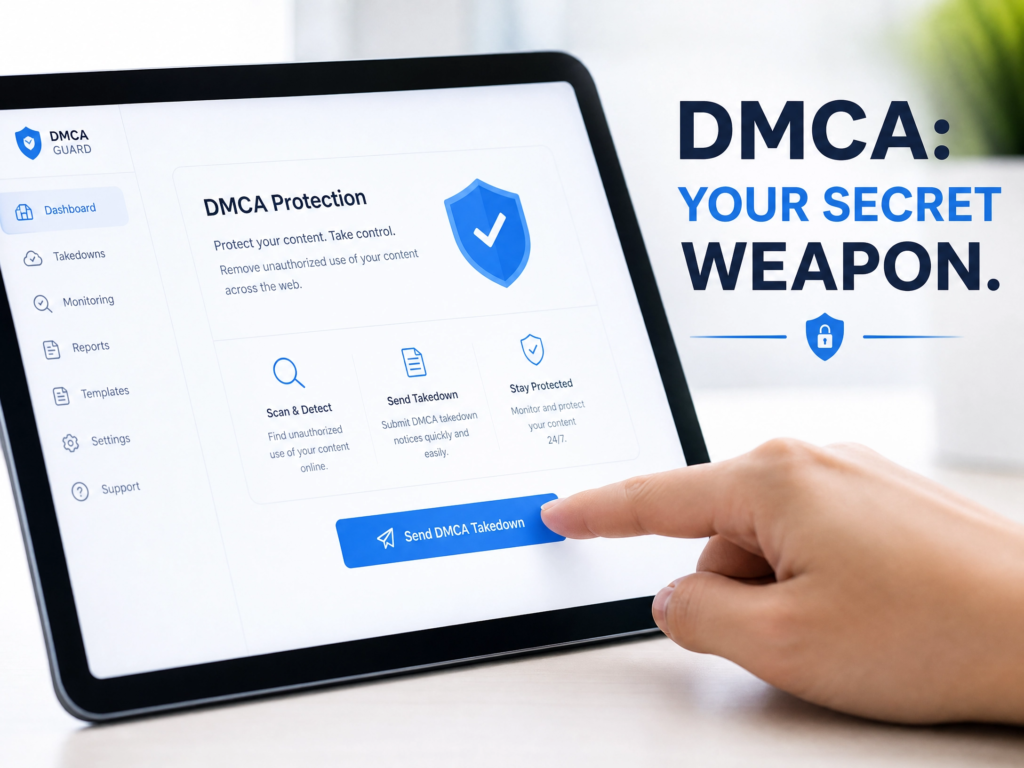
Now it is time to make your demand.
You are offering them a choice.
Option A : They pay the final invoice immediately. In return, you sign over full rights. You allow them to keep the case study up.
Option B : They refuse. You issue a DMCA takedown on their portfolio. You alert the end-client of the unlicensed IP usage.
This is how you recover an unpaid invoice yourself without hiring a lawyer.
It is a business transaction.
You are selling them the clean title to the work they already published.
The DMCA framework provides a structured process through which hosting providers may review and act on intellectual property complaints.
Agencies know this. A DMCA strike on their main site domain is devastating.
Keep your tone cold, polite, and factual.
Never threaten. Merely state the next procedural steps.
“Since the final invoice remains unpaid, the IP license is revoked. Please remove the case study by Friday to avoid automated takedown notices.”
In many cases, this prompts a faster financial resolution.
The IP Leverage Email Generator
I built a simple tool for you.
Use this HTML/JS code block on your local machine to generate the perfect leverage email.
It keeps the emotion out and the pressure high.
IP Leverage Email Generator
Draft a cold, non-aggressive notice regarding unpaid creative assets.
Copy that, fill in the blanks, and send it.
United States vs. Global : Knowing Your Turf
Look, dealing with a US-based agency from India or Eastern Europe feels intimidating. They assume geographical distance makes them untouchable.
They think you won’t fight back across borders.
I used to believe that too. But I was wrong. The US legal system actually gives you massive leverage if you know which buttons to push.
You must know how to protect yourself when working with international clients.
Let’s break down how the laws stack up, with a heavy focus on the United States.
The United States : Your Strongest Leverage
When a US agency strips your name and ghosts your invoice, they usually hide behind a “Work for Hire” clause.
Here is the thing: under the US Copyright Act (17 U.S.C. § 201), ownership only transfers if the contract conditions—like actual payment—are met.
In many cases, if payment conditions are not fulfilled, the transfer of rights may be considered incomplete.
You might hear lawyers talk about the Visual Artists Rights Act (VARA). Under 17 U.S.C. § 106A, artists have the right to claim authorship.
But VARA mostly protects physical fine art. It will not help you with a white-labeled SaaS dashboard or a WordPress site.
For commercial digital work, your absolute best friend is the Digital Millennium Copyright Act.
Specifically, Section 512 of the DMCA, outlined by Congress.gov. It regulates exactly how hosting companies must handle stolen IP.
US agencies are terrified of DMCA takedowns.
This process should be used carefully, as incorrect or misleading takedown notices can carry legal consequences in some jurisdictions.
Why ? Because it bypasses the agency entirely. It forces their hosting provider, like AWS or GoDaddy, to pull the plug on the stolen case study.
If they falsely claim the work was created entirely by their in-house team, you can also look at the Lanham Act.
According to the Legal Information Institute at Cornell University (15 U.S.C. § 1125), false designation of origin is a civil violation.
You don’t need a Wall Street lawyer for this. Just citing these exact .edu and .gov statutes in a calm email shows them you aren’t playing around.
You instantly go from “annoying freelancer” to “serious business risk.”
The United Kingdom : Paternity Rights
If you are dealing with London instead of New York, the rules shift slightly. The UK has strong statutory “Paternity Rights.”
You have the fundamental right to be identified as the author of your work.
If a UK agency strips your name without a paid waiver, they are breaking statutory law.
India : Section 57 Protection
Back home in India, the Copyright Act of 1957 (Section 57) grants the author special moral rights.
Even if you fully assigned the copyright to a local agency, you can still claim authorship.
You can legally restrain them from modifying or claiming your work if it damages your professional reputation.
But no matter where the agency is headquartered, the core strategy remains the same.
Public reputation is an agency’s most valuable asset. When you know the exact laws governing their turf, you control the narrative.
For high-value disputes or cross-border enforcement, consulting a qualified legal professional is strongly recommended.
The Risk Matrix for Freelancers

Before you hit send on any legal threat, you need to assess the blast radius.
I use a simple Risk Matrix with my clients.
You need to know the potential fallout of every action you take.
Low Risk / High Reward : Sending a firm, polite email offering IP clearance in exchange for final payment. Why : It gives them an easy way out without losing face.
Medium Risk / High Reward : Filing a DMCA takedown notice with their web host. Why : It gets immediate results. But it will permanently burn the bridge with that agency. (Which you probably want anyway).
High Risk / Low Reward : Emailing the end-client directly to complain about the agency. Why : End-clients hate drama. They might just forward your email to the agency CEO. It makes you look desperate.
Only contact the end-client as an absolute last resort.
And if you do, frame it as an “IP Compliance Notice,” not a personal rant.
Diagram : The Freelance Leverage Flow
Here is exactly how your decision process should look.
Follow this path logically. Do not skip steps.
This flow removes emotion. It turns debt recovery into an algorithm.
Quick Decision Section : What To Do Right Now
Feeling overwhelmed? Stop. Breathe.
Here are your immediate next steps.
Step 1 : Do not send an angry message. Silence is your friend right now.
Step 2 : Screenshot everything. Their website, their LinkedIn, the contract, your Figma files.
Step 3 : Double-check your invoice date. Make sure you are actually past the due date.
Step 4 : Generate the Leverage Email using the tool above.
Step 5 : Send it directly to the agency founder or CEO. Ignore middle-management.
Do not bluff. If you say you will file a DMCA by Friday, you must file it on Friday.
Agencies smell fear. They respect boundaries.
Frequently Asked Questions
You probably still have some doubts. That is natural.
Here are the five most common questions creatives ask me when an agency steals their work.
Can I Legally Take Down an Agency’s Website for Non-Payment ?
No, you cannot directly shut down a website. However, you may file a formal DMCA notice with the hosting provider, which they may review under their IP compliance policies.
However, you can file a formal DMCA notice with their hosting provider. If the work is unpaid, It may be treated as unlicensed use of intellectual property. Hosting providers often review such claims under their IP compliance policies.
What if my contract says “Work for Hire” ?
“Work for Hire” clauses usually only activate upon full consideration (payment). If they breached the payment terms, the copyright transfer is generally voided. The work remains yours.
Will sending a legal email ruin my industry reputation ?
No. Reputable agencies typically maintain professional boundaries and respect clear payment enforcement. Good agencies respect boundaries. Defending your cash flow makes you look like a seasoned professional, not an amateur.
The agency says the end-client refused to pay them. Do I still get paid ?
Yes. Your contract is with the agency, not the end-client. Their cash flow problems are not your problem. They owe you regardless of what their client does.
How long should I wait before escalating ?
Do not wait months. Send one polite reminder. If ignored, initiate the leverage strategy immediately. Time kills leverage.
The Reality Check
If an Agency Strips Your Name Off the Case Study, it is a test.
They are testing your boundaries.
They want to see if you will accept being invisible and unpaid.
You have the power to change the narrative.
You own the work until the check clears.
Use your leverage. Protect your creative equity.
And never, ever work for free.
Author Box
Adv. Sagar Haribhau Shirsat is an active legal professional specializing in commercial transaction architectures, cross-border corporate compliance, and digital debt recovery systems. He designs strategic asset-protection and recovery frameworks that help freelancers, independent contractors, and global agencies defend their cash flow and enforce their billing rights.
Connect via his Official Professional LinkedIn Profile and About Us page.
Disclaimer : This guide is intended for educational purposes and risk management analysis. It does not replace formal legal counsel. For specific cross-jurisdictional contract disputes, always consult a certified attorney or local legal advocate.